

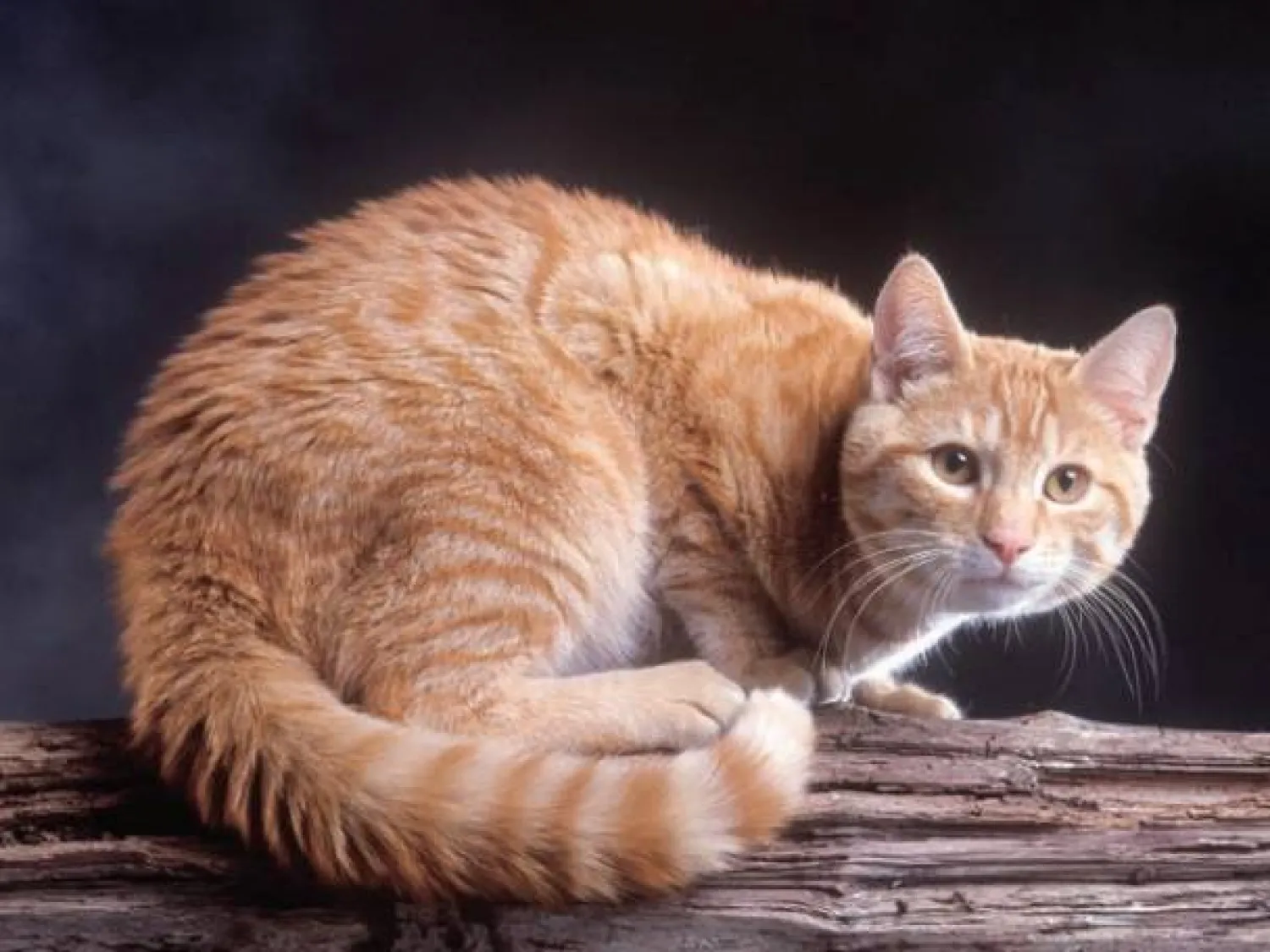

Decades-Long Mystery of Ginger Cats Revealed

Mystery of ginger cats (Getty)
TT

Decades-Long Mystery of Ginger Cats Revealed

Mystery of ginger cats (Getty)

Garfield, Puss in Boots, Aristocats' Toulouse – cultural icons maybe, ginger most certainly.

And now scientists across two continents have uncovered the DNA mystery that has given our furry friends, particularly males, their notable color.

They discovered, according to BBC, that ginger cats are missing a section of their genetic code, which means the cells responsible for their skin, eye and fur tone produce lighter colors.

The breakthrough has brought delight to the scientists but also the thousands of cat lovers that originally crowdfunded the research.

The scientists hope solving the puzzle could also help shed light on whether orange colored cats are at increased risk of certain health conditions.

It has been known for decades that it is genetics that gives orange tabby cats their distinctive coloring, but exactly where in the genetic code has evaded scientists till now.

Two teams of scientists at Kyushu University in Japan and Stanford University in the US have now revealed the mystery in simultaneous papers published on Thursday.

What the teams found was that in the cells responsible for giving a cat its skin, hair follicles and eyes their color - melanocytes - one gene, ARHGAP36, was much more active.

Genes are made up of pieces of DNA which give instructions to a cat's cells, like other living creatures, on how to function.

By comparing the DNA from dozens of cats with and without orange fur they found that those with ginger coloring had a section of DNA code missing within this ARHGAP36 gene.

Without this DNA the activity of the ARHGAP36 is not suppressed, and therefore, it is more active. The scientists believe that the gene instructs those melanocytes to produce lighter pigment.

Also, for decades scientists have observed that cats with completely ginger coloring are far more likely to be male. This tallies with the fact that the gene is carried on the X chromosome.

Chromosomes are larger sections of DNA, and male cats like other mammals have an X and a Y chromosome, which carry different number of genes.

As it is a gene only on the X chromosome, in this case controlling the pigment production, then one missing piece of DNA is enough to turn a cat fully ginger.

In comparison female cats have two X chromosomes so the DNA needs to be missing in both chromosomes to increase lighter pigment production to the same extent - it means a mixed coloring is more likely.

“These ginger and black patches form because, early in development, one X chromosome in each cell is randomly switched off,” explains Prof Hiroyuki Sasaki, geneticist at Kyushu University.

“As cells divide, this creates areas with different active coat color genes, resulting in distinct patches.”



Astronaut's Serious Medical Condition Forces NASA to End Space Station Mission Early

Crew-11 mission astronauts departed the Kennedy Space Center in Cape Canaveral, Florida on August 1, 2025 (Gregg Newton/AFP)  
TT

Astronaut's Serious Medical Condition Forces NASA to End Space Station Mission Early

Crew-11 mission astronauts departed the Kennedy Space Center in Cape Canaveral, Florida on August 1, 2025 (Gregg Newton/AFP)  

NASA announced that four astronauts will return from the International Space Station more than a month ahead of schedule after an unnamed crew member experienced a medical issue.

The incident marks the first time in history NASA has brought astronauts home from the space station early because of a medical issue, according to CNN.

NASA has not provided details about the nature of the problem, citing privacy concerns. The agency typically does not discuss the specifics of health matters related to astronauts.

A SpaceX Crew Dragon capsule will bring the four-person crew home, disembarking from the ISS as soon as Wednesday at 5 pm ET. The spacecraft is then expected to splash down off the coast of California early the following morning, NASA said in a statement last week.

The affected astronaut is in stable condition, NASA previously confirmed, and is not expected to receive special treatment during the return trip, said Dr James Polk, NASA’s chief health and medical officer at the agency’s headquarters.

The astronaut would also be best served by being evaluated on the ground, Polk added.

“We have a very robust suite of medical hardware on board the International Space Station,” Polk noted during a news conference. “But we don’t have the complete amount of hardware that I would have in the emergency department, for example, to complete a workup of a patient.”

He added, “And in this particular incident, we would like to complete that work up, and the best way to complete that workup is on the ground.”


Astronomers Spot White Dwarf Star Creating a Colorful Shockwave

The central square image, taken with the MUSE instrument on ESO's Very Large Telescope, shows shock waves around the dead star RXJ0528+2838. (European Southern Observatory (ESO)/K. Ilkiewicz and S. Scaringi et al./Handout via Reuters)
TT

Astronomers Spot White Dwarf Star Creating a Colorful Shockwave

The central square image, taken with the MUSE instrument on ESO's Very Large Telescope, shows shock waves around the dead star RXJ0528+2838. (European Southern Observatory (ESO)/K. Ilkiewicz and S. Scaringi et al./Handout via Reuters)

Astronomers have observed a white dwarf - a highly compact Earth-sized stellar ember - that is creating a colorful shockwave as it moves through space, leaving them searching for an explanation.

The highly magnetized white dwarf is gravitationally bound to another star in what is called a binary system. The white dwarf is siphoning gas from its companion as the two orbit close to each other. The system is located in the Milky Way about 730 light-years from Earth - relatively nearby in cosmic terms - in the constellation Auriga.

A light-year is the distance light travels in a year, 5.9 trillion miles (9.5 trillion km).

The shockwave - more specifically a bow shock - caused by the white dwarf was observed using the European Southern Observatory's Chile-based Very Large Telescope. The shockwave was seen in an image released by the scientists glowing in various colors produced when material flowing outward from the white dwarf collided with interstellar gas.

"A shockwave ‌is created when ‌fast-moving material plows into surrounding gas, suddenly compressing and heating it. A ‌bow shock ⁠is the curved ‌shock front that forms when an object moves rapidly through space, similar to the wave in front of a boat moving through water," said astrophysicist Simone Scaringi of Durham University in England, co-lead author of the study published on Monday in the journal Nature Astronomy.

"The colors come from interstellar gas that is being heated and excited by the shock. Different chemical elements glow at specific colors when this happens," Scaringi added.

In this shockwave, a red hue represented hydrogen, green represented nitrogen and blue represented oxygen residing in interstellar space.

A handful of other white dwarfs have been observed creating shockwaves. But all of those were ⁠surrounded by disks of gas siphoned from a binary partner. Although this white dwarf is siphoning gas from its companion, it lacks any such disk and ‌is releasing gas into space for unknown reasons.

White dwarfs are among the ‍universe's most compact objects, though not as dense as ‍black holes.

Stars with up to eight times the mass of the sun appear destined to end up as ‍a white dwarf. They eventually burn up all the hydrogen they use as fuel. Gravity then causes them to collapse and blow off their outer layers in a "red giant" stage, eventually leaving behind a compact core - the white dwarf.

"There are plenty of white dwarfs out there, as these are the most common endpoints of stellar evolution," Scaringi said.

The sun appears fated to end its existence as a white dwarf, billions of years from now.

This white dwarf has a mass comparable to the sun contained in a body slightly larger than Earth. Its binary companion is ⁠a type of low-mass star called a red dwarf that is about a tenth the mass of the sun and thousands of times less luminous. It orbits the white dwarf every 80 minutes, with the two extremely close to each other - approximately the distance between the moon and Earth.

The gravitational strength of the white dwarf is pulling gas off the red dwarf. This siphoned material is being pulled into the white dwarf along its strong magnetic field, eventually landing at its magnetic poles. While this process releases energy and radiation, it cannot account for the outflow of material needed to produce the observed shockwave, Scaringi said.

"Every mechanism with outflowing gas we have considered does not explain our observation, and we still remain puzzled by this system, which is why this result is so interesting and exciting," Scaringi said.

"The shape and length of the (shockwave) structure show that this process has been ongoing for at least about 1,000 years, making it long-lived rather than a one-off event," Scaringi added.

The ‌researchers took note of the aesthetics of the colorful shockwave.

"Beyond the science, it's a striking reminder that space is not empty or static as we may naively imagine it: it's dynamic and sculpted by motion and energy," Scaringi said.


Australian Firefighters Warn of ‘High-Risk’ Bushfire Season

Country Fire Authority (CFA) crew fill up tankers in the bushfire affected town of Ruffy, Victoria, Australia, 12 January 2026. (EPA)
TT

Australian Firefighters Warn of ‘High-Risk’ Bushfire Season

Country Fire Authority (CFA) crew fill up tankers in the bushfire affected town of Ruffy, Victoria, Australia, 12 January 2026. (EPA)

Australian firefighters warned people on Monday to prepare for more bushfires in a "high-risk" summer, after blazes killed one person and incinerated more than 350 buildings in the southeast.

Weather conditions have eased since strong winds and temperatures topping 40C fed dozens of wildfires in southeastern Australia's Victoria, which declared a state of disaster on Saturday.

But officials said 12 major fires were still burning across the state.

Country Fire Authority chief officer Jason Heffernan said another "heating event" was expected towards the end of January, though its intensity was uncertain.

"We are early in the high-risk weather season," Heffernan told a news conference.

"There's been a lot of fire in the landscape. Much work will be done between now and then to contain these fires," he said.

"Whilst we join with community in the rebuilding and the relief and recovery of the fires that have been, we need to turn our minds to the fires that could be as the season continues."

More than 350 structures -- including over 65 homes -- have been lost so far in the state, officials said, with the number likely to rise as fire damage is assessed.

One person died in a fire near the town of Longwood, about two hours' drive north of state capital Melbourne, police say.

Emergency Management Commissioner Tim Wiebusch said weather conditions had become more favorable for firefighters.

"But that doesn't mean that the risk is over," he said.

"Whilst the conditions are easing in some parts of the state, even the slightest of winds are still causing those fires to move around."

High temperatures and dry winds combined last week to form some of the most dangerous bushfire conditions since the "Black Summer" blazes.

The Black Summer bushfires raged across Australia's eastern seaboard from late 2019 to early 2020, razing millions of hectares, destroying thousands of homes and blanketing cities in noxious smoke.

Australia's climate has warmed by an average of 1.51C since 1910, researchers have found, fueling increasingly frequent extreme weather patterns over both land and sea.