
Climate Action Could Save Half of World's Vanishing Glaciers

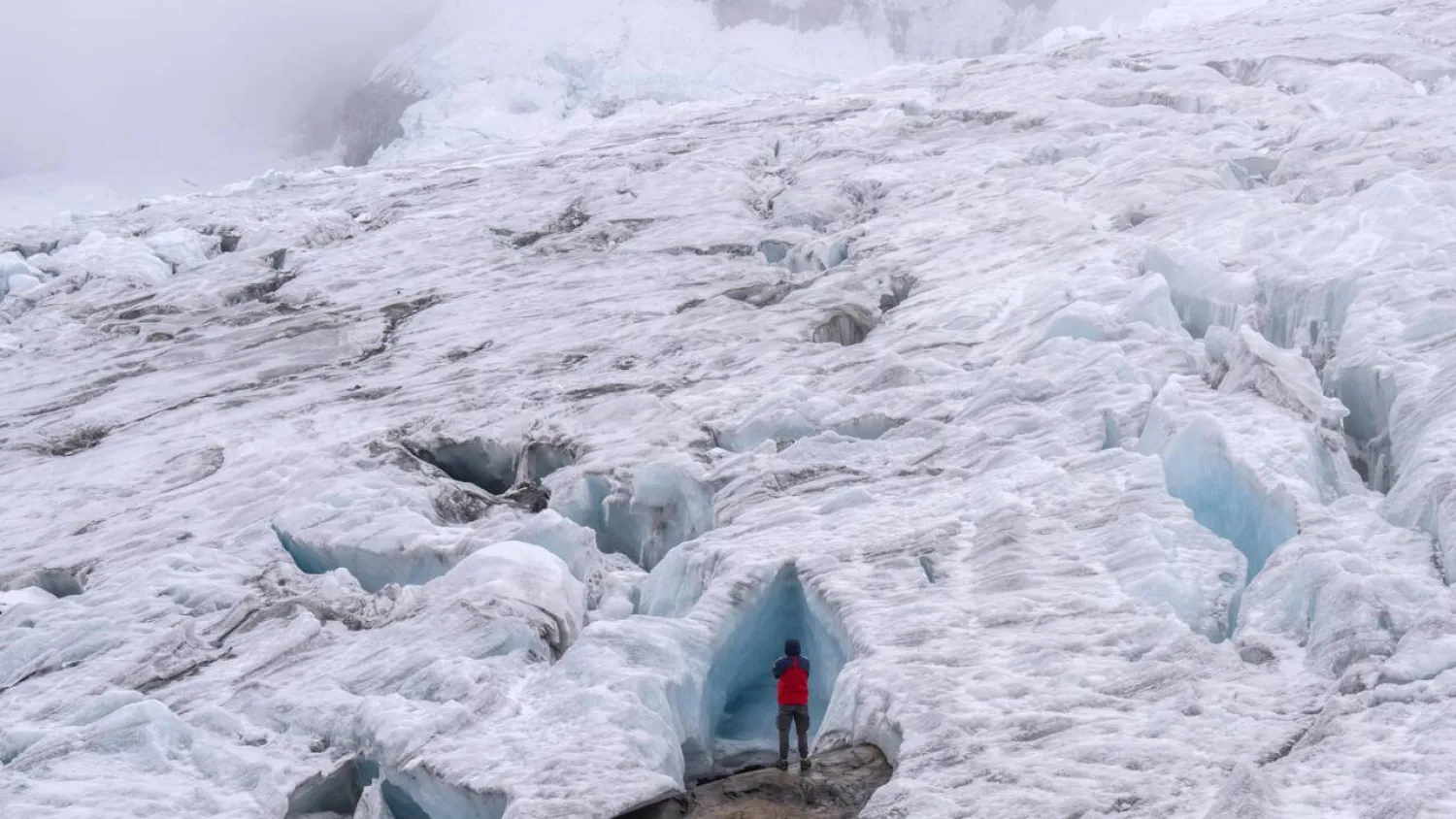
A tourist explores the Ritacuba Blanco glacier at the Natural National Park Nevado El Cocuy in Boyaca Department, Colombia, on April 19, 2024. Luis ACOSTA / AFP/File
TT

Climate Action Could Save Half of World's Vanishing Glaciers

A tourist explores the Ritacuba Blanco glacier at the Natural National Park Nevado El Cocuy in Boyaca Department, Colombia, on April 19, 2024. Luis ACOSTA / AFP/File

More than three-quarters of the world's glaciers are set to vanish if climate change continues unchecked, a major new study warned Thursday, fueling sea-level rise and jeopardizing water supplies for billions.

Published in Science, the international analysis provides the clearest picture yet of long-term glacier loss, revealing that every fraction of a degree in global temperature rise significantly worsens the outlook, reported AFP.

It may sound grim, but co-lead author Harry Zekollari, a glaciologist at Vrije Universiteit Brussel and ETH Zurich, told AFP the findings should be seen as a "message of hope."

Under existing climate policies, global temperatures are projected to reach 2.7 degrees Celsius (4.9F) above pre-industrial levels by 2100 -- a pathway that would ultimately erase 76 percent of current glacier mass over the coming centuries.

But if warming is held to the Paris Agreement's 1.5C target, 54 percent of glacial mass could be preserved, according to the study, which combined outputs from eight glacier models to simulate ice loss across a range of future climate scenarios.

"What is really special about this study is we can really show how every tenth of a degree of additional warming matters," co-lead author Lilian Schuster of the University of Innsbruck told AFP.

The paper's release comes as Swiss authorities monitor flood risks following the collapse of the massive Birch Glacier, which destroyed an evacuated village.

While Swiss glaciers have been heavily impacted by climate change, it remains unclear how much the latest disaster was driven by warming versus natural geological forces.

Cultural and economic importance

Glaciers are found on every continent except Australia -- from Mount Kilimanjaro to the Austrian Alps and the Karakoram range in Pakistan.

While most are clustered in the polar regions, their presence in mountain ranges across the world makes them vital to local ecosystems, agriculture and human communities.

Vast bodies of snow, ice, rock, and sediment that gain mass in winter and lose it in summer, glaciers formed in the Earth's deep past when conditions were far colder than today.

Their meltwater sustains rivers critical for farming, fisheries, and drinking water.

Their loss can have profound ripple effects, from disrupting tourism economies to eroding cultural heritage.

In recent years, symbolic glacier funerals have been held in Iceland, Switzerland and Mexico.

"The question I always get is, why are you a glaciologist in Belgium?" said Zekollari. "Well -- sea level rise. Glaciers melt everywhere on Earth... and that affects coastal defenses even in places far from mountains."

Around 25 percent of current sea-level rise is attributed to glacier melt.

Even if all fossil fuel use stopped today, the study finds that 39 percent of glacier mass loss is already locked in -- enough to raise sea levels by at least 113 millimeters (4.4 inches).

Uneven impacts

One key finding of the study is that some glaciers are far more vulnerable than others -- and the global average obscures drastic regional losses.

Glaciers in the European Alps, the Rockies of the US and Canada, and Iceland are expected to lose nearly all their ice at 2C of warming -- the fallback goal of the Paris accord.

In the central and eastern Himalayas, whose rivers support hundreds of millions of people, only 25 percent of glacier ice would remain at 2C.

By contrast, the west of the range may retain 60 percent of its ice at the same temperature thanks to its wide range of elevations, which allows some glaciers to persist at colder, higher altitudes, said Shuster.

Glacier loss is already affecting communities.

In a related commentary in Science, Cymene Howe and Dominic Boyer of Rice University describe how the retreat of Oregon's Glisan Glacier has imperiled orchards, fisheries, and the cultural heritage of the Indigenous Quinault people.

"Unfortunately we'll lose a lot, but with ambitious targets we can still save many of these glaciers -- which are not only beautiful, but vital for water supply, sea-level regulation, tourism, hydroelectricity, spiritual values, ecology, and more," said Zekollari.


Islamabad Puts Drivers on Notice as Smog Crisis Worsens

This picture taken on December 9, 2025, shows buildings engulfed in dense smog due to severe air pollution in Islamabad. (Photo by Aamir QURESHI / AFP)
TT

Islamabad Puts Drivers on Notice as Smog Crisis Worsens

This picture taken on December 9, 2025, shows buildings engulfed in dense smog due to severe air pollution in Islamabad. (Photo by Aamir QURESHI / AFP)

Truck driver Muhammad Afzal was not expecting to be stopped by police, let alone fined, as he drove into Islamabad this week because of the thick diesel fumes emanating from his exhaust pipe.

"This is unfair," he said after being told to pay 1,000 rupees ($3.60), with the threat of having his truck impounded if he did not "fix" the problem.

"I was coming from Lahore after getting my vehicle repaired. They pressed the accelerator to make it release smoke. It's an injustice," he told AFP.

Checkpoints set up this month are part of a crackdown by authorities to combat the city's soaring smog levels, with winter months the worst due to atmospheric inversions that trap pollutants at ground level.

"We have already warned the owners of stern action, and we will stop their entry into the city if they don't comply with the orders," said Dr Zaigham Abbas of Pakistan's Environmental Protection Agency (EPA), as he surveyed the checkpoint at the southeast edge of the capital.

For Waleed Ahmed, a technician inspecting the vehicles at the site, "just like a human being, a vehicle has a life cycle. Those that cross it release smoke that is dangerous to human health".

While not yet at the extreme winter levels of Lahore or the megacity Karachi, where heavy industry and brick kilns spew tons of pollutants each year, Islamabad is steadily closing the gap.

So far in December it has already registered seven "very unhealthy" days for PM2.5 particulates of more than 150 micrograms per cubic meter, according to the Swiss-based monitoring firm IQAir.

Intraday PM2.5 levels in Islamabad often exceed those in Karachi and Lahore, and in 2024 the city's average PM2.5 reading for the year was 52.3 micrograms -- surpassing the 46.2 for Lahore.

Those annual readings are far beyond the safe level of five micrograms recommended by the World Health Organization.

Built from scratch as Pakistan's capital in the 1960s, the city was envisioned as an urban model for the rapidly growing nation, with wide avenues and ample green spaces abutting the Himalayan foothills.

But the expansive layout discourages walking and public transport remains limited, meaning cars -- mostly older models -- are essential for residents to get around.

"The capital region is choked overwhelmingly by its transport sector," which produces 53 percent of its toxic PM2.5 particles, the Pakistan Air Quality Initiative, a research group, said in a recent report.

"The haze over Islamabad... is not the smoke of industry, but the exhaust of a million private journeys -- a self-inflicted crisis," it said.

Announcing the crackdown on December 7, EPA chief Nazia Zaib Ali said over 300 fines were issued at checkpoints in the first week, with 80 vehicles impounded.

"We cannot allow non-compliant vehicles at any cost to poison the city's air and endanger public health," she said in a statement.

The city has also begun setting up stations where drivers can have their emissions inspected, with those passing receiving a green sticker on their windshield.

"We were worried for Lahore, but now it's Islamabad. And that's all because of vehicles emitting pollution," said Iftikhar Sarwar, 51, as he had his car checked on a busy road near an Islamabad park.

"I never needed medicine before but now I get allergies if I don't take a tablet in the morning. The same is happening with my family," he added.

Other residents say they worry the government's measures will not be enough to counter the worsening winter smog.

"This is not the Islamabad I came to 20 years ago," said Sulaman Ijaz, an anthropologist.

"I feel uneasy when I think about what I will say if my daughter asks for clean air -- that is her basic right."


Spider-Like Scar Haunts Jupiter's Moon Europa

A dendritic “lab star” formed by liquid water flowing through Europa ice simulant at NASA JPL, modeling how features like Damhán Alla could form on Jupiter's icy moon, similar to how lake stars form on Earth. (Image credit: Prof. Lauren Mc Keown.)
TT

Spider-Like Scar Haunts Jupiter's Moon Europa

A dendritic “lab star” formed by liquid water flowing through Europa ice simulant at NASA JPL, modeling how features like Damhán Alla could form on Jupiter's icy moon, similar to how lake stars form on Earth. (Image credit: Prof. Lauren Mc Keown.)

Scientists have explored a strange, spider-like scar on Jupiter's icy moon Europa, suggesting the feature might have formed from briny water eruptions beneath the moon's ice.

NASA's Galileo spacecraft, whose mission ended in 2003, spotted the unique feature - officially named Damhán Alla, an Irish word meaning “spider” or “wall demon” - within Europa's Manannán crater.

The starburst-like pattern first appeared in images captured by the spacecraft in the late 1990s, but scientists are only now piecing together how it may have formed, according to a statement from Trinity College Dublin.

“The significance of our research is really exciting,” Lauren Mc Keown, lead author of a study published in The Planetary Science Journal.

“Surface features like these can tell us a lot about what's happening beneath the ice. If we see more of them with Europa Clipper, they could point to local brine pools below the surface.”

On Earth, lake stars emerge when snow falls on frozen lakes and holes form in the ice, allowing water to flow upwards and melt surrounding snow, carving radial, branching channels as it spreads.

Such patterns are common in nature, from lightning scars to tidal channels, illustrating the movement of fluids and energy through different surfaces.

The researchers suggest that Europa's version might form the same way - except the liquid in this case would be salty brine forced upward after an impact disrupted the ice shell.

“Lake stars are really beautiful, and they are pretty common on snow or slush-covered frozen lakes and ponds,” McKeown said in the statement. “It is wonderful to think that they may give us a glimpse into processes occurring on Europa and maybe even other icy ocean worlds in our solar system.”


‘Like Skiing’: First Urban Cable Car Unveiled Outside Paris

This photograph shows the first urban cable car "C1" in Ile-de-France region during its official launch, in between Creteil Pointe du Lac and Villeneuve-Saint-Georges, on the outskirts of Paris on December 13, 2025. (AFP)
TT

‘Like Skiing’: First Urban Cable Car Unveiled Outside Paris

This photograph shows the first urban cable car "C1" in Ile-de-France region during its official launch, in between Creteil Pointe du Lac and Villeneuve-Saint-Georges, on the outskirts of Paris on December 13, 2025. (AFP)

Gondolas floated above a cityscape in the southeastern suburbs of Paris on Saturday as officials unveiled the first urban cable car in the French capital's region.

Authorities inaugurated the C1 line in the suburb of Limeil-Brevannes in the presence of Valerie Pecresse, the head of the Ile-de-France region, and the mayors of the towns served by the cable car.

The 4.5-kilometer route connects Creteil to Villeneuve-Saint-Georges and passes through Limeil-Brevannes and Valenton.

Historically used to cross rugged mountain terrain, such systems are increasingly being used to link up isolated neighborhoods.

"It's like skiing!" joked Ibrahim Bamba, a 20-year-old student who lives in Limeil-Brevannes which is not served by the Paris metro or any rail network.

"It's the Alps on the Marne!" said Pecresse, referring to the department of Val-de-Marne located in the Grand Paris metropolis.

The cable car will carry some 11,000 passengers per day in its 105 gondolas, each able to accommodate ten passengers.

The total journey will take 18 minutes, including stops along the way, compared to around 40 minutes by bus or car, connecting the isolated neighborhoods to the Paris metro line 8. A ride requires a bus ticket or travel pass used for the Paris metro.

"This is a great step forward in terms of transportation. The roads are often congested in the morning," said Salimatou Bah, 52, who has lived in Limeil-Brevannes for thirteen years.

"We wondered if people would be hesitant, but I think it just takes a little time to adapt."

- 'Urban divides' -

Pecresse said the project was the result of "a 10-year obstacle course."

"We had to find the funding, convince local residents," she said. "For the inhabitants of Val-de-Marne, it's a sign of consideration."

The 138-million-euro project was cheaper to build than a subway, officials said.

"An underground metro would never have seen the light of day because the budget of more than billion euros could never have been financed," said Gregoire de Lasteyrie, vice-president of the Ile-de-France regional council in charge of transport.

Each cabin can accommodate ten seated passengers as well as wheelchairs, bicycles, and strollers. Inside, video surveillance and emergency call buttons have been installed to ensure passenger safety in addition to staff at each station.

The cable car is a response to "urban divides" in neighborhoods that were "lacking in terms of public transport," said Metin Yavuz, mayor of Valenton, a town of 16,000 inhabitants.

It is France's seventh urban cable car, with aerial tramways already operating in cities including Brest, Saint-Denis de La Reunion and Toulouse.

France's first urban cable car was built in Grenoble, nestled at the foot of the Alps, in 1934. The iconic "bubbles" have become one of the symbols of the southeastern city.

Cable cars are considered one of the safest means of transport in the world.

In France, the last fatal accident occurred in 1999 in the Hautes-Alpes, when 20 people lost their lives.