
Türkiye Sends Firefighting Aircraft to Syria as Wildfires Rage on Both Sides of the Border

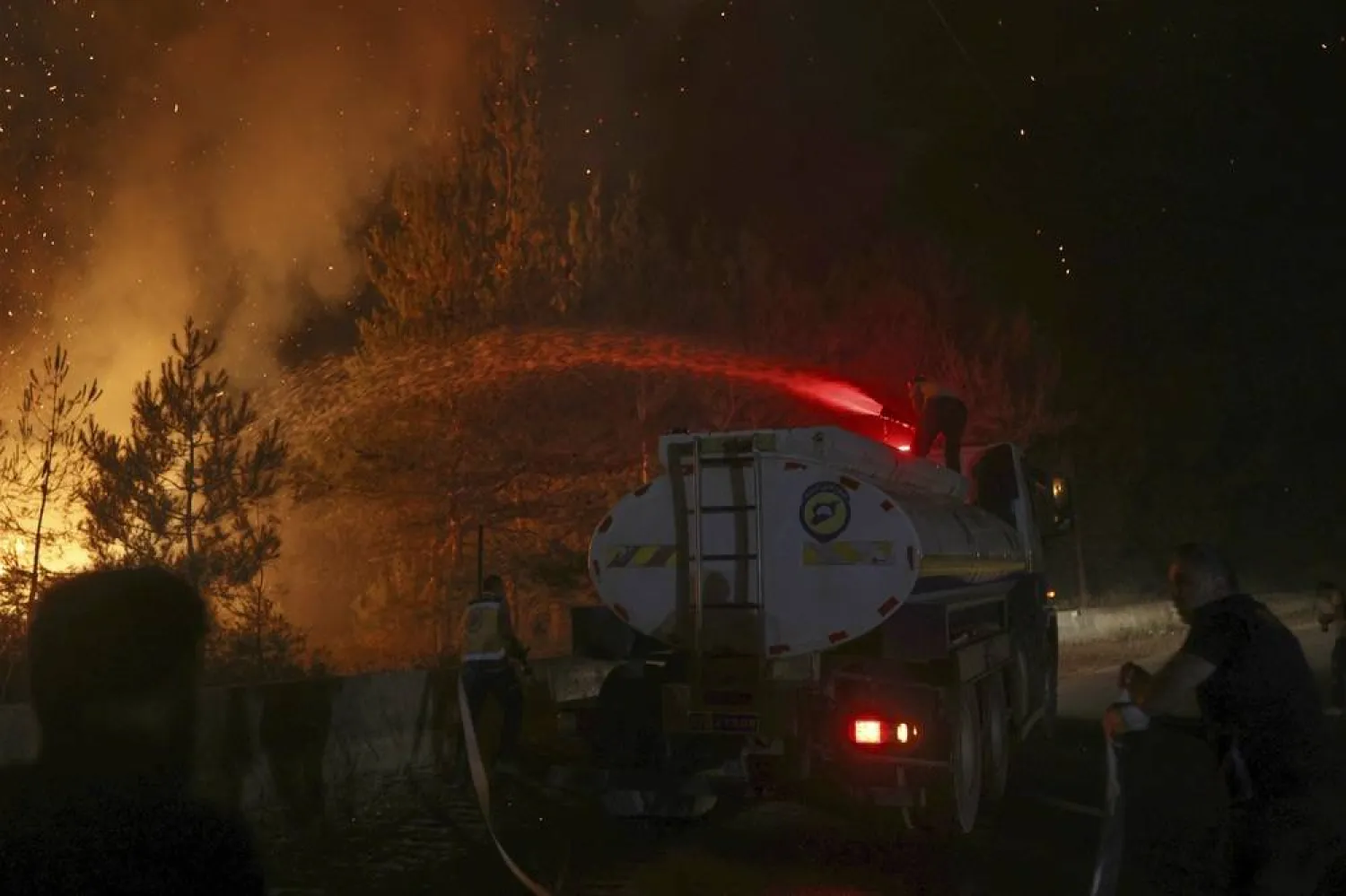
An emergency responder with the Syrian Civil Defense, known as the White Helmets, works to extinguish a wildfire in the town of Rabia, in Latakia province, Syria, Saturday, July 5, 2025. (AP)
TT

Türkiye Sends Firefighting Aircraft to Syria as Wildfires Rage on Both Sides of the Border

An emergency responder with the Syrian Civil Defense, known as the White Helmets, works to extinguish a wildfire in the town of Rabia, in Latakia province, Syria, Saturday, July 5, 2025. (AP)

Türkiye sent two firefighting aircraft Saturday to help battle wildfires in neighboring Syria as Turkish firefighters battled a blaze on their side of the border and one person was reported dead in the country's west.

Eleven fire trucks and water support vehicles were also dispatched to help beat back flames in Syria’s northwest Latakia region, according to Raed Al Saleh, the Syrian minister of emergency and disaster management. He posted on X, saying “sudden wildfires in Türkiye” delayed their arrival by almost a day.

Türkiye has been battling wildfires since June 26.

Forestry Minister Ibrahim Yumakli said Saturday that firefighters successfully controlled 10 major fires in western Türkiye, but an injured forestry worker had died, the third in the municipality of Odemis in Izmir province.

Authorities said most of the fires in Izmir were caused by faulty power lines.

Meanwhile, in Hatay province, which borders Syria, emergency crews continued fighting a blaze that broke out Friday afternoon in the Dortyol district near a residential area and rapidly intensified due to strong winds, the state-run Anadolu Agency reported.

Some 920 homes had been evacuated as a precaution against the advancing flames, Governor Mustafa Musatli said late Friday.

Interior Minister Ali Yerlikaya said 44 suspects had been detained in relation to 65 fires that broke out across the country.

Fires that have hit Türkiye, Greece and Syria over the past week have been fueled by soaring temperatures, strong winds, and low humidity. In Türkiye, they led to the evacuation of tens of thousands of people and damaged some 200 homes.

The Syrian Civil Defense expressed concerns over the presence of unexploded ordnance from the country’s past conflicts in some of the wildfire areas.

Summer fires are common in the eastern Mediterranean region, where experts warn that climate change is intensifying conditions.

Not Your Everyday Coffee in a Serbia Cafe. Enjoy it in the Company of Alpacas

Six alpacas roam among the tables in the Alpaca Cafe interacting with the guests in the village of Stajicevo, 50 kilometers north of Belgrade, Serbia, Wednesday, Sept. 30, 2026. (AP Photo/Darko Vojinovic)
TT

Not Your Everyday Coffee in a Serbia Cafe. Enjoy it in the Company of Alpacas

Six alpacas roam among the tables in the Alpaca Cafe interacting with the guests in the village of Stajicevo, 50 kilometers north of Belgrade, Serbia, Wednesday, Sept. 30, 2026. (AP Photo/Darko Vojinovic)

A cafe in northern Serbia has unusual hosts: six alpacas.

The South American animals, of various sizes and colors, roam among the tables at the Tiganjica Ethno-Village resort near Stajicevo, north of Belgrade, happy to interact with the guests.

The Alpaca Cafe here opened only a week ago and is a rare sight in Europe. Tiganjica resort owner Zoran Ostojin said he got the idea in Slovakia.

“My wife and I were in an Alpaca cafe in Slovakia and we were fascinated,” Ostojin told The Associated Press. “We wanted people in our country to get to know alpacas and feel this animal and its energy.”

Calm and friendly, alpacas are known for their mild character and easy disposition. While related to llamas and camels, alpacas are smaller, loved for their soft fleece and gentle humming sounds they produce to communicate.

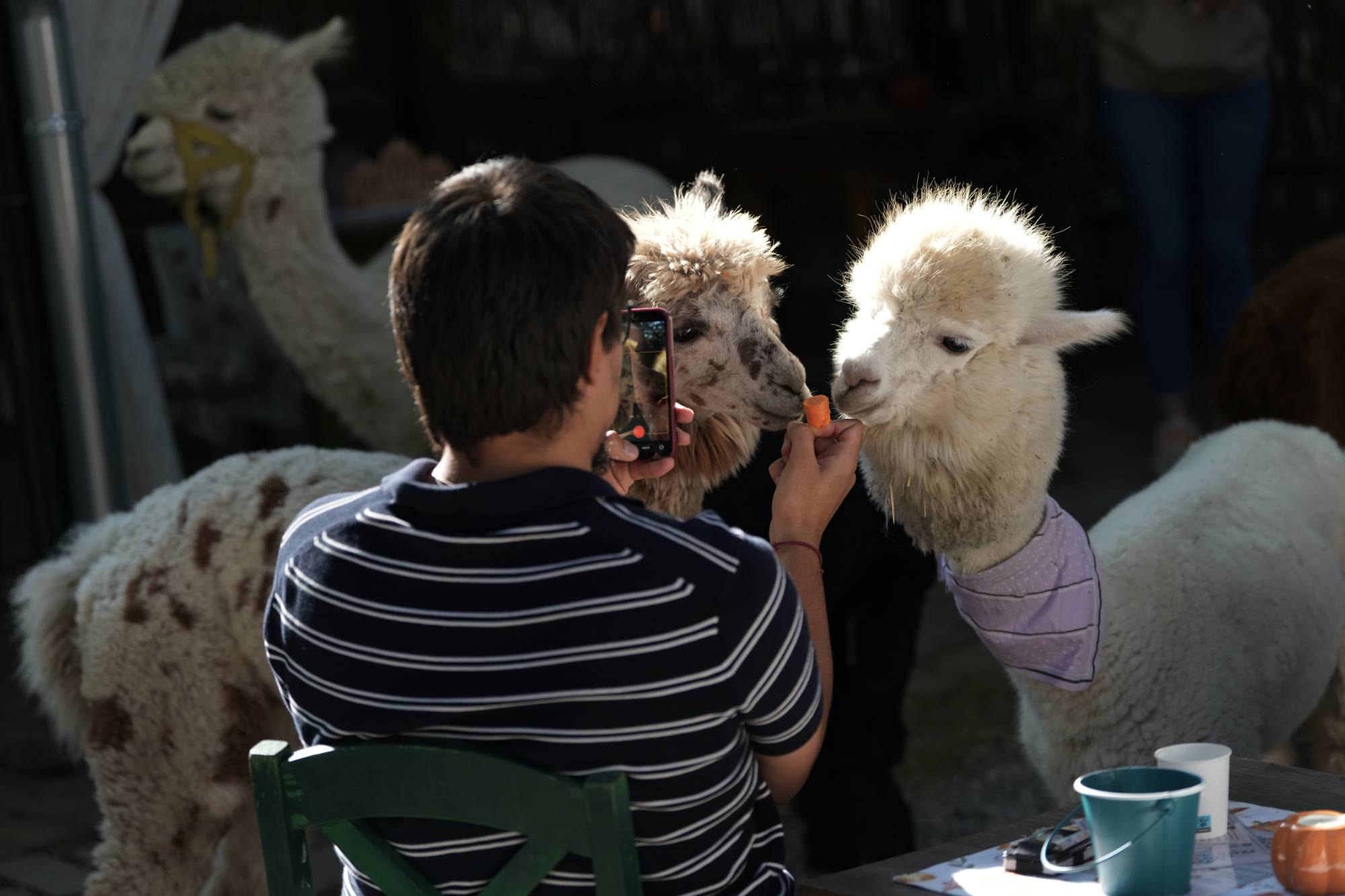
A man feeds alpacas in the Alpaca Cafe happy in the village of Stajicevo, 50 kilometers north of Belgrade, Serbia, Wednesday, Sept. 30, 2026. (AP Photo/Darko Vojinovic)

The alpacas in Tiganjica mingle with the visitors who often come in organized tours to see the animals and spend time in their company.

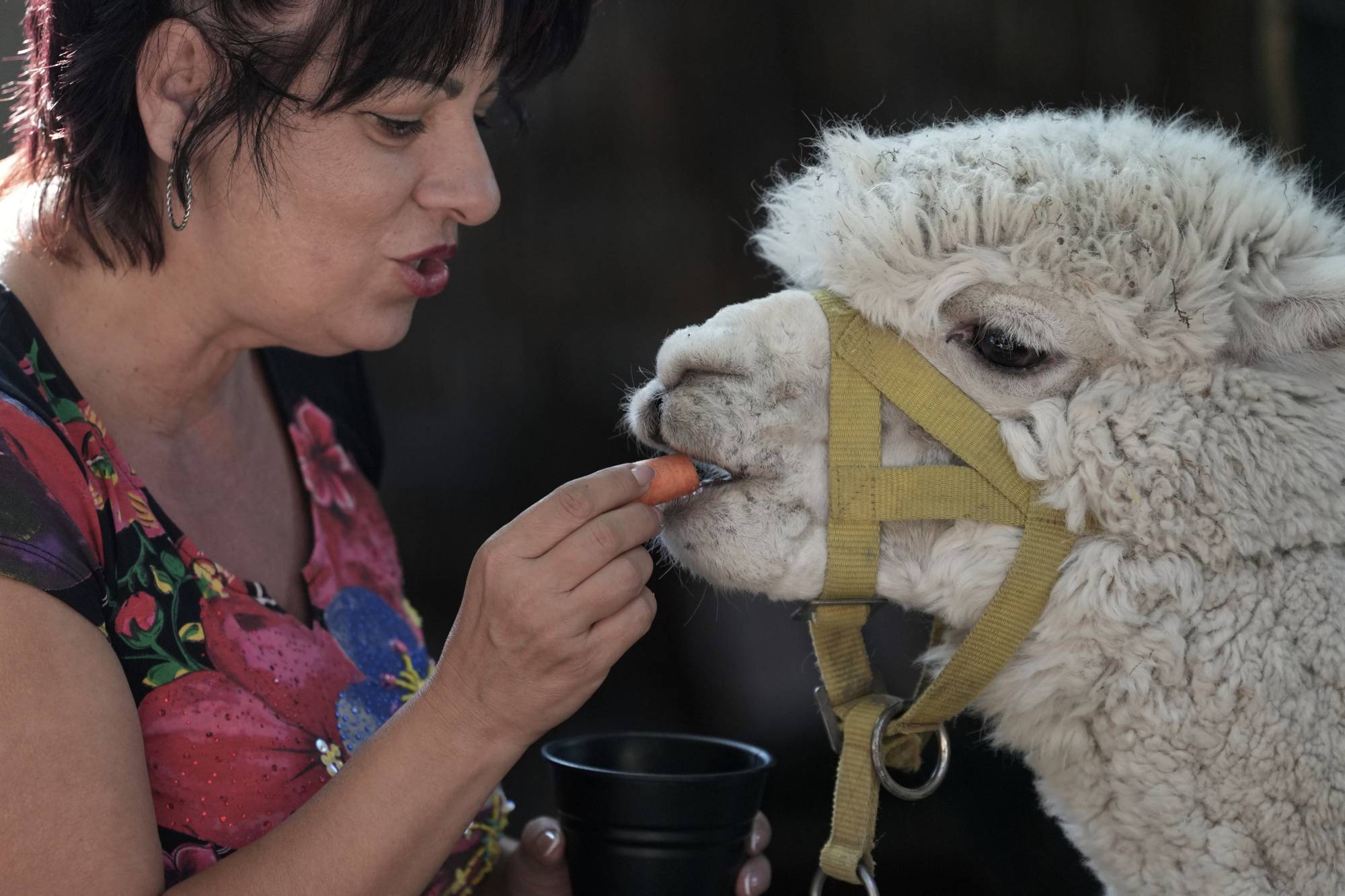
Written on a board are house rules. Visitors are asked not to approach the alpacas from behind or feed them any food they brought along. Guests are instead given small buckets with carrots, lettuce and apples.

Visits must be prearranged and the cost is around 10 euros ($11.35), which includes a drink and a bucket with alpaca food.

All six animals differ in character, according to the alpacas' carer Simona Frangi, who said a black alpaca called Ljubica is grumpy, while Snezana is the herd leader despite being the smallest of all.

A woman feeds an alpaca in the Alpaca Cafe happy in the village of Stajicevo, 50 kilometers north of Belgrade, Serbia, Wednesday, Sept. 30, 2026. (AP Photo/Darko Vojinovic)

“They are very sensitive to people's intentions,” Frangi explained. “They feel if someone wants to harm them, they move away. But if someone wants to offer something, they will come close.”

Ostojin runs a small zoo within his resort, which also includes a restaurant and a garden on the family estate. Ostojin said it all started because he and his brother were bringing over injured animals to care for since they were boys.

The first alpaca came as a present from the Belgrade Zoo eight years ago. Ostojin said he “very much liked the energy, the emotion that this animal sends out.”

“Almost like a healing ability,” he said.


Japan to Survey Animal Cafes for 1st Time over Welfare and Disease Concerns

Syaina Nozaki, manager of Owl Otter Cafe, holds food for Asian small-clawed otters at the cafe, which houses rescued animals, in Kamakura, Kanagawa Prefecture, Japan, September 24, 2026. REUTERS/Kim Kyung-Hoon
TT

Japan to Survey Animal Cafes for 1st Time over Welfare and Disease Concerns

Syaina Nozaki, manager of Owl Otter Cafe, holds food for Asian small-clawed otters at the cafe, which houses rescued animals, in Kamakura, Kanagawa Prefecture, Japan, September 24, 2026. REUTERS/Kim Kyung-Hoon

Japan has started its first nationwide survey of animal cafes amid concerns over animal welfare, hygiene and public health, a government official said, bringing greater scrutiny to the popular but lightly regulated sector.

The desktop survey, which began this month, will examine the number of facilities, the types of animals they house and the conditions they are held in, and how visitors interact with the animals.

Exotic animal cafes, where visitors can interact with species ranging from otters to owls and marmots, have become popular attractions ⁠for both Japanese ⁠and foreign tourists. But researchers say some facilities keep threatened species, raising concerns about animal welfare and the trade in wildlife.

Japan lacks specific standards governing such cafes and handling of many exotic species, said Takuya Ishikawa, an official at the Environment Ministry.

"There has been strong public interest, including from animal welfare groups, which have regularly shared findings from their own research with the ministry," Reuters quoted Ishikawa as saying. "Experts on a ⁠government advisory panel have also frequently raised concerns about potential problems at such cafes."

Cafes with domesticated animals including cats and dogs will also be included in the survey.

The government also plans a public awareness campaign, acknowledging that it had not done enough to inform public about the risks of interacting with exotic animals.

The prospect of tighter oversight has been welcomed by some in the industry.

Syaina Nozaki, manager of Owl Otter Cafe, which houses rescued animals, checks on owls at the cafe in Kamakura, Kanagawa Prefecture, Japan, September 24, 2026. REUTERS/Kim Kyung-Hoon

"Japan is clearly lagging behind when it comes to (animal welfare) regulation," said Syaina Nozaki, manager of Owl Otter Cafe in Kamakura, near Tokyo, which houses rescued animals.

Nozaki said that she hoped that regulations will help distinguish facilities like hers from less ⁠responsible operators focused ⁠solely on profit.

Japan, which has a large domestic pet market, ranked as the world's second-biggest importer of both live reptiles and mammals by value in 2024, a report by the World Wildlife Fund this month said, highlighting risks including invasive species introduced through pet releases and the spread of zoonotic diseases.

Of about 80 registered wildlife animal cafes in Tokyo and Osaka, three-quarters were also registered to sell animals, according to a separate report by WWF and Hokkaido University.

Researchers visiting 25 cafes found more than 1,700 animals on display, 27% of them threatened species. More than 90% of the cafes displayed animals considered at high risk of causing injury through contact, while samples from four cafes tested positive for enterohemorrhagic E. coli (EHEC), which can cause bloody diarrhea.


Fat Bear Week: Nepobaby Wins Alaska Contest

This handout photo from the National Park Service shows Chunk (Bear 32), the 2025 Fat Bear Week champion, a wild brown bear in Katmai National Park and Preserve in southwest Alaska. (Photo by T. CARMACK / NATIONAL PARK SERVICE / AFP)
TT

Fat Bear Week: Nepobaby Wins Alaska Contest

This handout photo from the National Park Service shows Chunk (Bear 32), the 2025 Fat Bear Week champion, a wild brown bear in Katmai National Park and Preserve in southwest Alaska. (Photo by T. CARMACK / NATIONAL PARK SERVICE / AFP)

The winner of this year's Fat Bear Week has been crowned after a nail-biting final -- and it's the son of a former champion.

Backpack, a 20-year-old male beloved by rangers in Alaska for his quiet determination, edged out female fellow finalist Dancing Queen in the annual ursine eating competition at Katmai National Park.

More than 2.3 million people voted in the week-long competition that sees bears unwittingly jostle in a series of head-to-head contests to decide which one of them has most impressively piled on the pounds ahead of hibernation.

Viewers watch a livestream of the enormous animals as they scoop salmon from the Brooks River, while visitors to a dedicated website can browse biographies of some of the top contenders, including before-and-after pictures showing how much weight the bears have gained over a summer of feasting.

Backpack's victory -- by a razor-thin margin of just 5,000 votes out of 200,000 cast for the final alone -- continues something of a family tradition: his mother Holly is a previous winner.

The animal, known officially by the more prosaic name Bear 89, was nicknamed Backpack by rangers who noted his habit of climbing on his mother's back when she swam across the river, AFP reported.

He previously suffered a leg injury that left him with a limp and has apparently adapted his lifestyle, preferring to spend his time lazing on a rock, rather than fighting with fellow bears.

"Unlike many large adult male bears, Backpack hasn't shown much aggression toward his competitors," his contestant profile says.

Sarah Bruce, a Katmai park ranger, told Alaska Public Media that Backpack now weighs around 1,200 pounds (544 kilograms) and is a clear fan favorite.

"He's one of the bears that we've been able to watch on the live cams since the live cams were put in in 2012," she said.

The bears of Katmai spend summer and early autumn gorging themselves on salmon as they look to bulk up ahead of a long winter of hibernation.

For five months, the creatures will not eat or drink, slowing all bodily functions as they shelter away from the harsh Alaskan weather.

While the increasingly popular annual competition is largely for fun, organizers say it is helpful in raising awareness of brown bears and their Alaskan habitats, as well as the risks they face from human activity.