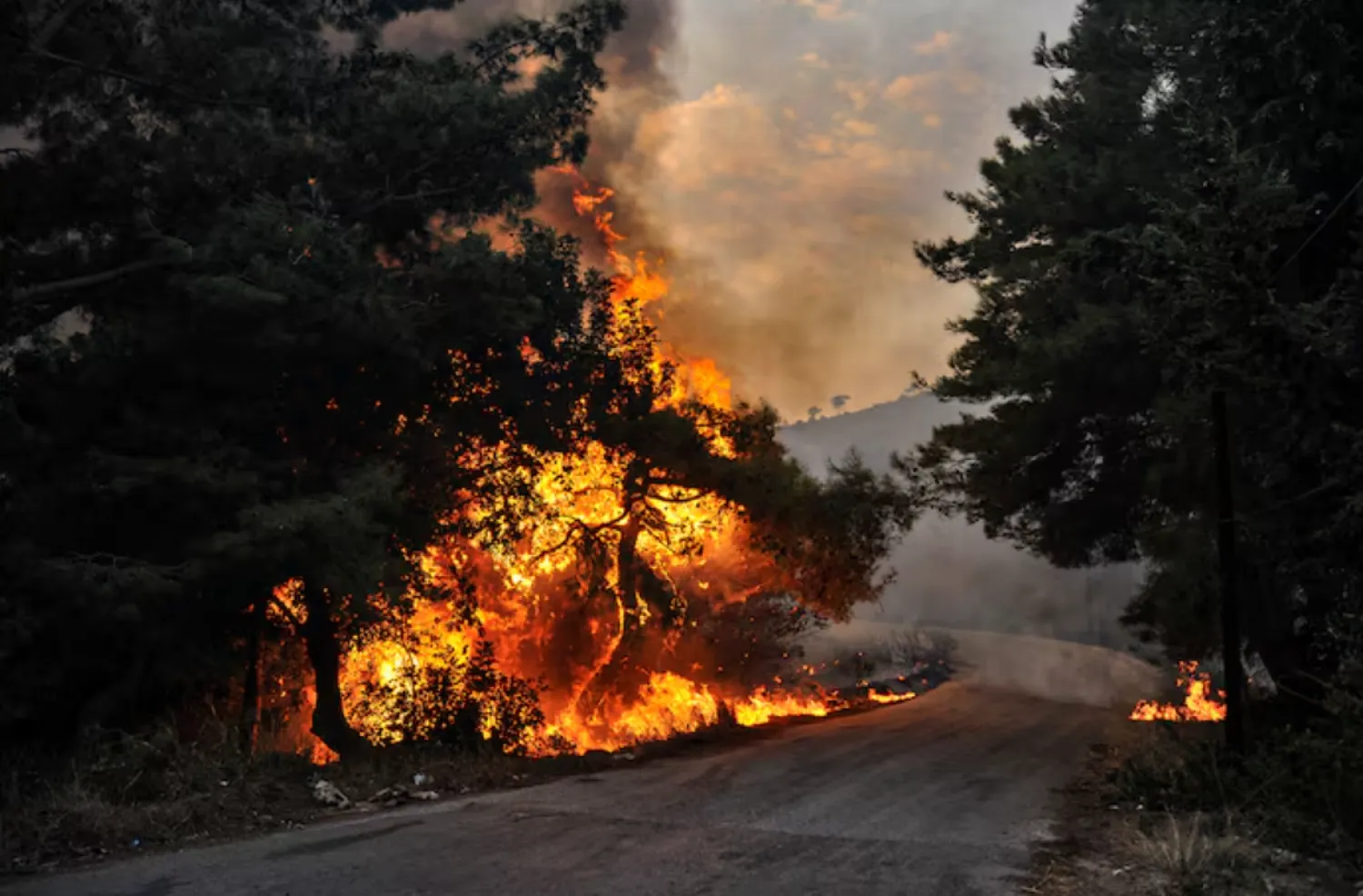
Syria Seeks EU Help to Battle Massive Wildfires

FILE : A fire burns at a forest in Latakia province, Syria in this handout released by SANA on October 9, 2020. SANA/Handout via REUTERS
TT

Syria Seeks EU Help to Battle Massive Wildfires

FILE : A fire burns at a forest in Latakia province, Syria in this handout released by SANA on October 9, 2020. SANA/Handout via REUTERS

Syria’s minister of emergencies and disaster management on Tuesday requested support from the European Union to battle wildfires that have swept through a vast stretch of forested land.

The fires have been burning for six days, with Syrian emergency crews struggling to bring them under control amid strong winds and severe drought.

Neighboring countries Jordan, Lebanon and Türkiye have already dispatched firefighting teams to assist in the response.

“We asked the European Union for help in extinguishing the fires,” minister Raed al-Saleh said on X, adding Cyprus was expected to send aid on Tuesday, AFP reported.

“Fear of the fires spreading due to strong winds last night prompted us to evacuate 25 families to ensure their safety without any human casualties,” he added.

According to the United Nations Office for the Coordination of Humanitarian Affairs (OCHA) office in Syria, the fires impacted “some 5,000 persons, including displacements, across 60 communities.”

An estimated 100 square kilometers (40 square miles) of forest and farmland -- more than three percent of Syria’s forest cover -- have burned, OCHA told AFP.

At least seven towns in Latakia province have been evacuated as a precaution.

Efforts to extinguish the fires have been hindered by “rugged terrain, the absence of firebreaks, strong winds, and the presence of mines and unexploded ordnance”, Saleh said.

With man-made climate change increasing the likelihood and intensity of droughts and wildfires worldwide, Syria has also been battered by heatwaves and low rainfall.

In June, the United Nations Food and Agriculture Organization said Syria had “not seen such bad climate conditions in 60 years.”


Cool Japan: Human Fridge Chills Workers in Extreme Heat

Konoe employee Taichi Konishi takes a break in a cooling box for workers also known as a "human fridge" at the company's warehouse on a hot day in Higashiosaka, Osaka Prefecture on August 21, 2026. (Photo by ANDREW CABALLERO-REYNOLDS / AFP)
TT

Cool Japan: Human Fridge Chills Workers in Extreme Heat

Konoe employee Taichi Konishi takes a break in a cooling box for workers also known as a "human fridge" at the company's warehouse on a hot day in Higashiosaka, Osaka Prefecture on August 21, 2026. (Photo by ANDREW CABALLERO-REYNOLDS / AFP)

Feeling dizzy and unwell after cycling to work in Japan's punishing summer heat, warehouse worker Isao Tabuchi headed for his company's newest acquisition: a refrigerator for humans.

The phonebooth-sized machine, where jets of chilled air ensure ice-cold comfort, only launched this year but has proved popular in a country that seems to be getting inexorably warmer.

"I was really able to recover thanks to that. Once you use it, it's very, very cool," Tabuchi, 51, told AFP in the western industrial city of Higashiosaka.

Tokyo-based industrial equipment distributor Trusco Nakayama said it has sold more than 300 units of the "Do Hiemon Box" since April, priced at 1.5 million yen ($9,400).

Customers include construction sites, factories and warehouses, and will expand in the future to golf courses, said company sales agent China Yamamoto. Baseball stadiums may also be interested.

Some within the company had been skeptical, she added.

"It's large, it's expensive, and it's not the kind of product where you can just explain it in words and have customers say, 'Okay, let's buy one.' So there were a lot of uncertainties," she told AFP.

Scientists say human-induced climate change is increasing the frequency and intensity of extreme heat events around the world.

In 2025, Japan saw its hottest summer on record.

This year, the weather office began using a new word -- "kokushobi" or "cruelly hot day" -- when temperatures hit 40C (104F), urging the public to treat extreme heat like a natural disaster.

Tokyo alone recorded almost 120 heat-related deaths in the month to mid-August, while close to 63,000 people nationwide this summer needed emergency care.

Since last year, Japanese businesses have faced tougher legal requirements to help employees toiling in the heat.

Building sites, for example, must provide workers with suitable clothing such as jackets with built-in fans, as well as air-conditioned break rooms and canopies to ensure shade.

A new initiative introduced this year allows bureaucrats in Tokyo to come to work in shorts -- a groundbreaking move in a country where formal business attire still rules.

The impact of rising temperatures on businesses in the world's fourth-biggest economy is real.

A survey in July by Teikoku Databank found that 50 percent of companies said intense heat had disrupted their operations.

Almost 88 percent said they had upgraded efforts to help workers cope with the heat.

The Do Hiemon Box can provide one line of defense.

It operates from a regular power socket, can be wheeled around and doesn't use much power, according to its maker.

To prevent overuse, it automatically shuts off after 20 minutes.

Investing in heat-countering measures has become essential to maintain the existing workforce and attract new recruits, said Yutaka Kono from Konoe, the specialist wholesaler of screws and surveying equipment where Tabuchi works.

Conventional air conditioners and spot coolers offer relief, but Kono's firm has many open areas to allow trucks and heavy equipment to operate.

"I was really surprised by this new concept of putting people into a kind of refrigerator, and I found it very appealing that by going inside that refrigerator, a person's body can be cooled in an instant to a safe temperature," Kono told AFP.

"That made me think, 'We definitely want to install one of these'," he said.

Worker Taichi Konishi, 24, says he uses it about three times a day.

After moving heavy boxes of metal tools and parts by hand between cargo pallets, he strolls over, steps into the box, sits down and smiles, running his fingers through his hair like in the shower.

"This feels really good," he told AFP.

"I've only been in for about two minutes, but even that was enough for all my sweat to dry up."


Unusual Dragonfly Swarms Sweep Across California after Warm Spring Rains

A dragonfly rests on a plant at the Lake Merritt Dragonfly Habitat Garden in Oakland, Calif., Friday, Aug. 21, 2026. (AP Photo/Jeff Chiu)
TT

Unusual Dragonfly Swarms Sweep Across California after Warm Spring Rains

A dragonfly rests on a plant at the Lake Merritt Dragonfly Habitat Garden in Oakland, Calif., Friday, Aug. 21, 2026. (AP Photo/Jeff Chiu)

Californians are spotting swarms of dragonflies flitting around parks, chasing mosquitoes in ponds and hunting flies on farms, a phenomenon experts say was likely fueled by unusually warm spring rains.

Peter Veilleux, who owns a nursery in Oakland, said he started noticing the dragonflies — at one point spotting about 100 flying together — while walking his dog at a park near his house and around the city’s Lake Merritt.

“It’s been amazing to see them,” Veilleux said, adding that he started seeing big groups of dragonflies in July.

He was so awed by the sight that he posted about it on Facebook, asking if anyone else was seeing the formidable predators in such large numbers.

Dozens of people commented about their own sightings in the San Francisco Bay Area and elsewhere in California.

Warm monsoon storms likely fueled dragonfly surge It is common to see dragonflies during the summer months, when they emerge from freshwater as flying insects. But this year’s large numbers are probably due to the warm monsoon storms that came through the state in late spring and early summer, said Kathy Biggs, a dragonfly expert and co-author of the book “Dragonflies of California.”

She said most are likely wandering gliders, a highly migratory dragonfly that can appear in large numbers when conditions line up. Dragonflies, which can fly at speeds of up to 35 mph (56 kph), use air pressure changes to help them fly great distances, Biggs said.

“We could say that they’re surfing the pressure system, the monsoon,” she added, according to The Associated Press.

Joe Del Bosque said he noticed swarms of them earlier this month at his farm in Fresno County, flying 10 to 20 feet (3 to 6 meters) above him.

“We do have them every year, but we had more than normal,” he said.

Del Bosque said he was happy to see the flying hunters because they eat aphids, whiteflies and fruit flies that feed on his crops. The insects, along with ladybugs working on the plants, are excellent pest control because they eat tiny insects on the plants and larger winged ones, like adult aphids and moths, he said.

“They are like little fighter jets,” Del Bosque said. “They zoom in for other insects and capture them in the air.”

Dragonflies spend most of their lives in water Dragonflies spend most of their lives wingless and underwater. Their life cycle begins after female and male dragonflies mate and the female dragonfly lays tiny eggs in freshwater. After the eggs hatch, the young dragonflies, called nymphs, live underwater for at least six months and for up to five years for some species. They start hunting then and feed on mosquito larvae, tadpoles, and even other nymphs.

Once they emerge from the water, they shed their skin and transform into four-winged insects that can move their forewings and hindwings independently. This allows them to fly forward, backward, up and down, and hover perfectly in place.

But their life as flying animals is short, lasting a few weeks or months. They spend it looking for new lakes, rivers and ponds, preying on tiny insects and attempting to repeat the cycle of life.

“They’re super agile, super strong flying insects with really good vision, really good eyes, and really strong flight muscles, and they are voracious predators that are out there feeding on mosquitoes nonstop,” said Chris Grinter, senior collection manager of entomology at the California Academy of Science in San Francisco.

Grinter said dragonflies are among the most effective predators in nature, with more than 90% of their hunts ending successfully.

“They can eat hundreds of mosquitoes a single day,” he said.

Dragonflies have awed humans for thousands of years. To Native Americans, a dragonfly is a symbol of purity and happiness. In Japan, they symbolize power, agility and victory. In some European folklore, they were considered to represent evil or bad luck.

To attract them to your garden, Biggs recommends avoiding pesticides and building fishless ponds and sunny areas with perches.

There are about 70 dragonfly species in California, but most are not migratory and remain near where they emerged, Biggs said.

Some of them might be out the very first thing in the spring, even as the snow is melting, and some of them are out in the Mojave Desert in the driest, hottest places in California, Grinter said.

Biggs said the migratory species keep moving on, ‘surfing’ high-pressure systems in the air.

“They could be somewhere a few days and then leave,” she said.


‘Crying Face’ is Officially Number 1 Emoji, Could Also be Showing Your Age

Emojis are a digital language for conveying meaning (Shutterstock)
TT

‘Crying Face’ is Officially Number 1 Emoji, Could Also be Showing Your Age

Emojis are a digital language for conveying meaning (Shutterstock)

Emojis have become an integral feature of modern communication. As a new icon is crowned the most popular symbol of the last year on record, The Independent looked at what its mixed meaning could do to our brains.

That little yellow circle with tears streaming down its face has officially been named the most popular emoji worldwide, according to data from Google shared with The New York Times.

While the original cry-laughing face and its diagonal sibling have traditionally been used to convey joy digitally, their overuse has essentially rendered them a bit toe-curling.

Want to show your age? Send one to anyone below the age of 30 and see them send a (dead from laughing) skull back. Honorable mentions also go to: the two beers emoji, the monkey covering its eyes and the sunglasses smiley. They can all get – unless used with irony – firmly in the digital bin.

Much like with new fashion drops or sought-after artwork, the appeal of an emoji in 2026 stems from its originality.

So, it’s no surprise to find that, although young people are conveying the same emotions as everyone else using a smart phone, the images being used to express them have evolved: the wilting rose (93rd most used) instead of the broken heart, the praying hands instead of thumbs up, And then we come to the Moai statue, which has become the 33rd most used emoji up from 482nd in 2021.

The New York Times says, is used now instead of raised eyebrows or the routine deadpan smiley.

While it’s easy to dismiss emoji use as irrelevant or childish, the symbols have become a language in their own right, with more and more people leaning on the icons to convey meaning.

Although emojis play increasingly critical communicative functions, studies have found that frequency of use decreases among older adults, who may struggle to adapt to new forms of non-verbal communication due to lack of confidence.

In Adolescence, emojis like the red pill were used in incel subcultures, which police struggled to decode without a teen’s help, On the flip side, a recent study by researchers at Bournemouth University found that emojis can trigger similar neural response patterns to those involved in processing real human facial expressions.

“This suggests that emojis are not simply fun additions to digital communication but may be processed by the brain in ways comparable to genuine facial cues. In this sense, emojis can function as meaningful emotional signals during online interaction,” said the study’s lead, Madeline Molly Ely.

So, whether you are perceiving this year’s most popular emoji as joy or sorrow, could actually be having an impact on your brain.