


An Uncontrolled Wildfire Sends a Cloud of Smoke over Spain’s Capital

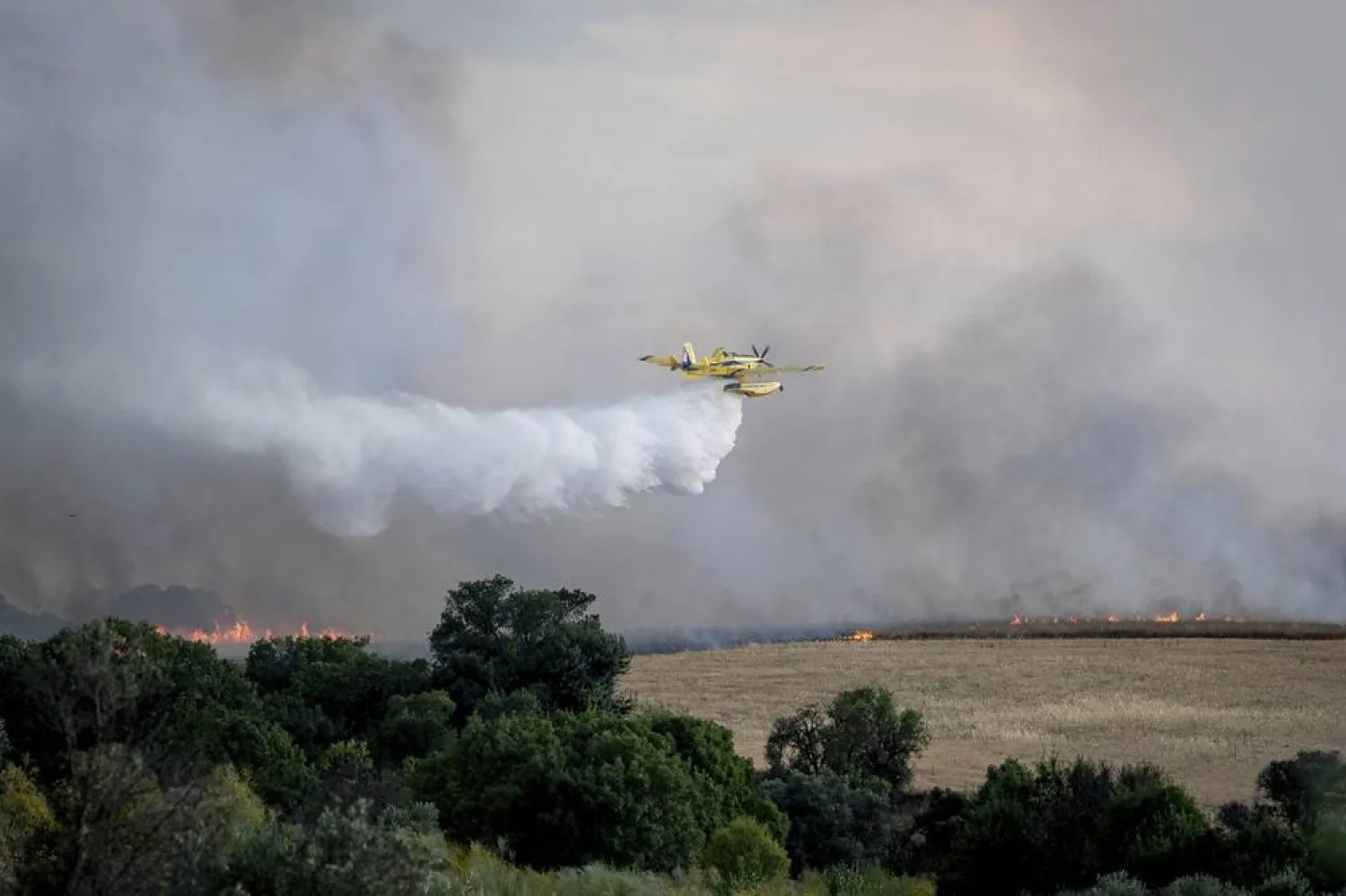
 A firefighting plane drops water during efforts to extinguish a wildfire near Navalcarnero, on the outskirts of Madrid, Spain, Thursday, July 17, 2025. (A. Pérez Meca/Europa Press via AP)
A firefighting plane drops water during efforts to extinguish a wildfire near Navalcarnero, on the outskirts of Madrid, Spain, Thursday, July 17, 2025. (A. Pérez Meca/Europa Press via AP)
TT

An Uncontrolled Wildfire Sends a Cloud of Smoke over Spain’s Capital

 A firefighting plane drops water during efforts to extinguish a wildfire near Navalcarnero, on the outskirts of Madrid, Spain, Thursday, July 17, 2025. (A. Pérez Meca/Europa Press via AP)
A firefighting plane drops water during efforts to extinguish a wildfire near Navalcarnero, on the outskirts of Madrid, Spain, Thursday, July 17, 2025. (A. Pérez Meca/Europa Press via AP)

An uncontrolled wildfire burned outside Madrid on Thursday, sending a giant cloud of smoke over the Spanish capital.

The fire broke out in the town of Mentrida in central Spain's Castile-La Mancha region about 50 kilometers (30 miles) southwest of the capital. Local authorities urged residents to stay home and close their windows.

Spanish authorities said the blaze had burned around 3,000 hectares (roughly 7,400 acres) by the late evening.

Firefighters deployed on the ground and in the air were working to extinguish the fire that began around 3 pm.

Wind blew the smoke over Madrid, where in the afternoon skies turned orange and thick with smoke.

Large parts of Spain are under heat and fire warnings, with temperatures on Thursday reaching 37 degrees Celsius (100 degrees Fahrenheit) in Madrid.

Europe is the world’s fastest-warming continent, with temperatures increasing at twice the speed as the global average since the 1980s, according to the European Union’s Copernicus Climate Change Service.

Scientists warn that climate change is exacerbating the frequency and intensity of heat and dryness, which makes places more vulnerable to wildfires.



India has Begun its Long-delayed Population Census

FILE - Indians crowd ticket counters at a railway station in Ahmadabad, India, Oct. 23, 2011. (AP Photo/Ajit Solanki, File)
TT

India has Begun its Long-delayed Population Census

FILE - Indians crowd ticket counters at a railway station in Ahmadabad, India, Oct. 23, 2011. (AP Photo/Ajit Solanki, File)

India has begun the world’s largest national population count, which could reshape welfare programs and political representation across the country.

The previous census in 2011 recorded a population of 1.21 billion. It's now estimated to be more than 1.4 billion, making India the most populous nation, The Associated Press reported.

The new census had been planned for 2021 but was postponed due to the COVID-19 pandemic and logistical challenges.

Here’s how India’s census works and why it is significant:

The first phase of the count started Wednesday and will roll out around the country through September. The workers will spend about a month in each area collecting information on homes and available facilities and will document housing stock and living conditions.

The exercise will blend in-person surveys with a digital option where residents can submit information through a multilingual smartphone application that integrates satellite-based mapping.

The second phase to be conducted from September to next April 1 will record more detailed information, like people's social and economic characteristics, including religion and caste.

More than 3 million government workers are expected to be deployed over the course of the year. In 2011, nearly 2.7 million enumerators surveyed more than 240 million households nationwide.

The second phase of the census will attempt a broader accounting of caste beyond historically marginalized groups.

Caste is an ancient system of social hierarchy in India and is influential in defining social standing and deciding who gets access to resources, education and economic opportunity.

There are hundreds of caste groups based on occupation and economic status across India, particularly among Hindus, but the country has limited or outdated data on how many people belong to them.

The last attempt to gather detailed caste information through a census dates to 1931, during British colonial rule. Since independent India’s first census in 1951, it counted only Dalits and Adivasis, members of marginalized groups known as Scheduled Castes and Scheduled Tribes who qualify for certain government benefits.

Successive governments have resisted conducting a full caste count, arguing it could heighten social tensions and trigger unrest.

Population data collected through the census underpins the distribution of government welfare programs and a wide range of public policies.

It could also prompt a redrawing of India’s political map, as seats in the lower house of Parliament and state legislatures may be increased to reflect population growth. A 2023 law reserves one-third of legislative seats for women, so any expansion would raise the number of seats set aside for female representatives.


Pakistan’s Blossom Season Brings Calm in a Troubled World

Commuters ride past apricot blossom trees at Ghanche district in Gilgit-Baltistan region on March 30, 2026. (AFP)
TT

Pakistan’s Blossom Season Brings Calm in a Troubled World

Commuters ride past apricot blossom trees at Ghanche district in Gilgit-Baltistan region on March 30, 2026. (AFP)

The harsh days of winter are over in Pakistan's high north and while snow still tops the towering peaks that dominate the landscape, spring has arrived in the foothills.

But this year, visitors who have come to witness the region's cherry and apricot blossoms see it as the perfect tonic to the war in the Middle East and its knock-on effects.

"There's war going on all over the world right now. It's petrol crisis, this and that, everything has become more expensive, everyone is in a depression," Hatib, 27, from Pakistan's biggest city, Karachi, told AFP.

"But to get out of depression, you need to step outside, go out somewhere for a bit, see places, explore, and relax the mind," he said.

The blossoms that turn bare trees into a vibrant shade of pink carpet the thawing farmland of Gilgit-Baltistan from late March every year, marking renewal and the promise of fruit harvests to come for local people.

"The best part is when these flowers are falling. It literally feels like a dream," Hatib said.

The region, home to about 1.7 million people, has some of the world's highest mountains, including K2, which soars to 8,611 meters (28,251 feet) -- second only to Mount Everest.

The jagged mountain ranges, high-altitude lakes and glaciers of Gilgit-Baltistan are a magnet for the daring and adventurous.

But more sedate visitors can instead take selfies in the orchards of the flowering deep valleys, under a clear blue sky with only the chirrup of birdsong and the bleat of foraging goats to break the surrounding silence.

"No matter how much inflation there is in Pakistan today, no matter how much petrol prices are going up, tourists still don't want to miss the cherry blossom and apricot blossom season," said local visitor Maria Akbar, 29.

"Even if we have to spend extra money, it's not a problem, but we'll enjoy this view."

"Things like cherry blossom and apricot blossom are what make Gilgit-Baltistan unique compared to all other regions," added Junaid Ahmed, 31.

"Tourists from all over the world come to enjoy this season. As you can see around me how beautiful it is, the beautiful view of these cherry and apricot blossoms is right before your eyes."


Hong Kong’s ‘Hero Trees’ Lose Their Glory as Climate Warms

A kapok tree blooms with vibrant red flowers while retaining green foliage that typically would have shed during winter, in Hong Kong on March 15, 2026. (AFP)
TT

Hong Kong’s ‘Hero Trees’ Lose Their Glory as Climate Warms

A kapok tree blooms with vibrant red flowers while retaining green foliage that typically would have shed during winter, in Hong Kong on March 15, 2026. (AFP)

Hong Kong's beloved kapok trees are not blooming the way they used to, drawing concern from conservationists who see it as a sign that nature is falling out of sync as the climate warms.

Locally known as "hero trees" for their majestic appearance, kapoks attract large numbers of photographers every spring when their bright red flowers bloom on otherwise bare branches.

But that contrast has been fading in recent years as leaves that should have been shed during winter stay put as the seasons change, worrying researchers.

"The kapok trees we see now very often have both flowers and leaves at the same time," said Lam Chiu-ying, former director of the Hong Kong Observatory.

"In some places, half the tree is covered in green leaves and the other half in red flowers."

The kapok, also known as the red silk-cotton tree, is native to tropical and subtropical Asia, including southern China.

The shift in their springtime appearance has "become increasingly common" over the past decade due to warming winters caused by climate change, Lam told AFP.

Hong Kong has just recorded its warmest winter on record, with the mean temperature from December to February hitting 19.3C, two degrees higher than normal, according to the observatory.

Angie Ng, an ecologist and conservation manager at local NGO The Conservancy Association, said the trees seemed to be blooming about two weeks earlier than usual this year, likely due to climate factors like temperature and moisture.

The trees have to divert resources to maintain both old leaves and new flowers, which may result in fewer blooms, she said.

The disruption could have knock-on effects on wildlife, as flowers provide nectar for birds and pollen for bees.

"Ecological processes function like an intricate web," Ng says.

"When the timing of animals and plants does not align properly, it can trigger ripple effects that impact not only animals dependent on those plants but also the broader ecological chains."