

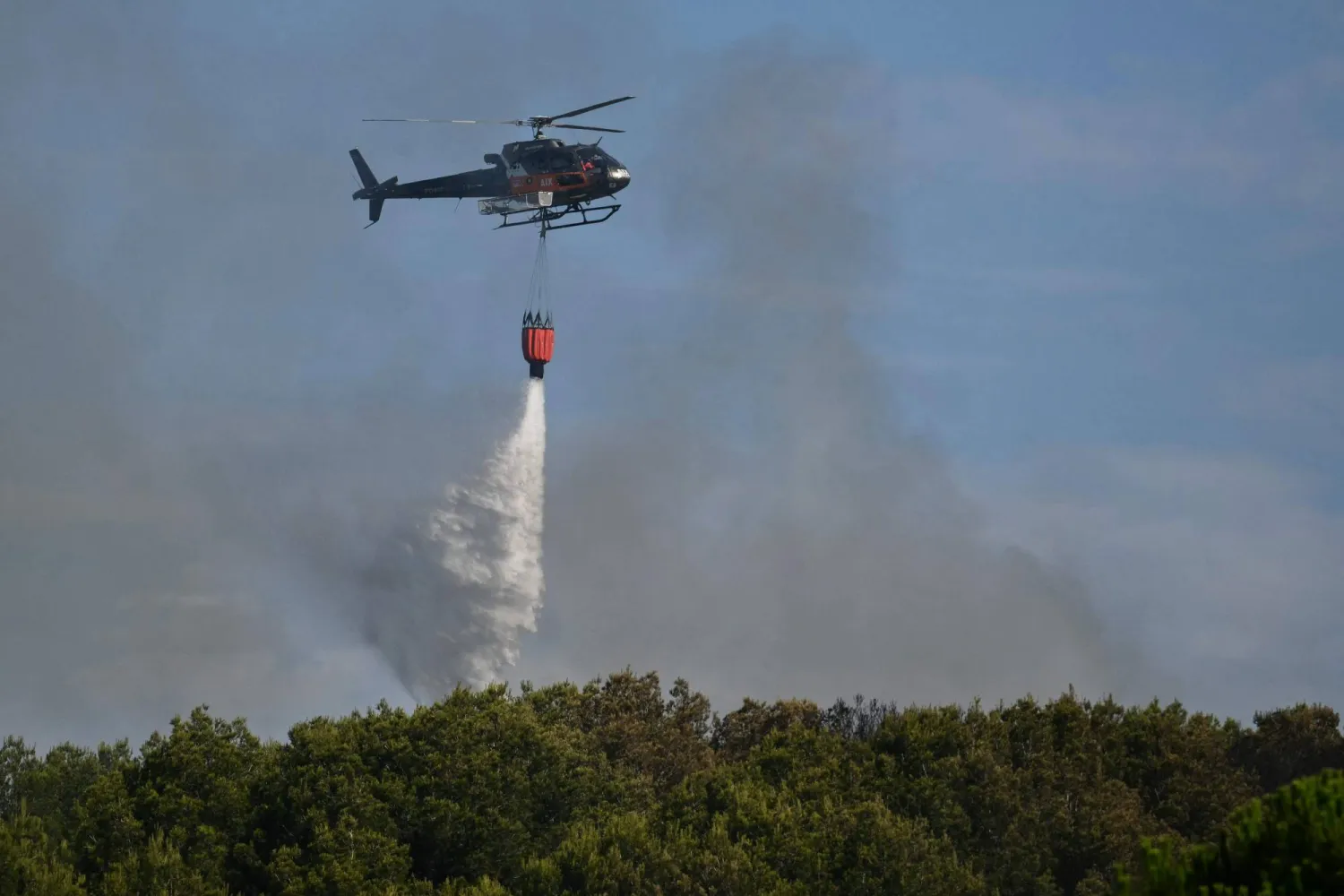

Hundreds of Firefighters Battling Wildfire in Southern France

An Airbus H125 helicopter drops water over a wildfire in Saint-Julien Les Martigues, northwest of Marseille in southern France on July 18, 2025. (Photo by Christophe SIMON / AFP)
TT

Hundreds of Firefighters Battling Wildfire in Southern France

An Airbus H125 helicopter drops water over a wildfire in Saint-Julien Les Martigues, northwest of Marseille in southern France on July 18, 2025. (Photo by Christophe SIMON / AFP)

Nearly 1,000 firefighters and helicopters battled a wildfire about 40 kilometers (25 miles) northwest of France's second-largest city Marseille on Friday, but officials said lower temperatures and increased humidity had improved the situation.

The 240-hectare (593 acres) wildfire flared up a week after a separate conflagration reached the northwestern outskirts of Marseille, forcing people to evacuate or into lockdown and temporarily shuttering the area's airport.

Pierre Bepoix, the colonel of rescue operations and deputy director for the area's firefighters, said 150 people had been evacuated, but firefighters had managed to save 150 homes and portions of the area's forests.

"It was a fire that swept through relatively dense vegetation ... which made our work particularly complicated," Bepoix told Reuters. "Obviously, priority was given to the preservation and protection of these homes and the lives that could be in these buildings."

Local officials said in a statement that 120 homes had been threatened by the fire, adding that it was not possible yet to identify any possible damage to them, and that two firefighters had been injured.

Meanwhile in Spain, a wildfire that broke out on Thursday evening in the central Toledo province and could be seen from downtown Madrid, ravaged 3,200 hectares of woodland.

Regional emergency services said early on Friday firefighters had secured the perimeter, though there were concerns over strong winds and high temperatures forecast throughout the day.



Fontainebleau: French Forest of Kings, Painters and Hikers

 A drone view from Milly-la-Foret shows smoke rising from a wildfire in the Fontainebleau forest near Paris during a heatwave affecting large parts of France, July 13, 2026. (Reuters)
A drone view from Milly-la-Foret shows smoke rising from a wildfire in the Fontainebleau forest near Paris during a heatwave affecting large parts of France, July 13, 2026. (Reuters)
TT

Fontainebleau: French Forest of Kings, Painters and Hikers

 A drone view from Milly-la-Foret shows smoke rising from a wildfire in the Fontainebleau forest near Paris during a heatwave affecting large parts of France, July 13, 2026. (Reuters)
A drone view from Milly-la-Foret shows smoke rising from a wildfire in the Fontainebleau forest near Paris during a heatwave affecting large parts of France, July 13, 2026. (Reuters)

A massive wildfire near Paris has torched swathes of a forest that has lured admirers for centuries, from royal hunting parties to impressionist painters, rock climbers and nature lovers.

Fontainebleau is no stranger to fire but this inferno -- fanned by strong winds and heatwave conditions -- is among the worst in decades, destroying nearly five percent of the 25,000-hectare (61,800 acre) forest.

- Prehistory and royalty -

Fontainebleau attracts between 15 and 18 million visitors a year -- nearly twice as many as the Louvre museum in Paris.

Most travel from the French capital 60 kilometers (40 miles) away but 30 percent come from outside France.

Rock art dating back to prehistoric times has been discovered in its caves.

Fontainebleau became a royal estate around the year 1000 under Robert II "the Pious" of France. Later, a grand palace was built to host hunting parties.

The hunting paths are still used today by firefighters to access the forest, said Sophie David, an archaeologist who heads the environment and visitor services department at the state-run National Forestry Office.

- Blank canvas -

Around 200 years ago, swathes of the forest had been cleared for agriculture, reducing it to roughly one-third of its current size.

"In the 19th century, trees were planted to fill in the gaps. Pines were chosen, trees with shallow roots" capable of growing in Fontainebleau's sandy soil, said David.

The character of this new, more open forest was captured by the painters of the Barbizon Impressionist school.

The invention of the paint tube, and rise of leisure travel among France's growing bourgeoisie, helped make Fontainebleau attractive for walkers and artists.

"The railway arrived in 1849 and the world's first signposted (hiking) trails were created" in Fontainebleau shortly after, said David.

Rosa Bonheur, a renowned French artist of this era, painted her iconic "Fairy Pond" in Fontainebleau.

- Nature hotspot -

The forest is home to oak and beech woods as well as coniferous forests, open heathland, fossil dunes, ponds and wetlands.

Thirty million years ago, the forest was an ocean. As the sea receded, it left behind sand which, over millennia, formed the sandstone blocks that now attract rock climbers.

"What makes the Fontainebleau massif unique is the diversity of its landscapes and the richness of its biodiversity," said David.

It hosts more than 6,500 known animal species -- hares and deer to birds like warblers and tawny owls and rare insects, such as the stag beetle.

UNESCO designated Fontainebleau a "biosphere reserve" in 1998.

Around 1,000 hectares are designated strict nature reserves, with no human intervention. One of those reserves has been among the hardest hit by the fire.

- Old foe -

Fire was first recorded in Fontainebleau in the 13th century.

David said detailed records had been kept since 1863 and the current blaze -- which has burned some 1,000 hectares already -- was among the largest in the history books.

In the early 20th century, surveillance towers were erected to address the problem, helping reduce the area burned.

More recently, six 10,000-litre (2,650-gallon) water tanks have been installed in the forest to enable a more rapid response to fires.

Around 30 fires break out each year, most often caused by cigarette butts or unauthorized campfires.

For the past two years, the fire service has been testing an AI surveillance system which can detect smoke and quickly locate the source to notify the fire department.


In a Sweet Discovery, Astronomers Find Sugar Lurking in the Space Between Stars

A long exposure photo shows the Milky Way galaxy star cluster from Tuban village in Badung, Bali, Indonesia, March 23, 2023. (AFP)
TT

In a Sweet Discovery, Astronomers Find Sugar Lurking in the Space Between Stars

A long exposure photo shows the Milky Way galaxy star cluster from Tuban village in Badung, Bali, Indonesia, March 23, 2023. (AFP)

The space between stars just got a little sweeter.

Astronomers have detected a type of sugar in space that's also found in raspberries and self-tanners. The sugar, called erythrulose, lurks in what's called the interstellar medium: thin clouds of gas and dust littered between stars.

Sugar does more than sweeten tea and powder doughnuts. Different varieties fuel our cells and even make up DNA. Scientists are itching to know how sugars form because they're a key ingredient for life as we know it.

Using two dish-shaped radio telescopes in Spain, researchers collected data from a large gas cloud near the center of the Milky Way. They identified the sugar in gas form by comparing telescope signals to samples in the lab. It's the latest kind of sugar detected in space — in a region crossed by NASA's twin Voyager, the farthest spacecraft to ever travel from Earth.

The results were published Monday in the journal Nature Astronomy.

Scientists have found interesting chemistry in our galaxy, including building blocks for genetic material and parts of the cell. They spotted a cousin to table sugar near the center of the Milky Way about 25 years ago, and black grains from asteroid Bennu retrieved by NASA’s Osiris-Rex spacecraft yielded other sugars, including a key DNA ingredient.

The latest sugar isn’t essential for life, but can easily convert to a form that’s thought to be crucial to kick-starting life on Earth. And it’s one of the most complex sugars spotted so far, said astrophysicist Erika Hamden with the University of Arizona.

It's “a pristine example of the stuff that’s just floating out in the galaxy,” said Hamden, who had no role in the new research.

Researchers want to look for more sugars in space and learn about how they convert to different forms.

Finding them in one spot means they're likely also hiding in distant corners of the galaxy along with other important bits, said study author Izaskun Jiménez-Serra, an astrophysicist at the Center for Astrobiology in Spain.

“The key ingredients for the origin of life could be present in other regions across the galaxy, opening the possibility for life to develop elsewhere in the universe,” Jiménez-Serra said.


Two Romanian Mountain Climbers Found Dead in Italian Alps

A rescue helicopter hovers over the Punta Rocca glacier near Canazei, in the Italian Alps in northern Italy, July 4, 2022 - File photo/AP news
TT

Two Romanian Mountain Climbers Found Dead in Italian Alps

A rescue helicopter hovers over the Punta Rocca glacier near Canazei, in the Italian Alps in northern Italy, July 4, 2022 - File photo/AP news

The bodies of two Romanian climbers missing since last week were found Monday in the Gran Paradiso massif in the Italian Alps, authorities told AFP.

The two Romanian nationals whose ages have not been disclosed had not made contact since leaving a mountain refuge on July 9, according to authorities in the Aosta Valley, a northern region bordering Switzerland and France.

After several days of helicopter searches, their bodies were found Monday morning at the bottom of a crevasse about 20 metres deep, regional authorities said.

Gran Paradiso rises to 4,061 metres within Italy's oldest national park.

Mountain accidents are common in Italy: in 2025, they caused 528 deaths, an increase of 13 percent compared with the 466 fatalities recorded in 2024, according to the Italian National Alpine and Speleological Rescue Corps (CNSAS).
