Greece to Create New Marine Reserves to Protect Underwater Wildlife

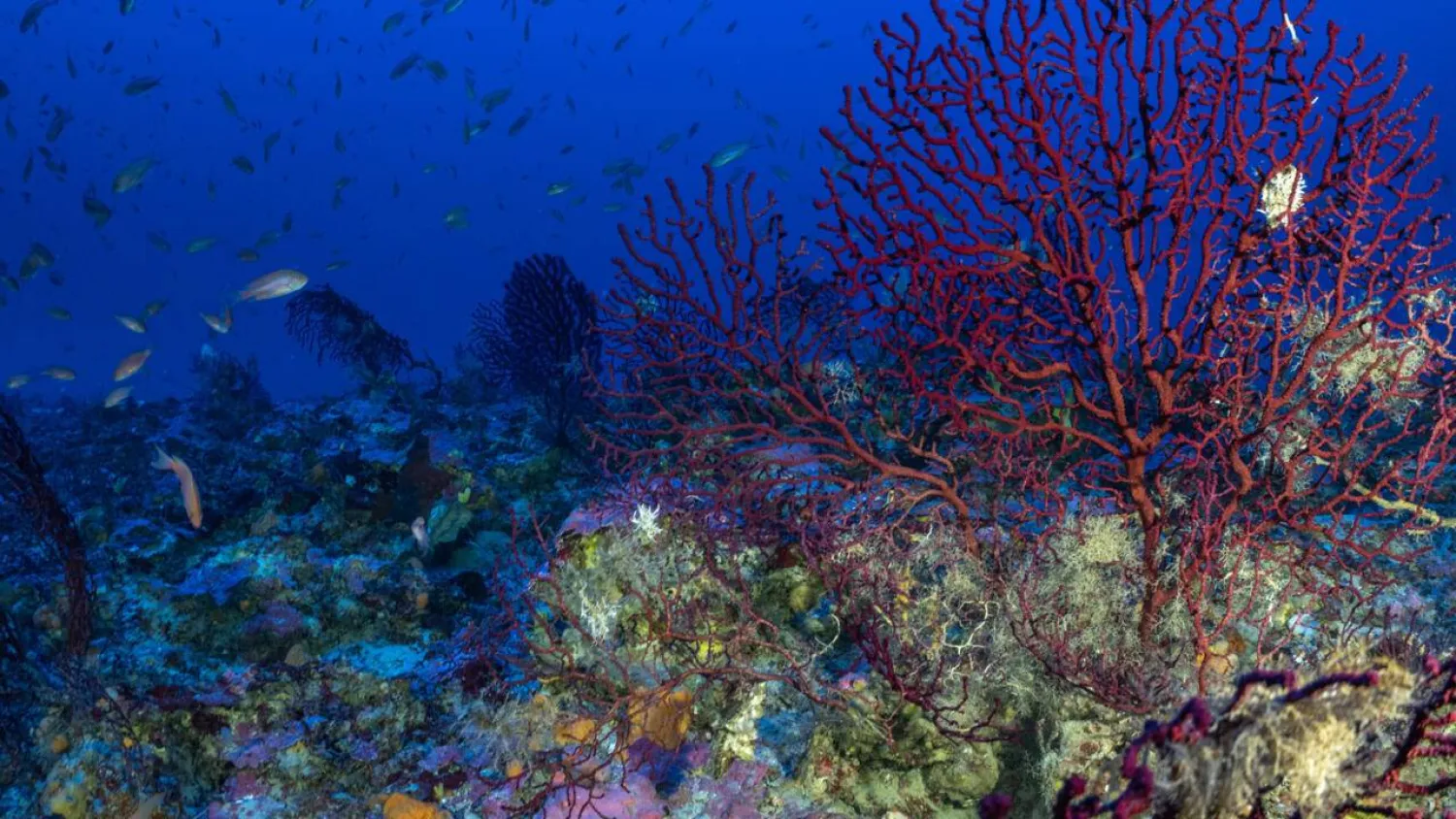
Greece banned bottom trawling in the waters of the Fournoi Korseon island chain in the Aegean to protect recently discovered coral reefs. Handout / Under the Pole/AFP
TT

Greece to Create New Marine Reserves to Protect Underwater Wildlife

Greece banned bottom trawling in the waters of the Fournoi Korseon island chain in the Aegean to protect recently discovered coral reefs. Handout / Under the Pole/AFP

Greek Prime Minister Kyriakos Mitsotakis on Monday said that his government was creating two new protected marine areas, fulfilling a promise he made at a United Nations conference on the oceans in June.

The new protected areas -- in the Ionian Sea and in the Southern Cyclades in the Aegean Sea -- would be "among the largest marine protected areas in the entire Mediterranean", he said in a video message in English.

The prime minister said that the "hugely damaging practice of bottom trawling" by commercial fishing boats would be banned within the new marine reserves and in all Greece's marine protected areas by 2030, making it the first country in Europe to take such a significant step in preservation, reported AFP.

Fishing is generally allowed in protected marine areas worldwide, even by trawlers which scrape the seabed with a huge funnel-shaped net, to devastating effect.

Mitsotakis said that he had "made a promise to honor (Greece's) unique marine heritage" at last month's UN Oceans Conference in southern France, "and to protect it for generations to come".

"Today I am delivering on that promise with the establishment of two new marine national parks... because when we protect our ocean, we protect our own future."

Greece is located in the eastern Mediterranean and has around 13,600 kilometers (8,450 miles) of coastline and thousands of islands.

Greece, Brazil and Spain all used the UN conference in Nice, to announce new protected marine reserves and measures to ban bottom trawling, in order to better protect marine wildlife.

Mitsotakis said that the size of the new Greek marine reserves "will enable us to achieve the goal of protecting 30 percent of our territorial waters by 2030".

He said that the government would work with "local communities, local fishermen, scientists (and) global partners (to) make these parks examples of what is possible".

The oceans are 'life itself'

In May, Athens banned bottom trawling in the waters of the Fournoi Korseon island chain in the Aegean to protect recently discovered coral reefs that are exceptionally rich in marine wildlife.

Neighboring Türkiye, whose western coast is close to the Aegean islands, responded to Monday's announcement by criticizing such "unilateral action".

"International maritime law encourages cooperation between the coastal states of these seas, including on environmental issues," the foreign ministry in Ankara said.

It said that Türkiye was willing to cooperate with Greece and would soon announce its own plans to protect maritime areas.

Greece and Türkiye, both members of NATO, have historical disputes over maritime boundaries in the Aegean Sea.

They signed an agreement in 2023 aimed at easing tensions.

Mitsotakis said that "Ocean", a new documentary by British natural history broadcaster Sir David Attenborough, had inspired Greece to accelerate efforts to protect life below the waves.

"Ocean", which features spectacular footage of undersea habitats and marine life, emphasizes the importance of healthy seas for tackling climate change and the current sweeping loss of wild species across the planet.

Mitsotakis said "Ocean" showed that the sea was "not just beautiful scenery".

"It is life itself. Delicate. Powerful. And under threat."


Portugal Closes All Schools and Non-Essential Services Ahead of a Major Atlantic Storm

Heavy machinery clears the debris from a landslide along the Marocos road in Machico municipality, on the Portuguese island of Madeira, due to severe weather caused by the passage of Storm Charles, 11 November 2026. (EPA)
TT

Portugal Closes All Schools and Non-Essential Services Ahead of a Major Atlantic Storm

Heavy machinery clears the debris from a landslide along the Marocos road in Machico municipality, on the Portuguese island of Madeira, due to severe weather caused by the passage of Storm Charles, 11 November 2026. (EPA)

Portugal closed all schools and shuttered non-essential public services on Wednesday as a major Atlantic storm headed for the country's mainland.

Streets remained largely deserted ahead of the arrival of Storm Charles after the government told people to stay at home as heavy rain and rough seas were expected to batter the Portuguese coast, with wind gusts of up to 140 kph (85 mph).

It was the first time in living memory that Portugal’s roughly 8,000 schools had canceled classes nationwide over a storm forecast.

Buses without passengers drove through the country's capital, Lisbon, where some streets flooded due to clogged drains. A national supermarket chain closed its stores, while an international technology conference in Lisbon attended by around 70,000 people called off the day's events.

In January, the country's center-right government faced harsh criticism for its weak response when Storm Kristin hit central Portugal, felling thousands of trees and causing widespread property damage that is still being repaired.

The brunt of Storm Charles was expected to hit the Atlantic coast on Wednesday afternoon and evening, coming from the southwest after it had struck the Portuguese island of Madeira on Tuesday with 130 kph (81 mph) winds.


Once the World's Fastest, Ocean Liner Will Become Largest Artificial Reef

The S.S. United States crossed the Atlantic more than 800 times. (Getty Images)
TT

Once the World's Fastest, Ocean Liner Will Become Largest Artificial Reef

The S.S. United States crossed the Atlantic more than 800 times. (Getty Images)

An ocean liner that is longer than the Titanic and was once the fastest on the seas is headed to a final home on the floor of the Gulf of Mexico as the world's largest artificial reef.

The S.S. United States is scheduled to be sunk Wednesday off the coast of the Florida Panhandle, fulfilling a long-planned $13.5 million project aimed at attracting more divers and fishing enthusiasts to the area while creating a home for tuna, marlin and swordfish.

The project will keep what had been a technological marvel when it made its maiden voyage in 1952 from becoming scrap metal.

The S.S. United States crossed the Atlantic more than 800 times, carrying old Hollywood stars like Grace Kelly and Elizabeth Taylor. Other passengers have included President John F. Kennedy and Britain’s former King Edward VIII. In 1968, a young Bill Clinton took it when he went to Oxford University, decades before he was elected president.

In preparation for the sinking, organizers removed the 65-foot smokestacks and plan to have them anchor a new museum that celebrates the ship. Once aboard, passengers were treated to dinners that included caviar, roast duckling, smoked ox tongue and Calf's Head en Tortue.

“It was our goal to make sure that she wasn’t lost forever,” said David Lawrence, a member of the board for the S.S. United States Conservancy, which is dedicated to preserving the ship.

The ship will be sunk without using explosives

Federal environmental and explosives rules prevent Okaloosa County, Florida, and its contractor from using explosives to scuttle the ship, said Nick Tomecek, the county's spokesperson. Concerns about inclement weather prompted officials to move up the sinking by a day.

The S.S. United States has pipes that pulled seawater into tanks as part of the system that cooled its boilers, he said, and those tanks have been removed so that once the valves are opened, water will flood the hull. Workers also have cut 10-foot by 10-foot holes in the decks, and more than 400 portholes have been removed.

The ship is to sink in about 180 feet (55 meters) of water, with its top deck about 60 feet (18 meters) below the surface — shallow enough that inexperienced divers can visit. It will settle on the floor of the waters about 25 miles (40 kilometers) southwest of Destin, between Panama City and Pensacola.

Larger than the Titanic, the ship's first voyage set a speed record

More than 3,000 workers helped build the S.S. United States in 1950 and 1951 in Virginia. An Associated Press reporter and President Harry Truman's daughter, Margaret, were among 1,700 passengers for the first voyage.

The ship's average speed for that trip was almost 41 miles (66 kilometers) per hour, besting a record set by Britain's R.M.S. Queen Mary in 1938 by 4.5 miles (7.2 kilometers) per hour, according to the AP's dispatch.

The S.S. United States set the record even though its journey ended in the face of a full gale that reached 69 miles (111 kilometers) per hour — “so strong it blew a ping pong table off the deck,” AP reported.

At 990 feet (302 meters), the ship is 108 feet (33 meters) longer than the ill-fated Titanic, which hit an iceberg and sank on its first voyage across the Atlantic.

“She really embodies and expresses this country’s best,” said Susan Gibbs, the granddaughter of the ship's designer. “She represents pride and resilience and strength and beauty.”

The ship's resting place has many artificial reefs

About 500 artificial reefs are located in the waters near where the S.S. United States will rest, Tomecek said.

Previously, the largest artificial reef came from the 2006 scuttling of an aircraft carrier, the USS Oriskany in the Gulf off of Pensacola — near enough to the S.S. United States site that an experienced diver could visit both in the same day, Tomecek said. The Oriskany, launched in 1950, was 911 feet (278 meters) in length.

“We're trying to be the best diving destination in the world,” Tomecek said.

The ship was decommissioned in 1969. Attempts by a hotel magnate and Norwegian Cruise Lines to use the ship never floated, and from 1996 until recently, it sat along a dock in Philadelphia.

“I’m just so happy that we are able to save parts of her,” Gibbs said.


Medical Breakthrough for People with Same Disorder as Celine Dion

Celine Dion. (AFP)
Celine Dion. (AFP)
TT

Medical Breakthrough for People with Same Disorder as Celine Dion

Celine Dion. (AFP)
Celine Dion. (AFP)

People suffering from stiff person syndrome (SPS), which affects Celine Dion, the singer, could soon benefit from a new medicine which improves symptoms.

Patients in the US were given a one-off immunotherapy drug in a clinical trial, resulting in two individuals regaining function related to everyday life that had been lost to SPS, according to The Telegraph.

SPS is a rare neurological disorder that gets progressively worse, and symptoms include stiffness in the body, spine, arms and legs.

The Telegraph said patients were given chimeric antigen receptor T-cell (CAR-T) therapy, which teaches the body’s immune system to recognize and attack deadly cells causing disease.

CAR-T therapy is already approved on the NHS for some illnesses, including certain types of cancer, and research is ongoing.

One patient in the US trial, Jonathan Walden, had reached the point where walking and basic daily tasks required help from his family.

After CAR-T therapy, he has now returned to work and normal activities.

“I can go to work every single day. I can do everything I did before. I go hunting, I can go fishing,” he said.

Dr. Anastasia Zekeridou, a neurologist and researcher at Mayo Clinic in Rochester in the US, which led the trial, said: “What was most striking was the degree of improvement we saw in some patients.”

“With existing treatments, we may be able to improve symptoms, but we very rarely see patients return to their previous level of function,” she said, adding that these early results are very encouraging, and the key question now is whether those improvements will be sustained over time.

Dr. Sean Pittock, chairman of the department of neurology at Mayo Clinic, said: “CAR-T therapy has already transformed the treatment of some cancers, and we are now beginning to see its potential in autoimmune neurologic diseases.”

Pittock also explained that the results in stiff person syndrome offer tremendous hope, not only for people living with this disease but potentially for patients with other immune-mediated neurologic conditions where effective treatment options remain limited.

“There is still much we need to learn, but this opens an exciting new avenue for the field,” he said.

Dion, the Canadian vocalist, announced she was diagnosed with stiff person syndrome in December 2022.

In an Instagram video, she told fans the condition had affected “every aspect of my daily life,” including harming her voice.

SPS affects an estimated 8,000 people worldwide. The British Neurological Surveillance Unit identified 119 confirmed cases in the UK across a five-year tracking period between 2000 and 2005.

Scientists believe it can become a widespread syndrome that affects multiple parts of the body and involves the brain, brainstem and spinal cord.