


Locusts Spread in Ukraine’s South as War Disrupts Control Measures 

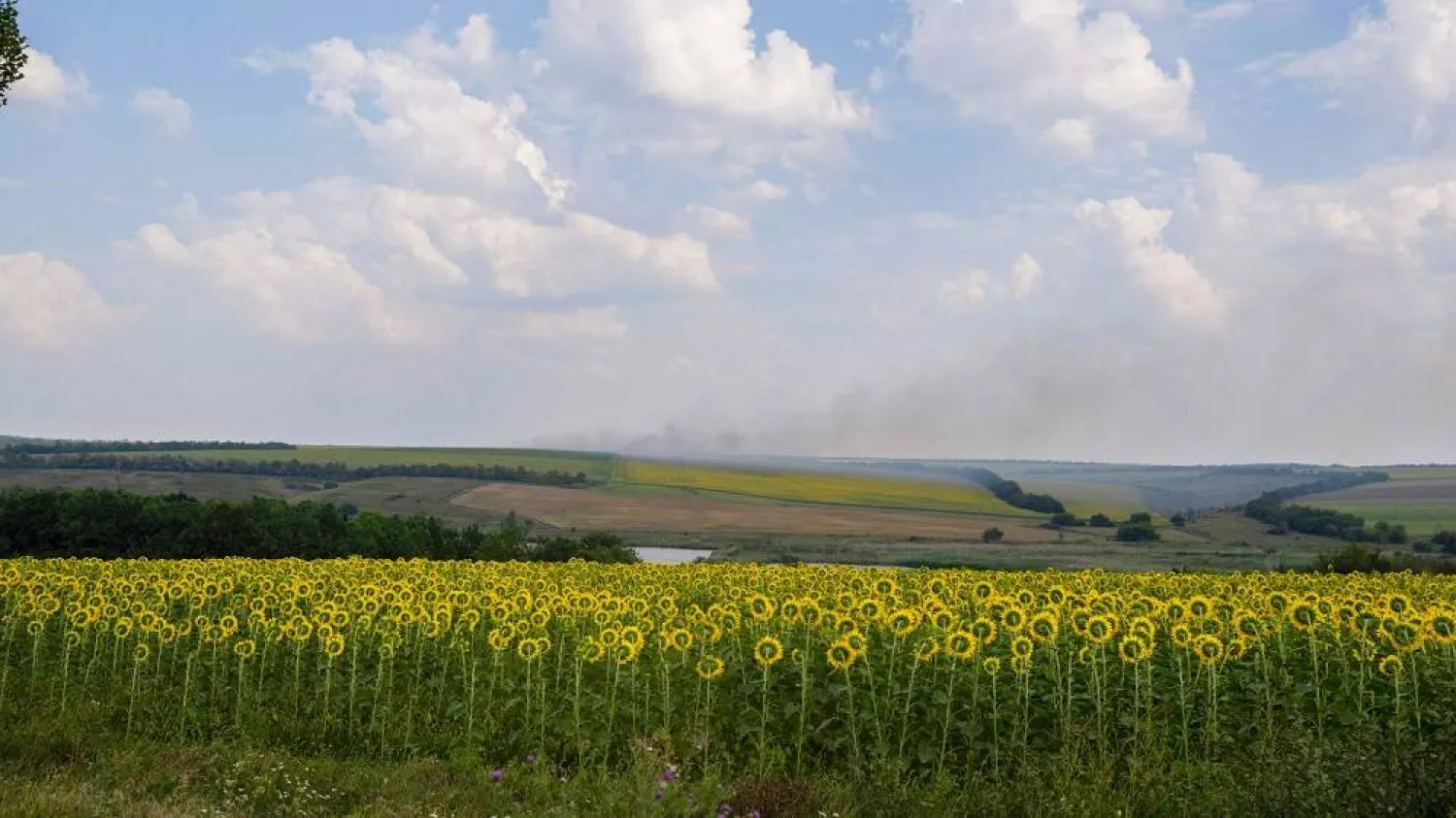
A smoke plume billows on the horizon behind sunflower fields, in the Donbas region on August 11, 2022, amid the Russian invasion of Ukraine. (AFP via Getty Images) 
TT

Locusts Spread in Ukraine’s South as War Disrupts Control Measures 

A smoke plume billows on the horizon behind sunflower fields, in the Donbas region on August 11, 2022, amid the Russian invasion of Ukraine. (AFP via Getty Images) 

A massive locust invasion is threatening sunflower and other crops in Ukraine's southern regions, largely caused by the war against Russia's invasion that makes it impossible to use traditional pest control methods, officials and producers say.

Locusts, which can destroy huge areas of crops in a matter of days, traditionally breed in secluded places along rivers or in uncultivated areas, and controlling that is almost impossible in regions neighboring the frontline.

The situation is complicated by record high temperatures this summer, the inability to use aircraft for locust control and the absence of birds - locusts' natural predators - which are avoiding the combat zone.

Local and government officials declined to provide data on the extent of the locust infestation or damage caused so far. Ukraine is the world's largest sunflower oil exporter and before the war ranked fifth among wheat exporters.

Swarms of locusts are covering roads, fields and bushes in Zaporizhzhia region and farmers say the insects have destroyed up to a third of their sunflower crops.

"We saw a big swarm. And the next day the 'infantry' marched in. The small ones, they ate everything that was hanging low, they ate everything," said Oleh Tolmatov, 46, a resident of Kushuhum village in Zaporizhzhia region.

Russia, which invaded Ukraine in 2022, has partially occupied the southern Ukrainian regions of Zaporizhzhia, Mykolaiv and Kherson, forcing farmers to abandon their fields.

Grains and oilseeds are traditional crops for these regions.

"The reason for all of this is high temperatures, the reason for all of this is abandoned land, the reason for all of this is the corresponding Russian aggression," Vadym Chaikovskyi, Ukraine's Chief Phytosanitary Inspector, told Reuters.

Denys Marchuk, deputy head of Ukraine's largest farm producers' union UAC, said that the destruction of the Kakhovka dam on the Dnipro River by Russian troops two years ago had created huge swampy areas where locusts are breeding.

Kyiv says that Russia blew up the Kakhovka dam in the summer of 2023, draining thousands of square kilometers of the former reservoir and leaving farms and Europe's largest nuclear power plant without water.



Wave of Low Temperature Brings Rare Snowfall to Shanghai

A woman holding an umbrella rides a bicycle amid snowfall in Shanghai, China January 20, 2026. (Reuters)
TT

Wave of Low Temperature Brings Rare Snowfall to Shanghai

A woman holding an umbrella rides a bicycle amid snowfall in Shanghai, China January 20, 2026. (Reuters)

A wave of low temperature sweeping southern China brought rare snowfall to ​Shanghai on Tuesday, delighting residents of the financial hub as authorities warned that the frigid weather could last for at least three days.

The city, on China's east coast, last ‌experienced a heavy snowfall ‌in January ‌2018. ⁠And ​just ‌last week, Shanghai basked in unusually high temperatures of 20 degrees Celsius (68 degrees Fahrenheit), which local media said had caused some osmanthus trees to bloom.

"The weather seems rather ⁠strange this year," said 30-year-old resident Yu Xin.

"In ‌general, the temperature ‍fluctuations have ‍been quite significant, so some people ‍might feel a bit uncomfortable," she said.

Chinese state media said other areas experienced sharp temperature drops, including Jiangxi and ​Guizhou provinces, which sit south of China's Yangtze and Huai ⁠rivers. Guizhou province is expected to experience temperature drops of 10 to 14 degrees Celsius, the Zhejiang News reported.

Across China, authorities have also shut 241 sections of major roads in 12 provinces including Shanxi, Inner Mongolia and Heilongjiang due to snowfall and icy ‌roads, state broadcaster CCTV said.


Researchers Find Antarctic Penguin Breeding Is Heating up Sooner, and That’s a Problem

View of gentoo (Pygoscelis papua) penguins at the Paradise Bay in the Gerlache Strait -which separates the Palmer Archipelago from the Antarctic Peninsula, on January 20, 2024. (AFP)
TT

Researchers Find Antarctic Penguin Breeding Is Heating up Sooner, and That’s a Problem

View of gentoo (Pygoscelis papua) penguins at the Paradise Bay in the Gerlache Strait -which separates the Palmer Archipelago from the Antarctic Peninsula, on January 20, 2024. (AFP)

Warming temperatures are forcing Antarctic penguins to breed earlier and that's a big problem for two of the cute tuxedoed species that face extinction by the end of the century, a study said.

With temperatures in the breeding ground increasing 5.4 degrees Fahrenheit (3 degrees Celsius) from 2012 to 2022, three different penguin species are beginning their reproductive process about two weeks earlier than the decade before, according to a study in Tuesday's Journal of Animal Ecology. And that sets up potential food problems for young chicks.

“Penguins are changing the time at which they’re breeding at a record speed, faster than any other vertebrate,” said lead author Ignacio Juarez Martinez, a biologist at Oxford University in the United Kingdom. "And this is important because the time at which you breed needs to coincide with the time with most resources in the environment and this is mostly food for your chicks so they have enough to grow.''

For some perspective, scientists have studied changes in the life cycle of great tits, a European bird. They found a similar two-week change, but that took 75 years as opposed to just 10 years for these three penguin species, said study co-author Fiona Suttle, another Oxford biologist.

Researchers used remote control cameras to photograph penguins breeding in dozens of colonies from 2011 to 2021. They say it was the fastest shift in timing of life cycles for any backboned animals that they have seen. The three species are all brush-tailed, so named because their tails drag on the ice: the cartoon-eye Adelie, the black-striped chinstrap and the fast-swimming gentoo.

Suttle said climate change is creating winners and losers among these three penguin species and it happens at a time in the penguin life cycle where food and the competition for it are critical in survival.

The Adelie and chinstrap penguins are specialists, eating mainly krill. The gentoo have a more varied diet. They used to breed at different times, so there were no overlaps and no competition. But the gentoos' breeding has moved earlier faster than the other two species and now there's overlap. That's a problem because gentoos, which don't migrate as far as the other two species, are more aggressive in finding food and establishing nesting areas, Martinez and Suttle said.

Suttle said she has gone back in October and November to the same colony areas where she used to see Adelies in previous years only to find their nests replaced by gentoos. And the data backs up the changes her eyes saw, she said.

“Chinstraps are declining globally,” Martinez said. “Models show that they might get extinct before the end of the century at this rate. Adelies are doing very poorly in the Antarctic Peninsula and it’s very likely that they go extinct from the Antarctic Peninsula before the end of the century.”

Martinez theorized that the warming western Antarctic — the second-fasting heating place on Earth behind only the Arctic North Atlantic — means less sea ice. Less sea ice means more spores coming out earlier in the Antarctic spring and then “you have this incredible bloom of phytoplankton,” which is the basis of the food chain that eventually leads to penguins, he said. And it's happening earlier each year.

Not only do the chinstraps and Adelies have more competition for food from gentoos because of the warming and changes in plankton and krill, but the changes have brought more commercial fishing that comes earlier and that further shortens the supply for the penguins, Suttle said.

This shift in breeding timing “is an interesting signal of change and now it’s important to continuing observing these penguin populations to see if these changes have negative impacts on their populations,” said Michelle LaRue, a professor of Antarctic marine science at the University of Canterbury in New Zealand. She was not part of the Oxford study.

With millions of photos — taken every hour by 77 cameras for 10 years — scientists enlisted everyday people to help tag breeding activity using the Penguin Watch website.

“We’ve had over 9 million of our images annotated via Penguin Watch,” Suttle said. “A lot of that does come down to the fact that people just love penguins so much. They’re very cute. They’re on all the Christmas cards. People say, ‘Oh, they look like little waiters in tuxedos.’”

“The Adelies, I think their personality goes along with it as well,” Suttle said, saying there's “perhaps a kind of cheekiness about them — and this very cartoon-like eye that does look like it’s just been drawn on.”


100 Vehicles Pile Up in Michigan Crash Amid Snowstorm

This image taken from video provided by WZZM shows part of a severe multi-car pileup leading Michigan State Police to shut down an interstate south of Grand Rapids Monday, Jan. 19, 2026, in Ottawa County, Mich. (WZZM via AP)
TT

100 Vehicles Pile Up in Michigan Crash Amid Snowstorm

This image taken from video provided by WZZM shows part of a severe multi-car pileup leading Michigan State Police to shut down an interstate south of Grand Rapids Monday, Jan. 19, 2026, in Ottawa County, Mich. (WZZM via AP)

More than 100 vehicles smashed into each other or slid off an interstate in Michigan on Monday as snow fueled by the Great Lakes blanketed the state.

The massive pileup prompted the Michigan State Police to close both directions of Interstate 196 Monday morning just southwest of Grand Rapids while officials worked to remove all the vehicles, including more than 30 semitrailer trucks. The State Police said there were numerous injuries, but no deaths had been reported.

Pedro Mata Jr. said he could barely see the cars in front of him as the snow blew across the road while driving 20-25 mph (32-40 kph) before the crash. He was able to stop his pickup safely, but then decided to pull his truck off the road into the median to avoid being hit from behind.

“It was a little scary just listening to everything, the bangs and booms behind you. I saw what was in front of me. I couldn’t see what was behind me exactly,” The Associated Press quoted Mata as saying.

The crash is just the latest impact of the major winter storm moving across the country. The National Weather Service issued warnings about either extremely cold temperatures or the potential for winter storms across several states starting in northern Minnesota and stretching south and east into Wisconsin, Indiana, Ohio, Pennsylvania and New York.

A day earlier, snow fell as far south as the Florida Panhandle and made it harder for football players to hang onto the ball during playoff games in Massachusetts and Chicago. Forecasters warned Monday that freezing temperatures are possible overnight into Tuesday across much of north-central Florida and southeast Georgia.

The Ottawa County Sheriff's office in Michigan said multiple crashes and jack-knifed semis were reported along with numerous cars that slid off the road. Stranded motorists were being bused to Hudsonville High School, where they could call for help or arrange a ride.

Officials expected the road to be closed for several hours during the cleanup.
One of the companies helping remove the stranded cars, Grand Valley Towing, sent more than a dozen of its trucks to the scene of the chain-reaction crash. Several towing companies responded in the brutally cold weather.

“We’re trying to get as many vehicles out of there as quickly as possible, so we can get the road opened back up,” manager Jeff Westveld said.