

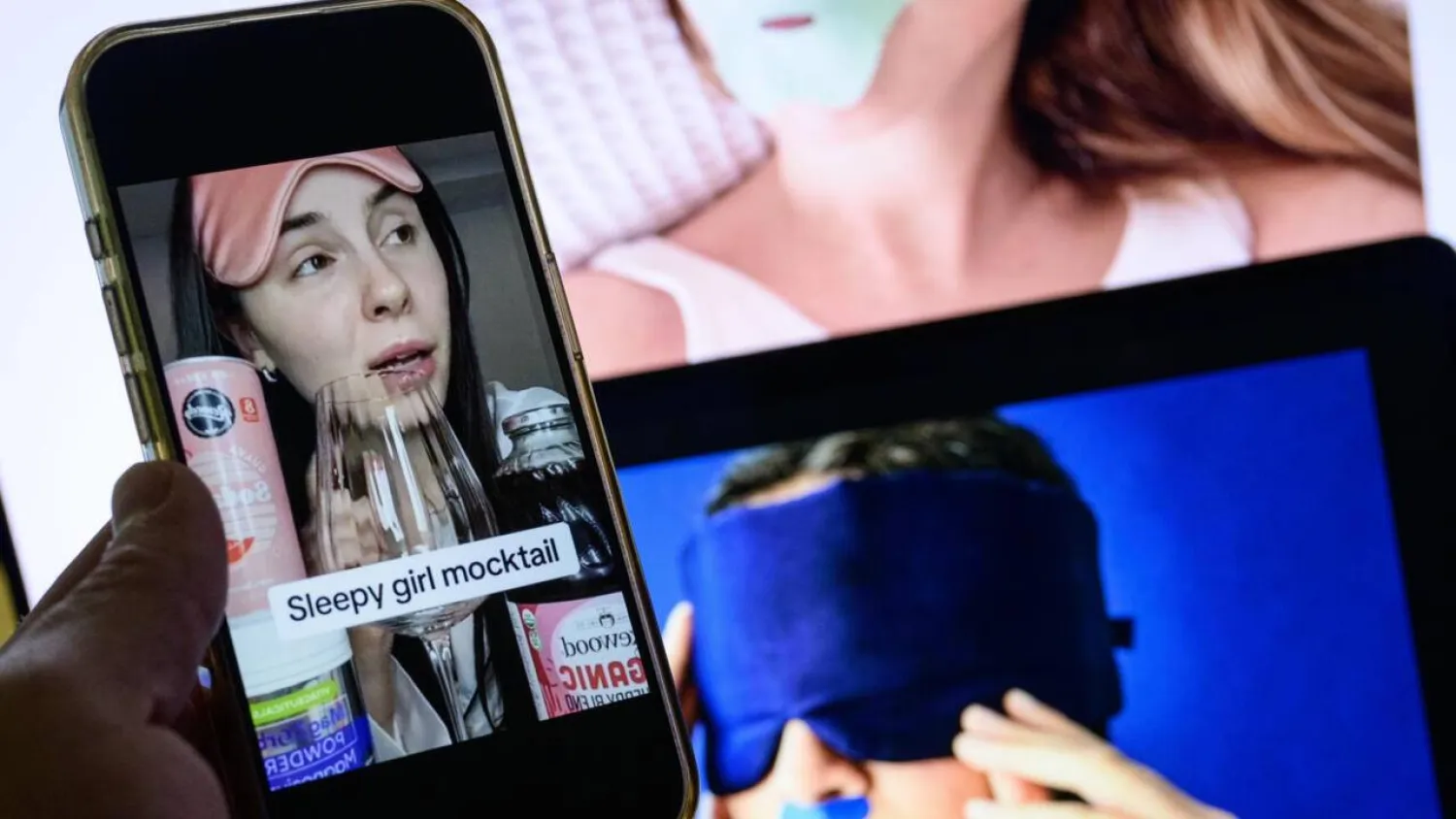

Dangerous Dreams: Inside Internet's 'Sleepmaxxing' Craze

The trend of 'sleepmaxxing,' featuring mouth taping, eye masks and other bedroom practices with unproven health effects, is being promoted on social media by online influencers. Drew ANGERER / AFP
TT

Dangerous Dreams: Inside Internet's 'Sleepmaxxing' Craze

The trend of 'sleepmaxxing,' featuring mouth taping, eye masks and other bedroom practices with unproven health effects, is being promoted on social media by online influencers. Drew ANGERER / AFP

From mouth taping to rope-assisted neck swinging, a viral social media trend is promoting extreme bedtime routines that claim to deliver perfect sleep -- despite scant medical evidence and potential safety risks.

Influencers on platforms including TikTok and X are fueling a growing wellness obsession popularly known as "sleepmaxxing," a catch-all term for activities and products aimed at optimizing sleep quality, AFP reported.

The explosive rise of the trend -- generating tens of millions of posts -- underscores social media's power to legitimize unproven health practices, particularly as tech platforms scale back content moderation.

One so-called insomnia cure involves people hanging by their necks with ropes or belts and swinging their bodies in the air.

"Those who try it claim their sleep problems have significantly improved," said one clip on X that racked up more than 11 million views.

Experts have raised alarm about the trick, following a Chinese state broadcaster's report that attributed at least one fatality in China last year to a similar "neck hanging" routine.

Such sleepmaxxing techniques are "ridiculous, potentially harmful, and evidence-free," Timothy Caulfield, a misinformation expert from the University of Alberta in Canada, told AFP.

"It is a good example of how social media can normalize the absurd."

Another popular practice is taping of the mouth for sleep, promoted as a way to encourage nasal breathing. Influencers claim it offers broad benefits, from better sleep and improved oral health to reduced snoring.

But a report from George Washington University found that most of these claims were not supported by medical research.

Experts have also warned the practice could be dangerous, particularly for those suffering from sleep apnea, a condition that disrupts breathing during sleep.

Other unfounded tricks touted by sleepmaxxing influencers include wearing blue- or red-tinted glasses, using weighted blankets, and eating two kiwis just before bed.

'Damaging'

"My concern with the 'sleepmaxxing' trend -- particularly as it's presented on platforms like TikTok -- is that much of the advice being shared can be actively unhelpful, even damaging, for people struggling with real sleep issues," Kathryn Pinkham, a Britain-based insomnia specialist, told AFP.

"While some of these tips might be harmless for people who generally sleep well, they can increase pressure and anxiety for those dealing with chronic insomnia or other persistent sleep problems."

While sound and sufficient sleep is considered a cornerstone of good health, experts warn that the trend may be contributing to orthosomnia, an obsessive preoccupation with achieving perfect sleep.

"The pressure to get perfect sleep is embedded in the sleepmaxxing culture," said Eric Zhou of Harvard Medical School.

"While prioritizing restful sleep is commendable, setting perfection as your goal is problematic. Even good sleepers vary from night to night."

Pinkham added that poor sleep was often fueled by the "anxiety to fix it," a fact largely unacknowledged by sleepmaxxing influencers.

"The more we try to control sleep with hacks or rigid routines, the more vigilant and stressed we become -- paradoxically making sleep harder," Pinkham said.

Beauty over health

Many sleepmaxxing posts focus on enhancing physical appearance rather than improving health, reflecting an overlap with "looksmaxxing" –- another online trend that encourages unproven and sometimes dangerous techniques to boost sexual appeal.

Some sleepmaxxing influencers have sought to profit from the trend's growing popularity, promoting products such as mouth tapes, sleep-enhancing drink powders, and "sleepmax gummies" containing melatonin.

That may be in violation of legal norms in some countries like Britain, where melatonin is available only as a prescription drug.

The American Academy of Sleep Medicine has recommended against using melatonin to treat insomnia in adults, citing inconsistent medical evidence regarding its effectiveness.

Some medical experts also caution about the impact of the placebo effect on insomnia patients using sleep medication -- when people report real improvement after taking a fake or nonexistent treatment because of their beliefs.

"Many of these tips come from non-experts and aren't grounded in clinical evidence," said Pinkham.

"For people with genuine sleep issues, this kind of advice often adds pressure rather than relief."




Australian Bushfires Raze Homes in Two States; Firefighter Dies 

Ruins of buildings and a car smolder after a wildfire destroyed houses in Koolewong, Australia, Saturday, Dec. 6, 2025. (Dan Himbrechts/AAP Image via AP)
TT

Australian Bushfires Raze Homes in Two States; Firefighter Dies 

Ruins of buildings and a car smolder after a wildfire destroyed houses in Koolewong, Australia, Saturday, Dec. 6, 2025. (Dan Himbrechts/AAP Image via AP)

An Australian firefighter was killed overnight after he was struck by a tree while trying to control a bushfire that had destroyed homes and burnt large swathes of bushland north of Sydney, authorities said on Monday.

Emergency crews rushed to bushland near the rural town of Bulahdelah, 200 km (124 miles) north of Sydney, after reports that a tree had fallen on a man. The 59-year-old suffered a cardiac arrest and died at the scene, officials said.

Prime Minister Anthony Albanese said the "terrible news is a somber reminder" of the dangers faced by emergency services personnel as they work to protect homes and families.

"We honor that bravery, every day," Albanese said in a statement.

A fast-moving fire over the weekend destroyed 16 homes in New South Wales state's Central Coast region, home to about 350,000 people and a commuter region just north of Sydney.

Resident Rouchelle Doust, from the hard-hit town of Koolewong, said she and her husband tried to save their home as flames advanced.

"He's up there in his bare feet trying to put it out, and he's trying and trying, and I'm screaming at him to come down," Doust told the Australian Broadcasting Corp.

"Everything's in it: his grandmother's stuff, his mother's stuff, all my stuff - everything, it's all gone, the whole lot."

Conditions eased overnight, allowing officials to downgrade fire danger alerts, though the weather bureau warned some inland towns in the state could hit more than 40 degrees Celsius (104 Fahrenheit) on Tuesday, raising fire dangers.

More than 50 bushfires were burning across New South Wales as of Monday.

On the island state of Tasmania, a 700-hectare (1,729 acres) blaze at Dolphin Sands, about 150 km (93 miles) northeast of the state capital of Hobart, destroyed 19 homes and damaged 40. The fire has been contained, but residents have been warned not to return as conditions remain dangerous, officials said.

Authorities have warned of a high-risk bushfire season during Australia's summer months from December to February, with increased chances of extreme heat across large parts of the country following several relatively quiet years.

In neighboring New Zealand, five helicopters and multiple crews were working to put out a fire near the country's oldest national park, a month after a wildfire burnt through 2,589 hectares (6,400 acres) of alpine bush there.

Police said they had closed a road near the state highway and advised motorists to avoid the area and expect delays after the blaze near Tongariro National Park, a popular hiking spot, spread to 110 hectares (272 acres) by Monday afternoon.


Queen Elizabeth II to Appear on New Commemorative Coin

Queen Elizabeth II gold coins (Shutterstock) 
TT

Queen Elizabeth II to Appear on New Commemorative Coin

Queen Elizabeth II gold coins (Shutterstock) 

Many British know Queen Elizabeth II’s profile better than the back of their own hands. After all, her image has stared back at us from the hundreds of coins jangling around our pockets for decades.

But in the year marking what would have been her 100th birthday, a royal revelation is emerging. Or rather, an old one that never got its moment in the spotlight, according to London’s Metro newspaper.

A portrait of the late Queen, sculpted almost forty years ago and then quietly tucked away, is finally being released to the public for the very first time from The London Mint Office, which has secured the rights to unveil this long-hidden likeness in an exclusive collector’s coin.

Even better, the coin featuring this never before seen effigy is being offered as a free gift to the nation, with only £2.50 postage to pay.

For collectors and royal watchers, it is undoubtedly the most unexpected royal resurfacing in the recent past – a kind of numismatic archaeology.

When sculptor Raphael Maklouf created his now famous 1985 effigy of Queen Elizabeth II, he didn’t just produce the one design that graced coins from 1985 – 1997.

Several versions of the effigy were prepared, studied and refined in the long, meticulous process of creating a monarch’s official image. Some of these effigies were presented to officials, and some sketches have been referenced in numismatic circles over the years.

But one fully realized effigy – sculpted to the same level as the final chosen design – was never revealed to the public.

Instead, it remained sealed away in Maklouf’s archive. Not rejected. Not forgotten. Just quietly concealed for all this time. Until now.

2026 would have been the year that Queen Elizabeth II turned 100, making it a perfect moment for reflection, particularly on aspects of her legacy that remained unseen.

The London Mint Office’s release of this never-seen-before effigy taps directly into that sense of discovery.

For anyone who followed the Queen’s reign or simply loves an unexpected historical twist, this is one to watch. After years in the dark, Maklouf’s forgotten portrait is finally stepping into the light. And this time, it won’t be hidden away again.


Nobel Laureates Arrive for a Week of Events and Awards in Stockholm and Oslo

The Nobel medal in physiology or medicine presented to Charles M. Rice is displayed, Tuesday, Dec. 8, 2020, during a ceremony in New York. (AP)
TT

Nobel Laureates Arrive for a Week of Events and Awards in Stockholm and Oslo

The Nobel medal in physiology or medicine presented to Charles M. Rice is displayed, Tuesday, Dec. 8, 2020, during a ceremony in New York. (AP)

Nobel week was underway in Stockholm and Oslo with laureates holding news conferences and lectures before they will be awarded the prestigious prizes.

Hungarian László Krasznahorkai, who won the Prize in literature for his surreal and anarchic novels that combine a bleak world view with mordant humor, was expected to give a lecture in Stockholm on Sunday in one of his rare public appearances.

When the Nobel judges announced the award in October, they described the 71-year-old as “a great epic writer” whose work “is characterized by absurdism and grotesque excess.”

“Krasznahorkai’s work can be seen as part of a Central European tradition," the Nobel Prize organization said. “Important features are pessimism and apocalypse, but also humor and unpredictability."

Last year’s winner was South Korean author Han Kang. The 2023 winner was Norwegian writer Jon Fosse, whose work includes a seven-book epic made up of a single sentence.

Meanwhile, the director of the Norwegian Nobel Institute, Kristian Harpviken, said Saturday that Venezuelan Peace Prize laureate and opposition leader María Corina Machado will come to Oslo this week to receive her award in person.

The 58-year-old, who won for her struggle to achieve a democratic transition in the South American nation, has been hiding and has not been seen in public since January.

Harpviken told Norwegian public broadcaster NRK that Machado was expected to personally pick up the prize on Wednesday.

“I spoke with the Peace Prize winner last night, and she will come to Oslo,” Harpviken said, according to NRK.

Nobel Prize award ceremonies are held on Dec. 10, the anniversary of Alfred Nobel’s death in 1896. The award ceremony for peace is in Oslo and the other ceremonies are in Stockholm.
