Paris: Elaine Sciolino
Guy Savoy, who worked his way up from modest beginnings and a recent setback, has become the first chef inducted into the prestigious Académie des Beaux-Arts.
One of France’s premier chefs, he accompanied two French presidents on formal visits to the White House.
He was given the Légion d’Honneur, the highest award of the French state, for his contributions to the nation’s gastronomy. He has written and co-written several books, most recently, a two-volume collection of French literary figures on food — with recipes. His signature Paris restaurant, Guy Savoy, has welcomed dignitaries and celebrities for more than four decades.
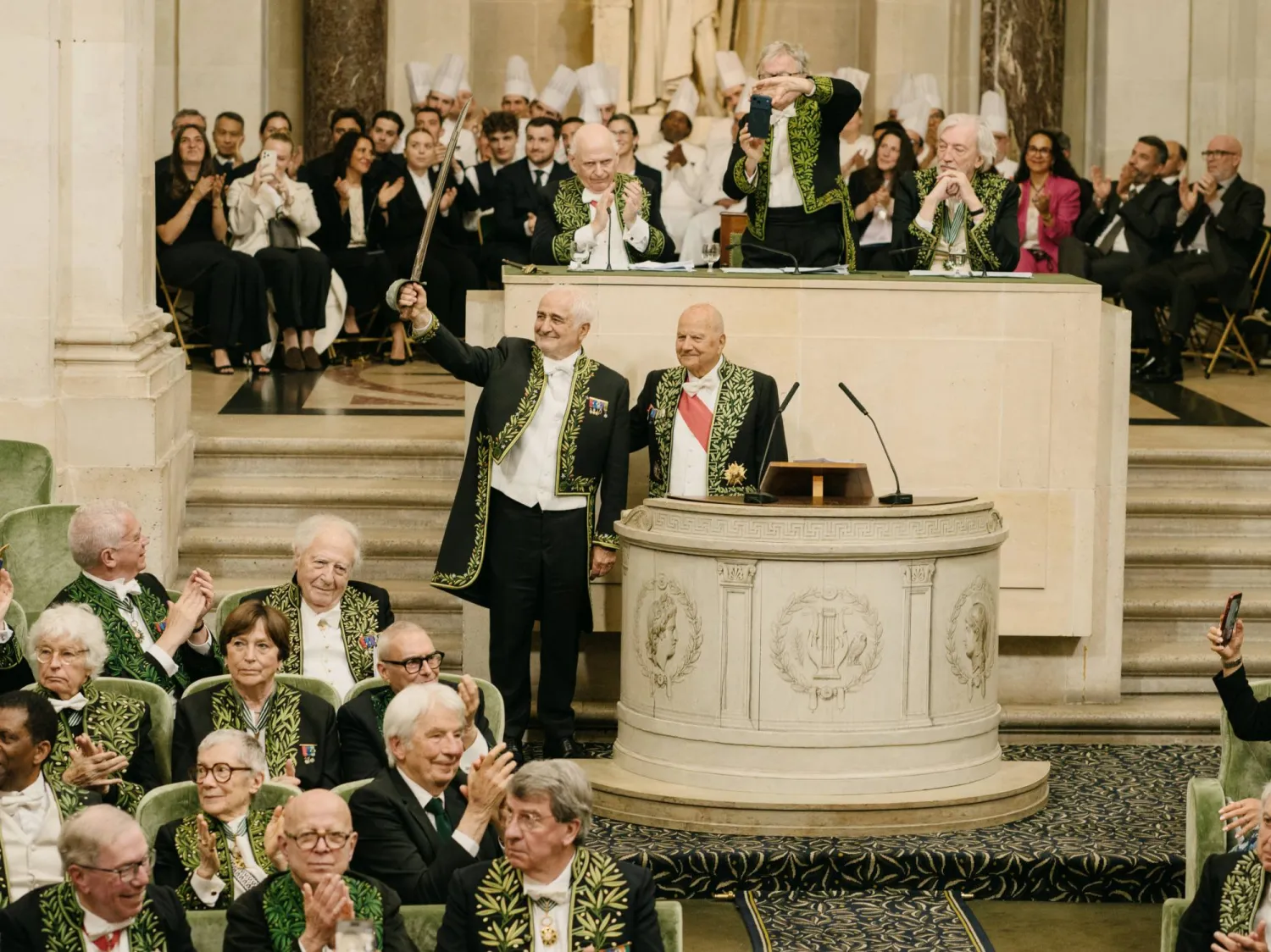
But on Wednesday, he snagged an honor that may top all others. He became the first chef in the 110-year history of one of France’s loftiest cultural institutions, the Académie des Beaux-Arts, to be welcomed into its ranks of artists, composers and other creative professionals.
At a formal ceremony in its gilded-domed headquarters at the Institut de France, Savoy was presented a long ritual saber he had designed himself. Blinking back tears, he held it high over his head, to a standing ovation and shouts of “Bravo!”
“So here I am, an artisan, and perhaps an artist thanks to my election,” he told the hundreds in attendance. The award, he added, also belongs to “all the artisans who contribute to gastronomy, to the land of France, to the art of food and wine, to graciousness, to the art of hosting, in short, the art of living well the French way.”
The Académie’s decision to admit him is especially sweet for Savoy, who made headlines in 2023 when the Michelin Guide removed one of the three stars his restaurant had held for 21 years.
“It was a real scandal, so shameful and not at all justified,” Laurent Petitgirard, the Académie’s permanent secretary, said in an interview. “Guy Savoy’s welcome into the Académie is the most beautiful revenge.”
The Académie des Beaux-Arts is one of five academies that reside in the Institut de France, led by the royal Académie Française founded under Louis XIV. Among the Académie des Beaux-Arts’ more than 60 members — called “immortals” — are painters, sculptors, architects, photographers, choreographers, musicians and film and museum directors.
In recent years, the organization has sought to shed its reputation as a stuffy state institution for old and safe artists, opening its doors to younger members, including Jean-Michel Othoniel, an artist who works in glass, and Catherine Meurisse, an illustrator and regular contributor to the satirical magazine Charlie Hebdo. (A more controversial member is Roman Polanski, the filmmaker who fled the United States to his native France in 1978 after pleading guilty to unlawful sex with a minor.)
The inclusion of a chef, even in a country where gastronomy has historically been a sort of state religion, represents a tectonic cultural shift. The ballot to join the Académie is secret, and not all its members were delighted to welcome a culinary figure, Petitgirard said in his interview. But Savoy won on the first round, unlike the painter Eugène Delacroix and the composer Hector Berlioz, who were rejected several times.
Savoy, 72, is one of the last of a generation of French chefs dedicated to the art and craft of turning foods into perfect objects of desire. His cuisine belongs to an era of long meals, grand dining rooms, orchestrated service, luxury ingredients and abundant time.
Eating habits in France have changed. Takeout services that took off during Covid continue to expand. With the French economy suffering, fast-food consumption has soared.
Savoy comes from a modest background. His mother, Léonie, opened a buvette, a small bar and informal restaurant attached to their family home in Bourgoin-Jallieu, not far from Lyon.
His Swiss-born father, Louis, was the town gardener, and grew the fruits and vegetables for the restaurant.
Savoy credits his mother for teaching him how to transform simple ingredients into culinary artistry. Working alongside her, he has said, he discovered the driving force behind his own cooking: “Pleasure.”
Mocked at school when he expressed interest in cooking, he left at 15 to become an apprentice to a local chocolate maker.
After training as an apprentice with the Troisgros brothers, he worked in various restaurants, learning classic French cuisine. In 1980, at age 27, he struck out on his own in Paris with the restaurant that holds his name today. The restaurant moved in 2015 into a grand 4,300-square-foot top-floor space in the building that houses the Monnaie de Paris, the French mint.
For the last nine years, Guy Savoy has been named the world’s No. 1 restaurant by La Liste, a restaurant guide that aggregates scores from hundreds of gastronomic guides, websites and press reviews. Savoy prides himself on being present there just about every day, greeting all his guests as if they were old friends.
For the Wednesday ceremony, Savoy shed his starched, double-breasted chef’s whites and donned a custom-made version of the Académie’s embroidered uniform that he designed with Laure de Sagazan, who is best known for her wedding dresses.
The saber he designed has a bronze hilt shaped to resemble large artichoke leaves, symbolizing his favorite vegetable and his signature dish: an artichoke soup with black truffle and Parmesan, served with a toasted mushroom brioche slicked in truffle butter.
His lifetime motto was engraved into the sword: “Cuisine is the art of instantly transforming products steeped in history into joy.” So were the first names of his parents, his two children and his seven grandchildren.
“Your humanism and life experience are a great source of learning for us, making us feel as though you have always been with us,” Petitgirard, a composer and conductor, said in introducing him. Comparing Savoy to a composer, performer and soloist, he added, “You are going from the status of indispensable to that of immortal.”
In his speech, Savoy paid tribute to Michel David-Weill, an investment banker and scion of the Lazard banking dynasty, who had previously occupied the seat that is now Savoy’s — an assigned place in the “free section” reserved for academicians who don’t fit into more classical artistic categories.
David-Weill, who died in 2022 at age 89, was one of Europe’s most important art collectors, a major donor and trustee of the Metropolitan Museum of Art and chairman of France’s official art acquisition committee.
Like David-Weill, Savoy is a passionate art collector, but on a much smaller scale. His restaurant is filled with contemporary works by artists like Fabrice Hyber, Adel Abdessemed and Pierre et Gilles, and African and Asian sculptures.
“It’s marvelous that a chef takes the seat held by my husband,” said David-Weill’s widow, Hélène. “Both sought the same perfection — one from food, the other from art.”
At an outdoor reception after the ceremony, Savoy set up food stations under white umbrellas around the courtyard so his staff could serve many of his favorite creations. Much of the talk was about the creativity and refinement of the food — a terrine made with 13 different meats, and a fowl suprême with foie gras and artichoke.
“Iced poached oysters in gelatin!” exclaimed Emmanuel Guibert, a graphic novelist and Académie member. “I’ve never eaten an oyster so sublime. Try them, try them!”
The most popular food station was the one serving Savoy’s famous artichoke soup. Guests waiting in line joked that in honor of Savoy — at least for the day — the Académie des Beaux-Arts should be renamed the Académie des Beaux-Artichauts, the Academy of Beautiful Artichokes.
Jean-Robert Pitte, an Académie member and geographer whose expertise is the French countryside, said he had long been pushing to have Savoy admitted into the Académie. He said he stepped up his campaign after the two of them conceived the project that in 2010 led to UNESCO’s recognition of the French mealtime tradition as part of the world’s Intangible Cultural Heritage.
“I have been waiting 15 years for this day,” Pitte said. “They kept telling me that they didn’t want a chef, because a chef wasn’t an artist. They said that eating and drinking was vulgar not an art. Finally it happened. And it’s a great day.”
The New York Times