Kenyan Farmers Use Bees and Sesame to Keep Away Marauding Elephants 

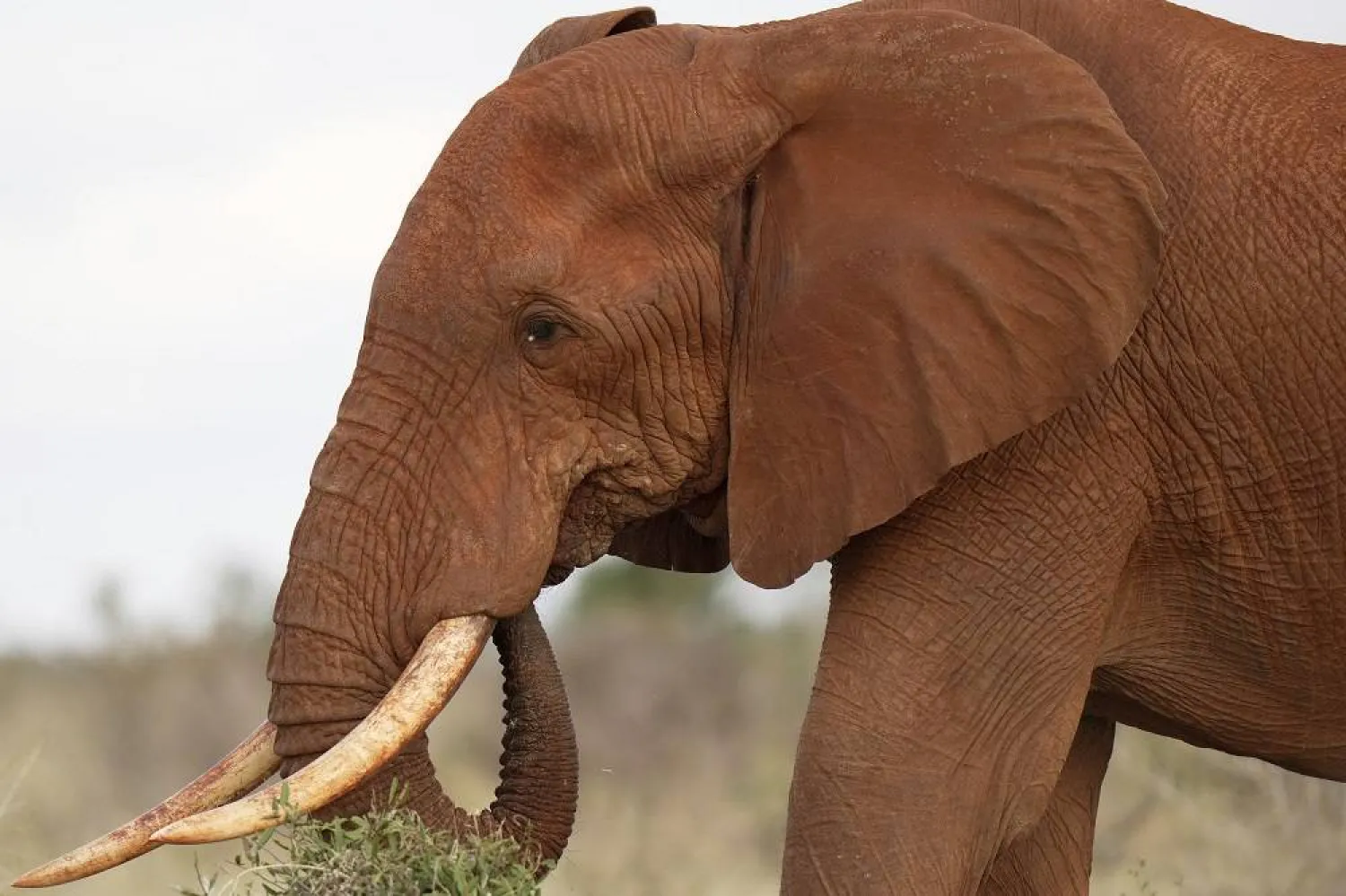
An elephant eats grass in Tsavo West National Park, near Voi town in Taita-Taveta County, Kenya, on Aug. 6, 2025. (AP)
TT

Kenyan Farmers Use Bees and Sesame to Keep Away Marauding Elephants 

An elephant eats grass in Tsavo West National Park, near Voi town in Taita-Taveta County, Kenya, on Aug. 6, 2025. (AP)

For farmers in the Taita hills in southern Kenya, elephants are a menace: they raid crops and will occasionally injure or even kill people.

Farmer Richard Shika, 68, has had some close encounters. “One time, I was trying to chase away an elephant that was in my maize field, but it turned and charged me,” Shika remembers. “It stopped when it was right in front of me, and I managed to jump out of the way.”

He feels lucky to be alive. Almost exactly two years ago, local media reported that a 3-year-old girl had been trampled to death by an elephant in Taita Taveta county, her mother injured.

The area where Shika has his farm is almost surrounded by Kenya’s biggest National Park. The border of Tsavo East National Park is less than 10 kilometers (6 miles) to the east, and Tsavo West curves around to the north, west and south. The parks have always been unfenced, allowing animals to migrate. Increasingly, that puts them in the path of humans.

“The places and infrastructure that we humans develop hinder the migratory routes and paths which elephants used to take,” explains Yuka Luvonga, who researches human-elephant coexistence for conservation organization Save The Elephants.

Elephants eat about 150 kilograms (330 pounds) of vegetation a day, so keeping them off farms is tricky, especially if forage is scarce elsewhere. “Elephants are clever creatures,” says Shika. “They will try touching a fence, and once they realize that it is not electrified, they charge through.”

If farmers try to chase them off, as Shika did, the elephants will sometimes turn and defend themselves. Kenya Wildlife Service and conservation organizations tracking human-elephant conflict estimate that 30-35 people are killed every year in elephant-related incidents across Kenya.

Communities will sometimes retaliate by spearing or poisoning elephants, but there are other solutions, as farmers here have found.

One of them is bees.

“Elephants don’t like getting stung by bees, so they keep away from areas where hives are,” Shika says.

With help from Save The Elephants, Shika is one of 50 farmers who have hung beehives from wires between poles around their farms. If an elephant touches the wire, the hives are rocked, disturbing the bees. It’s an army of tiny security guards that keeps elephants well away from the farm.

“With hives acting as a fence, I can continue crop-farming and also earn a livelihood from honey,” Shika says. This year, he’s made almost $250 selling honey.

Changing crops can also make a difference. Elephants love maize and watermelons. But sesame? Blegh.

Sesame plants produce a scent that actively repels elephants, so for 70-year-old Gertrude Jackim, swapping out maize and green grams for sesame was a no-brainer. “Look at me, I’m aging, so I can’t fend off the elephants or chase them away,” she says.

She is one of 100 farmers who have been supported to adopt sesame seed production. The change was urgently needed, she says. “Over the years, the elephants have become too destructive.”

Farming practices that deter elephants – like beekeeping and growing sesame – have made coexistence much easier for farmers like Shika and Jackim.

Conservationists hope that in the long run, this will win hearts and minds in an area where human-elephant conflict had reached worrying levels.

“We have to live harmoniously with these elephants,” says Yuka Luvonga from Save the Elephants, “and to create awareness and sensitize the communities to change their attitudes towards the animals that we have.”

Only then can both people and elephants here continue to thrive.


British Writer John Harrison Wins 2026 Booker Prize for ‘The End of Everything’

British author John Harrison poses after winning the 2026 Booker Prize for his novel "The End of Everything" at the awards ceremony in London, Britain, 09 November 2026. (EPA)
TT

British Writer John Harrison Wins 2026 Booker Prize for ‘The End of Everything’

British author John Harrison poses after winning the 2026 Booker Prize for his novel "The End of Everything" at the awards ceremony in London, Britain, 09 November 2026. (EPA)

British author ‌John Harrison has won the 2026 Booker Prize for his novel, "The End of Everything," a dystopian satire that the prize says probes the limits of human understanding, becoming the oldest winner in the literary award's history at age 81.

Harrison's 13th novel follows Phillip Tennent and his elderly aunt Marnie on England's south coast years after social order has broken down ‌and mysterious entities ‌known as the iGhetti have arrived.

The ‌Booker ⁠judges unanimously selected ⁠the 198-page book, saying it "turns you upside down, raises a wry smile and, surprisingly, given the subject matter, leaves you with a twinge of optimism."

The victory was the first Booker Prize for Harrison, whose career as a ⁠novelist and critic spans six ‌decades and includes acclaimed science ‌fiction and fantasy works.

His win also marks ‌a rare triumph for speculative fiction.

Mary Beard, ‌chair of the judging panel, described the book as "the politics of now seen through the lens of the future", saying it depicts a society grappling ‌with a catastrophe its inhabitants do not fully understand.

Accepting the £50,000 ($67,235) prize at ⁠a ⁠ceremony in London, Harrison said literary awards remained important in a "landscape of industrialized fiction."

Speaking to the Booker Prize in August, Harrison said his novel was inspired by the 2008 financial crisis and asks what happens when "all of our expectations and explanations of the world become an ongoing disaster, but we still have to make a life."

Harrison beat a shortlist that included former Booker winners Douglas Stuart and Marlon James.


Fossil Fuel Emissions Fall Due to Iran War, Renewables, Research Finds

Vessels at the Strait of Hormuz, as seen from Musandam, Oman, November 9, 2026. (Reuters)
TT

Fossil Fuel Emissions Fall Due to Iran War, Renewables, Research Finds

Vessels at the Strait of Hormuz, as seen from Musandam, Oman, November 9, 2026. (Reuters)

Global fossil fuel emissions are projected to fall slightly in 2026 due to the expansion of renewable energy and the oil price shock sparked by the Iran war, researchers said Tuesday.

Emissions from the burning of oil, gas and coal -- the main drivers of climate change -- rose by 0.9 percent per year on average in the past decade, hitting a record high in 2025, according to the Global Carbon Budget report.

But they are expected to drop by 0.4 percent in 2026, according to the research, published as nations meet at the UN's COP31 climate summit in Antalya, Türkiye.

It would be the first annual drop since 2020, when the Covid pandemic paralyzed the global economy, trade and transport.

This year, the US-led war in Iran and closure of the Strait of Hormuz played a role in driving emissions down as it caused a drop in oil consumption amid soaring crude prices, the researchers found.

The deployment of solar panels, wind farms and electric vehicles also contributed to the drop. Two thirds of the increase in global energy demand is being met by solar and wind power and electric vehicles, the report found.

"A decline in fossil CO2 emissions is encouraging, but a reduction driven partly by geopolitical shocks is not a sustainable climate solution," said Pierre Friedlingstein, director of the Global Carbon Budget Office at the University of Exeter in Britain.

"The long-term answer remains the rapid deployment of clean energy technologies," said Friedlingstein, who led the study published in the journal Earth System Science Data.

- Rebound looms -

Corinne Le Quere, a climate change science professor at the University of East Anglia, noted that emissions rebounded when economies recovered following shocks such as Covid or the global financial crisis.

A rebound is likely "when the oil tensions go away", she said in a media briefing.

Oil-related emissions are projected to drop 1.9 percent last year but it was "likely a short-term response to the energy shock triggered by the Iran conflict", the researchers said.

Gas emissions are set to fall 0.3 percent while those from coal use will rise 0.6 percent.

Overall, fossil carbon dioxide emissions are expected to reach 38.2 billion tons in 2026.

Including emissions from land-use change such as deforestation, total CO2 emissions are projected to rise to 43.3 billion tons, from 42.8 billion tonnes last year.

The researchers said land-use emissions are projected to rise partly due to peat fires and forest degradation in southeast Asia, associated with drier conditions linked to this year's exceptionally strong El Nino climate pattern.

The report found that the world's carbon budget -- the amount of CO2 that can be emitted before global warming exceeds 1.5C above pre-industrial levels -- stands at 150 billion tons.

The researchers calculated that at the current, the carbon budget would be exhausted in less than four years.

Nations agreed at the 2015 UN climate talks in Paris to keep global warming "well below" 2C above pre-industrial levels, while pursuing efforts to limit it to 1.5C.

But the United Nations declared in September that the long-term 1.5C target would be missed in a matter of years.

Scientists say it is crucial to reduce greenhouse gas emissions from fossil fuels to limit the period of "overshoot" above 1.5C and bring temperatures back down as quickly as possible.


Food Industry Pushes Back on WHO Guidance for Products with Added Color, Sweeteners

Around 11 million deaths a year are linked to unhealthy diets, according to the agency, based on data from a global study. (Getty Images)
TT

Food Industry Pushes Back on WHO Guidance for Products with Added Color, Sweeteners

Around 11 million deaths a year are linked to unhealthy diets, according to the agency, based on data from a global study. (Getty Images)

Governments should consider regulating foods that include added colors, flavors or sweeteners designed to make the product more appealing to consumers, according to new draft World Health Organization guidance that has sparked swift pushback from the food industry.

The WHO draft aims to help governments identify which foods should be consumed in moderation as part of a healthy diet – and which products could be subject to measures like warning labels or taxes, depending on national priorities.

The new draft food-profiling model, published last week, marks the first time the UN health agency has included this type of ‌ingredient in its guidance, ‌previously only focused on nutritional content, including fat and salt.

“This draft ‌goes ⁠beyond traditional nutrient ⁠profiling by recognizing that foods may need to be considered not only for their nutrient content, but also for other aspects of their formulation” in order to prevent diet-related disease, said Katrin Engelhardt, technical officer at the WHO's department of nutrition and food safety.

Around 11 million deaths a year are linked to unhealthy diets, according to the agency, based on data from a global study.

The proposed new model is also the WHO’s attempt to guide member states through an increasingly polarized debate ⁠about ultra-processed foods (UPFs), a class of food or drink made using processing ‌techniques, additives and industrial ingredients, which often contain little ‌whole food. Examples include carbonated soft drinks or instant noodles.

BEYOND NUTRIENTS ALONE

Many food scientists say UPFs pose ‌numerous health risks but others – and the food industry – say they are defined too widely, ‌which risks demonizing healthy products.

The International Food and Beverage Alliance, an organization representing major multinational food and beverage companies, said it was concerned the proposed approach shifts attention away from nutritional quality and could capture more products for potential regulation.

"Of particular concern is the potential to undermine established nutrition priorities and reformulation ‌efforts,” said IFBA Secretary General Rocco Renaldi.

Other concerns for the food industry are higher costs from reformulating products or stringent labelling requirements, as well ⁠as the risk ⁠of class-action lawsuits as seen in the United States, and higher taxes for processed food companies.

Broadly, the WHO said the model covers “industrially-produced foods to be consumed in moderation” and is a bridge between its healthy diet recommendations and government policy on individual food products.

Lindsey Smith Taillie, co-director of the Global Food Research Program at the University of Chapel Hill, North Carolina, said the point of the model was to target unhealthy foods, combining both nutrients and UPFs.

“These two frameworks have never been mutually exclusive and can and should be used by policymakers as the starting place,” she said, adding that healthiness is measured by multiple criteria.

Kraft Heinz CEO Steve Cahillane last week told Reuters that industry players should have a say.

"We're in the food business and we care about consumers deeply," Cahillane said. "And so we ought to have a seat at the table as these discussions evolve."

The WHO proposal is out for consultation until November 27.