


Spain Battles 20 Major Wildfires amid Scorching Heat, Deploys More Troops

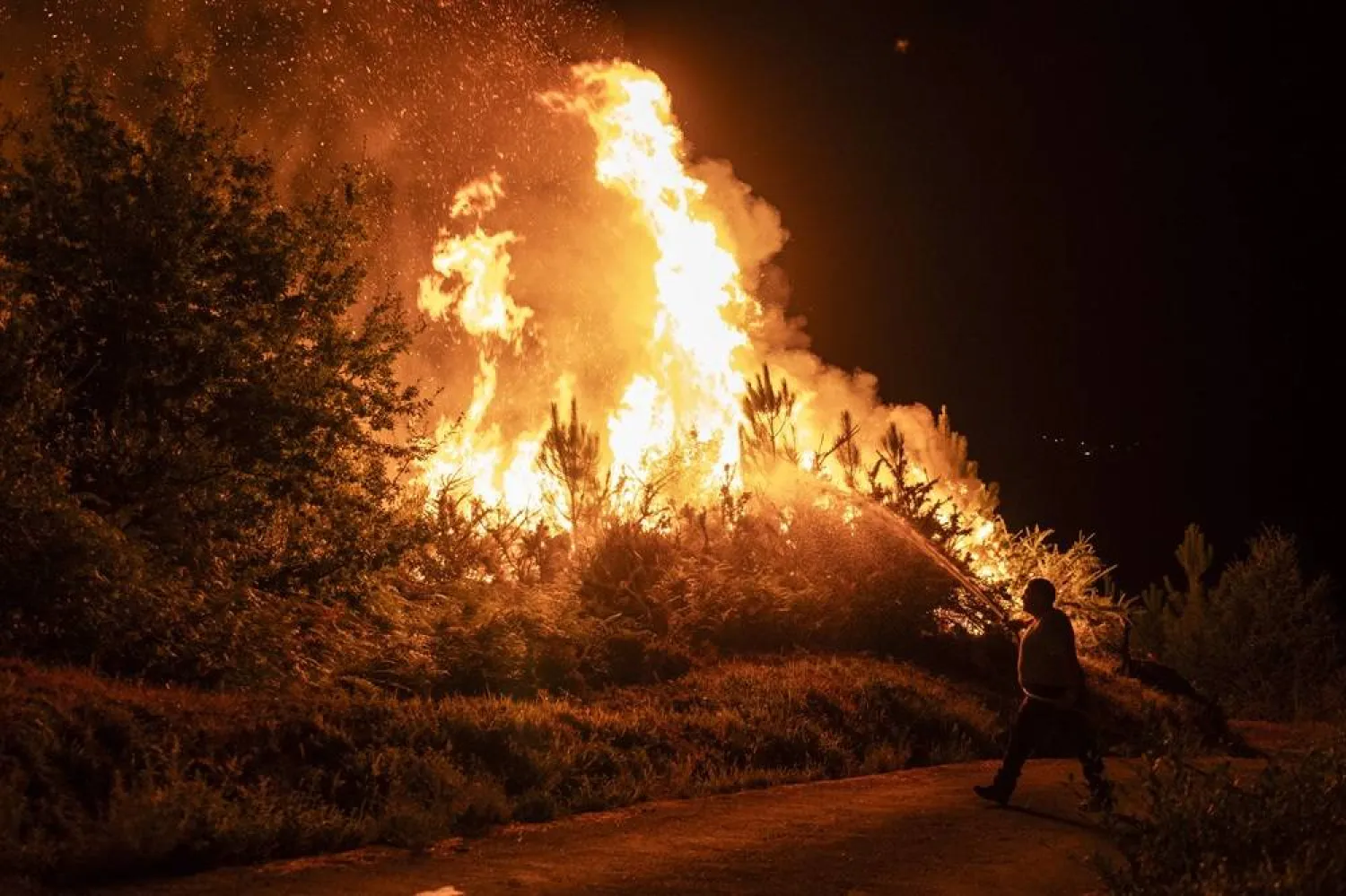
Locals collaborate to extinguish a forest fire in Carballeda de Avia, Ourense, Galicia province, north-western Spain, 16 August 2025. (EPA)
TT

Spain Battles 20 Major Wildfires amid Scorching Heat, Deploys More Troops

Locals collaborate to extinguish a forest fire in Carballeda de Avia, Ourense, Galicia province, north-western Spain, 16 August 2025. (EPA)

Scorching heat hampered efforts to contain 20 major wildfires across Spain on Sunday, prompting the government to deploy an additional 500 troops from the military emergency unit to support firefighting operations.

In the northwestern region of Galicia, several fires have converged to form a large blaze, forcing the closure of highways and rail services to the region.

Southern Europe is experiencing one of its worst wildfire seasons in two decades, with Spain among the hardest-hit countries.

In the past week alone, fires there have claimed three lives and burned more than 115,000 hectares, while neighboring Portugal also battles widespread blazes.

Temperatures are expected to reach up to 45 degrees Celsius (113 Fahrenheit) in some areas on Sunday, Spanish national weather agency AEMET said.

"There are still some challenging days ahead and, unfortunately, the weather is not on our side," Prime Minister Pedro Sanchez told a news conference in Ourense, one of the most affected areas.

He announced an increase in military reinforcements, bringing the total number of troops deployed across Spain to 1,900.

Virginia Barcones, director general of emergency services, told Spanish public TV temperatures were expected to drop from Tuesday, but for now the weather conditions were "very adverse".

"Today there are extremely high temperatures with an extreme risk of fires, which complicates the firefighting efforts," Barcones said.

VILLAGERS RESORT TO BUCKETS

In the village of Villardevos in Galicia, desperate neighbors have organized to fight the flames on their own with water buckets as the area was left without electricity to power water pumps.

"The fireplanes come in from all sides, but they don't come here," Basilio Rodriguez, a resident, told Reuters on Saturday.

Added Lorea Pascual, another local resident: "It's insurmountable, it couldn't be worse".

Interior ministry data show 27 people have been arrested and 92 were under investigation for suspected arson since June.

In neighboring Portugal, wildfires have burnt some 155,000 hectares of vegetation so far this year, according to provisional data from the ICNF forestry protection institute - three times the average for this period between 2006 to 2024. About half of that area burned just in the past three days.

Thousands of firefighters were battling eight large blazes in central and northern Portugal, the largest of them near Piodao, a scenic, mountainous area popular with tourists.

Another blaze in Trancoso, further north, has now been raging for eight days. A smaller fire a few miles east claimed a local resident's life on Friday - the first this season.



Sleepy Seal Diverts Traffic in Australian Seaside Town

This frame grab from handout video footage by Laura Ellen taken on April 10, 2026 shows traffic along a road in the seaside Australian town of Dromana, located south of Melbourne in the southern state of Victoria, that was briefly diverted after a local seal decided to take a nap. (Photo by Handout / LAURA ELLEN / AFP)
TT

Sleepy Seal Diverts Traffic in Australian Seaside Town

This frame grab from handout video footage by Laura Ellen taken on April 10, 2026 shows traffic along a road in the seaside Australian town of Dromana, located south of Melbourne in the southern state of Victoria, that was briefly diverted after a local seal decided to take a nap. (Photo by Handout / LAURA ELLEN / AFP)

Traffic in a seaside Australian town was briefly diverted on Friday when a local seal decided to take a nap on the road.

The dozy pinniped was spotted snoozing on a road in Dromana in the southern state of Victoria.

Local police placed cones around the seal -- known to some locals as Sammy -- who could be seen sunning himself with little concern for the traffic.

"You don't know where he will pop up next," local Laura Ellen, who spotted the slumbering animal, told AFP.

"He usually sleeps all day," she said.

"It made me laugh when I saw him on the road. Haven't seen him do that before."

The seal was later redirected back to the beach by wildlife rescuers and the lane was re-opened.

Seals are a common sight along Victoria's coast and it is illegal to touch or feed them, the state government says.


Saudi Ministry of Interior, Red Sea Global Sign MoU

The Saudi Ministry of Interior and Red Sea Global signed a memorandum of understanding. (SPA)
TT

Saudi Ministry of Interior, Red Sea Global Sign MoU

The Saudi Ministry of Interior and Red Sea Global signed a memorandum of understanding. (SPA)

The Saudi Ministry of Interior and Red Sea Global signed a memorandum of understanding (MoU) on Thursday at the ministry’s headquarters in Riyadh.

The agreement was signed by Undersecretary of the Ministry of Interior for Security Capabilities Abdullah Al-Kathiri and Chief Executive Officer of Red Sea Global John Pagano, the Saudi Press Agency said.

The agreement aims to promote integration between the two sides in strengthening public safety requirements and standards.


Citizen ‘Frog Patrol’ Helps Amphibians Survive a Dangerous Road Journey in Poland

 Biologist Krzysztof Klimaszewski holds a common toad during a "Frog Patrol" in Otrebusy, Poland, Monday, March 30, 2026. (AP)
Biologist Krzysztof Klimaszewski holds a common toad during a "Frog Patrol" in Otrebusy, Poland, Monday, March 30, 2026. (AP)
TT

Citizen ‘Frog Patrol’ Helps Amphibians Survive a Dangerous Road Journey in Poland

 Biologist Krzysztof Klimaszewski holds a common toad during a "Frog Patrol" in Otrebusy, Poland, Monday, March 30, 2026. (AP)
Biologist Krzysztof Klimaszewski holds a common toad during a "Frog Patrol" in Otrebusy, Poland, Monday, March 30, 2026. (AP)

On rainy spring nights in a forest near the Polish capital, a citizen “Frog Patrol” springs into action — humans helping amphibians survive dangerous road crossings for a chance to enjoy millennia-old mating rituals.

As warmer weather comes to Mlochowski Forest, 30 kilometers (19 miles) west of Warsaw, thousands of toads and frogs wake up from their winter slumber and begin their meticulous spawning journey to the marshes, a few kilometers away.

The females carry the burden of the journey. Male toads here don't really give off princely vibes but travel on the backs of their much larger female partners, tightly holding on to ensure they are not dumped in favor of a rival upon reaching the waters.

While generations of toads and frogs have traveled to these marshes to mate, a road built in the last decade right across their route made the spring journey much more dangerous.

What followed was sheer amphibian slaughter — when the mating season started and the frogs were on the move, thousands would get run over.

Enter the ‘Frog Patrol’

Łukasz Franczuk, coordinator of the “Frog Patrol” initiative, recounted the sad scenes from four years ago.

“The frogs were being run over in the hundreds or thousands,” he said. “When you were driving on this road, you could see the decomposing corpses of the frogs. People going to collect the surviving ones were crying, they couldn’t stand to watch what was happening.”

Franczuk and his friends responded by helping locals organize, starting three years ago.

Volunteers would meet every wet, rainy evening as soon as spring starts, fan out along the road by the forest and collect frogs from the roadside, then carry them safely across to the marshes. Frogs breathe through their skin, which must stay humid, so they only move and migrate when it rains.

Wearing reflective yellow vests emblazoned with the words “Frog Patrol” and armed with head lamps and buckets, hundreds of volunteers can now be routinely seen out in the evenings during migration season.

Locals, including children, have also started carrying gloves with them during the day, so they can pick up the amphibians if they see them in distress at any time.

“It's really impressive to see whole families with kids walking in the rain, with buckets, in these lovely jackets to make them visible because it's pretty unsafe, this road is narrow, and they carry the frogs from one side of the road to the other,” said Katarzyna Jacniacka, one of the participants.

“When the frogs are migrating, there are a lot of people here,” she added.

For Aleksandra Tkaczyk, another volunteer, this is “the kind of connection with nature about which some of us care deeply.”

Locals say they have saved about 18,000 amphibians since their initiative started.

Helping frogs survive

Biologist Krzysztof Klimaszewski from the Institute of Animal Sciences at the Warsaw SGGW University, who took part in a few of the frog patrols, said that what the locals are doing here is very important because “it actually allows this local population of amphibians to survive.”

Such citizen initiatives to help toads and frogs cross roads built through their natural habitats are not unique to Poland.

In New Hampshire, US volunteers from the Harris Center for Conservation Education save all sorts of amphibians, including salamanders, from being run over by cars. In Bavaria, in southeastern Germany, volunteers from BUND Naturschutz say they rescue up to 700,000 frogs, toads, newts and salamanders every year.

Even in France, where frog legs are a culinary delicacy, local volunteers help the suffering amphibians. In the southern French region of Provence-Alpes-Côte d’Azur, people have installed nets on the roadside to collect the frogs before they head into the dangerous traffic.

And in the Estonian capital of Tallinn, authorities announced in early April the construction of additional frog fences on Tahetorni Street — right on the frogs' springtime migrating route — to guide the amphibians and other animals safely into underground tunnels and avoid getting them killed by traffic.