Scientists Get a Rare Peek Inside of an Exploding Star

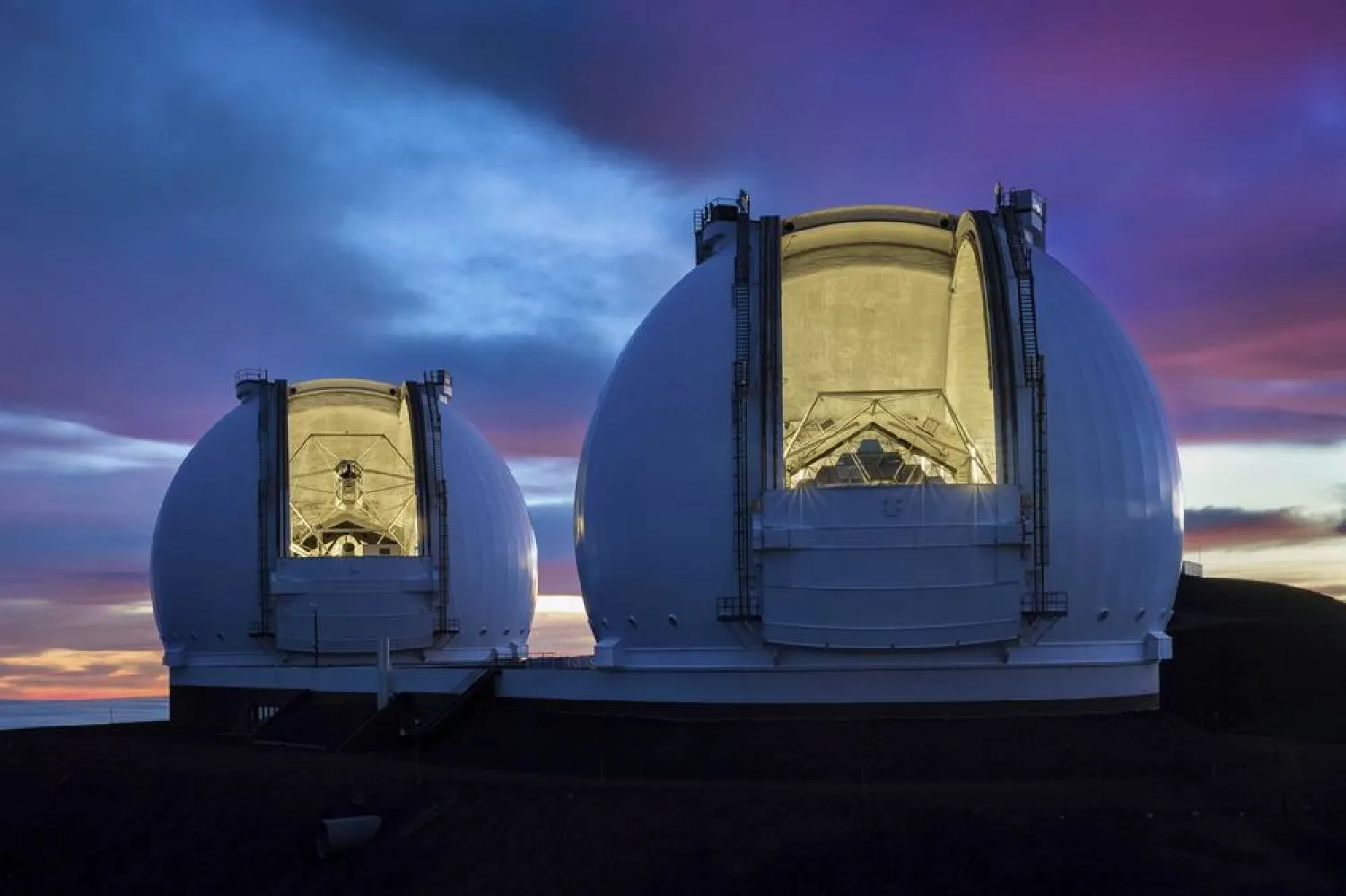
This 2012 image provided by W.M. Keck Observatory shows the W.M. Keck Observatory in Hawaii, whose telescopes were used to spot the insides of a dying star. (Ethan Tweedie/W. M. Keck Observatory via AP)
TT

Scientists Get a Rare Peek Inside of an Exploding Star

This 2012 image provided by W.M. Keck Observatory shows the W.M. Keck Observatory in Hawaii, whose telescopes were used to spot the insides of a dying star. (Ethan Tweedie/W. M. Keck Observatory via AP)

Scientists for the first time have spotted the insides of a dying star as it exploded, offering a rare peek into stellar evolution.

Stars can live for millions to trillions of years until they run out of fuel. The most massive ones go out with a bang in an explosion called a supernova.

Using telescopes that peer deep into space, researchers have observed many such explosions. The cosmic outbursts tend to jumble up a dying star's layers, making it hard for scientists to observe the inner structure.

But that wasn't the case for the new discovery, a supernova called 2021yfj located in our Milky Way galaxy.

The collapsing star's outermost layers of hydrogen and helium had peeled away long ago, which wasn't surprising. But the star's dense, innermost layers of silicon and sulfur had also shed during the explosion.

“We have never observed a star that was stripped to this amount,” said Northwestern University's Steve Schulze, who was part of the discovery team that published the research Wednesday in the journal Nature.

The finding lends evidence to ideas scientists have about how large stars look near the end of their lives, organized into layers with lighter elements on the outside and heavier ones close to the core.

“Because so many of the layers had been stripped off this star, this basically confirmed what those layers were,” said Anya Nugent, who studies supernovas at the Harvard-Smithsonian Center for Astrophysics. She was not involved with the new research.

It's not yet clear how this star got so whittled down — whether its layers were flung off violently in the final stages of its life or yanked away by a twin star. Future research may yield clues, though scientists acknowledged such an event may be tough to capture again.


Two Snowboarders Dead after Austrian Avalanche

A member of the CRS Alpes Grenoble mountain rescue team operates as he searches for potential buried victims during an avalanche emergency response rescue mission in an off-piste area of the Ecrins massif, French Alps on January 29, 2026. (Photo by JEFF PACHOUD / AFP)
TT

Two Snowboarders Dead after Austrian Avalanche

A member of the CRS Alpes Grenoble mountain rescue team operates as he searches for potential buried victims during an avalanche emergency response rescue mission in an off-piste area of the Ecrins massif, French Alps on January 29, 2026. (Photo by JEFF PACHOUD / AFP)

Two snowboarders have been confirmed dead after their bodies were recovered following an avalanche in western Austria over the weekend, police said Monday.

Avalanches across the Alps have claimed several victims in recent days following heavy snowfall.

An avalanche struck two 37-year-old off-piste snowboarders on the Stubai glacier in Tyrol province, burying them under the snow, police said in a statement.

The two Austrian men were reported missing after they had not returned from their snowboarding trip, prompting a large-scale search operation that included dogs and drones.

The buried snowboarders were located on Sunday night, but emergency services "could only confirm the death of the two men", Reuters quoted the statement as saying.

A level-four avalanche risk warning -- out of five -- is currently in place in the area following heavy snowfall in recent days.

In neighboring Italy, two skiers were killed on Sunday and another was in serious condition after an avalanche struck a slope near Courmayeur.

Avalanches have already killed several dozen people across the French, Swiss, Italian and Austrian Alps so far this season.


Wild New Zealand Storm Disrupts Transport, Leaves Thousands Without Power

Trees lie amid the floodwaters after heavy rain and wild winds in Puketotara, Waikato region, New Zealand, February 14, 2026, in this picture obtained from social media. Wayne Feisst/via REUTERS
TT

Wild New Zealand Storm Disrupts Transport, Leaves Thousands Without Power

Trees lie amid the floodwaters after heavy rain and wild winds in Puketotara, Waikato region, New Zealand, February 14, 2026, in this picture obtained from social media. Wayne Feisst/via REUTERS

Heavy rain and strong winds disrupted flights, trains and ferries, forcing the closure of roads across large parts of New Zealand's North Island on Monday, while snapping power links to tens of thousands.

Domestic media reported a few flights had resumed operating by afternoon from the airport in Wellington, the capital, although cancellations were still widespread after airport authorities said most morning flights were disrupted.

Air New Zealand said it hoped to ‌resume services when conditions ‌ease later on Monday, after it paused ‌operations at ⁠Wellington, Napier and ⁠Palmerston North airports.

Online images showed flooded semi-rural neighborhoods, inundated homes, trees fallen on vehicles and collapsed sections of road after waters receded.

The weather had been "absolutely terrifying", Marilyn Bulford, who lives in the rural town of Bunnythorpe, about 160 km (100 miles) north of Wellington, told the New Zealand Herald newspaper.

"I've never seen huge trees blowing around this much," she added. "It's so bad. ⁠I haven't seen anything like it."

The Wellington region accounted ‌for more than half the ‌852 emergency calls received overnight, said Ken Cooper, assistant national commander of the emergency services.

"We ‌had a very busy night, and our firefighters are continuing to ‌respond to calls," Reuters quoted him as saying.

More than 30,000 properties were without power, including about 10,000 customers in Wellington, said authorities, who have urged motorists to stay off roads, while several schools were closed as emergency crews tackled widespread damage.

The storm is ‌forecast to bring heavy rains as it heads for the east coast of the South Island on ⁠Tuesday, the ⁠weather bureau said, with authorities warning of further disruption.

Raw sewage discharged after this month's failure of Wellington's main wastewater treatment plant in a storm was washed back onto the south coast by the weekend storm, in an incident some residents called a "poonami" on social media.

A low-pressure system east of the North Island has battered several regions since the weekend, bringing heavy rain and severe gales. A man was found dead on Saturday in a submerged vehicle on a highway.

The storm follows six deaths last month in a landslide triggered by heavy rains at Mount Maunganui on the North Island's east coast, bringing down soil and rubble on a site crowded with families on summer holidays.


New York Creatives Squeezed Out by High Cost of Living

A couple dances next to a street musician in Central Park on Valentine's day in New York, on February 14, 2026. (Photo by Charly TRIBALLEAU / AFP)
TT

New York Creatives Squeezed Out by High Cost of Living

A couple dances next to a street musician in Central Park on Valentine's day in New York, on February 14, 2026. (Photo by Charly TRIBALLEAU / AFP)

After 20 years as a makeup artist for TV and cinema, Noel Jacoboni sees few other options than to leave New York City, where she has been "priced out" by the soaring cost of living.

Affordability issues, which Mayor Zohran Mamdani made a core part of his election campaign, are increasingly driving those in the creative arts like Jacoboni to bid farewell to one of the world's cultural capitals.

Since 2019, the number of New Yorkers working in creative fields ranging from design to fashion has fallen by 6.1 percent, according to a December report by the Center for an Urban Future.

Eli Dvorkin, an author of the paper, said that artists were "hit harder during the (Covid-19) pandemic than nearly any other workforce in the city."

Since then, "costs have risen far faster than incomes, and artists are really feeling the squeeze," he told AFP.

About 326,000 people are employed in the cultural and creative sector in New York, but many are being drawn to other cities like Miami, Dallas and Nashville.

A key factor, the report noted, is that creatives in New York make around 23 percent less than the national average when accounting for the cost of living. That number was 15 percent less a decade ago.

That has come as inflation across the United States has remained stubbornly high post-pandemic, and New York in particular has seen rents rise on high demand, supply shortages and other factors.

Salaries for those in the arts have just not kept up.

According to the report, median household rent in New York rose 42 percent in the last decade, with creative salaries rising just 25 percent -- well below the citywide average gain of 44 percent.

Speaking to a city committee on cultural affairs in February, Jacoboni complained about a "lack of work due to the rising cost of production in the city."

"We're losing talented individuals in our city," she said.

Since 2020, the number of cinema and TV workers has declined by 19.1 percent, according to the Center for an Urban Future report.

A similar trend was seen in advertising, down 15.7 percent, and design, which dropped 14.3 percent.

New York has seen more than 50 theaters, music clubs, museums and galleries close since 2020, the report said, citing the rising cost of rent, salaries and insurance.

Even major players in New York's cultural scene are impacted.

Just four Broadway musicals launched in the past six years have turned a profit, while key institutions like the Met Opera and the Guggenheim Museum have announced layoffs in recent months.

Mayor Mamdani has signaled that he is working to address affordability issues for creatives.

His media and entertainment head, Rafael Espinal, said in January he wants to "keep New York the creative capital of the world."

"Not just a place where great work gets made, but a place where the people who make that work can actually live in," he said.

Espinal, who led the Freelancers Union for independent workers, said he wants to "secure and expand good-paying union jobs" and ensure training for underrepresented communities.

Another initiative supported by Julie Menin, the speaker of the New York City Council, envisions reserving more rent-controlled housing for artists.

The Center for an Urban Future has also proposed creating a major cultural festival across the city's five boroughs to revitalize the arts sector.