

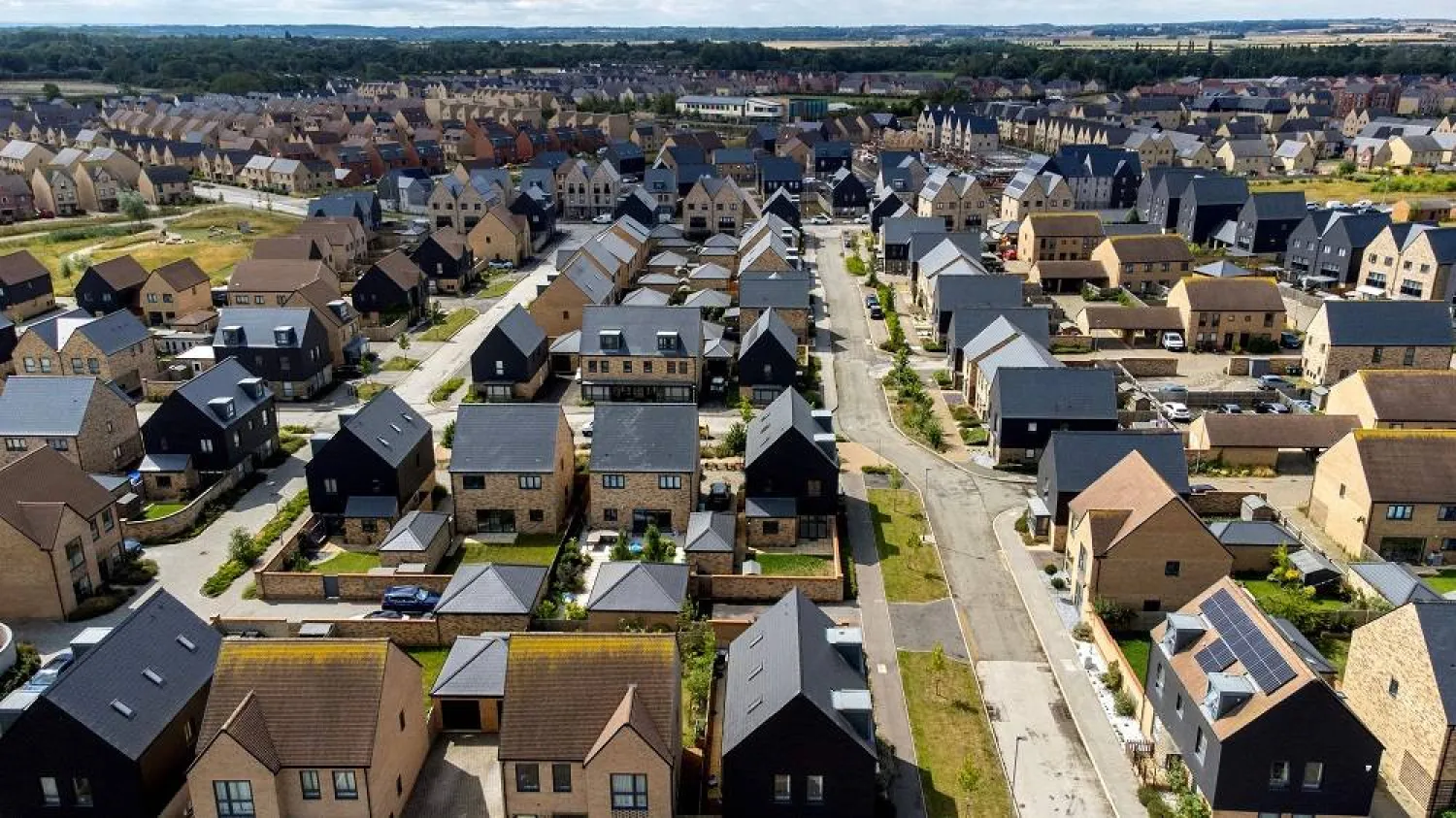

Back to the Future: UK Eyes New Towns to Help Housing Crunch 

An aerial view shows newly built homes in the new town of Northstowe, eastern England on July 31, 2025. (AFP)
TT

Back to the Future: UK Eyes New Towns to Help Housing Crunch 

An aerial view shows newly built homes in the new town of Northstowe, eastern England on July 31, 2025. (AFP)

The UK's newest town Northstowe is gradually taking shape amid cranes and scaffolding, a possible blueprint for others as the government seeks to tackle a desperate housing shortage.

So far the town, which lies close to the affluent eastern city of Cambridge, has just 3,000 or so residents and next to no amenities.

But planners project that within the next two decades its population could swell to 30,000 people.

"I'm really excited about the future," said Jason Benedicic, who moved with his partner and young child to the town in 2020 because it offered more affordable space than the nearby historic university city.

"There is an amazing community, the people really make the place special," he said, adding there were regular events which brought everyone together as well as "great transport links" and "open spaces".

Labor Prime Minister Keir Starmer, elected in July last year, has pledged to build 1.5 million houses by 2029, as he tries to solve a chronic shortage of homes.

Most will be built by expanding existing urban developments, but the British leader has also vowed to start work on the UK's "next generation" of new towns.

The idea harks back to the late prime minister Clement Attlee's reforming Labor government of 1945-1951, which famously set up the National Health Service and welfare state.

Its new town project paved the way for the construction in the 1960s of arguably Britain's most famous new town -- the oft-derided Milton Keynes, just north of London.

When Milton Keynes -- now a city of more than 250,000 residents -- was built, car was king and the future of shopping was thought to be inside vast malls.

Now urban designers are more conscious about biodiversity and the battle against global warming, while buyers tend to prefer market towns, noted Katja Stille, of Northstowe planner Tibbalds.

"The world is very different from that time," she told AFP.

With its green spaces, cycle lanes, lakes and transport links, Northstowe, 12 miles (19 kilometers) northwest of Cambridge, calls itself a "healthy" new town with a "low-carbon community".

The site, on what used to be Royal Air Force barracks, welcomed its first residents in 2017 and some 1,600 homes are now occupied.

Once complete, the town will have 10,000 houses and eight schools.

It currently has no shops or doctor's surgery, but officials have announced plans for a "vibrant town center" on what is currently a field and a health facility.

"It would be nice to have a barber," said Benedicic, an IT consultant who became Northstowe's mayor earlier this year.

Stephen Brewer runs the town's Tap and Social cafe which opened in April 2024.

The 68-year-old feels "proud" to be one of the new community's pioneers but looks forward to the day his business has some competition.

"We're not fearful of that," he told AFP.

Britain has been gripped by a national housing crisis for several years, with supply failing to keep up with demand as people live longer and immigration soars.

With housing prices skyrocketing, home ownership is out of reach for many young people.

The charity Shelter England has estimated around 354,000 people are homeless across the country.

Starmer wants to deliver 300,000 homes a year during this parliament -- well above what has been achieved in recent years.

He has set about overhauling planning laws to make it easier for developers to override environmental regulations.

But there are questions over the availability of land, building materials, and workers with the necessary skills.

"It is an exciting but ambitious target and challenge," Tim Wray, group development director at Keepmoat, which is building 300 houses in Northstowe, told AFP.

A government task force is considering more than 100 sites across England for the next new towns, which could host 10,000 homes each. It is due to announce the locations this summer.

They will be "well-designed, beautiful communities with affordable housing, GP (doctor's) surgeries, schools and public transport," the government has promised.




World’s Largest Whale Graveyard Discovered by Chinese Sub

This handout photograph taken by Global TREnD, IDSSE, seven kilometers under the sea on the deep seafloor of the Diamantina Zone in the Indian Ocean in 2023 and released on June 10, 2026, shows whale bones at the world's biggest known whale graveyard discovered by the Chinese submersible Fendouzhe. (Handout / Global TREnD, IDSSE / AFP)
TT

World’s Largest Whale Graveyard Discovered by Chinese Sub

This handout photograph taken by Global TREnD, IDSSE, seven kilometers under the sea on the deep seafloor of the Diamantina Zone in the Indian Ocean in 2023 and released on June 10, 2026, shows whale bones at the world's biggest known whale graveyard discovered by the Chinese submersible Fendouzhe. (Handout / Global TREnD, IDSSE / AFP)

The world's largest whale graveyard has been discovered at the bottom of the Indian Ocean by Chinese scientists, who found that the vast expanse of both new and ancient carcasses supports huge communities of deep-sea life.

It is also the deepest and oldest known whale graveyard on Earth, according to research published in the journal Nature on Wednesday, with some fossils dating back 5.3 million years.

From inside a small submersible, the Chinese researchers saw many strange animals -- many believed to be new to science -- living off the whale carcasses.

A new, though extinct, species of whale was also identified among the nearly 500 skeletons found up to 7,000 meters deep along a 1,200 kilometer corridor of bones in the Indian Ocean west of Australia.

Lead study author Xiaotong Peng of the Chinese Academy of Sciences told AFP that the researchers were "astonished" when the scale of their discovery became clear.

It was known that when whales die and drop to the seafloor, their sunken bodies -- called "whale falls" -- provide a source of food to deep-sea creatures.

"But discovering a necropolis of this scale was completely unexpected: the size of distribution, the depth and the age range were far beyond anything we had imagined," Xiaotong Peng said.

The whales were believed to have died in such numbers in this particular area because it is a popular foraging habitat -- and has a V-shaped trench that funnels carcasses to the seafloor.

- 'Truly incredible experience' -

For the discovery, the Fendouzhe submersible carried out 32 dives in 2023 -- though what it found was only revealed in Nature on Wednesday.

The sub took up to three people on the dives, collecting the fossil samples using robotic arms.

Study co-author Peng Zhou said witnessing the whale graveyard "was a truly incredible experience".

"The vibrant ecosystems we saw offered a completely different perspective on this otherwise dark and cold ocean floor."

Among the animals they discovered living off the carcasses were jellyfish, brittle stars, bone-boring worms and mollusks called bivalves.

Most of the 485 fossils the scientists catalogued were from different species of beaked whales.

Extrapolating from the number of bones they found, the scientists estimated there could be more than 10 million carcasses across the area, which is called the Diamantina Zone.

The soft tissue and lipids inside that many carcasses "translates to roughly 6.7 million tons of sequestered carbon," Xiaotong Peng said.

This provides an immense source of sustenance for animals, similar to how hydrothermal vents create their own ecosystems on the ocean floor.

Some of the animals seen by the scientists also live in hydrothermal vents and cold seeps, suggesting whale carcasses could help connect these deep-sea communities.

While this is by far the largest whale graveyard yet found, fossils found during trawling suggest there could be others off South Africa, the Iberian peninsula and the Crozet islands, said the study.

- 'More blockbusters to come'? -

University of Hawaii oceanographer Craig Smith, who discovered the first whale fall in 1987 but was not involved in the new research, told AFP it was "extremely exciting".

"The vast number of fossil whale falls documented, including a new species of beaked whale, is truly amazing and is of major importance to understanding whale evolution and whale distributions over geologic time," he said.

Whale fall researcher Amy Baco-Taylor at Florida State University told AFP the "remarkable discovery" would "likely provide many new insights".

This includes for the animals living in these "chemosynthetic" communities, whose numbers had been thought to have been drastically reduced by human whaling, she added.

US paleontologist Stephen Godfrey compared the "truly unique discovery" to past major underwater finds, such as when scientists first identified hydrothermal vents teeming with life on the ocean floor in 1977.

He called for future submersible voyages to find more whale graveyards across the world.

This discovery "reminded me of a trailer for the first in a series of epic movies", Godfrey commented in a linked Nature paper.

"I hope that there will be many more of these blockbusters to come."


UK's Prince William Says AI Can Help to Tackle Homelessness

Prince William, Prince of Wales, attends the launch of the Global Humanitarian Memorial in London, Britain October 01, 2025. Chris Jackson/Pool via REUTERS
TT

UK's Prince William Says AI Can Help to Tackle Homelessness

Prince William, Prince of Wales, attends the launch of the Global Humanitarian Memorial in London, Britain October 01, 2025. Chris Jackson/Pool via REUTERS

Britain's Prince William said artificial intelligence was being harnessed to identify people at risk of homelessness, enabling early intervention to keep them in housing or reduce the time they spend on the streets or in temporary accommodation.

The prince told an audience at London Tech Week that it was an "unusual conversation" for a technology forum, but the types of data companies handled daily could give insights that made a real difference.

"I'm not sure you realise how much that data can be used to predict and see problems with potential homelessness before they arise," he said, Reuters reported.

Homelessness has long been an important cause for the prince, and three years ago he set up the "Homewards" project with the aim of making the problem "rare, brief and unrepeated".

The program launched its Homelessness Data Lab at Tech Week in partnership with LandAid and Salesforce, supported by Bloomberg, VodafoneThree, Accenture, NatWest Group and others.

The lab will analyse data to flag warning signs - such as a missed bill payment, a phone being cut off or a child absent from school - to intervene to reduce homelessness, a problem Homewards said affected more than 430,000 people in Britain.

The prince said the data could help identify much earlier when somebody was getting into difficulties, allowing intervention that could help them stay in their homes, jobs and communities.

"Prevention is better than cure," he said, appealing to other companies and organizations to join the 25 already working with the lab.

William was shown an "Economic Wellbeing Explorer" map that uses anonymized data from NatWest to pinpoint homelessness risks in Lambeth, London, one of the six locations Homewards works in.

"It's game-changing stuff," he told Tim Siret, an analyst at Smart Data Foundry, a subsidiary of the University of Edinburgh, which created the explorer.


Japan Lawmakers Back Plan to Ease Imperial Succession Crisis

Japans Emperor Naruhito delivers a speech at the opening ceremony of the World Island Nations Ocean Conference in Tokyo on June 3, 2026. (Photo by Jiji / AFP)
TT

Japan Lawmakers Back Plan to Ease Imperial Succession Crisis

Japans Emperor Naruhito delivers a speech at the opening ceremony of the World Island Nations Ocean Conference in Tokyo on June 3, 2026. (Photo by Jiji / AFP)

Japan's legislature endorsed on Wednesday a proposed framework aimed at easing a looming imperial succession crisis, with just one young heir to the throne currently remaining.

The imperial household operates under strict rules that allow only male offsprings from the male side of the family to ascend to the ancient Chrysanthemum Throne.

That means that the household's future currently hinges on 19-year-old Prince Hisahito, Emperor Naruhito's nephew and the only young man in the family.

Other family members are either women -- who are not allowed to inherit the throne -- or older men, the youngest among them 60-year-old Crown Prince Akishino, who is Naruhito's brother and Hisahito's father.

In a bid to expand the thinning line of succession, lawmakers endorsed in principle amending the Imperial Household Law, presenting their initiative to Prime Minister Sanae Takaichi.

The proposals would allow women keep their royal status even after marrying someone outside the family, and let the imperial family adopt male distant relatives.

"Given all the differing opinions, we believe we've managed to produce the best possible result," lower house speaker Eisuke Mori told a news conference before presenting the legislature's view to Takaichi.

Once her government drafts the amendments, the bill will return to the legislature, with Mori expressing his wish to pass it before the current parliament session ends on July 17, AFP reported.

Under the proposal, adopted men would not be heirs but their sons could be placed in line to succeed the throne, Mori said this week.

The imperial family now has 16 members in total, including five men -- the 66-year-old emperor and his brother, Prince Hisahito, retired emperor Akihito, who is 92, and his 90-year-old brother.

Emperor Naruhito has a daughter, Princess Aiko. The existing male-succession rule means that she would have to leave the family once she marries a commoner.

The lawmakers' proposal did not address the possibility of a woman emperor, an idea that has wide public support.