

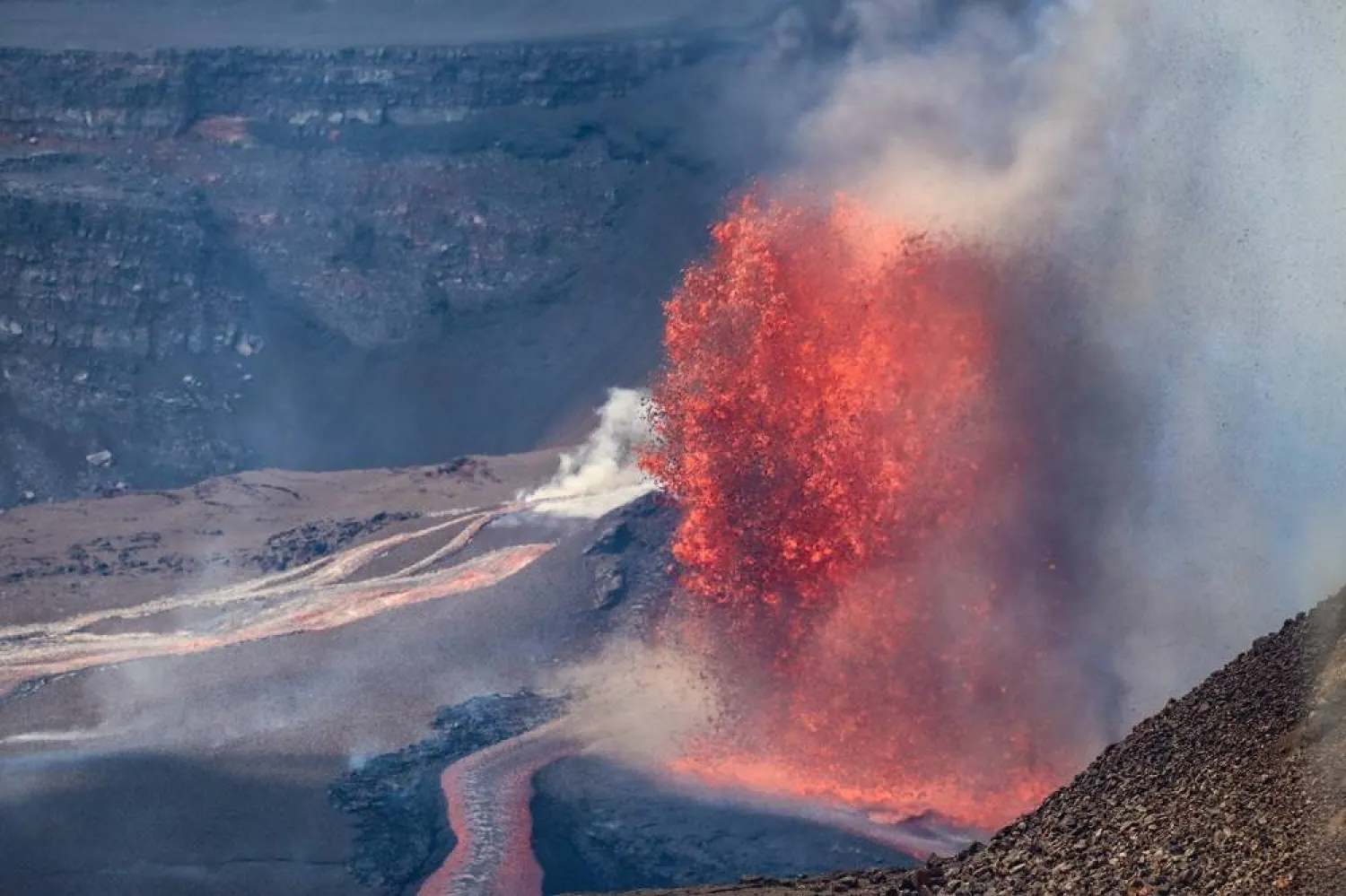

Hawaii’s Kilauea Volcano Erupts with Lava Pouring Out from Multiple Vents 

This image released by the US Geological Survey shows the erupting Halemaʻumaʻu crater from the rim of the Kilauea caldera at the summit of the Kīlauea volcano on Tuesday, Sept. 2, 2025, in Hawaii. (C. Cauley/US Geological Survey via AP)
TT

Hawaii’s Kilauea Volcano Erupts with Lava Pouring Out from Multiple Vents 

This image released by the US Geological Survey shows the erupting Halemaʻumaʻu crater from the rim of the Kilauea caldera at the summit of the Kīlauea volcano on Tuesday, Sept. 2, 2025, in Hawaii. (C. Cauley/US Geological Survey via AP)

Hawaii's Kilauea volcano resumed erupting on Tuesday, firing lava 330 feet (100 meters) into the sky from its summit crater.

It's the 32nd time the volcano has released molten rock since December, when its current eruption began. So far, all the lava from this eruption has been contained within the summit crater inside Hawaii Volcanoes National Park.

Lava emerged from the north vent in Halemaumau Crater after midnight. The vent began shooting fountains of lava at 6:35 a.m., the US Geological Survey said. By mid-morning, it was also erupting from the crater's south vent and a third vent in between.

Kilauea is one of the world's most active volcanoes. It's located on Hawaii Island, the largest of the Hawaiian archipelago. It’s about 200 miles (320 kilometers) south of the state’s largest city, Honolulu, which is on Oahu.



UK, France Mull Social Media Bans for Youth as Debate Rages

Some experts worry a blanket ban on social media could have unintended consequences. Saeed KHAN / AFP/File
TT

UK, France Mull Social Media Bans for Youth as Debate Rages

Some experts worry a blanket ban on social media could have unintended consequences. Saeed KHAN / AFP/File

Countries including France and Britain are considering following Australia's lead by banning children and some teenagers from using social media, but experts are still locked in a debate over the effectiveness of the move.

Supporters of a ban warn that action needs to be taken to tackle deteriorating mental health among young people, but others say the evidence is inconclusive and want a more nuanced approach.

Australia last month became the first nation to prohibit people under-16s from using immensely popular and profitable social media platforms such as Instagram, Facebook, Tiktok and YouTube.

France is currently debating bills for a similar ban for under-15s, including one championed by President Emmanuel Macron.

The Guardian reported last week that Jonathan Haidt, an American psychologist and supporter of the Australian ban, had been asked to speak to UK government officials.

Haidt argued in his bestselling 2024 book "The Anxious Generation" that too much time looking at screens -- particularly social media -- was rewiring children's brains and "causing an epidemic of mental illness".

While influential among politicians, the book has proven controversial in academic circles.

Canadian psychologist Candice Odgers wrote in a review of the book that the "scary story" Haidt was telling was "not supported by science".

One of the main areas of disagreement has been determining exactly how much effect using social media has on young people's mental health.

Michael Noetel, a researcher at the University of Queensland in Australia, told AFP that "small effects across billions of users add up".

There is "plenty of evidence" that social media does harm to teens, he said, adding that some were demanding an unrealistic level of proof.

"My read is that Haidt is more right than his harshest critics admit, and less right than his book implies," Noetel said.

Given the potential benefit of a ban, he considered it "a bet worth making".

After reviewing the evidence, France's public health watchdog ANSES ruled last week that social media had numerous detrimental effects for adolescents -- particularly girls -- while not being the sole reason for their declining mental health.

Everything in moderation?

Noetel led research published in Psychological Bulletin last year that reviewed more than 100 studies worldwide on the links between screens and the psychological and emotional problems suffered by children and adolescents.

The findings suggested a vicious cycle.

Excessive screen time -- particularly using social media and playing video games -- was associated with problems. This distress then drove youngsters to look at their screens even more.

However, other researchers are wary of a blanket ban.

Ben Singh from the University of Adelaide tracked more than 100,000 young Australians over three years for a study published in JAMA Pediatrics.

The study found that the young people with the worst wellbeing were those who used social media heavily -- more than two hours a day -- or not at all. It was teens who used social networks moderately that fared the best.

"The findings suggest that both excessive restriction and excessive use can be problematic," Singh told AFP.

Again, girls suffered the most from excessive use. Being entirely deprived of social media was found to be most detrimental for boys in their later teens.

'Appallingly toxic'

French psychiatrist Serge Tisseron is among those who have long warned about the huge threat that screens pose to health.

"Social media is appallingly toxic," he told AFP.

But he feared a ban would easily be overcome by tech-savvy teens, at the same time absolving parents of responsibility.

"In recent years, the debate has become extremely polarized between an outright ban or nothing at all," he said, calling for regulation that walks a finer line.

Another option could be to wait and see how the Australian experiment pans out.

"Within a year, we should know much more about how effective the Australian social media ban has been and whether it led to any unintended consequences," Cambridge University researcher Amy Orben said.

Last week, Australia's online safety watchdog said that tech companies have already blocked 4.7 million accounts for under 16s.


Innovative Drug Lowers Triglycerides, Other Blood Lipids

High levels of triglycerides in the blood increase the risk of heart disease (Monash University) 
TT

Innovative Drug Lowers Triglycerides, Other Blood Lipids

High levels of triglycerides in the blood increase the risk of heart disease (Monash University) 

A study led by researchers from the Ecole Polytechnique Fédérale de Lausanne (EPFL) in Switzerland, revealed a new liver- and gut-targeted oral drug that can safely lower triglycerides and other blood lipids.

Researchers of the study, published last Friday in Nature Medicine, said the innovative drug could represent a breakthrough in treating metabolic diseases related to high triglycerides in the body.

The study said that when we eat, our bodies convert extra calories, especially from carbs, sugar, fats, and alcohol, into molecules called “triglycerides.”

Triglycerides are a form of fat or “lipid,” which the body stores away into its fat cells as an energy fuel for energy between meals.

But, excess amounts of fat in the body can be dangerous, causing a condition known as “hypertriglyceridemia” (“excess triglycerides in the blood”), which significantly increases the risk of heart disease, stroke, and pancreatitis.

This is why we are universally advised to make healthy lifestyle choices in diet, exercise, while particularly bad cases require medication.

The study also found that keeping blood fats in check depends on a careful balance.

It said the liver and intestine release fat particles into the bloodstream, while enzymes work to break them down and clear them away.

When fat production outpaces clearance, triglycerides build up, setting the stage for metabolic diseases like dyslipidemia, acute pancreatitis, and metabolic dysfunction-associated steatotic liver disease (MASLD).

One of the master switches in this system is a protein called Liver X Receptor, or LXR, which controls several genes that are involved in making and handling fats.

When LXR is active, triglycerides and cholesterol tend to rise.

Therefore, dialing it down through medication seems promising, but as LXR is also involved in protective cholesterol pathways elsewhere in the body, blocking it everywhere could do more harm than good.

Now, scientists have addressed this problem with an orally administered compound that can repress the activity of LXR specifically in the liver and gut to lower triglycerides without disrupting the body’s protective cholesterol pathways.

The compound, TLC‑2716, is what is known as an “inverse agonist” for the LXR. Unlike a “blocker” (“antagonist”) that merely stops a receptor from being activated, an “inverse agonist” makes the receptor signal the opposite effect to what it would normally do.

Clinical Trial

The lab findings set the stage for a randomized, placebo-controlled Phase 1 study in healthy adults. Participants received TLC‑2716 for 14 days given as a single dose per day and the trial focused first on safety and tolerability, and the authors report that the drug met these primary endpoints.

But even this short trial had clear effects: participants who received higher doses of TLC‑2716 showed notable drops in triglycerides as well as remnant cholesterol.

At the highest doses of TLC‑2716 (12mg), triglycerides fell by up to 38.5%, while postprandial (“after eating”) remnant cholesterol dropped by as much as 61%.

This happened despite participants starting with relatively normal lipid levels and without the use of other lipid-lowering drugs, the study showed.

Also, the treatment sped up triglyceride clearance by reducing the activity of two proteins that normally slow it down, ApoC3 and ANGPTL3.

At the same time, the study did not detect reductions in blood-cell expression of ABCA1 and ABCG1, genes used here as markers linked to reverse cholesterol transport.

Researchers said larger trials will be needed, but, for now, the concept has its first human proof of principle.


Small Part of Sunshine State Becomes Snowy State as Florida Gets Snow Second Year in a Row

A rare snow is seen in Holt, Florida, on Sunday, Jan. 18, 2026. (Danielle Brahier via AP)
TT

Small Part of Sunshine State Becomes Snowy State as Florida Gets Snow Second Year in a Row

A rare snow is seen in Holt, Florida, on Sunday, Jan. 18, 2026. (Danielle Brahier via AP)

A small part of Florida is the Snowy State for the second year in a row.

Snow briefly covered the grass and rooftops in parts of the western Florida Panhandle on Sunday morning as just enough frigid air rushed in behind a cold front to turn the last rain showers into snowflakes in the Sunshine State.

And it wasn't a once-in-a-lifetime thing. Less than a year ago, on Jan. 21, 2025, some of those same areas saw up to 8 inches (20 centimeters) of snow in what was the most significant snowfall in many places since the late 1800s.

Snow photos flooded social media. There were a few flakes on the beach and snow nestled into palm fronds. It was too warm to stick to the roads, but a dusting of snow sat on the grass for a little while before mostly melting.

The rare snow in the South wasn't just in Florida. Southeastern Alabama and southern Georgia also reported snow in areas that also got to celebrate a second winter wonderland in less than a year.

Snow covered the ground in Columbus and Macon, Georgia, and officials warned enough might fall to make travel treacherous.