
New Recipes Help Pakistani Mothers Ward off Malnutrition

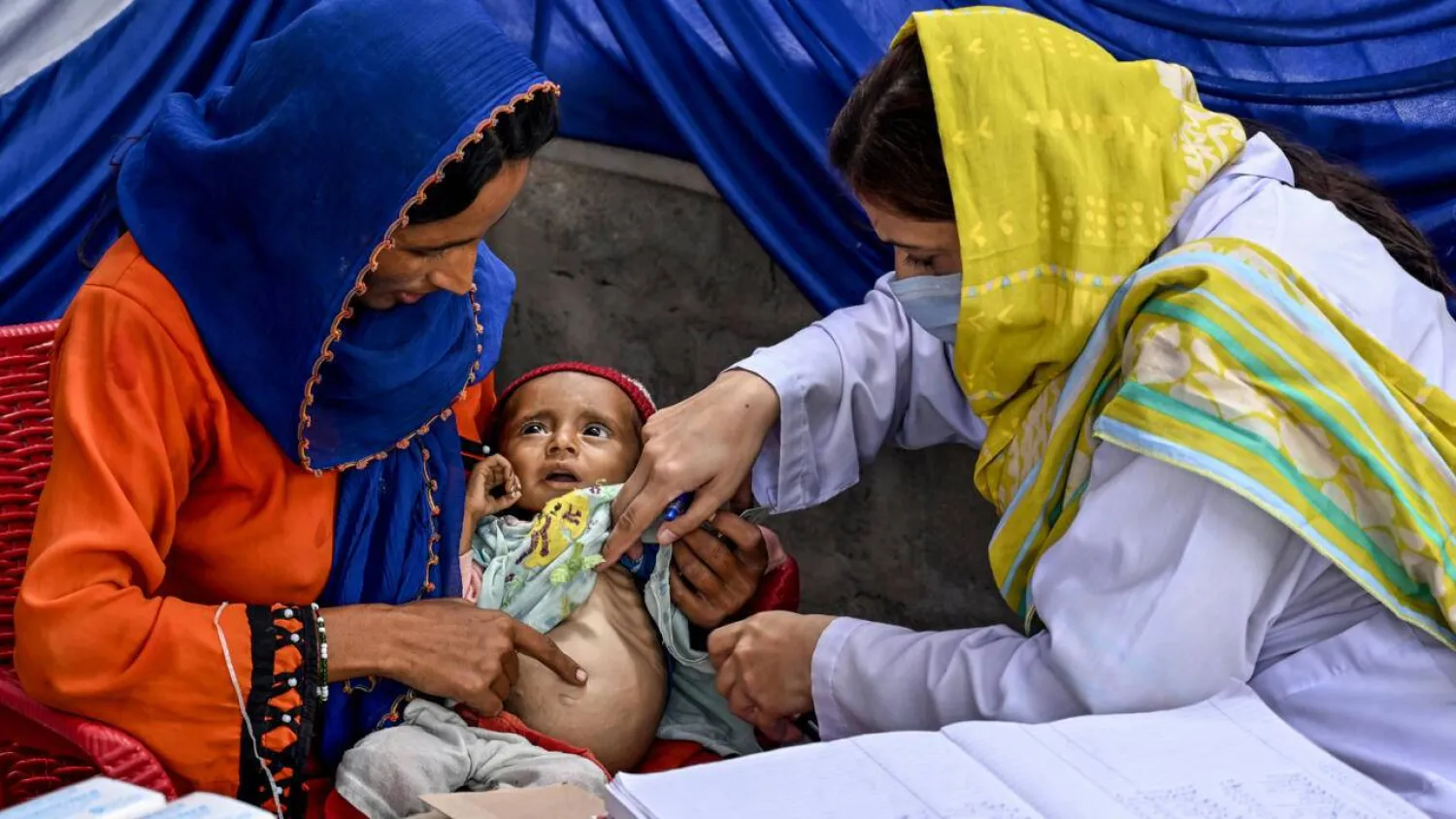
A doctor examines a child during a UNICEF nutrition program at Fateh Muhammad Soomro village in Sindh. Rizwan TABASSUM / AFP
TT

New Recipes Help Pakistani Mothers Ward off Malnutrition

A doctor examines a child during a UNICEF nutrition program at Fateh Muhammad Soomro village in Sindh. Rizwan TABASSUM / AFP

Clutching their hungry babies, a group of mothers mix a semolina dish under the guidance of a teacher, an attempt to curb malnutrition which affects nearly one in two children in Pakistan's south.

Despite Sindh province being home to the mega port city of Karachi, the financial center of the country that sprawls along the Arabian coastline, children in rural areas just a few hours away face stark levels of wasting and stunting, reported AFP.

In the arid village of Sujawal, lethargic children with prominent bones wilt in the searing heat as social workers educate mothers on nutrient-rich ingredients and dispel myths around food.

"Before, we only gave our children potatoes because they were always available at home," said Shahnaz, 25, who has radically changed the diet of her six children, weak and frequently sick, after a year of classes.

Now, convinced that children should eat a varied diet, she has introduced affordable ingredients such as lentils and semolina into her cooking, lifting her daughter out of malnutrition.

In impoverished rural Sindh province, 48 percent of children under five suffer from malnutrition and 20 percent from its most severe form, wasting, according to the latest national survey on the issue conducted in 2018.

In this class, Azma, a social worker, shows mothers how to cook with semolina -- easily available in the market.

"Semolina is cheap -- for 50 rupees it can last a week if you're feeding one to two spoonfuls daily to a six-month-old child," she explained to AFP.

In Sindh, a province of 55 million people where contraception remains taboo and large families are the norm, 3,500 mothers have benefited from cooking classes developed by UNICEF.

Like many mothers in the area, Kulsoom, 23 and pregnant with her sixth child, all born prematurely and underweight, once only fed her children pieces of fried flatbread.

"One of my children died, and my youngest is extremely weak, so I was advised to take these classes," said Kulsoom, who goes by only one name, like most women in her district.

No spices

Parents are recommended to feed babies solid foods from about six months old, but in rural Sindh this often means adult leftovers, too spicy for young stomachs.

"The main problem is the lack of dietary diversity," says Mazhar Iqbal, a nutritionist for UNICEF.

In Pakistan, 38 percent of children eat only two or fewer of the eight food categories recommended by UNICEF.

Meat is saved for special occasions, yet inexpensive protein alternatives exist such as chicken offal, boiled bones, lentils and beans.

As for fruit and vegetables, they are usually fried, losing their nutrients.

Bakhtawar Kareem joined the program after her child died of anemia.

"I have no money. Sometimes we eat, sometimes we don't," she lamented, scanning the swollen belly of her one-year-old daughter, who has only sparse clumps of hair.

Like 72 percent of children in the village, her daughter has stunting, well above the average rate in Pakistan of 42 percent -- one of the highest in the world.

Stunting is most closely associated with brain development and physical growth, and can have long-term physical and mental impacts.

Vulnerable to a lack of clean water and sanitation which contributes to malnutrition, children often also suffer from dengue fever or malaria, from vomiting, diarrhea, or difficulty urinating, and have abnormally swollen bellies.

Women eat leftovers

But the vicious cycle of malnutrition begins with the mothers.

"With early marriages and repeated pregnancies, more than 45 percent of women in Sindh are anemic," said the nutritionist.

"This increases the risk of having low birth weight babies, who are more likely to suffer from malnutrition."

In Sujawal, where only a quarter of the population can read and write, myths about food also deprive women of vital nutrients.

Farrah Naz, the head of the Global Alliance for Improved Nutrition in Pakistan, regularly has to repeat that eggs and dried fruits do not cause women to bleed more during their periods.

Cultural norms around women serving meals to men first and eating the leftovers -- despite the physical work they carry out in the fields -- also contributes to poor health.

"And when food runs out, it's their rations that are cut first."


Chile Fights Wildfires that Killed 19 and Left 1,500 Homeless

Mirtza Aguilera, right, and her daughter embrace in front of their home burned by wildfires in Tome, Chile, Monday, Jan. 19, 2026. (AP Photo/Javier Torres)
TT

Chile Fights Wildfires that Killed 19 and Left 1,500 Homeless

Mirtza Aguilera, right, and her daughter embrace in front of their home burned by wildfires in Tome, Chile, Monday, Jan. 19, 2026. (AP Photo/Javier Torres)

Firefighters in Chile are battling forest fires that started on Sunday and have killed at least 19 people and left around 1,500 homeless as they swept through thousands of acres in the center and south of the country, officials said.

Five large wildfires were still active Monday in the South American nation, with temperatures higher than usual due to a summer heatwave, said the National Service for the Prevention of Disasters, The AP news reported.

Chilean President Gabriel Boric declared a state of catastrophe in the central Biobio and neighboring Ñuble regions on Sunday. The emergency designation allows greater coordination with the military to rein wildfires.

Boric said on his X account on Monday morning that weather conditions are adverse, which means some of the fires could reignite.

Wildfires are common in Chile during the summer due to high temperatures and dry weather. The current outbreak of fires in central and southern Chile is one of the deadliest in recent years.

In 2024, massive fires ripping across Chile’s central coastline killed at least 130 people, becoming the nation’s deadliest natural disaster since a devastating 2010 earthquake.


Nepal Halts Search after Guide Killed, Iranian Climber Missing

A tourist looks at a view of Mt. Everest from the hills of Syangboche in Nepal December 3, 2009. REUTERS/Gopal Chitrakar
TT

Nepal Halts Search after Guide Killed, Iranian Climber Missing

A tourist looks at a view of Mt. Everest from the hills of Syangboche in Nepal December 3, 2009. REUTERS/Gopal Chitrakar

Bad weather forced Nepali rescuers to suspend the search Monday for an Iranian climber missing for four days after an accident which killed a Nepali team member, expedition organizers said.

Extreme conditions, including fierce winds, made rescue efforts impossible on the 8,481-meter (27,825-feet) high Mount Makalu, the world's fifth highest mountain.

Iranian climber Abolfazl Gozali, 42, and Nepali guide Phurba Ongel Sherpa, 44, were part of a rare winter expedition on the peak.

The four-member team successfully summited on Thursday, but during the descent the guide fell to his death.

Team lead Sanu Sherpa, who has climbed all 14 highest peaks in the world at least twice, and Lakpa Rinji Sherpa went to his aid but found that he had fallen hundreds of meters and did not survive.

When they returned to where they had left Gozali, he was no longer there.

"A team of eight experienced climbers have been sent but the wind has been very strong and affected the search," Madan Lamsal of expedition organizer Makalu Adventure told AFP.

"We hope to resume soon."

Lamsal said the rescuers intend to find Gozali, as well as recover the guide's body.

Phurba Ongel Sherpa was a highly experienced mountaineering guide with multiple summits of Everest and other major peaks.

Gozali is also an accomplished climber, who has climbed two of world's highest peaks and completed the "snow-leopard peaks" -- the five mountains of over 7,000 meters between Tajikistan and Kyrgyzstan.

This was his second attempt to summit Makalu in winter. Last year, freezing temperatures and high winds forced the team to turn back, just 800 meters short of the summit.

Nepal is home to eight of the world's 10 highest peaks, including Mount Everest, and welcomes hundreds of climbers every year during the spring and autumn climbing seasons.

Dangerous terrain and extreme weather can make winter expeditions particularly risky.


Shark Mauls Surfer in Sydney, 3rd Attack in Two Days

People stand next to warning signs in place, and beaches are closed after a surfer suffered a shark attack at Dee Why Beach in Sydney, Australia, January 19, 2026. REUTERS/Jeremy Piper
TT

Shark Mauls Surfer in Sydney, 3rd Attack in Two Days

People stand next to warning signs in place, and beaches are closed after a surfer suffered a shark attack at Dee Why Beach in Sydney, Australia, January 19, 2026. REUTERS/Jeremy Piper

A shark mauled a surfer off an ocean beach in Sydney on Monday in the Australian city's third shark attack in two days, authorities said.

The surfer, believed to be in his 20s, was in a critical condition in hospital with serious leg injuries after the attack at a northern Sydney beach, police said.

"The man was pulled from the water by members of the public who commenced first aid before the arrival of emergency services," New South Wales state police said in a statement.

All of Sydney's northern beaches were closed until further notice.

The attack at North Steyne Beach in the suburb of Manly came hours after a shark bit a large chunk out of a young surfer's board about 4 kilometers (2.5 miles) north along the coast at Dee Why Point.

That surfer, reportedly a boy aged about 11, was uninjured but the beach was closed immediately, AFP reported.

On Sunday, a large shark bit a 12-year-old boy in the legs as he played with friends at a beach in Sydney harbor, leaving him fighting for survival in hospital.

The boy and his friends were jumping from a six-meter (20-foot) rock into the water off Shark Beach in the eastern suburb of Vaucluse when the predator struck, police said.

"It was a horrendous scene at the time when police attended. We believe it was something like a bull shark that attacked the lower limbs of that boy," said Superintendent Joseph McNulty, New South Wales marine area police commander.

"That boy is fighting for his life now," he told reporters on Monday.

Recent heavy rain had drained into the harbor, and authorities believed the combination of the brackish seawater and the children's splashing created a "perfect storm" for a shark attack, McNulty said.

He warned people not to go swimming in the harbor or other river systems in New South Wales because of the risks.

He praised the boy's "brave" young friends for pulling him out of the water on Sunday.

Officers put the unconscious child in a police boat and gave him first aid, applying two tourniquets to stem the bleeding from his legs, McNulty said.

They tried to resuscitate the boy as they sped across the harbor to a wharf where ambulance paramedics were waiting.

The child, confirmed by police to be 12 years old, was in intensive care at Sydney Children's Hospital surrounded by family and friends, McNulty said.