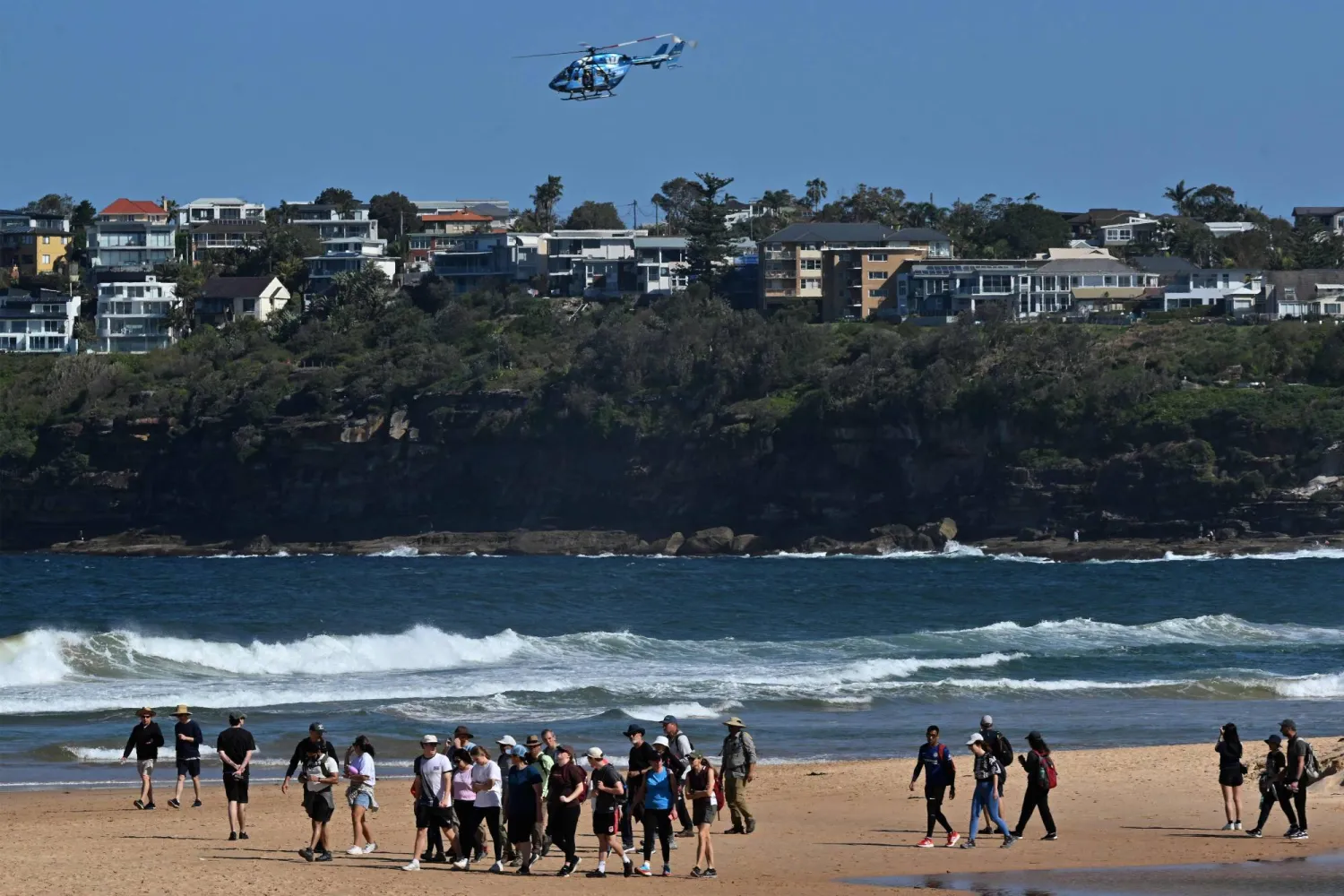
Popular Sydney Beach Deploys Drones, Helicopter after Fatal Shark Attack

Visitors avoid the water while a helicopter scans the ocean as northern Sydney beaches are closed following a shark attack at Long Reef Beach on September 6, 2025. (Photo by Saeed KHAN / AFP)
TT

Popular Sydney Beach Deploys Drones, Helicopter after Fatal Shark Attack

Visitors avoid the water while a helicopter scans the ocean as northern Sydney beaches are closed following a shark attack at Long Reef Beach on September 6, 2025. (Photo by Saeed KHAN / AFP)

Australian authorities on Sunday deployed drones and a helicopter to monitor the waters around a popular Sydney beach after a surfer was killed by a great white shark on Saturday, officials said.

Two beaches in Australia's most populous city remained closed on Sunday after the attack on Saturday morning that took place about 100 m (328 ft) from shore while the man was surfing with friends at Long Reef Beach, in the north of the New South Wales state capital.

The experienced surfer was pulled from the water by other surfers, but had lost too much blood and died at the scene, police said. It was the first shark-attack death in Sydney since a swimmer was killed off a beach in February 2022, which the city's first since 1963.

On Sunday, the state's main water rescue organization, Surf Life Saving NSW, deployed drones and a helicopter to surveil the area for the shark, New South Wales Department of Primary Industries and Regional Development (DPIRD) said, according to Reuters.

More so-called SMART drumlines, which use satellite technology to notify authorities when a shark is hooked on a baited line, had also been installed, it said in a statement.

Government shark biologists, after assessing photos of the victim’s surfboard, "determined a White shark approximately 3.4-3.6 meters (11.15-11.81 feet) in length was likely responsible" for the mauling, DPIRD said.

White sharks are also commonly known as great white sharks or white pointers, according to the agency.

Saturday's incident marked the fourth fatal shark attack in Australia in 2025, data from the state-run operator of Sydney's Taronga Zoo shows. In March, a surfer was killed by a shark in shallow water on a remote beach in Western Australia.

Australia ranked behind only the United States in the number of unprovoked shark bites on humans in 2024, according to the University of Florida's International Shark Attack File.


US Cancels Automatic Protections for Imperiled Animals as Critics Warn of Extinctions

FILE - A male alligator snapping turtle is held after being trapped by the Turtle Survival Alliance-North American Freshwater Turtle Research Group, Nov. 24, 2018, as part of the process of tagging turtles. (Melissa Phillip/Houston Chronicle via AP, File)
TT

US Cancels Automatic Protections for Imperiled Animals as Critics Warn of Extinctions

FILE - A male alligator snapping turtle is held after being trapped by the Turtle Survival Alliance-North American Freshwater Turtle Research Group, Nov. 24, 2018, as part of the process of tagging turtles. (Melissa Phillip/Houston Chronicle via AP, File)

The US Interior Department on Friday canceled a rule meant to protect plants and animals that are determined to be threatened with extinction, the latest step by President Donald Trump’s administration to dismantle key provisions of the landmark Endangered Species Act at the behest of industry.

Instead of receiving automatic protections, imperiled species will need individualized protection plans once they are added to the threatened species list. That's a potentially lengthy process in which companies could seek exemptions for oil and gas drilling, mining and other development where those species live.

Opponents said it would make it harder to save wildlife that’s awaiting federal protections and in danger of disappearing, such as monarch butterflies and alligator snapping turtles.

Interior Secretary Doug Burgum said in a statement that the Endangered Species Act had been used for too long “to stop almost any new project in America, driving up costs for families, weakening our competitiveness, and undermining our national security.”

“Success should be measured by species recovery and delisting, not by adding more species to the list,” Burgum added.

A second change finalized Friday requires officials to analyze economic impacts when deciding whether habitat is critical to a species’ survival. Critics say it gives corporations an opportunity to put their thumb on the scale so that officials will allow development in those areas.

“If you're exempting certain industries that cause habitat destruction, in many instances you'll be exempting the main threat to those species,” said Noah Greenwald with the environmental group Center for Biological Diversity.

Officials made similar changes during Trump’s first term but they were reversed under former Democratic President Joe Biden.

The rules that gave what some consider “blanket protections” to threatened species were first adopted for wildlife in 1975 and for plants in 1977.

Two groups, the Rocky Mountain Elk Foundation and the Property and Environment Research Center, sued the Biden administration in 2024 after officials restored the blanket protections rule. They argued the rule unfairly imposed the same restrictions on landowners when a species' status improves from endangered, which is more dire, to threatened.

That removed incentives for landowners to participate in species recovery, said Jonathan Wood, vice president at the Montana-based research center.

Wood said the Trump administration's approach allows officials to “better reward progress and encourage proactive conservation.”

There have been no species added to the endangered or threatened lists in Trump’s second term. By comparison, more than 20 species were added in Trump’s first term, and about 60 during Biden’s presidency, The Associated Press reported.

About 30 species are currently proposed to be listed as threatened. Besides monarchs and alligator snapping turtles, they include California spotted owls and various snakes, fish, clams and insects.

Changes to government policies for endangered plants and wildlife have come faster and extended further in Trump's second term than in his first.

The administration in March exempted oil and gas drilling in the Gulf of Mexico from the Endangered Species Act after Defense Secretary Pete Hegseth said environmentalists’ lawsuits threatened to hobble domestic energy supplies as the US wages war against Iran.

Last week, Interior officials sharply narrowed the definition of what constitutes “harm” to a species. The change would allow development on critical wildlife habitat so long as the animals themselves are not immediately killed or injured.

This week officials sharply reduced the amount of critical habitat in the US Rocky Mountains designated for Canada lynx, forest dwelling wildcats that are threatened by climate change and other pressures.

Also this week, Burgum said in a visit to Montana that the US Fish and Wildlife Service would turn over more management authority for grizzly bears to states where the bruins live. That's been a longstanding priority for the Republican governors of Wyoming, Idaho and Montana.

The Endangered Species Act is credited with bringing back iconic animals including the bald eagle and American alligator from the brink of extinction.

Burgum noted Friday that 97% of the species that have been given protections still have them. That’s a frustration for Republican lawmakers who say species should be taken off the endangered and threatened lists more quickly once they’ve recovered.



Spain Braces for 3rd Heatwave with Highs Above 40C

This screen grab taken from handout video footage released on July 18, 2026 by Spain's Military Emergencies Unit (UME) shows the military fighting a massive wildfire, in Luesia area, in a sparsely populated part of the Aragon region in northeastern Spain. (Photo by Handout / UME / AFP)
TT

Spain Braces for 3rd Heatwave with Highs Above 40C

This screen grab taken from handout video footage released on July 18, 2026 by Spain's Military Emergencies Unit (UME) shows the military fighting a massive wildfire, in Luesia area, in a sparsely populated part of the Aragon region in northeastern Spain. (Photo by Handout / UME / AFP)

Spain is set to enter its third heatwave of the summer on Tuesday, with temperatures forecast to climb above 40C across large parts of the country, the national weather office said.

The heatwave will be fueled by a persistent area of high pressure that will trap hot, dry air from North Africa over Spain for several days, pushing temperatures to exceptionally high levels, AFP quoted AEMET as saying in a statement.

The heat is expected to intensify through Thursday, which forecasters say is likely to be the peak of the event, with some isolated areas potentially exceeding 45C.

"The level of danger will be significant during the central hours of the day, especially for outdoor activities and vulnerable people," the weather agency said.

Spain has already endured two other heatwaves this summer -- one in late June that broke temperature records across Europe, and another in early July.

Mainland Spain recorded its hottest first half of summer since records began in 1961, AEMET said on Tuesday, with average temperatures from June 1 to July 15 reaching 24.5C -- 3.3C above the 1991-2020 reference period average of 21.2C.

Scientists say human-driven climate change is increasing the length, intensity and frequency of heatwaves, which dry out vegetation and raise the risk of wildfires.

A ferocious blaze in the southeastern province of Almeria earlier this month killed 13 people, making it Spain's deadliest wildfire in recent years.


Massive Fire Destroys 100 Homes in Norway and Forces Hundreds to Evacuate

17 July 2026, Norway, Drammen: Smoke rises from a major residential fire that destroyed row houses and forced mass evacuations in Krokstadelva, Drammen. Photo: Thomas Fure/NTB/dpa
TT

Massive Fire Destroys 100 Homes in Norway and Forces Hundreds to Evacuate

17 July 2026, Norway, Drammen: Smoke rises from a major residential fire that destroyed row houses and forced mass evacuations in Krokstadelva, Drammen. Photo: Thomas Fure/NTB/dpa

A major fire in southern Norway destroyed more than 100 homes Friday and forced hundreds of people to evacuate the area, according to police and the country's public broadcaster.

The blaze started in a townhouse in the city of Drammen around 3:30 p.m. Friday, police said.

It then spread through the area and into nearby forests.

Firefighters continued their efforts Saturday morning to bring the blaze under control.

The Associated Press quoted NRK, Norway's public broadcaster, as saying that hundreds of people went to an evacuation center.

No residents have been reported missing, police said. It was not immediately clear what caused the fire.

Drammen is roughly 34 kilometers (21 miles) southwest of Oslo.