

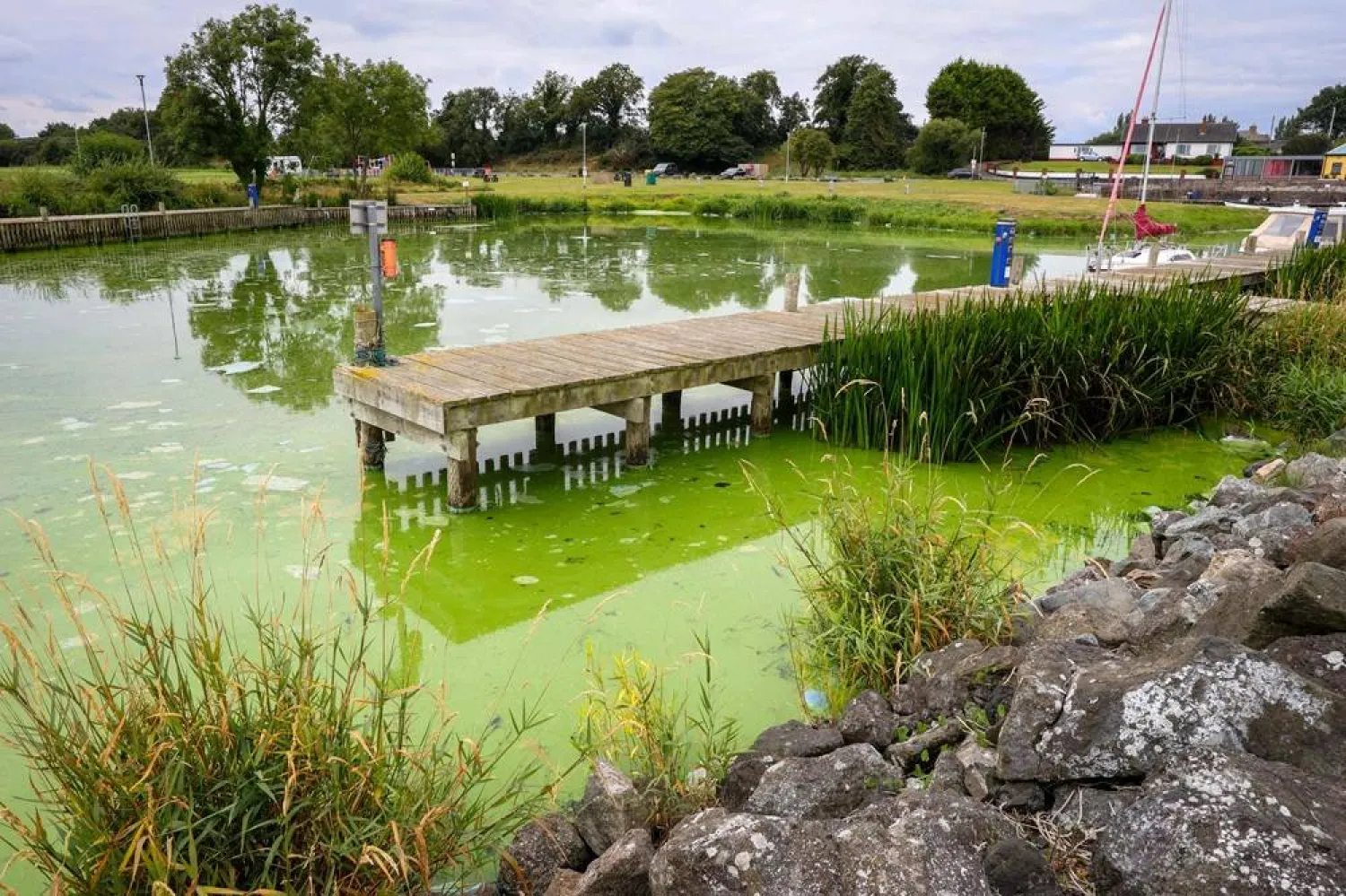

UK's Largest Lake 'Dying' as Algae Blooms Worsen

Blue-green algae infested water is pictured in Battery Harbor on the shores of Lough Neagh, in Northern Ireland, on August 22, 2025. (AFP)
TT

UK's Largest Lake 'Dying' as Algae Blooms Worsen

Blue-green algae infested water is pictured in Battery Harbor on the shores of Lough Neagh, in Northern Ireland, on August 22, 2025. (AFP)

For the third year running toxic blue-green algae blooms that look like pea soup and smell like rotten eggs have covered much of Lough Neagh, the largest lake in the UK and Ireland.

But this summer, the thick green veneer -- so widespread it is visible from space -- has been worse than ever, according to locals living near the Northern Ireland landmark.

"The lake is dying," Mary O'Hagan, an open water swimmer, told AFP at Ballyronan, on its western shore, as ducks struggled over slick green-coated stones.

The algae growth -- fueled by industrial, agricultural and sewage pollution, as well as climate change, according to experts -- has ravaged fishing and watersports, and prompted concerns about drinking water safety.

Signs banning bathing dot the lake's 78-mile-long shoreline, including at Ballyronan, 34 miles (54 kilometers) west of the Northern Irish capital Belfast.

Nutrient-rich fertilizer and slurry run-off from farms supplying mega-firms like chicken processor Moy Park are being blamed for contributing to the pollution.

Untreated sewage spills and septic tank effluent are also suspected.

Moy Park deny polluting the lake and say the poultry sector is "highly regulated with strict limits set for wastewater quality" at all its local sites.

The algae growth is a "complex issue not specifically linked to any one sector," a spokesperson told AFP.

Lough Neagh was O'Hagan's "training ground" during the Covid years, but she has hardly dipped a toe in the water since.

The 48-year-old told AFP she suffers from chronic health problems and swimming is her only exercise. Now she must rely on local swimming pools.

"Swimming here with its spectacular sunrises helped me when I was in a bad place in my life. It's heartbreaking to see it now," she said as green-tinted waves lapped the shore.

O'Hagan has joined a campaign group, "Save Lough Neagh", and at a recent protest urged Northern Ireland's regional government to act faster.

"Fine the polluters!" she said, calling in addition for the creation of an independent environmental agency able to punish factory farms and agri-food giants guilty of pollution.

The invasive zebra mussel species, a recent arrival in the lake's waters, filter water but any benefit is far outweighed by the molluscs also stimulating algal photosynthesis, worsening the green water effect.

Meanwhile the algae has decimated the Lough Neagh fly, a staple for fish and birds, local fisherman Mick Hagan told AFP while casting a line in a nearby tributary river.

"This river used to be full of trout, but no longer," said the 38-year-old wading back to dry land without a catch.

Europe's largest eel fishery -- also on the lough -- suspended operations this year due to quality concerns.

Hagan's is the first of many generations in his family not to fish for eels in Lough Neagh.

Now he runs a pizza truck at a campervan site near Ballyronan, but the powerful stench from the lough kept most tourists away this summer.

According to Gavin Knox, whose paddleboard small business also fell victim to the sludge, the foul smell can reach miles inland.

The 48-year-old launched his venture in 2022 to help people safely have fun on the water.

Working with people with learning disabilities and brain injuries as well as families, Knox said bookings gradually dried up after the algae appeared.

"Doing business became impossible," he told AFP. "Even if there are safe places to paddle, nobody wants to do it when the fish are dying and the birds are covered in green slime."

Forced to repay a large start-up loan, he is angry that no compensation was ever offered by the government to affected small businesses.

"It's not fair that the people most impacted haven't been responded to in a meaningful manner," said Knox.

Last July the regional government launched an action plan to kickstart a fix.

But less than half the planned measures have been delivered.

The remaining steps have "delivery timelines extending into 2026 and beyond," said a government statement sent to AFP. It did not provide further details.

With around 40 percent of Northern Ireland's drinking water supplied by Lough Neagh, the risk of a health emergency might force swifter action by authorities, said Les Gornall, a local slurry expert whose nickname is "Doctor Sludge".

"If Belfast suddenly cannot guarantee a clean water supply, then there would be a property and tourism crash," he predicted.

"Maybe that prospect will jolt them into fixing the lake."


Scientists: 'Bleak' Future for Seals Decimated by Bird Flu

(FILES) This photograph shows elephant seals on the Possession Island, part of the Crozet Islands which are a sub-Antarctic archipelago of small islands in the southern Indian Ocean, on December 21, 2022. (Photo by Patrick HERTZOG / AFP)
TT

Scientists: 'Bleak' Future for Seals Decimated by Bird Flu

(FILES) This photograph shows elephant seals on the Possession Island, part of the Crozet Islands which are a sub-Antarctic archipelago of small islands in the southern Indian Ocean, on December 21, 2022. (Photo by Patrick HERTZOG / AFP)

The world's largest species of seal has been devastated by bird flu, which has wiped out half of all breeding females at a key wildlife haven near Antarctica, scientists warned Thursday.

The remote island of South Georgia is the home of a majority of all southern elephant seals. Males of these blubbery giants can grow up to two meters (six feet seven inches) long, weigh nearly four tons (8,800 pounds) -- and have a distinctive elephant-trunk-like proboscis on their face that earned the mammals their name.

Bird flu arrived on South Georgia in 2023 during an outbreak that has seen the virus spread across the world like never before, killing millions of birds and infecting many mammals, including several humans.

Earlier this year, scientists warned that bird flu had sparked the worst die-off on record for southern elephant seals when it spread among a population on Argentina's coast in 2023, AFP reported.

In a study published in the journal Communications Biology on Thursday, a UK team of researchers gave the first estimate for how hard South Georgia's seals have been hit.

"It paints a pretty stark and harrowing picture," Connor Bamford, a marine ecologist at the British Antarctic Survey and lead author of the study, told AFP.

According to the last count in 1995, South Georgia is home to 54 percent of all southern elephant seals.

On the same day of the year in 2022 and 2024, the scientists used hand-launched drones to take images of the island's three biggest breeding beaches.

After bird flu arrived, the number of breeding females plummeted by 47 percent, a loss of around 53,000 seals, according to the study.

Many pups also died on the beach after being abandoned by their bird-flu-infected mothers.

Scientists at the breeding ground on the Valdes Peninsula along Argentina's coast have determined that 97 percent of elephant seal pups died either from being abandoned or contracting bird flu in 2023.

On the peninsula, an even higher rate of breeding females -- 67 percent -- were estimated to have been wiped out.

"If the South Georgia population responds similarly to the modelled outlook at Peninsula Valdes, the future is bleak," the authors of the new study said.

However, Bamford did not think the elephant seals would be pushed "close to extinction".

The South Georgia population is much larger -- numbering in the hundreds of thousands -- so is likely to be more resilient, he said.

"That being said, the impacts to this population will be felt for many years to come," he added.

For the Valdes seals, scientists have estimated that the aftermath of this bird flu outbreak will likely reverberate until the end of the century.

The researchers believe that the seals are transmitting the virus to each other via water droplets, Bamford said.

While elephants spend most of their time in the water, they breed in densely packed colonies on wide, sandy beaches.

"There are thousands of them together, all coughing and splattering," Bamford said, adding that the seals are also particularly "snotty".

The scientist called for "regular check-ups" on South Georgia's elephant seals.


Solar Storms Delay the Launch of Blue Origin's Big New Rocket with Mars Orbiters for NASA

A Blue Origin New Glenn rocket is fueled for launch with NASA's EscaPADE mission, carrying two satellites to orbit Mars, from the Cape Canaveral Space Force Station in Cape Canaveral, Florida, US, November 9, 2025. REUTERS/Joe Skipper
TT

Solar Storms Delay the Launch of Blue Origin's Big New Rocket with Mars Orbiters for NASA

A Blue Origin New Glenn rocket is fueled for launch with NASA's EscaPADE mission, carrying two satellites to orbit Mars, from the Cape Canaveral Space Force Station in Cape Canaveral, Florida, US, November 9, 2025. REUTERS/Joe Skipper

Intense solar storms responsible for breathtaking auroras across the US delayed the launch of Blue Origin’s big new rocket Wednesday.

Already grounded by poor weather, the New Glenn rocket was poised to blast off in the afternoon with two Mars orbiters for NASA from Florida. But five hours before the targeted liftoff, it was called off because of the heightened solar activity, The AP news reported.

Worried about the possible impact of increased radiation on its Mars-bound spacecraft, NASA decided to postpone the launch until conditions improve. Officials said they would try again Thursday.

This will be only the second flight of a New Glenn rocket, which made its debut in January. At 321 feet (98 meters), it is considerably larger and more powerful than the New Shepard rockets that Jeff Bezos' Blue Origin is launching from Texas with passengers.


For First Time, Scientists See the Very Early Stages of a Supernova

An artist's impression shows a star exploding at the end of its lifecycle, called a supernova, in this handout image released by the European Southern Observatory on November 12, 2025. The star is located about 22 million light-years away from Earth in the galaxy NGC 3621. ESO/L. Calcada/Handout via REUTERS
TT

For First Time, Scientists See the Very Early Stages of a Supernova

An artist's impression shows a star exploding at the end of its lifecycle, called a supernova, in this handout image released by the European Southern Observatory on November 12, 2025. The star is located about 22 million light-years away from Earth in the galaxy NGC 3621. ESO/L. Calcada/Handout via REUTERS

The explosive death of a star - a supernova - is among the most violent cosmic events, but precisely how this cataclysm looks as it unfolds has remained mysterious. Scientists now have observed for the first time the very early stages of a supernova, with a massive star exploding in a distinctive olive-like shape, according to Reuters.

The researchers used the European Southern Observatory's Chile-based Very Large Telescope, or VLT, to observe the supernova, which involved a star roughly 15 times the mass of our sun residing in a galaxy called NGC 3621 about 22 million light-years from Earth in the direction of the constellation Hydra. A light-year is the distance light travels in a year, 5.9 trillion miles (9.5 trillion km).

The shape of such explosions has been hard to nail down until now because of how rapidly they take place, so it took quick action with this supernova. The explosion was detected on April 10, 2024, around the time astrophysicist Yi Yang of Tsinghua University in China had landed on a long flight to San Francisco. Yang's formal request just hours later to aim the VLT at the supernova was granted.

The researchers thus were able to observe the explosion just 26 hours after the initial detection and 29 hours after material from inside the star first broke through the stellar surface.

What they saw was the doomed star surrounded at its equator by a preexisting disk of gas and dust, with the explosion pushing material outward from the stellar core to distort the star's shape into one resembling a vertical-standing olive. The explosion notably did not blow the star apart in a spherical shape. Instead, the explosion pushed violently outward at opposite sides of the star.

"The geometry of a supernova explosion provides fundamental information on stellar evolution and the physical processes leading to these cosmic fireworks," said Yang, lead author of the study published on Wednesday in the journal Science Advances.

"The exact mechanisms behind supernova explosions of massive stars, those with more than eight times the mass of the sun, are still debated and are one of the fundamental questions scientists want to address," Yang said.

Big stars like those live relatively short lives. This one, a type called a red supergiant, was about 25 million years old at the time of its demise. In comparison, the sun is more than 4.5 billion years old and has a few more billion years to go.

At the time it exploded, this star's diameter was 600 times greater than the sun. Some of the star's mass was blown into space in the explosion. The remainder is believed to have become a neutron star, a highly compact stellar remnant, according to study co-author Dietrich Baade, a Germany-based astrophysicist at the European Southern Observatory.

When a star exhausts the hydrogen fuel for the nuclear fusion occurring at its center, its core collapses, which then sends material blasting outward, penetrating the stellar surface and into space.

"The first VLT observations captured the phase during which matter accelerated by the explosion near the center of the star shot through the star's surface, the photosphere," Yang said.

"Once the shock breaks through the surface, it unleashes immense amounts of energy. The supernova then brightens dramatically and becomes observable. During a short-lived phase, the supernova's initial 'breakout' shape can be studied before the explosion interacts with the material surrounding the dying star," Yang said.

This shape, Yang said, offers clues about how the explosion was triggered at the heart of the star. The new observations seem to rule out some current scientific models of the explosion process, Yang said, as scientists refine their understanding of the deaths of massive stars.
