


Report: Rising Oceans to Threaten 1.5 Million Australians by 2050

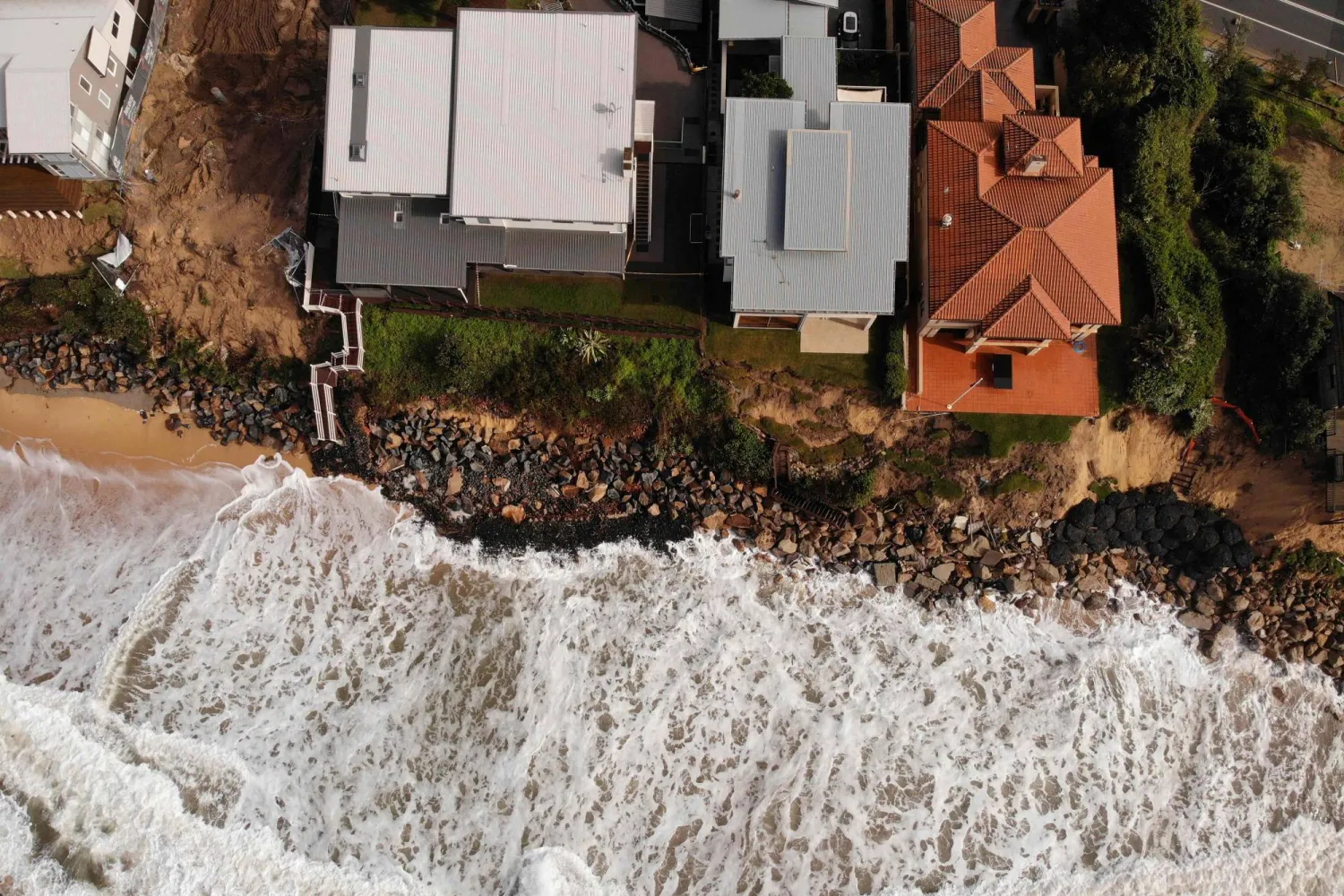
(FILES) An aerial file photo taken on July 28, 2020 shows homes perched on Australia's eastern coastal town of Wamberal that are at risk of being swept away, after days of driving rain, high winds and monster swells smashed the coastline. (Photo by Peter PARKS / AFP)
TT

Report: Rising Oceans to Threaten 1.5 Million Australians by 2050

(FILES) An aerial file photo taken on July 28, 2020 shows homes perched on Australia's eastern coastal town of Wamberal that are at risk of being swept away, after days of driving rain, high winds and monster swells smashed the coastline. (Photo by Peter PARKS / AFP)

Rising oceans and flooding caused by climate change will threaten the homes and livelihoods of over a million Australians by 2050 while deaths from heat-related illness will soar, a landmark report warned Monday ahead of the country's releasing its emission reduction targets this week.

The long-awaited national climate risk assessment found that rising temperatures will have "cascading, compounding, concurrent" impacts on life in Australia, home to more than 27 million people.

"We are living climate change now. It's no longer a forecast, a projection or prediction -- it is a live reality, and it's too late to avoid any impacts," AFP quoted Climate Minister Chris Bowen as saying.

The report, prepared independently for the government, found that 1.5 million people living in coastal areas will be at risk of sea level rise and coastal flooding by 2050.

By 2090, about three million people will be at risk from rising oceans.

Sea level rises pose a significant threat to homes, livelihoods, and cultural connections -- particularly in locations such as the Torres Strait Islands.

Scattered through the warm waters off Australia's northernmost tip, the sparsely populated islands are threatened by seas rising much faster than the global average.

Monday's report comes as Australia is set to release its next round of emissions reduction targets in the coming week, a key obligation under the landmark Paris climate agreement.

Many hope the country will reveal more ambitious targets.

Losses in Australian property values are estimated to soar to Aus$611 billion (US$406 billion) by 2050 and could increase to $770 billion by 2090.

Should the temperatures increase by 3C, heat-related deaths could soar by over 400 percent in the country's most-populated city of Sydney, the report said.

And Australia's unique species will be forced to move, adapt to the new conditions or die out, as climate change intensifies, the report added.

Amanda McKenzie, chief executive of the Climate Council NGO, described the report as "terrifying.”

"We can choose a better future by cutting climate pollution harder and faster now," McKenzie said.

"The first step is legislating the strongest possible 2035 climate target and stopping new polluting projects," she added.

One of the world's biggest fossil fuel exporters, Australia has been criticized for treating climate action as a political and economic liability.

The so-called "climate wars" -- a years-long domestic fight over emissions policy -- were blamed for curtailing progress in cutting heat-trapping carbon emissions.

In recent years, the center-left Labor government has stepped up efforts to bring down emissions and roll out renewable energy.

But despite its green ambitions, the government continues to approve fossil fuel projects, including granting a 40-year extension to a major liquified gas plant.

The extended lifeline of the North West Shelf project -- a sprawling industrial complex of offshore rigs and processing factories pumping out more than 10 million tons of liquified gas and petroleum each year -- has angered Indigenous and environmental groups.

Bowen said moving to a greener future presented a "complicated and complex" set of challenges and that gas would remain a necessary backup renewable in the future energy mix.

"But we also face that challenge from a position of strength, because we have the best renewable resources in the world," he added.



Saudi Space Agency Wins Four Platinum MarCom Awards

Saudi Space Agency Wins Four Platinum MarCom Awards
TT

Saudi Space Agency Wins Four Platinum MarCom Awards

Saudi Space Agency Wins Four Platinum MarCom Awards

The Saudi Space Agency achieved a distinguished international milestone by winning four Platinum Awards at the 2025 MarCom Awards, one of the world’s leading creative competitions in marketing, communications, and creativity, reported the Saudi Press Agency on Tuesday. The Platinum tier is reserved for entries that meet the highest standards of quality and innovation.

The agency’s awards covered four main categories: Best Campaign for launching the Knowledge Space Portal, Best Integrated Marketing Campaign for the public awareness initiative during World Space Week, Best Social Media Engagement Campaign for the same initiative, and Best Creative Design for the campaign.

The MarCom Awards are administered by the Association of Marketing and Communication Professionals. In 2025, the competition announced its winners after receiving more than 6,000 entries from 43 countries worldwide.

These achievements reflect the agency’s effective collaboration with partners from both the public and private sectors in awareness and outreach campaigns aligned with the goals of Saudi Vision 2030, supporting the Kingdom’s drive to build a knowledge-based, innovation-led economy.


Demand for Air Con Set to Triple by 2050, Warns UN

 A woman protects herself from the sun with a fan during a heat wave in Seville, Spain. (Getty Images/AFP)
A woman protects herself from the sun with a fan during a heat wave in Seville, Spain. (Getty Images/AFP)
TT

Demand for Air Con Set to Triple by 2050, Warns UN

 A woman protects herself from the sun with a fan during a heat wave in Seville, Spain. (Getty Images/AFP)
A woman protects herself from the sun with a fan during a heat wave in Seville, Spain. (Getty Images/AFP)

Global demand for air conditioning could more than triple by 2050, the United Nations warned on Tuesday, calling for more sustainable cooling solutions.

The UN Environment Program said demand could surge due to increases in population and wealth around the world, combined with more extreme heat.

Rising demand for more polluting and inefficient cooling systems "would almost double cooling-related greenhouse gas emissions over 2022 levels", said UNEP.

UNEP launched its Global Cooling Watch 2025 report on the sidelines of the COP30 UN climate summit in Belem in the Brazilian Amazon.

"Installed cooling capacity is on a trajectory to triple by 2050... Yet billions will still lack adequate protection from heat. We must reimagine cooling -- not as a source of emissions, but as a cornerstone of heat resilience and sustainable development," it said.

The most rapid growth in cooling demand is projected in Africa and South Asia.

"As deadly heat waves become more regular and extreme, access to cooling must be treated as essential infrastructure alongside water, energy and sanitation," UNEP chief Inger Andersen said in a statement.

"But we cannot air condition our way out of the heat crisis, which would drive greenhouse gas emissions higher and raise costs."

UNEP highlighted so-called "passive cooling" options, including better wall and roof designs, shading, solar off-grid solutions and ventilation.

The potential impact on indoor temperatures from passive cooling strategies range from 0.5 to 8 degrees Celsius.

"Passive, energy efficient and nature-based solutions can help meet our growing cooling needs and keep people, food-chains and economies safe from heat as we pursue global climate goals," said Andersen.

The Cooling Report suggested adopting such measures could reduce emissions to 64 percent below the levels otherwise expected in 2050.


Devil In The Beetails: Australian Scientists Discover New 'Lucifer' Bee

Archive - Bees from the apiary of the Universidad del Rosario raised for the research of the formula to protect the brain of bees and other pollinators affected by exposure to insecticides, which was patented in Britain under the leadership of researchers from the Faculty of Natural Sciences of the Universidad del Rosario, in alliance with the Department of Neuroscience of the University of Arizona - Reuters
TT

Devil In The Beetails: Australian Scientists Discover New 'Lucifer' Bee

Archive - Bees from the apiary of the Universidad del Rosario raised for the research of the formula to protect the brain of bees and other pollinators affected by exposure to insecticides, which was patented in Britain under the leadership of researchers from the Faculty of Natural Sciences of the Universidad del Rosario, in alliance with the Department of Neuroscience of the University of Arizona - Reuters

As if deadly snakes, spiders and sharks were not enough, Australia now has a new creepy critter: a "lucifer" bee with devil-like horns.

The species -- dubbed Megachile (Hackeriapis) lucifer -- was found in the state of Western Australia, Curtin University announced on Tuesday.

Kit Prendergast at the university's School of Molecular and Life Sciences discovered the bee while surveying a critically endangered wildflower in 2019 and was immediately drawn to the insect's unique appearance, said AFP.

"The female had these incredible little horns on her face," she said.

A fan of the Netflix TV show "Lucifer", she said the name was the perfect fit for the bee's distinctively devilish appearance.

"It's the first new member of this bee group to be described in more than 20 years, which really shows how much life we still have to discover," Prendergast said.

She added that she hopes the discovery will raise awareness about the number of undiscovered species that could still be out there, especially in areas threatened by mining.

"Many mining companies still don't survey for native bees, so we may be missing undescribed species, including those that play crucial roles in supporting threatened plants and ecosystems," she said.

"Without knowing which native bees exist and what plants they depend on, we risk losing both before we even realize they're there."

Almost all flowering plants depend on wild pollinators, particularly bees, but habitat loss and climate change are driving many vital species to the brink of extinction.