Wolf-dog hybrids are rarer than first thought. Even the theory about how dogs originated from a relative of the grey wolf (pictured here) has shifted over time. DENIS LOVROVIC / AFP/File
Wolf-dog hybrids are rarer than first thought. Even the theory about how dogs originated from a relative of the grey wolf (pictured here) has shifted over time. DENIS LOVROVIC / AFP/File
A prominent Greek wildlife group on Friday said it had confirmed the first case of a wolf-dog hybrid in the north of the country.
The Callisto group -- which is currently involved in efforts to trap a rogue wolf in Halkidiki, northern Greece -- said the hybrid was found near the northern city of Thessaloniki.
"This is the first genetic (case) to be confirmed in Greece," Callisto biologist Aimilia Ioakimeidou told a conference in Athens.
The animal is 45 percent wolf and 55 percent canine according to DNA testing, she said.
It was discovered during tests on 50 wolf samples from the Greek mainland, Ioakimeidou said.
While wolf-dog hybrids had previously been reported in Europe, Central Asia and the United States, that categorization largely stemmed from just the appearance of the animals, said AFP.
Later genetic testing has shown such hybrids are rarer than first thought.
The wolf population in Greece has been growing steadily in past years as a result of a 1983 hunting ban under the Berne Convention.
According to a recent six-year study recently concluded by Callisto, it stands at 2,075 individuals, including at least three packs of a minimum of 31 wolves in the Mount Parnitha range near Athens.
The Thessaloniki-based organization aims to study, protect and manage the populations and habitats of large carnivores such as bears and wolves and other endangered species.
It is currently mounting an operation to locate a young wolf that injured a five-year-old girl from Serbia in the coastal resort of Neos Marmaras on September 12.
While domesticated dogs came from a close relative to the grey wolf some 40,000 to 15,000 years ago, the story of their origin has shifted in recent times.
A longstanding popular theory had held that wolves became tame by hanging around human settlements for food scraps.
But that has been challenged, and another theory holds that perhaps human hunter-gatherers took wolf pups to rear and they developed into the dogs we have today.
Bangkok Food Vendor Curbs Push City Staple from the Streetshttps://english.aawsat.com/varieties/5269045-bangkok-food-vendor-curbs-push-city-staple-streets
Bangkok Food Vendor Curbs Push City Staple from the Streets
This photo taken on April 30, 2026 shows a street vendor selling fried food along Silom road in Bangkok. (Photo by Lillian SUWANRUMPHA / AFP)
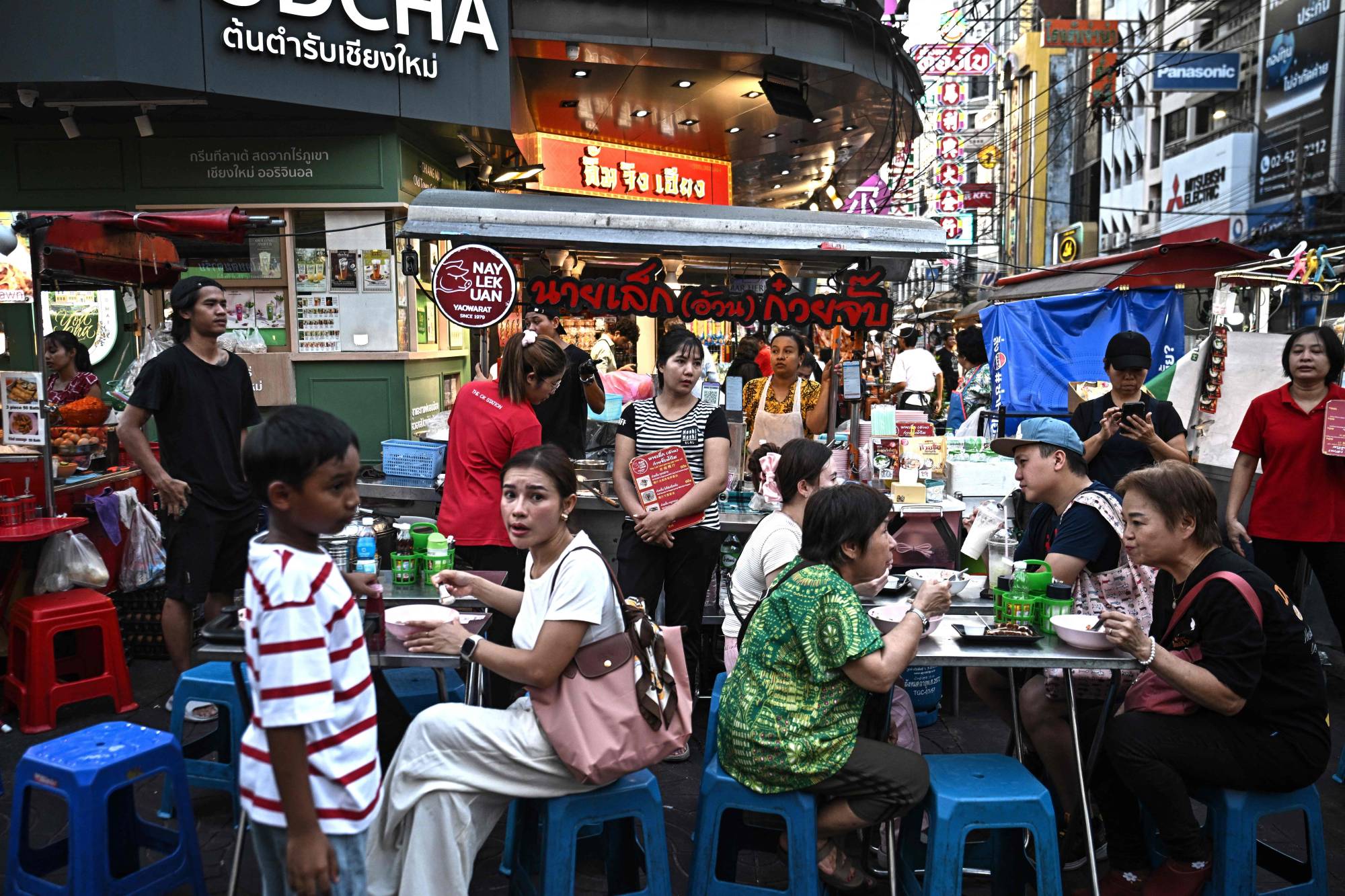
Across Bangkok, aromas of garlic, chili and grilled meat drift from roadside stalls and carts, but tighter controls on vendors threaten livelihoods and the street food culture that defines the Thai capital.
Convenient, full of flavor and popular among locals and tourists alike, Bangkok's street food is one of the city's signatures -- where sizzling woks and smoky charcoal grills turn boulevards and sidewalks into open-air kitchens from morning until late at night.
But many street sellers in the foodie paradise face an uncertain future as the Bangkok government in recent years has moved to clear footpaths, improve order and relocate vendors from curbsides in packed commercial districts to designated market stalls.
"I am worried because we are here illegally," said Looknam Sinwirakit, who was once fined 1,000 baht ($30) for obstructing the street while selling 50-baht fried glutinous rice cakes in the capital's Chinatown.
This photo taken on April 29, 2026 shows people eating noodles from a street food stall in Chinatown in Bangkok. (Photo by Lillian SUWANRUMPHA / AFP)
One of Bangkok's busiest tourist areas, the neighborhood's steady flow of customers is worth the risk of city fines, Looknam, 45, told AFP.
"Vendors need to earn a living," she said. "It's not fair just to evict us, but if they tell us to (leave) then we have to."
Nearby, durian seller Wong Jaidee, who has sold the strong-smelling fruit for more than two decades, said he also feared being made to move.
"I don't have any backup plan," the 56-year-old said. "Bangkok is a high-priced city and we may not be able to cope."
- Time to move -
Since 2022, the estimated number of mobile vendors in the city has fallen by more than 60 percent, with around 10,000 fewer now on the streets, according to data from the Bangkok Metropolitan Administration (BMA).
While dozens have moved to informal markets and hawker centres -- using a model similar to Singapore, where food vendors are grouped in designated locations -- many others have simply closed their business due to the stricter regulations or because they were no longer profitable, said BMA official Kunanop Lertpraiwan.
The municipality has mostly targeted vendors crowding main roads with heavy pedestrian foot traffic, while those on side streets and in areas popular with backpackers and other tourists were allowed more flexibility, Kunanop said.
"We give them time and communicate with them clearly," he said, adding some sellers were given several months to find a new location.
"It's not like we will move them tomorrow."
The city is pushing more vendors to set up shop in one of five hawker centers opened in recent years -- the latest in April beside Bangkok's popular Lumphini Park.
With rows of food stalls and picnic tables, the new hub so far houses around a dozen vendors who previously sold food on nearby streets.
BMA encouraged them to relocate, and they now pay 60 baht a day to rent a hawker stall.
Panissara Piyasomroj, who sold noodles to morning runners in the park since 2004, said moving into the center meant better conditions, including convenient water and electricity access.
Under a roof to beat the heat, the 59-year-old said her business had been "upgraded" and "looks cleaner".
- 'Part of the culture' -
But for other vendors, the prospect of moving from a familiar setting remains a concern.
Thitisakulthip Sang-uamsap, 67, has sold fried vegetable balls near Chinatown for more than 40 years and worries she could be forced to relocate.
"I live around here... if they ask me to leave, I won't be comfortable," she said, adding she hoped the government would show empathy for older vendors earning little income.
The crowded, bustling sidewalks and the smell of freshly grilled squid and other street treats are for many visitors a key part of Bangkok's charm -- and a cheap, tasty meal on-the-go is worth the hassle of a blocked path.
German tourist Oliver Peter said Thailand has one of the best cuisines in the world, noting his favorite, Pad Thai -- the popular stir-fried rice noodles ubiquitous in Bangkok's streetside woks.
"It would be sad if they go away," he said. "It's part of the culture."
Mexico City is Sinking So Quickly, it Can be Seen from Spacehttps://english.aawsat.com/varieties/5269024-mexico-city-sinking-so-quickly-it-can-be-seen-space
Mexico City is Sinking So Quickly, it Can be Seen from Space
Uneven buildings and grounds at the Templo Mayor shows a city sinking, July 28, 2016, in Mexico City. (AP Photo/Ross D. Franklin)
Mexico City is sinking by nearly 10 inches (about 25 centimeters) a year, according to new satellite imagery released this week by NASA, making it one of the world’s fastest-subsiding metropolises.
One of the world's most sprawling and populated urban areas, at 3,000 square miles (about 7,800 square kilometers) and some 22 million people, the Mexican capital and surrounding cities were built atop an ancient lake bed.
Many downtown streets were once canals, a tradition that continues in the rural fringes.
Extensive groundwater pumping and urban development have dramatically shrunk the aquifer, meaning that Mexico City has been sinking for more than a century, leaving many monuments and older buildings — like the Metropolitan Cathedral, where construction began in 1573 — visibly tilted to the side. The contracting aquifer has also contributed to a chronic water crisis that is only expected to worsen.
“It damages part of the critical infrastructure of Mexico City, such as the subway, the drainage system, the water, the potable water system, housing and streets,” said Enrique Cabral, a researcher studying geophysics at the National Autonomous University of Mexico. “It’s a very big problem.”
Mexico City is sinking so fast that the subsidence can be spotted from space.
In some parts it is happening at an average rate of 0.78 inches (2 centimeters) a month, according to NASA’s newly released report, such as at the main airport and the iconic monument commonly known as the Angel of Independence.
Overall that means a yearly subsidence rate of about 9.5 inches (24 centimeters). Over the course of less than a century, the drop has been more than 39 feet (12 meters), according to Cabral.
“We have one of the fastest velocities of land subsidence in the whole world,” The Associated Press quoted him as saying.
The NASA estimates are based on measurements taken between October 2025 and January 2026 by a powerful satellite known as NISAR, which can track real-time changes on the Earth’s surface and is a joint initiative between NASA and the Indian Space Research Organization.
NISAR scientist Paul Rosen said that by capturing details of the Earth from space, the project is also “telling us something about what’s actually happening below the surface.”
“It’s basically documentation of all of these changes within a city,” Rosen said. He added: “You can see the full magnitude of the problem.”
With time the team hopes to be able to zoom in even more on specific areas and someday get measurements on a building-by-building basis.
More broadly, researchers hope to apply the technology around the world to track things like natural disasters, changes in fault lines, the effects of climate change in regions like Antarctica and more.
Rosen said it could be used to bolster alert systems, letting scientists alert governments to the need for evacuations in cases of volcano eruptions, for example.
For Mexico City the technology amounts to a big advance in studying the subsidence issue and mitigating its worst effects, according to Cabral.
For decades the government has largely ignored the problem other than stabilizing foundations under monuments like the cathedral. But following recent flare-ups of the water crisis, Cabral said, officials have begun to fund more research.
Imagery from the NISAR satellite and the data that comes with it will be key for scientists and officials as they plan on how to address the problem.
“To do long-term mitigation of the situation,” Cabral said, “the first step is to just understand.”
60 Years Later… Man Returns Tiles from Medieval Prioryhttps://english.aawsat.com/varieties/5269021-60-years-later%E2%80%A6-man-returns-tiles-medieval-priory
English Heritage was particularly thrilled that one of the fragments had a dragon motif on it, which was previously unknown at the site. (English Heritage)
60 Years Later… Man Returns Tiles from Medieval Priory
English Heritage was particularly thrilled that one of the fragments had a dragon motif on it, which was previously unknown at the site. (English Heritage)
Fragments of a priory’s medieval tiled floor that spent almost 60 years stashed in a toffee tin after being pocketed by a nine-year-old boy during a family outing have finally been handed back, according to The Guardian.
The three pieces of decorative clay tiles, dating from the late 13th to early 14th century, were taken as a souvenir by Simon White during a family visit to Wenlock Priory in Shropshire in the late 1960s.
White, now a 68-year-old retired chartered surveyor, found the fragments in an old toffee tin during a house move and owned up to English Heritage. He told officials he recalled his father encouraging him to take the pieces but had always felt a little uneasy and was delighted when he rediscovered them.
“I can remember the day this all happened with my father standing guard,” he said. “Heaven knows what he would have said if we’d been caught. What happened to the tiles afterwards I’m not really sure, but they survived numerous house moves and assorted family upheavals only to turn up in my loft earlier this year in a battered tin.”
With the help of family diaries, White worked out that they probably came from Wenlock Priory and contacted the site’s custodians, English Heritage.
Matty Cambridge, assistant curator at the charity, said medievalists had concluded White was right to pinpoint Wenlock as the scene of the act. She said tiles like the ones White had taken were only known to have existed at three places in Shropshire: Haughmond Abbey, Bridgnorth Friary and Wenlock Priory.
Cambridge added: “Given Bridgnorth Friary has no in situ tile and wasn’t excavated until after Simon’s trip, and Haughmond Abbey only has a small patch of tile still at the site, we can narrow down the tiles found to Wenlock Priory.”
لم تشترك بعد
انشئ حساباً خاصاً بك لتحصل على أخبار مخصصة لك ولتتمتع بخاصية حفظ المقالات وتتلقى نشراتنا البريدية المتنوعة