


Nobel Prize in Physics Goes to 3 Scientists Whose Work Advanced Quantum Technology 

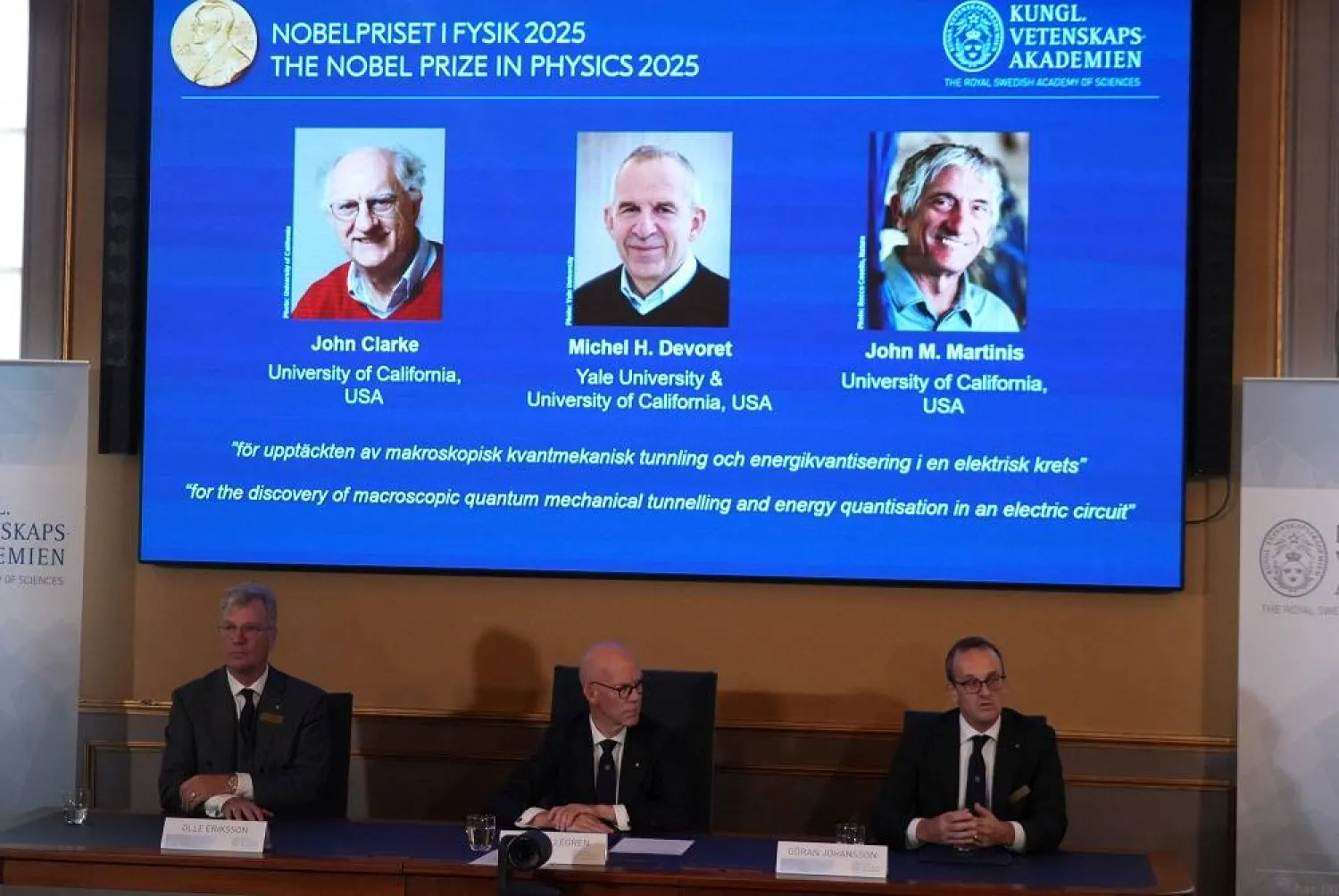
John Clarke, Michel H. Devoret and John M. Martinis are announced this year's Nobel Prize winners in Physics, by the Royal Swedish Academy of Sciences at a press conference in Stockholm, Sweden October 7, 2025. (Reuters)
TT

Nobel Prize in Physics Goes to 3 Scientists Whose Work Advanced Quantum Technology 

John Clarke, Michel H. Devoret and John M. Martinis are announced this year's Nobel Prize winners in Physics, by the Royal Swedish Academy of Sciences at a press conference in Stockholm, Sweden October 7, 2025. (Reuters)

John Clarke, Michel H. Devoret and John M. Martinis won the Nobel Prize in Physics on Tuesday for research on seemingly obscure quantum tunneling that is advancing digital technology.

Clarke, 83, conducted his research at the University of California, Berkeley; Martinis at the University of California, Santa Barbara; and Devoret at Yale and also at the University of California, Santa Barbara.

“To put it mildly, it was the surprise of my life,” Clarke told reporters at the announcement by phone after being told of his win.

He paid tribute to the other two laureates, saying that “their contributions are just overwhelming."

“Our discovery in some ways is the basis of quantum computing. Exactly at this moment where this fits in is not entirely clear to me.”

However, speaking from his cellphone, Clarke added: “One of the underlying reasons that cellphones work is because of all this work.’’

The Nobel committee said that the laureates' work in the 1980s continues to provide opportunities to develop “the next generation of quantum technology, including quantum cryptography, quantum computers, and quantum sensors.”

“It is wonderful to be able to celebrate the way that century-old quantum mechanics continually offers new surprises. It is also enormously useful, as quantum mechanics is the foundation of all digital technology,” said Olle Eriksson, Chair of the Nobel Committee for Physics.

The 100-year-old field of quantum mechanics deals with the seemingly impossible subatomic world where switches can be on and off at the same time and parts of atoms tunnel through what seems like impenetrable barriers. The prize-winning trio’s work helped take that into the larger world, where it has the potential to supercharge computing and communications.

What the three physicists did “is taking the scale of something that we can’t see, we can’t touch, we can’t feel and bringing it up to the scale of something recognizable and make it something you can build upon,” said Physics Today editor-in-chief Richard Fitzgerald, who in the 1990s worked in the field on a competitors’ group.

“Quantum computers is one very sort of obvious use, but they’re also can be used for quantum sensors, so to be able to make very sensitive measurements of, for example, magnetic fields, and perhaps also for cryptography, so to encode information so it cannot be easily listened to by a third party,” Mark Pearce, a professor of astrophysics and Nobel Physics Committee member, told The Associated Press.

It is the 119th time the prize has been awarded. Last year, artificial intelligence pioneers John Hopfield and Geoffrey Hinton won the physics prize for helping create the building blocks of machine learning.

On Monday, Mary E. Brunkow, Fred Ramsdell and Dr. Shimon Sakaguchi won the Nobel Prize in medicine on Monday for discoveries about how the immune system knows to attack germs and not our bodies.

Nobel announcements continue with the chemistry prize on Wednesday and literature on Thursday. The Nobel Peace Prize will be announced Friday and the Nobel Memorial Prize in economics on Oct. 13.

The award ceremony will be held Dec. 10, the anniversary of the 1896 death of Alfred Nobel, the wealthy Swedish industrialist and the inventor of dynamite who founded the prizes.

The prizes carry priceless prestige and a cash award of 11 million Swedish kronor (nearly $1.2 million).



Australian Teen Charged Over Sticking Eyes on Artwork

The local council said they could not remove the eyes without damaging the artwork (Facebook/Amelia Vanderhorst)
TT

Australian Teen Charged Over Sticking Eyes on Artwork

The local council said they could not remove the eyes without damaging the artwork (Facebook/Amelia Vanderhorst)

An Australian teenager has faced court for allegedly defacing a large blue sculpture of a mythical creature by sticking googly eyes on it.

Amelia Vanderhorst, 19, appeared via phone at Mount Gambier Magistrates Court in South Australia on Tuesday charged with one count of property damage.

In a statement at the time of the September incident, the local council said Closed Circuit Television (CCTV) footage showed a person putting artificial eyes on the artwork which locals have nicknamed the “Blue Blob.”

Vanderhorst did not enter a plea and told the court she was ill, according to the Australian Broadcasting Corporation (ABC), with the magistrate advising her to find a lawyer before her next court date in December.

A day after the alleged incident, the local mayor said repairs to the much-loved public artwork would be costly as the stickers could not be removed without damaging the sculpture.

“This willful damage to a valued public artwork is inappropriate and disrespectful,” City of Mount Gambier mayor Lynette Martin said in mid-September.

“It is not harmless fun, it is costly - it is also frustrating to those members of our community who have embraced Cast in Blue.”

She said the council would pursue the “significant” repair costs from those responsible for the damage.

When the sculpture was first proposed, it drew mixed reactions from the local community due to its price tag and design.

Costing 136,000 Australian dollar ($89,000), the artwork represents a mythical megafauna, with the sculpture's designers inspired by an ancient marsupial ant-eater found in local caves that was “massive, lumbering and fascinating.”


The Groves Opens at Riyadh Season 2025 with Exceptional Experiences

The Groves opens at Riyadh Season 2025 with exceptional experiences. (SPA)
TT

The Groves Opens at Riyadh Season 2025 with Exceptional Experiences

The Groves opens at Riyadh Season 2025 with exceptional experiences. (SPA)

The Groves welcomed visitors on Wednesday as part of Riyadh Season 2025, unveiling a new chapter of luxury and creativity in the heart of Al-Rafiah District and transforming into a global destination that blends flavors, art, music and nature.

The venue, which offers dining concepts to live entertainment, art, and nature-inspired design, drew large crowds who enjoyed an exceptional atmosphere filled with diverse culinary experiences, interactive performances and live music, the Saudi Press Agency reported on Thursday.

The venue reflects the growing popularity of Riyadh Season’s signature attractions each year.

Now in its fourth edition, The Groves introduces a range of innovative concepts, including the first Saudi-born Persian dining concept that fuses refined taste with rich heritage. Visitors can also immerse themselves in a live dramatic journey set amid the charm of old Damascus.

The destination further offers a unique world of candy and interactive theatrical performances in a family-friendly atmosphere, complemented by Italian and Japanese flavors served in a contemporary style inspired by the world of stars.


Scientists Unveil First Draft of Atlas of the Developing Brain

A researcher holds a human brain, part of a collection of more than 3,000 brains at the psychiatric hospital in Duffel, Belgium, July 19, 2017. REUTERS/Yves Herman
TT

Scientists Unveil First Draft of Atlas of the Developing Brain

A researcher holds a human brain, part of a collection of more than 3,000 brains at the psychiatric hospital in Duffel, Belgium, July 19, 2017. REUTERS/Yves Herman

Scientists have reached a milestone in an ambitious initiative to chart how the many types of brain cells emerge and mature from the earliest embryonic and fetal stages until adulthood, knowledge that could point to new ways of tackling certain brain-related conditions like autism and schizophrenia.

The researchers said they have completed a first draft of atlases of the developing human brain and the developing mammalian brain.

The research focused on human and mouse brain cells, with some work in monkey brain cells too. In their initial draft, the scientists mapped the development of different types of brain cells - tracking how they are born, differentiate and mature into various types with unique functions. They also tracked how genes are turned on or off in these cells over time, Reuters reported.

The scientists identified key genes controlling brain processes and uncovered some commonalities of brain cell development between human and animal brains, as well as some unique aspects of the human brain, including identifying previously unknown cell types.

The findings were detailed in a collection of studies published in Nature and related journals.

The research is part of the U.S. National Institutes of Health's BRAIN Initiative Cell Atlas Network, or BICAN, an international scientific collaboration to create a comprehensive atlas of the human brain.

"Our brain has thousands of types of cells with extraordinary diversity in their cellular properties and functions, and these diverse cell types work together to generate a variety of behaviors, emotions and cognition," said neuroscientist Hongkui Zeng, director of brain science at the Allen Institute in Seattle and leader of two of the studies.

Researchers have found more than 5,000 cell types in the mouse brain. It is thought there are at least that many in the human brain.

"The developing brain is an incredibly enigmatic structure because it is hard to access, comprised of so many distinct cell types, and rapidly changing. While we knew the big-picture shifts that happen during brain development, we now have a much more detailed understanding of what the pieces of the developing brain are because of this set of atlases," said UCLA neuroscientist Aparna Bhaduri, another of the research leaders.

The research promises important practical applications.

"First, by studying and comparing brain development in human and animals, we will better understand human specialization and where our unique intelligence comes from. Second, by understanding normal brain development in humans and animals, we will be better able to study what changes are happening in diseased brains - when and where - both in human diseased tissues and in animal disease models," Zeng said.

By gaining this knowledge, scientists hope to achieve more precise gene- and cell-based therapies for a range of human diseases, Zeng said. The hope is that the findings will provide a deeper understanding of autism, attention deficit hyperactivity disorder, schizophrenia and other conditions known to unfold during brain development.

The brain regions for which the researchers created atlases for cell type development included the neocortex, which is the part of the brain's outermost layer where higher cognitive function originates, and the hypothalamus, a small structure deep in the brain that helps govern body temperature, blood pressure, mood, sleep, sex drive, hunger and thirst.

One study showed that a subset of cells in human brain tumors are similar to embryonic progenitor cells - a kind of cell in the embryo that can change into specific types within a particular brain region - raising the possibility that such tumors may hijack developmental processes to drive malignancy.

According to Reuters, the researchers identified some unique aspects of the human brain. One example was the prolonged process of differentiation in cortical cell types due to the long period of human brain development from fetus to adolescence compared to the speedier development timeline in the animals.

Among the newly identified brain cell types were some in the neocortex and the striatum region, which controls movement and certain other functions.

More work is ahead.

"The goal is to ultimately understand not only what the pieces of the developing brain are, but also to describe what happens in neurodevelopmental and neuropsychiatric disorders that develop vulnerability during development," Bhaduri said.

"This is also relevant to brain cancer, which my lab also studies, as during brain cancer these developmental pieces re-emerge. So it is really a big goal, and it will take time to fully understand and treat all these disorders. But this set of papers is a nice piece of progress," Bhaduri said.