


Global Experts: World's Coral Reefs Cross Survival Limit

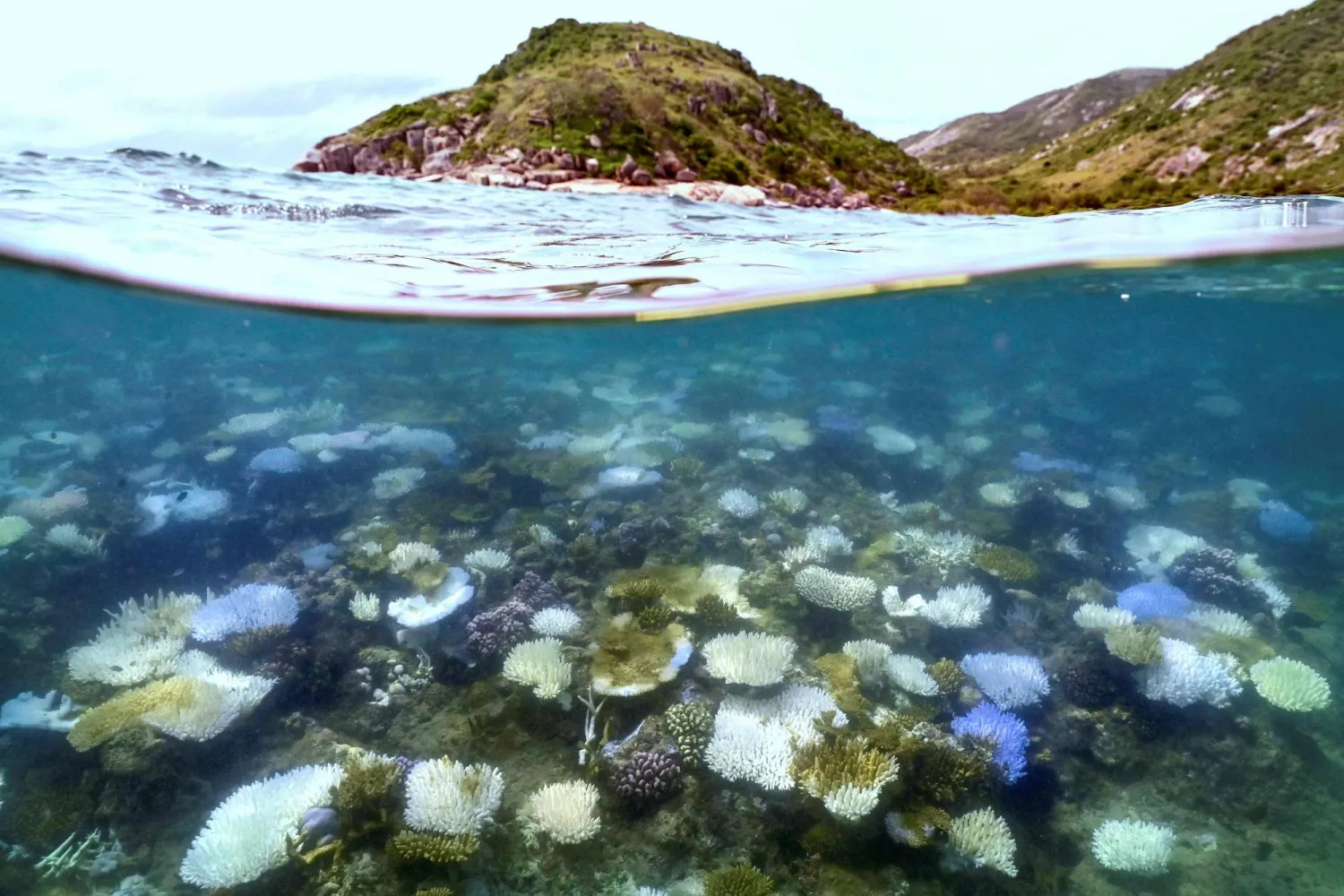
(FILES) This underwater photo taken on April 5, 2024, shows bleached and dead coral around Lizard Island on the Great Barrier Reef, located 270 kilometres (167 miles) north of the city of Cairns. (Photo by DAVID GRAY / AFP)
TT

Global Experts: World's Coral Reefs Cross Survival Limit

(FILES) This underwater photo taken on April 5, 2024, shows bleached and dead coral around Lizard Island on the Great Barrier Reef, located 270 kilometres (167 miles) north of the city of Cairns. (Photo by DAVID GRAY / AFP)

The world's tropical coral reefs have almost certainly crossed a point of no return as oceans warm beyond a level most can survive, a major scientific report announced on Monday.

It is the first time scientists have declared that Earth has likely reached a so-called "tipping point" -- a shift that could trigger massive and often permanent changes in the natural world.

"Sadly, we're now almost certain that we crossed one of those tipping points for warm water or tropical coral reefs," report lead Tim Lenton, a climate and Earth system scientist at the University of Exeter, told AFP.

This conclusion was supported by real-world observations of "unprecedented" coral death across tropical reefs since the first comprehensive assessment of tipping points science was published in 2023, the authors said.

In the intervening years, ocean temperatures have soared to historic highs, and the biggest and most intense coral bleaching episode ever witnessed has spread to more than 80 percent of the world's reefs.

Understanding of tipping points has improved since the last report, its authors said, allowing for greater confidence in estimating when one might spark a domino effect of catastrophic and often irreversible disasters.

Scientists now believe that even at lower levels of global warming than previously thought, the Amazon rainforest could tip into an unrecognizable state, and ice sheets from Greenland to West Antarctica could collapse.

'Unprecedented dieback'

For coral reefs, profound and lasting changes are already in motion.

"Already at 1.4C of global warming, warm water coral reefs are crossing their thermal tipping point and experiencing unprecedented dieback," said the report by 160 scientists from dozens of global research institutions.

The global scientific consensus is that most coral reefs would perish at warming of 1.5C above preindustrial levels -- a threshold just years away.

When stressed in hotter ocean waters, corals expel the microscopic algae that provides their distinct color and food source.

Unless ocean temperatures return to more tolerable levels, bleached corals simply cannot recover and eventually die of starvation.

Since 2023, marine scientists have reported coral mortality on a scale never seen before, with reefs turning ghostly white across the Pacific, Indian and Atlantic oceans.

"I am afraid their response confirms that we can no longer talk about tipping points as a future risk," Lenton told reporters.

Rather than disappear completely, scientists say reefs will evolve into less diverse ecosystems as they are overtaken by algae, sponges and other simpler organisms better able to withstand hotter oceans.

These species would come to dominate this new underwater world and over time, the dead coral skeletons beneath would erode into rubble.

Such a shift would be disastrous for the hundreds of millions of people whose livelihoods are tied to coral reefs, and the estimated one million species that depend on them.

'Danger zone'
Some heat-resistant strains of coral may endure longer than others, the authors said, but ultimately the only response is to stop adding more planet-warming greenhouse gases into the atmosphere.

Exceeding 1.5C "puts the world in a greater danger zone of escalating risk of further damaging tipping points", Lenton said, including the collapse of vital ocean currents that could have "catastrophic" knock-on impacts.

Scientists also warned that tipping points in the Amazon were closer than previously thought, and "widespread dieback" and large-scale forest degradation was a risk even below 2C of global warming.

That finding will be keenly felt by Brazil, which on Monday is hosting climate ministers in Brasilia ahead of next month's UN COP30 conference in Belem on the edge of the Amazon.

In good news -- the exponential uptake of solar power and electric vehicles were two examples of "positive" tipping points where momentum can accelerate for the better, said Lenton.

"It gives us agency back, policymakers included, to make some tangible difference, where sometimes the output from our actions is sometimes disproportionately good," he told AFP.



Mummified Cheetahs Found in Saudi Caves Shed Light on Lost Populations

This undated image provided by Communications Earth and Environment shows the mummified remains of a cheetah. (Ahmed Boug/Communications Earth and Environment via AP)
TT

Mummified Cheetahs Found in Saudi Caves Shed Light on Lost Populations

This undated image provided by Communications Earth and Environment shows the mummified remains of a cheetah. (Ahmed Boug/Communications Earth and Environment via AP)

Scientists have uncovered the mummified remains of cheetahs from caves in northern Saudi Arabia.

The remains range from 130 years old to over 1,800 years old. Researchers excavated seven mummies along with the bones of 54 other cheetahs from a site near the city of Arar.

Mummification prevents decay by preserving dead bodies. Egypt's mummies are the most well-known, but the process can also happen naturally in places like glacier ice, desert sands and bog sludge.

The new large cat mummies have cloudy eyes and shriveled limbs, resembling dried-out husks.

“It’s something that I’ve never seen before,” said Joan Madurell-Malapeira with the University of Florence in Italy, who was not involved with the discovery.

Researchers aren’t sure how exactly these new cats got mummified, but the caves’ dry conditions and stable temperature could have played a role, according to the new study published Thursday in the journal Communications Earth and Environment.

They also don't know why so many cheetahs were in the caves. It could have been a denning site where mothers birthed and raised their young.

Scientists have uncovered the rare mummified remains of other large cats, including a saber-toothed cat cub in Russia.

It's uncommon for large mammals to be preserved to this degree. Besides being in the right environment, the carcasses also have to avoid becoming a snack for hungry scavengers like birds and hyenas.

Cheetahs once roamed across most of Africa and parts of Asia, but now live in just 9% of their previous range and haven't been spotted across the Arabian Peninsula for decades. That’s likely due to habitat loss, unregulated hunting and lack of prey, among other factors.

In a first for naturally mummified large cats, scientists were also able to peek at the cheetahs' genes and found that the remains were most similar to modern-day cheetahs from Asia and northwest Africa. That information could help with future efforts to reintroduce the cats to places they no longer live.


Vonn Launches Social Media Search Mission After Ski Pole Goes Missing

 US' Lindsey Vonn crosses the finish line to win the Women's Downhill event of the FIS Alpine Ski World Cup in Altenmarkt Zauchensee, Austria, on January 10, 2026. (AFP)
US' Lindsey Vonn crosses the finish line to win the Women's Downhill event of the FIS Alpine Ski World Cup in Altenmarkt Zauchensee, Austria, on January 10, 2026. (AFP)
TT

Vonn Launches Social Media Search Mission After Ski Pole Goes Missing

 US' Lindsey Vonn crosses the finish line to win the Women's Downhill event of the FIS Alpine Ski World Cup in Altenmarkt Zauchensee, Austria, on January 10, 2026. (AFP)
US' Lindsey Vonn crosses the finish line to win the Women's Downhill event of the FIS Alpine Ski World Cup in Altenmarkt Zauchensee, Austria, on January 10, 2026. (AFP)

Lindsey Vonn may be dominating World Cup downhills at 41, but even the US speed queen is not immune to missing equipment.

Vonn took to social media on Thursday with an unusual plea after losing a ski pole in Tarvisio, Italy, ahead of this weekend's World Cup event.

"Someone took ‌my pole ‌in the parking ‌lot ⁠today in ‌Tarvisio. If you have seen it, please respond to this. Thank you," Vonn wrote on X, posting a photo of the matching pole complete with her initials on the ⁠hand strap.

Vonn, a favorite for the speed events ‌at next month's Milano-Cortina ‍Olympics, retired ‍from the sport in 2019 and ‍had a partial knee replacement in April 2024 but returned to competition later that year and has been enjoying a fairy-tale comeback that has defied age and expectation.

Already the oldest ⁠World Cup winner of all time, Vonn continued her astonishing, age-defying form with a downhill victory in Zauchensee, Austria last week.

That triumph marked Vonn's fourth podium from four downhills this season, cementing her lead in the World Cup standings and her status as the woman to ‌beat at next month's Olympics.


ISS Crew Splashes Down on Earth After Medical Evacuation

FILE - This photo provided by NASA shows the Moon's shadow covering portions of Canada and the US during a total solar eclipse as seen from the International Space Station on Monday, Aug. 8, 2024. (NASA via AP, File)
TT

ISS Crew Splashes Down on Earth After Medical Evacuation

FILE - This photo provided by NASA shows the Moon's shadow covering portions of Canada and the US during a total solar eclipse as seen from the International Space Station on Monday, Aug. 8, 2024. (NASA via AP, File)

Four International Space Station (ISS) crewmembers splashed down in the Pacific Ocean early Thursday, video footage from NASA showed, after a medical issue prompted their mission to be cut short.

American astronauts Mike Fincke and Zena Cardman, Russian cosmonaut Oleg Platonov and Japan's Kimiya Yui landed off the coast of San Diego about 12:41 am (0841 GMT), marking the first-ever medical evacuation from the ISS.