

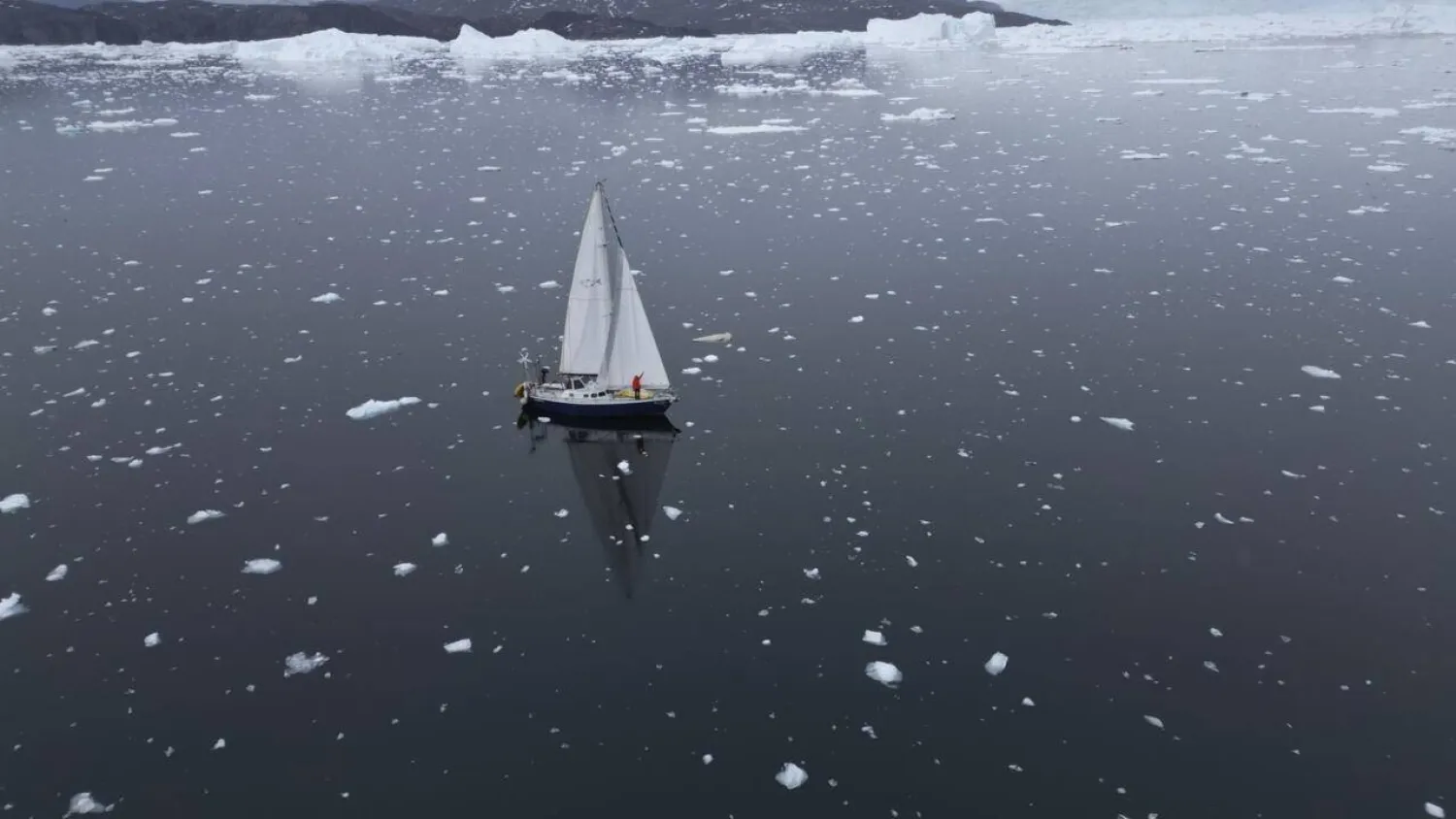

'Less and Less Sea Ice': Brazil Woman Sails Solo through Arctic

Brazilian sailor Tamara Klink poses on her sailboat 'Sardinha 2' as she completed her trip through the Northwest Passage. Tamara KLINK / Courtesy of Tamara Klink/AFP
TT

'Less and Less Sea Ice': Brazil Woman Sails Solo through Arctic

Brazilian sailor Tamara Klink poses on her sailboat 'Sardinha 2' as she completed her trip through the Northwest Passage. Tamara KLINK / Courtesy of Tamara Klink/AFP

Brazilian navigator Tamara Klink told AFP she encountered "very little" sea ice on her solo sail through the Northwest Passage -- a rare feat that would have been impossible without an icebreaker ship three decades ago.

In September, the 28-year-old became the second woman and the first Latin American to complete the perilous Arctic journey from the Atlantic to the Pacific Ocean, which has only become possible due to melting ice caused by climate change.

"I only found ice on nine percent of the way which is very little," Klink told AFP after returning from the 6,500-kilometer (4,000-mile) voyage between Greenland and Alaska.

"By talking to scientists, by talking to local people, especially hunters, Inuit hunters and Inuit fishermen, I understand that this very little amount of ice that I found is part of a general trend of having less and less sea ice every year."

According to the United Nations, global temperatures in 2024 were the hottest on record, surpassing 1.5C above pre-industrial levels for the first time.

"This is part of a trend that will be very difficult to reverse if we don't act with bold decisions, if we don't make courageous choices in this decade," she said, referring to the climate crisis.

Next month, Brazil will host the 30th edition of annual UN global climate talks which began at a time when the majority of ships needed icebreaker assistance or specialized hulls to navigate the Northwest Passage.

"With global warming, now the sea ice is melting during summertime... so smaller boats are able to pass and smaller crew are able to do this long trip," said Klink.

Tamara is the daughter of celebrated Brazilian explorer Amyr Klink, the first and only person to row solo across the South Atlantic Ocean.

'The sea doesn't care if I am female'

Klink said her father's long absences while at sea first drew her to the water.

"I was 12 years old when I asked my father to help me to start sailing alone and my father said that if I wanted to do that, he would help me with zero boats, with zero advice," she said.

"My father had all the answers and he had all the tools, but by telling me he would not help me, he gave me the right to make mistakes and to learn how to be who I became."

Klink's first solo sailing adventure took her from Norway to Brazil in 2021 in a tiny boat she bought "for the price of a bicycle."

She then spent eight months of winter in Greenland, her boat stuck in the ice, between 2023 and 2024.

In July, she began the two-month journey through the Northwest Passage.

Klink is only the 14th person to make the solo voyage, according to her team.

"When I'm at sea, in my boat, I know that my gender does not matter. The sea doesn't care if I'm female or male, if I'm old or young, if I'm strong or weak, if I'm there or if I'm not there anymore."



Mummified Cheetahs Found in Saudi Caves Shed Light on Lost Populations

This undated image provided by Communications Earth and Environment shows the mummified remains of a cheetah. (Ahmed Boug/Communications Earth and Environment via AP)
TT

Mummified Cheetahs Found in Saudi Caves Shed Light on Lost Populations

This undated image provided by Communications Earth and Environment shows the mummified remains of a cheetah. (Ahmed Boug/Communications Earth and Environment via AP)

Scientists have uncovered the mummified remains of cheetahs from caves in northern Saudi Arabia.

The remains range from 130 years old to over 1,800 years old. Researchers excavated seven mummies along with the bones of 54 other cheetahs from a site near the city of Arar.

Mummification prevents decay by preserving dead bodies. Egypt's mummies are the most well-known, but the process can also happen naturally in places like glacier ice, desert sands and bog sludge.

The new large cat mummies have cloudy eyes and shriveled limbs, resembling dried-out husks.

“It’s something that I’ve never seen before,” said Joan Madurell-Malapeira with the University of Florence in Italy, who was not involved with the discovery.

Researchers aren’t sure how exactly these new cats got mummified, but the caves’ dry conditions and stable temperature could have played a role, according to the new study published Thursday in the journal Communications Earth and Environment.

They also don't know why so many cheetahs were in the caves. It could have been a denning site where mothers birthed and raised their young.

Scientists have uncovered the rare mummified remains of other large cats, including a saber-toothed cat cub in Russia.

It's uncommon for large mammals to be preserved to this degree. Besides being in the right environment, the carcasses also have to avoid becoming a snack for hungry scavengers like birds and hyenas.

Cheetahs once roamed across most of Africa and parts of Asia, but now live in just 9% of their previous range and haven't been spotted across the Arabian Peninsula for decades. That’s likely due to habitat loss, unregulated hunting and lack of prey, among other factors.

In a first for naturally mummified large cats, scientists were also able to peek at the cheetahs' genes and found that the remains were most similar to modern-day cheetahs from Asia and northwest Africa. That information could help with future efforts to reintroduce the cats to places they no longer live.


Vonn Launches Social Media Search Mission After Ski Pole Goes Missing

 US' Lindsey Vonn crosses the finish line to win the Women's Downhill event of the FIS Alpine Ski World Cup in Altenmarkt Zauchensee, Austria, on January 10, 2026. (AFP)
US' Lindsey Vonn crosses the finish line to win the Women's Downhill event of the FIS Alpine Ski World Cup in Altenmarkt Zauchensee, Austria, on January 10, 2026. (AFP)
TT

Vonn Launches Social Media Search Mission After Ski Pole Goes Missing

 US' Lindsey Vonn crosses the finish line to win the Women's Downhill event of the FIS Alpine Ski World Cup in Altenmarkt Zauchensee, Austria, on January 10, 2026. (AFP)
US' Lindsey Vonn crosses the finish line to win the Women's Downhill event of the FIS Alpine Ski World Cup in Altenmarkt Zauchensee, Austria, on January 10, 2026. (AFP)

Lindsey Vonn may be dominating World Cup downhills at 41, but even the US speed queen is not immune to missing equipment.

Vonn took to social media on Thursday with an unusual plea after losing a ski pole in Tarvisio, Italy, ahead of this weekend's World Cup event.

"Someone took ‌my pole ‌in the parking ‌lot ⁠today in ‌Tarvisio. If you have seen it, please respond to this. Thank you," Vonn wrote on X, posting a photo of the matching pole complete with her initials on the ⁠hand strap.

Vonn, a favorite for the speed events ‌at next month's Milano-Cortina ‍Olympics, retired ‍from the sport in 2019 and ‍had a partial knee replacement in April 2024 but returned to competition later that year and has been enjoying a fairy-tale comeback that has defied age and expectation.

Already the oldest ⁠World Cup winner of all time, Vonn continued her astonishing, age-defying form with a downhill victory in Zauchensee, Austria last week.

That triumph marked Vonn's fourth podium from four downhills this season, cementing her lead in the World Cup standings and her status as the woman to ‌beat at next month's Olympics.


ISS Crew Splashes Down on Earth After Medical Evacuation

FILE - This photo provided by NASA shows the Moon's shadow covering portions of Canada and the US during a total solar eclipse as seen from the International Space Station on Monday, Aug. 8, 2024. (NASA via AP, File)
TT

ISS Crew Splashes Down on Earth After Medical Evacuation

FILE - This photo provided by NASA shows the Moon's shadow covering portions of Canada and the US during a total solar eclipse as seen from the International Space Station on Monday, Aug. 8, 2024. (NASA via AP, File)

Four International Space Station (ISS) crewmembers splashed down in the Pacific Ocean early Thursday, video footage from NASA showed, after a medical issue prompted their mission to be cut short.

American astronauts Mike Fincke and Zena Cardman, Russian cosmonaut Oleg Platonov and Japan's Kimiya Yui landed off the coast of San Diego about 12:41 am (0841 GMT), marking the first-ever medical evacuation from the ISS.