


S.Africa Seeks to Save Birds from Wind Turbine Risks

© RODGER BOSCH / AFP
TT

S.Africa Seeks to Save Birds from Wind Turbine Risks

© RODGER BOSCH / AFP

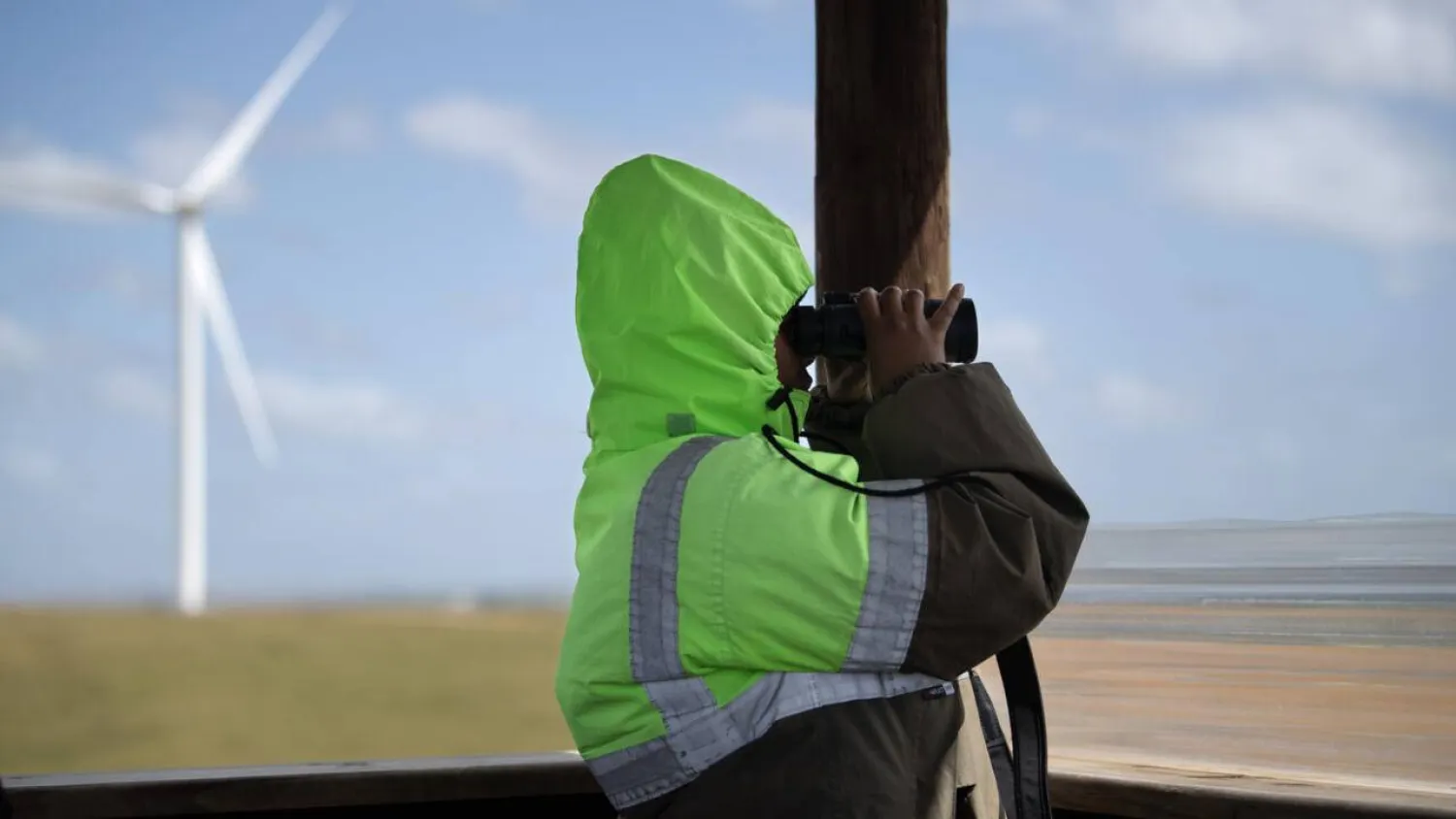
Powerful gusts shook an observation post perched on a hill at a wind farm in South Africa as two monitors scanned the landscape through binoculars.

The Overberg mountains stretched along the horizon, but the monitors -- bundled in scarves -- were focused on activity much closer: around a giant wind turbine, a small, dark silhouette had appeared, said AFP.

"Stop turbine 11, please. Cape vulture," one said into a walkie-talkie. "Stopping turbine 11," came the reply.

Immediately, the blades of the 150-meter (500-feet) turbine began to slow, coming to a complete stop in less than a minute.

BirdLife South Africa estimates that every year an average 4.25 birds are killed per wind turbine, most often when they fly into blades that can reach speeds of up to 280 kilometers (175 miles) per hour.

With more than 1,400 turbines operating across South Africa, an estimated 6,000 birds die this way a year, the group says. Ten percent are endangered species.

To mitigate the impact, Excelsior Wind Farm has implemented a Shutdown on Demand Protocol that prioritizes six vulnerable species, including the Cape vulture and endangered black harrier.

When monitors spot one, "they inform the control room via radio and that's when they will turn off the turbine," said conservationist Clarissa Mars, who oversees the program at the farm 200 kilometers east of Cape Town.

"That takes approximately 43 seconds," she told AFP.

"There were less than eight fatalities for the site in approximately five years," Mars said. "And I'm just very happy knowing there were no fatalities this year."

The Stop on Demand Protocol -- developed in the late 2010s, notably in Kenya -- has been adopted worldwide and was introduced at Excelsior in 2020.

Its impact on energy output at its small operation of 13 turbines has been negligible, said site manager Jacques Redelinghuys.

"We've lost less than 0.5 percent of revenue due to the program," he said. "And on days like today, when we do produce more due to our high wind speed, we make up for the losses that we incurred."

Extinction by wind farm?

While the shutdown protocol has saved some species from the blades at Excelsior, such as the Cape vulture, it has been less effective for the black harrier, a critically endangered bird of which only around 1,300 remain in the world.

The smaller bird is harder for the monitors to spot, conservationist Odette Curtis-Scott said.

The Overberg region is a vital breeding ground for the black harrier, but 95 percent of its natural habitat here has been lost to agriculture, she said.

This forces the bird to travel further in search of water and prey, increasing the risks of colliding with turbines.

"It's not ideal that the wind farm is where it is," said Curtis-Scott, who heads the Overberg Renosterveld Trust.

In early 2025, the trust bought land five kilometers from Excelsior where there is a black harrier colony and about 40 return to breed each year.

Despite the efforts, around 13 black harriers have been killed at South Africa's more than 30 wind farms in the past decade, according to University of Cape Town professor Rob Simmons.

"If we were to kill an extra three to five adult black harriers per year through wind farms, the population will go extinct within 75 to 100 years," he said.

"It's one of the first species in South Africa, possibly even in Africa, for which we know that wind farms can have a direct effect on the potential extinction."

Another potential solution to this "green-green dilemma" is painting turbine blades, Simmons said.

"Birds do not see black and white contrasts as well as we do," he said. "They, therefore, do not see a white blade spinning against a cloudy sky. This is very likely why they do not avoid it."

An experiment at a wind farm 90 kilometers north of Cape Town, where blades were painted with bold red stripes, resulted in a 87 percent drop in bird mortality over two years, he said.

"We cannot continue burning fossil fuels," he said. "Some species, like the black harrier, will not survive climate change. But we also cannot sacrifice numerous birds on the altar of renewable energy."


AI Helps Fuel New Era of Medical Self-testing

Neurable research scientist Alicia Howell-Munson demonstrates the company's headset, which it says can detect early signs of Alzheimer's disease. Patrick T. Fallon / AFP
TT

AI Helps Fuel New Era of Medical Self-testing

Neurable research scientist Alicia Howell-Munson demonstrates the company's headset, which it says can detect early signs of Alzheimer's disease. Patrick T. Fallon / AFP

Beyond smart watches and rings, artificial intelligence is being used to make self-testing for major diseases more readily available -- from headsets that detect early signs of Alzheimer's to an iris-scanning app that helps spot cancer.

"The reason preventive medicine doesn't work right now is because you don't want to go to the doctor all the time to get things tested," says Ramses Alcaide, co-founder and CEO of startup Neurable.

"But what about if you knew when you needed to go to the doctor?"

Connected rings, bracelets and watches -- which were everywhere at last week's Consumer Electronics Show in Las Vegas -- can already monitor heart rate, blood pressure and glucose levels, with varying degrees of accuracy.

These gadgets are in high demand from consumers. A recent study published by OpenAI showed that more than 200 million internet users check ChatGPT every week for information on health topics.

On Wednesday, OpenAI even launched a chatbot that can draw on a user's medical records and other data collected by wearable devices, with their consent, to inform its responses.

Using electroencephalogram (EEG) technology, Neurable has developed a headset that records and deciphers brain activity.

The linked app compares data with the user's medical history to check for any deviation, a possible sign of a problem, said Alcaide.

"Apple Watch can pick up Parkinson's, but it can only pick it up once you have a tremor," Alcaide said. "Your brain has been fighting that Parkinson's for over 10 years."

With EEG technology, "you can pick these things up before you actually see physical symptoms of them. And this is just one example."

Detection before symptoms

Some people have reservations about the capabilities of such devices.

"I don't think that wearable EEG devices are reliable enough," said Anna Wexler, a University of Pennsylvania professor who studies consumer detection products, although she acknowledges that "AI has expanded the possibilities of these devices."

While Neurable's product cannot provide an actual diagnosis, it does offer a warning. It can also detect signs of depression and early development of Alzheimer's disease.

Neurable is working with the Ukrainian military to evaluate the mental health of soldiers on the front lines of the war with Russia, as well as former prisoners of war, in order to detect post-traumatic stress disorder (PTSD).

French startup NAOX meanwhile has developed EEG earbuds linked to a small box that can help patients with epilepsy.

Rather than detect seizures, which are "very rare," the device recognizes "spikes" -- quick, abnormal electrical shocks in the brain that are "much more difficult to see," said NAOX's chief of innovation Marc Vaillaud, a doctor by training.

NAOX's device -- which has been cleared by the US Food and Drug Administration -- is designed to be worn at night, to track several hours of data at a time.

The company is working with the Rothschild and Lariboisiere hospitals in Paris to try to better understand the links between these brain "spikes" and Alzheimer's disease, which have been raised in scientific papers.

Advances in AI and technology in general have paved the way for the miniaturization of cheaper detection devices -- a far cry from the heavy machinery once seen in medical offices and hospitals.

IriHealth is preparing to launch, for only about $50, a small smartphone extension that would scan a user's iris.

The gadget relies on iridology, a technique by which iris colors and markings are believed to reveal information about a person's health, but which is generally considered scientifically unreliable.

But the founders of IriHealth -- a spin-off of biometrics specialist IriTech -- are convinced that their device can be effective in detecting anomalies in the colon, and potentially the lungs or the liver.

Company spokesman Tommy Phan said IriHealth had found its device to be 81 percent accurate among patients who already have been diagnosed with colon cancer.


Hawaii's Kilauea Volcano Puts on Spectacular Lava Display

Kilauea has been regularly throwing out thousands of tonnes of molten rock and gases since it burst to life in December 2024. UNITED STATES GEOLOGICAL SURVEY/AFP
TT

Hawaii's Kilauea Volcano Puts on Spectacular Lava Display

Kilauea has been regularly throwing out thousands of tonnes of molten rock and gases since it burst to life in December 2024. UNITED STATES GEOLOGICAL SURVEY/AFP

Hawaii's Kilauea was spraying a spectacular fountain of lava on Monday, keeping up its reputation as one of the world's most active volcanoes.

For over a year now, Kilauea has been regularly throwing out thousands of tons of molten rock and gases since it burst to life in December 2024, reported AFP.

Volcanologists with the US Geological Survey said the incandescent lava was being hurled more than 1,500 feet (460 meters) into the air, with plumes of smoke and gases rising as high as 20,000 feet (six kilometers).

Eruptions such as this one tend to last around one day, the USGS said, but can still vent up to 100,000 tons of sulfur dioxide.

This gas reacts in the atmosphere to create a visible haze known as vog -- volcanic smog -- which can cause respiratory and other problems.

Tiny slivers of volcanic glass, known as "Pele's hair," are also being thrown into the air.

Named after Pele, the Hawaiian goddess of volcanoes, the strands can be very sharp and can cause irritation to the skin and eyes.

The eruption poses no immediate danger to any human settlement, with the caldera having been closed to the public for almost two decades.

Kilauea has been very active since 1983 and erupts relatively regularly.

It is one of six active volcanoes located in the Hawaiian Islands, which also include Mauna Loa, the largest volcano in the world.

Kilauea is much smaller than neighboring Mauna Loa, but it is far more active and regularly wows helicopter-riding tourists who come to see its red-hot shows.


Astronaut's Serious Medical Condition Forces NASA to End Space Station Mission Early

Crew-11 mission astronauts departed the Kennedy Space Center in Cape Canaveral, Florida on August 1, 2025 (Gregg Newton/AFP)  
TT

Astronaut's Serious Medical Condition Forces NASA to End Space Station Mission Early

Crew-11 mission astronauts departed the Kennedy Space Center in Cape Canaveral, Florida on August 1, 2025 (Gregg Newton/AFP)  

NASA announced that four astronauts will return from the International Space Station more than a month ahead of schedule after an unnamed crew member experienced a medical issue.

The incident marks the first time in history NASA has brought astronauts home from the space station early because of a medical issue, according to CNN.

NASA has not provided details about the nature of the problem, citing privacy concerns. The agency typically does not discuss the specifics of health matters related to astronauts.

A SpaceX Crew Dragon capsule will bring the four-person crew home, disembarking from the ISS as soon as Wednesday at 5 pm ET. The spacecraft is then expected to splash down off the coast of California early the following morning, NASA said in a statement last week.

The affected astronaut is in stable condition, NASA previously confirmed, and is not expected to receive special treatment during the return trip, said Dr James Polk, NASA’s chief health and medical officer at the agency’s headquarters.

The astronaut would also be best served by being evaluated on the ground, Polk added.

“We have a very robust suite of medical hardware on board the International Space Station,” Polk noted during a news conference. “But we don’t have the complete amount of hardware that I would have in the emergency department, for example, to complete a workup of a patient.”

He added, “And in this particular incident, we would like to complete that work up, and the best way to complete that workup is on the ground.”
