

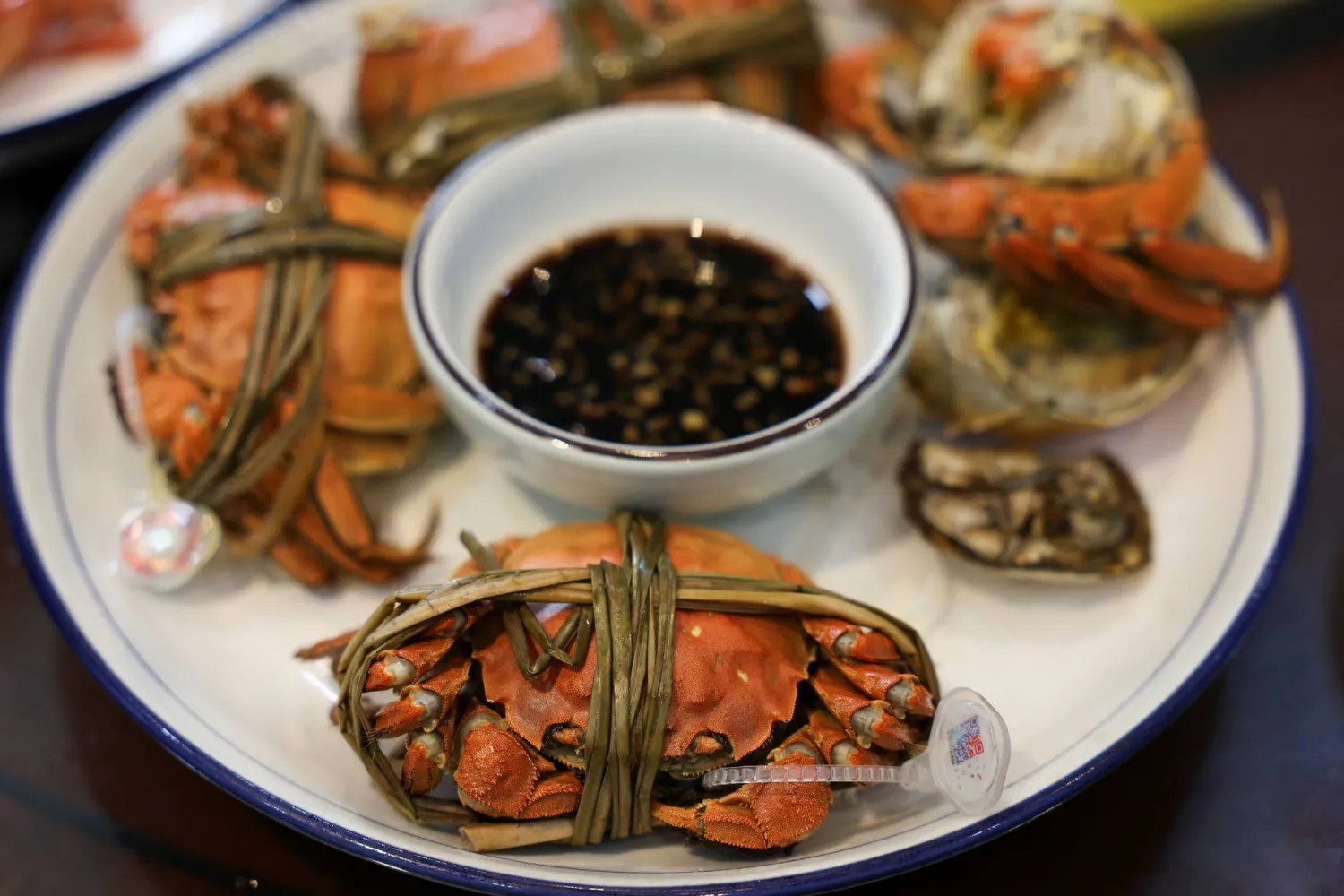

China’s Heatwaves Threaten to Dry up Supply of Delicious ‘Hairy Crabs’ 

Steamed hairy crabs sit on a plate in Suzhou, Jiangsu province, China, October 21, 2025. (Reuters)
TT

China’s Heatwaves Threaten to Dry up Supply of Delicious ‘Hairy Crabs’ 

Steamed hairy crabs sit on a plate in Suzhou, Jiangsu province, China, October 21, 2025. (Reuters)

The last three years have been the toughest for Xie Dandan and her family during more than a decade cultivating one of China's most esteemed culinary delicacies, the "hairy crab", named for its furry claws.

"From 2022, it feels like the weather has been getting worse every year," said the 34-year-old, standing amid tanks filled with the crabs, coveted for their sweet flesh and golden roe, while she wrapped some in straw to prepare them for customers.

"We've come to mentally prepare for these losses."

Xie is among the farmers at Yangcheng lake in the eastern province of Jiangsu being forced to devise new ways to keep the crustaceans alive as unusually high temperatures and longer-than-expected summers have disrupted breeding cycles since 2022.

The Chinese mitten crabs, as they are also known, can sell for hundreds of dollars when exported in sets of four to countries such as Singapore and Japan.

"Those who work in agriculture are at the mercy of the sky," said Xie, whose community reeled last year from losses caused by the strongest typhoon to hit the east coast since 1949, ripping out nets and shutting down oxygenation systems.

Higher temperatures than usual spell a triple threat for the crabs by slowing their growth, reducing the amount of oxygen in the water and boosting growth of bacteria, said Kenneth Leung, a marine environment expert at the City University of Hong Kong.

Hopes for a bumper harvest this year were crushed by summer temperatures around the lake in Suzhou city famed for some of the tastiest crabs, which stayed above 30 degrees C (86 degrees F) until late October, delaying their maturity.

The labor-intensive cultivation of the crabs begins with farmers growing their larvae in ponds for about a year before they are moved to fenced farms within the lake for the creatures to molt, or shed their outer shells, as they grow.

Molting happens about five times between March and the traditional end-September start of the harvest, Xie said.

But stronger heat can kill crabs as they shed their shells, in addition to the delay in maturity caused by longer summers. In 2022, farmers dumped blocks of ice into the water to cool it, Xie said.

Some of eastern China's hottest and longest summers in the last three years have brought temperatures of 40 degrees C (104 degrees F), or higher, on consecutive days as early as July.

In September, weather officials said this year's summer was China's hottest since 1961, while northern rains were the longest in the same period, bringing disruptions that scientists have linked to climate change.

Leung suggested selective breeding as a possible solution, by choosing crabs with a greater tolerance of higher temperatures for breeding.

Authorities expect the lake to yield a harvest of 10,350 metric tons this year, roughly in line with previous years' figures, except for 9,900 tons last year, when the typhoon hit.

While crab farmers may pray for better weather next year, they know they ultimately have little control, Xie added.

"We only can see whether the hairy crabs will be able to adapt, and if they can't, then maybe this industry will just be eliminated. We can't do anything about it."




Israel Cleared to Stay in Eurovision; Spain, Ireland and Others Quit in Protest

Pro-Palestinian protestors hold a flag and a banner outside the RTE (Radio Telefis Eireann) Irish public service broadcaster television studios as demonstrators call for an Irish boycott of the 2026 Eurovision Song Contest if there is Israeli participation, in Dublin, Ireland, November 1, 2025. (Reuters)
TT

Israel Cleared to Stay in Eurovision; Spain, Ireland and Others Quit in Protest

Pro-Palestinian protestors hold a flag and a banner outside the RTE (Radio Telefis Eireann) Irish public service broadcaster television studios as demonstrators call for an Irish boycott of the 2026 Eurovision Song Contest if there is Israeli participation, in Dublin, Ireland, November 1, 2025. (Reuters)

Israel was cleared on Thursday to enter the 2026 Eurovision Song Contest by the organizer, prompting Spain, the Netherlands, Ireland and Slovenia to withdraw over the Gaza war and plunging the competition into one of the biggest rows in its history.

The broadcasters who had threatened to boycott the event cited the death count in Gaza and accused Israel of flouting rules meant to guard the contest's neutrality. Israel accuses its critics of mounting a global smear campaign against it.

After a meeting in Geneva, the European Broadcasting Union, or EBU, decided not to call a vote on Israel's participation, saying it had instead passed new rules aimed at discouraging governments from influencing the contest, Reuters said.

Right after that announcement by the contest organizer, the Dutch, Spanish, Irish and Slovenian broadcasters said they would withdraw, meaning singers from their countries would not compete in the contest that draws millions of viewers worldwide.

Ben Robertson, a Eurovision expert from fan website ESC Insight, said the contest's integrity was at its lowest ebb.

"Never in the history of the contest have we had such a vote, and such a split, between the member broadcasters of the European Broadcasting Union," he said.

Both the Israeli government and opposition leaders celebrated the country's inclusion.

Golan Yochpaz, CEO of Israeli broadcaster KAN, likened the efforts to exclude Israel to a form of "cultural boycott."

Rounding on the countries withdrawing, Foreign Minister Gideon Saar said on X: "The disgrace is upon them."

IRELAND SAYS ITS PARTICIPATION 'UNCONSCIONABLE'

The Eurovision Song Contest dates back to 1956 and reaches around 160 million viewers, according to the EBU - more than the almost 128 million recorded for this year's US Super Bowl, according to figures from Nielsen.

Israel's participation has divided opinion in the competition that has a history of entanglement in national rivalries, international issues and political voting.

Its 2025 entrant, Yuval Raphael, was at the Nova music festival, a target of the October 7, 2023 attack by Palestinian group Hamas on Israel that triggered the Gaza war.

A total of 1,200 people were killed and 251 taken hostage in the assault by Hamas, according to Israeli tallies. More than 70,000 people have been killed in Gaza in the ensuing conflict, according to health authorities in the enclave.

Irish broadcaster RTE said it felt "Ireland's participation remains unconscionable given the appalling loss of lives in Gaza and the humanitarian crisis there which continues to put the lives of so many civilians at risk".

Jose Pablo Lopez, head of Spanish state broadcaster RTVE said on X: "What happened in the EBU Assembly confirms that Eurovision is not a song contest but a festival dominated by geopolitical interests and fractured."

RTV Slovenija said it together with Spain, Montenegro, the Netherlands, Türkiye, Algeria and Iceland requested a secret vote on Israel's participation, but it was not held.

Icelandic public broadcaster RUV said its board will make a decision on Wednesday on whether to participate in the next Eurovision, which will be held in Vienna in May.

"I feel sad that other countries are not going to compete next year," said 33-year-old Tel Aviv Eurovision fan Jurij Vlasov, adding the Netherlands' song this year was his favorite.

In Austria, which backed Israel, Eurovision fans welcomed its inclusion, even as some in Spain took the opposite view.

"Why should the population, or a part of the population, not participate?," said Vienna resident Bernhard Kleemann. "If countries decide not to participate because they condemn the government and the prime minister, that's their decision."

"BORN FROM THE ASHES OF THE SECOND WORLD WAR"

Instead of voting on Israel, the EBU said its members backed rules intended to discourage governments and third parties from disproportionately promoting songs to sway voters after allegations that Israel unfairly boosted its 2025 entrant.

"This vote means that all EBU Members who wish to participate in the Eurovision Song Contest 2026 and agree to comply with the new rules are eligible to take part," it said.

Israel's President Isaac Herzog thanked his country's supporters, saying he hoped the song contest would continue to champion "culture, music, friendship between nations".

Germany, a major Eurovision backer, had signaled it would not take part if Israel was barred. Germany's culture minister Wolfram Weimer told the Bild newspaper he welcomed the decision.

"Israel belongs to the Eurovision Song Contest like Germany belongs to Europe," he said.

Martin Green, the contest's director, said EBU members showed they wanted to protect the neutrality of the competition.

"Eurovision was born from the ashes of the Second World War," he said. "It was designed to bring us together, and it will hit bumps in the road, and we have a complicated world, but we hope it's a temporary situation, and we'll move forward."


Study Says African Penguins Starved En Masse Off South Africa

Yellow-eyed penguins fights in their colony in Katiki Point, on the southern end of the Moeraki Peninsula in New Zealand's South Island, about 80 kilometers north of Dunedin on November 12, 2025. (Photo by Sanka VIDANAGAMA / AFP)
TT

Study Says African Penguins Starved En Masse Off South Africa

Yellow-eyed penguins fights in their colony in Katiki Point, on the southern end of the Moeraki Peninsula in New Zealand's South Island, about 80 kilometers north of Dunedin on November 12, 2025. (Photo by Sanka VIDANAGAMA / AFP)

Endangered penguins living off South Africa's coast have likely starved en masse due to food shortages, a study said Friday, with some populations dropping by 95 percent in just eight years.

Fewer than 10,000 breeding pairs of the small, black and white African Penguin are left globally, according to scientists, and the species was listed as critically endangered last year by the International Union for Conservation of Nature (IUCN).

Two of the most important breeding colonies near Cape Town had collapsed between 2004 and 2011, with some 62,000 birds estimated to have died, the study by the UK's University of Exeter and the South African Department of Forestry, Fisheries and the Environment said.

In those eight years, sardine populations in South African waters -- a main food source for penguins -- were consistently below 25 percent of their peak abundance, Agence France Presse quoted co-author and biologist Richard Sherley as saying.

This drop in sardine stocks was due to fishing practices combined with environmental causes such as changes in water temperatures and salinity.

This "appears to have caused severe food shortage for African penguins, leading to an estimated loss of about 62,000 breeding individuals", Sherley said.

The global population of the species had declined by nearly 80 percent in the past 30 years, the scientists said.

Conservationists say that at the current rate of population decrease, the bird could be extinct in the wild by 2035.

For 10 years, authorities have imposed a commercial fishing ban around six penguin colonies, including Robben and Dassen islands, the two sites observed in the study.

Other initiatives underway include artificial nests and creating new colonies.

The birds are a strong attraction for tourists to South Africa, with thousands of people visiting colonies each year.

But the pressure from tourism also disturbs the birds and causes enhanced stress.


Saudi Post Issues Stamp Marking Int’l Day of Persons with Disabilities

Saudi Post (SPL) issued a set of commemorative stamps to mark the International Day of Persons with Disabilities.
TT

Saudi Post Issues Stamp Marking Int’l Day of Persons with Disabilities

Saudi Post (SPL) issued a set of commemorative stamps to mark the International Day of Persons with Disabilities.

Saudi Post (SPL), the Kingdom's national postal and logistics provider, has issued a set of commemorative stamps valued at SAR3 to mark the International Day of Persons with Disabilities, observed annually on December 3.

The day is celebrated worldwide, including in the Kingdom of Saudi Arabia, to reinforce care for persons with disabilities, empower them to achieve their aspirations, enhance their quality of life, ensure their rights, and include them in all activities and events by highlighting their talents and diverse abilities, said the Saudi Press Agency on Thursday.

The launch took place during a ceremony organized by the Authority for the Care of People with Disabilities (APD).

The event included the unveiling of a campaign titled “Say It Right,” which promotes the correct and officially adopted terminology for persons with disabilities.

The stamp features several individuals with disabilities who participated in the campaign.

APD continues to work collaboratively with various sectors to enhance service quality and raise awareness of the rights of persons with disabilities.