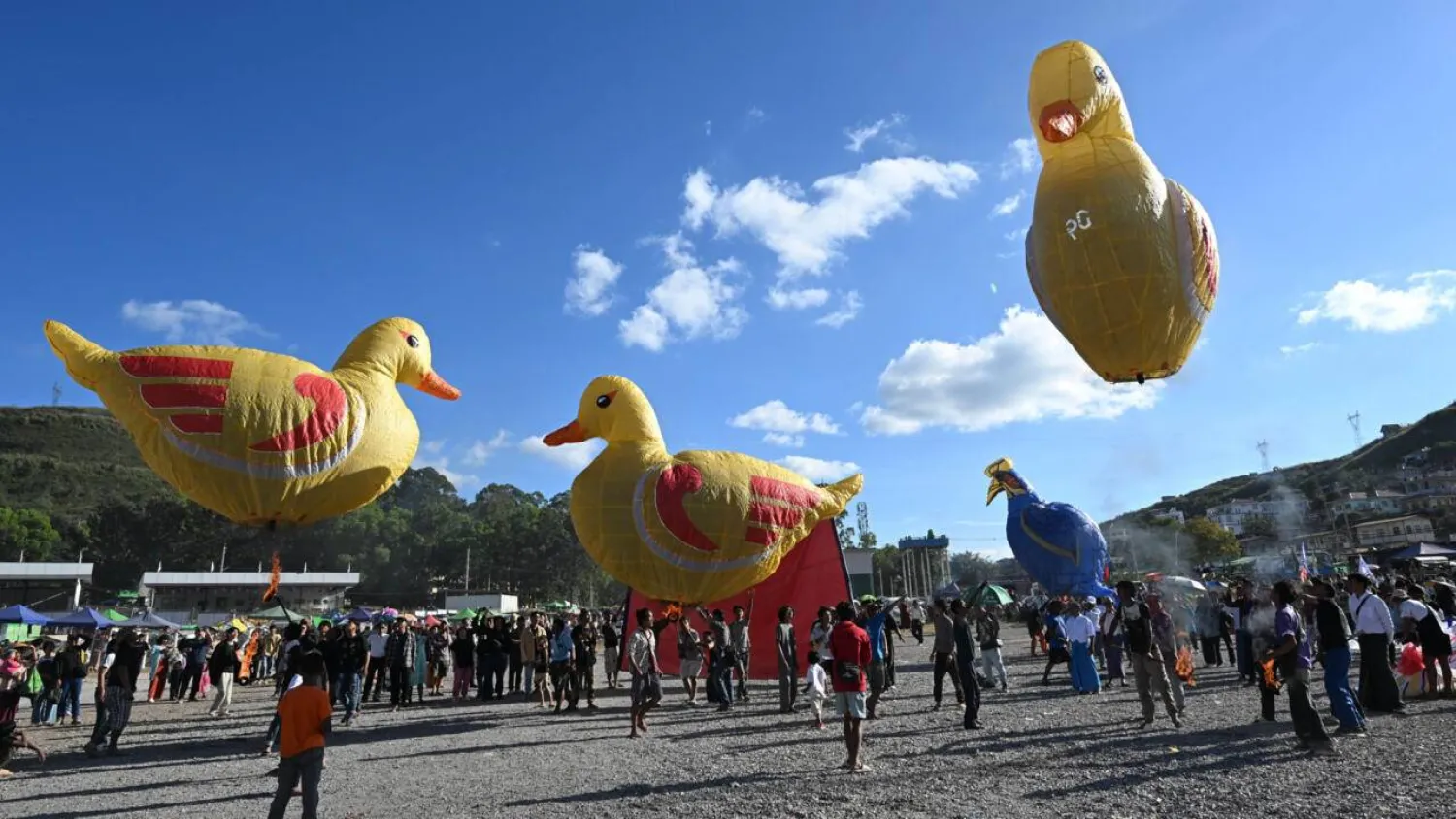
Myanmar Fireworks Festival Goers Shun Politics for Tradition

Bird-shaped hot air balloons released during the Tazaungdaing Lighting Festival in Taunggyi in Myanmar's northeastern Shan State. Sai Aung MAIN / AFP
TT

Myanmar Fireworks Festival Goers Shun Politics for Tradition

Bird-shaped hot air balloons released during the Tazaungdaing Lighting Festival in Taunggyi in Myanmar's northeastern Shan State. Sai Aung MAIN / AFP

Goat, hippo and duck-shaped hot air balloons floated in clear blue skies over war-ravaged Myanmar this week in a rare opportunity for escapism.

Tens of thousands of people have been killed since the military grabbed power in a 2021 coup, sparking a civil war between the junta and allied pro-democracy rebels and ethnic minority armed groups, AFP said.

But there was a muted celebratory air as teams loaded candles and fireworks onto the homemade airships, part of the annual Tazaungdaing hot air balloon festival in northern Shan state's Taunggyi city.

Crowds hoot and cheer as the contraptions float into the darkening sky, while referees judge the magnificence of their aerial explosions.

"Frankly speaking, we felt happier in the past," said local resident Myo Ko, who has attended the festival in years past. "There was no politics. That kind of feeling is the best."

Despite the usual crowds of thousands, the feeling of self-restraint was more evident this year, the 30-year-old told AFP.

"All our ethnic brothers used to take part freely and happily. I want to get those times back."

Shan state has been rocked by fighting since June 2024 when an alliance of ethnic armed groups renewed an offensive against the military along a trade highway to China.

The junta is trumpeting elections scheduled to start in December as an opportunity for reconciliation.

Taunggyi resident Di Lone, 50, said politics was the last thing on his mind at the cultural heritage event he has cherished since childhood.

"Politics is politics. Festival is festival. We keep them separate. It's not related," he said.

But while the conflict may have dented spirits, it has not dented numbers.

"It was very crowded since my childhood," Di Lone said. "It will be crowded even after I die."

There is no official death toll for Myanmar's civil war and estimates vary widely.

However more than 85,000 people have been killed on all sides since the 2021 coup according to non-profit monitoring group Armed Conflict Location & Data (ACLED).

Myo Ko noted more corporate sponsorship at the festival in recent years and lamented the loss of past cameraderie.

"We want to be happy like before," he said. "That's it."


London’s Most Urban Riding School Transforms Lives Through Horses

Children ride horses around a paddock during a class at the Ebony Horse Club in Brixton, Britain's most urban riding school, where children from under-privileged communities are taught to ride horses, in London, Britain, March 10, 2026. (Reuters)
TT

London’s Most Urban Riding School Transforms Lives Through Horses

Children ride horses around a paddock during a class at the Ebony Horse Club in Brixton, Britain's most urban riding school, where children from under-privileged communities are taught to ride horses, in London, Britain, March 10, 2026. (Reuters)

Sandwiched between social housing blocks and busy train tracks in south London is Britain's most urban riding school, where children from disadvantaged backgrounds learn to ride horses as part of a project aimed at improving their well-being.

About 160 children each week attend the Ebony Horse Club, a 30-year-old charity in the Brixton area of the capital which ranks amongst the most deprived in England and is a hotspot for knife crime.

Outside the stables, opened in 2011 by Queen Camilla, nine-year-old Matthew Sanchez shoveled horse dung into a wheelbarrow before his lesson.

Like ‌many of the ‌children who come for classes, he had never ‌encountered ⁠a horse before. ⁠But riding teacher Rachel Scott-Hayward, 37, said the children grow in confidence over weeks, learning to ride, grooming the animals and mucking out the stables.

Nylah Murray Charles, aged nine, said she was nervous before trotting on a horse for the first time.

"I got scared a bit, but I was like maybe I should just give it a ⁠try... when I tried, it was actually great ‌and I had fun," she said.

The ‌club is an oasis of rural charm in Brixton, about three miles (5 km) ‌from central London, where the smell of hay hangs in ‌the air. Lessons are free - a contrast to similar stables in wealthier parts of the city, where a 30-minute class can cost around 50 pounds ($67).

Scott-Hayward said while horse riding was traditionally "a white, upper-class hobby", the charity made ‌it accessible to local children, about 45% of whom identify as being from an ethnic minority.

The stables ⁠have become ⁠a home-from-home for Shanice Reid, 29, since she first learnt to ride with the project as a schoolgirl. She now teaches at the club and said it offers "somewhere to escape" for those with difficult home or school lives.

Between 2010 and 2019, about a third of London's youth clubs closed due to cuts to public funding, shrinking services for young people just as the pandemic hit.

Scott-Hayward said that horse riding can also be an antidote to the anxiety that she increasingly sees in children who spend a lot of time on screens and social media.

"When you're on a horse, you can't really think about too much else," she said.


US Weather to Go Nuts with Blizzard, Polar Vortex, Heat Dome, Atmospheric River All at Once

People spend time at Ha‘ena Beach Park, Monday, March 2, 2026, in Haena, Hawaii. (Noelle Fujii-Oride/Hawaii Civil Beat via AP)
TT

US Weather to Go Nuts with Blizzard, Polar Vortex, Heat Dome, Atmospheric River All at Once

People spend time at Ha‘ena Beach Park, Monday, March 2, 2026, in Haena, Hawaii. (Noelle Fujii-Oride/Hawaii Civil Beat via AP)

Nearly every part of the United States is getting walloped by wild weather or just about to be.

Days of downpours have begun in Hawaii. The Southwest will soon bake with day after day of record 100-degree-plus (38 Celsius-plus) heat. Two storms will dump snow by the foot over northern Great Lakes states. And the dreaded polar vortex will again invade the Midwest and East with soul-crushing Arctic chill.

This forecast of extremes comes as weather whiplash already hit much of the East. On Wednesday, Washington, D.C. residents walked around in shorts in record-breaking 86 degrees Fahrenheit (about 30 Celsius). On Thursday, it snowed, The Associated Press reported.

“All of the country, even if you’re not necessarily seeing extremes, are going to see generally changing from cold to warm, or warm to cold to warm,” said meteorologist Marc Chenard of the weather service’s Weather Prediction Center in Maryland.

Former National Oceanic and Atmospheric Administration chief scientist Ryan Maue said he expects extreme weather in all 50 states.

Triple-digit heat persists in Southwest A heat dome will form early next week and park over the Southwest, baking temperatures to triple digits that haven't been seen this early in the year, Maue and Chenard said.

Some forecasts see 98 (almost 37 Celsius) in Phoenix on Tuesday, followed by 103, 105 and two days of 107 (almost 42 C). In 137 years of record-keeping, Phoenix never hit 100 before March 26 and usually hit its first 100-degree day in early May, according to the weather service, which warned people: “Since we are not acclimated to this level of heat this early in the year, it will be more impactful than usual.”

It has already started in Los Angeles with unusual 90-degree March weather that had people in shorts and tank tops seeking shade anywhere they could get it, even if it was as slender as a light post.

Shane Dixon, 40, usually runs about 5 miles near his home in Culver City without much effort, he said, his face glistening with sweat and his T-shirt tucked into his shorts. But Thursday was hard because of the heat, and he had to cut it short.

“The back of my neck was melting,” he said. But he preferred it to the cold and snow that will hit elsewhere.

“I could go literally soak myself and walk out in the sun and I’ll make it home fine. If it was freezing cold I could not do this,” he said.

Single-digit cold invades North Around the same time as the heat starts blasting Phoenix, the polar vortex — a system that usually keeps frigid air penned up near the North Pole — is forecast to send its chill deep into the Midwest and East, even bordering some of the Southeast, Maue said.

Minneapolis will hover around zero for a low, and Chicago will be in the single digits Tuesday. The next day “temperatures in the teens and 20s in the northeast and 20s in the Mid-Atlantic,” Maue said. Even Atlanta could drop to the 20s.

One-two snowstorm punch Two storm systems in a row — one Friday, then another Sunday into Monday — will chug along the country's northern tier and Great Lakes and between them could dump 3 to 4 feet of snow in places, Maue said.

That bigger second storm system will see its barometric pressure drop so quickly and sharply — meaning it is intensifying and winds are strengthening — that it will qualify as a bomb cyclone, which is quite unusual to develop over land. Normally bomb cyclones get their energy from warm ocean waters, but this one will draw power from the polar vortex.

Even Alaska and Hawaii aren't quite right Maue said Hawaii is getting an atmospheric river that will have such persistent heavy rain that flooding will be a major issue. Oahu is under a flash flood warning.

And Alaska is normally frigid now, but it will be about 30 degrees colder than usual, he said.

It is “the time of year where we can see stuff like this,” Chenard said. “But this does seem even anomalous from what you would typically see. I mean, some of these areas will be setting records. Record-high temperatures for March and maybe multiple times.”

In the past week or so, tornadoes have killed at least eight people in Oklahoma, Michiganand Indiana. The forecast for severe storms doesn't look as big or widespread for the next week, but dangerous thunderstorms could pop up “anywhere from the Mississippi Valley toward the East Coast” on Sunday or Monday, Chenard said.

The jet stream goes nuts Underlying this is a jet stream gone wild, Maue and Chenard said.

The jet stream is the river of air that moves weather from west to east on a roller-coaster-like path. Usually the plunges are as mild as a kiddie roller coaster. But now that jet stream is going on near-vertical, scream-inducing drops following by straight-up ascents.

“Which means you get a lot of extremes next to each other,” Maue said. Storm fronts coming from the Pacific hit that high pressure heat dome in the Southwest and are pushed north to climb that mountainous jet stream peak, “grab access to that cold air reservoir up there" and bring it back down south down the other side of the hill, he said.

Numerous studies have connected unusual jet stream and polar vortex activity to shrinking Arctic sea ice and human-caused climate change.

But there is hope.

“The first day of spring is 20th (of March), and then after that we get recovery,” Maue said.


Saudi Arabia Establishes Royal Institute of Anthropology to Study Social Change

The establishment of the institute provides a scientific platform for documenting heritage and deepening awareness of local culture through anthropological research. (SPA)
TT

Saudi Arabia Establishes Royal Institute of Anthropology to Study Social Change

The establishment of the institute provides a scientific platform for documenting heritage and deepening awareness of local culture through anthropological research. (SPA)

Saudi Arabia has approved the establishment of the Royal Institute of Anthropology and Cultural Studies, marking a significant step toward expanding research on Saudi society and documenting its social transformations.

The institute, approved by the Saudi Cabinet on Tuesday, is expected to strengthen scholarly work related to the study of Saudi communities through rigorous scientific methods.

Saudi Minister of Culture Prince Badr bin Abdullah bin Farhan Al Saud welcomed the decision and thanked the Kingdom’s leadership for supporting the initiative.

He said the institute would serve as “a trusted narrator of our culture and a beacon of inspiration in studies that seek to understand humanity.”

Prince Badr added that the institute would provide a scientific platform for documenting Saudi heritage and deepening awareness of local culture through anthropological research. He noted that its work would help generate meaningful cultural insights and encourage cultural exchange with the wider world.

Saudi Arabia holds particular significance in anthropology and cultural studies because of its deep historical and civilizational heritage, which stretches back centuries.

The Kingdom is also characterized by wide cultural, social and regional diversity reflected in lifestyles, customs and traditions, language and oral expression, as well as literature, performing arts, architecture, visual arts, culinary traditions and fashion. Together, these elements provide rich material for academic study, analysis and documentation.

The institute will develop both academic and applied research in anthropology and cultural studies. Its work will include examining local communities, patterns of daily life, symbolic systems, social transformations and forms of cultural expression across the Kingdom.

It will also document both tangible and intangible cultural heritage within their social and historical contexts, including the knowledge systems, practices and values associated with them. The aim is to provide a comprehensive scientific understanding of cultural elements as part of the living human experience.

Observers and academics say the decision also reflects a shift in attitudes toward anthropology in Saudi Arabia.

Dr. Hamza bin Qablan Al-Mozainy said the institute’s establishment demonstrates growing recognition of the field’s importance. Speaking to Asharq Al-Awsat, he noted that anthropology once faced strong resistance in academic circles.

He cited the experience of Dr. Saad Al-Sowayan, one of the Kingdom’s pioneering anthropologists, who encountered opposition when he attempted to introduce the discipline in universities. As a result, Al-Sowayan carried out much of his research outside academic institutions, producing influential studies on Saudi society.

Al-Mozainy said Saudi society remains insufficiently studied, making it a rich field for future anthropological research. He added that the discipline helps societies better understand themselves and address both their strengths and their challenges.