

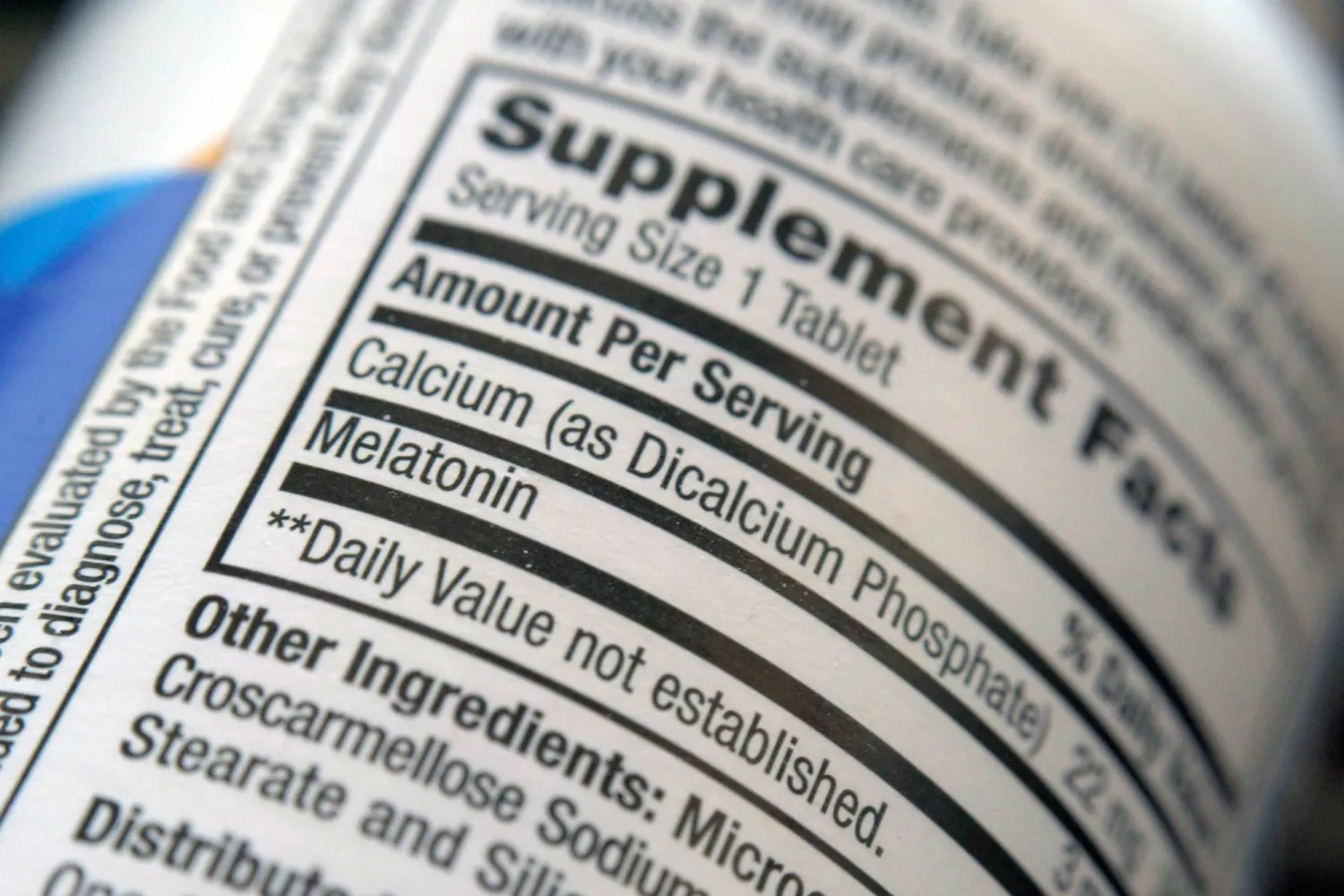

Study Questions Melatonin Use and Heart Health but Don't Lose Sleep Over it

FILE - The label for a bottle of melatonin pills is seen in New York on Thursday, June 2, 2022. (AP Photo/Patrick Sison, File)
TT

Study Questions Melatonin Use and Heart Health but Don't Lose Sleep Over it

FILE - The label for a bottle of melatonin pills is seen in New York on Thursday, June 2, 2022. (AP Photo/Patrick Sison, File)

Don’t lose sleep over headlines linking melatonin to heart failure.

That’s the message after some scary-sounding reports about a preliminary study involving the sleep-related supplement. It raised questions about the safety of long term use of melatonin for insomnia.

Doctors have long known that too little or interrupted sleep raises the risk of heart disease. But heart experts say this kind of so-called observational study can't prove that melatonin use plays any role — instead of the insomnia patients were trying to treat.

“We should not raise the alarm and tell patients to stop taking all their melatonin,” said Dr. Pratik Sandesara, an interventional cardiologist at Emory Healthcare who wasn’t involved with the research.

Our bodies naturally produce melatonin, a hormone that regulates our sleep cycles. Levels normally increase as it gets darker in the evening, triggering drowsiness.

People may take lab-produced melatonin to help them fall asleep or to adjust for jet lag or time changes.

The new study used international electronic health records, tracking adults diagnosed with insomnia who had a melatonin prescription that suggested they used the supplement for at least a year.

Over five years, 4.6% of the chronic melatonin users developed heart failure compared to 2.7% of insomnia patients whose charts showed no melatonin use, the researchers found. The study is being presented at an American Heart Association meeting but hasn’t undergone peer review.

But only certain countries require a melatonin prescription. It’s over-the-counter in the US, meaning Americans in the study might have used the supplements without it being recorded, said Northwestern University cardiology chief Dr. Clyde Yancy, who wasn't involved in the study. The study also did not show dosages, The Associated Press reported.

Also, US supplements don’t require government approval, meaning brands can vary in their ingredients. The researchers, from SUNY Downstate Health Sciences University, characterized the findings as a call for more research.

Meanwhile, patients wondering about melatonin should talk it over with their doctors, said Emory’s Sandesara. Generally doctors recommend it for short-term use, like for jet lag.

Yancy noted that while the study doesn't prove there's a danger from long term melatonin use, there's also no evidence that people should use melatonin indefinitely.

And one key to better shut-eye is to practice better sleep hygiene, like making sure your room is dark.

“When we expose ourselves to blue light in particular at night, we are diminishing our melatonin levels. That’s science,” he said. Sleep problems aren’t about “just being sleepy and tired — they’re putting yourself at risk.”



Shigeaki Mori, Hiroshima Atomic Bomb Survivor Embraced by Obama, Dies at 88

US President Barack Obama (L) hugs atomic bomb survivor Shigeaki Mori as he visits Hiroshima Peace Memorial Park in Hiroshima, Japan May 27, 2016. (Reuters)
TT

Shigeaki Mori, Hiroshima Atomic Bomb Survivor Embraced by Obama, Dies at 88

US President Barack Obama (L) hugs atomic bomb survivor Shigeaki Mori as he visits Hiroshima Peace Memorial Park in Hiroshima, Japan May 27, 2016. (Reuters)

Shigeaki ‌Mori, the survivor of the Hiroshima atomic bombing whom former US President Barack Obama embraced during a historic visit to the city in 2016, has died at 88, Jiji Press reported on Tuesday.

The image of Obama's arms wrapped around a tearful Mori at the Hiroshima Peace Memorial ‌Park became ‌a defining moment of that ‌visit - ⁠the first ever ⁠by a sitting US president.

Mori was eight years old when the US dropped the atomic bomb on Hiroshima, flattening the city on August 6, 1945 and knocking him ⁠unconscious with the force ‌of its ‌blast.

Thirty years later, Mori embarked on a ‌multi-decade quest to find victims who ‌were cremated at his school playground. His work also identified 12 Americans who died in the bombing.

He died in ‌a hospital in Hiroshima on March 14, Jiji reported.

Many nuclear ⁠bomb ⁠survivors - known as "hibakusha" in Japanese - despite their advanced age and dwindling numbers have tried to keep alive the legacies of Hiroshima and Nagasaki, the only two cities to ever suffer a nuclear attack.

The cities have counted some 550,000 deaths from the attacks to date, including from illnesses related to acute radiation exposure.


People with Diabetes Have a Higher Dementia Risk

A person taking a blood sugar test (University of British Columbia) 
TT

People with Diabetes Have a Higher Dementia Risk

A person taking a blood sugar test (University of British Columbia) 

A US study has shown that people with type 1 diabetes are more likely to develop dementia than the general population, highlighting the importance of following up on brain health as we age.

Researchers from Boston University highlighted a potential way to thwart the disease in adults with diabetes. The findings were published on Monday at the Neurology Journal.

Type 1 diabetes is a chronic condition that affects the insulin making cells of the pancreas.

It is often diagnosed in children and adolescents, characterized by the pancreas producing little to no insulin, and often requires lifelong management, including daily insulin injections (or pumps) and frequent blood sugar monitoring to avoid dangerous complications.

The study was conducted on about 284,000 people, with an average age of 64, including 5,442 suffering from type 1 diabetes, and about 51,000 with type 2 diabetes.

Over an average of 2.4 years follow-up, the researchers examined cases of dementia, a brain disorder that slowly destroys a person's memory and thinking skills.

They found that 2,348 people developed dementia, including 144 with type 1 diabetes (2.6%) and 942 with type 2 diabetes (1.8%), while only 1,262 cases were recorded among non-diabetics (0.6%).

Taking into account factors such as age and education, researchers found that individuals with type 1 diabetes face a significantly elevated risk of developing dementia, with estimates suggesting they are up to three times more likely to develop the condition compared to those without diabetes, while individuals with type 2 diabetes were nearly twice as likely to develop dementia.

The researchers noted that previous studies have shown a link between type 2 diabetes and an increased risk of dementia, but the new findings suggest that this link may be stronger in people with type 1 diabetes.


Budapest’s Vintage Freight Trams Celebrate 100 Years in Service

 Two century-old freight trams are parked in the Kelenfold tram depot in Budapest, Hungary on Thursday, March 12, 2026. (AP)
Two century-old freight trams are parked in the Kelenfold tram depot in Budapest, Hungary on Thursday, March 12, 2026. (AP)
TT

Budapest’s Vintage Freight Trams Celebrate 100 Years in Service

 Two century-old freight trams are parked in the Kelenfold tram depot in Budapest, Hungary on Thursday, March 12, 2026. (AP)
Two century-old freight trams are parked in the Kelenfold tram depot in Budapest, Hungary on Thursday, March 12, 2026. (AP)

With the toot of a horn, the ring of a bell and the hiss of air brakes, an unusual rail vehicle pulls out of a depot in Budapest to serve the Hungarian capital's public transit system, a job it has done for a century.

The so-called freight trams, known as mukis, run on electricity provided by overhead wires and travel on Budapest's vast tram rail network, one of the busiest in the world. But unlike the hundreds of iconic yellow trams in the passenger fleet, they don’t carry commuters.

Acquired by the city in 1926, the wood-sided trams were initially products of necessity: They brought goods and raw materials to and from Budapest's factories after much of the local freight infrastructure had been destroyed during World War I.

"Engineers at the time designed an electric drive system mainly using parts from vehicles damaged in the war, as well as parts from vehicles that had already been designated for scrapping," said Ádám Zadravecz, the head of tram vehicle development and technology at Budapest's public transit company BKV.

"Their primary purpose was freight transport, but after World War II, these vehicles were also used for removal of the war ruins," he said.

Over time, the mukis' function changed as Hungary recovered. In the 1960s, some of the original 40 trams were equipped with a snowplow, enabling them to clear the city's tram tracks in winter, as they do today.

They also perform nighttime maintenance runs, and transport broken-down trams into depots for repairs.

Various parts on the trams were gradually replaced, resulting in a mishmash of components. By 2018, the mukis were due for a more comprehensive refurbishment.

"When they were manufactured in the 1920s, they were extremely simple, extremely puritanical devices," said Nándor Meixner, head of vehicle maintenance at Budapest's Ferencváros depot. "During the refurbishment, we strove to make our colleagues’ work easier. That is why, for example, a seat was added to the vehicle, so that the driver can at least sit down."

Another addition: The trams were equipped with heating in the cabin.

Despite the changes over the last 100 years, Zadravecz said the trams' overall nature remained the same.

"Their maintenance costs is almost zero because these trams are very easy to maintain. Compared to the complex electronics of today’s vehicles, there is very little in them that can break down," he said. "People say that it can be repaired with a hammer and a file, and that’s absolutely true."

Driving them requires special training, however, as well as what Meixner called a certain "feel" for the vehicle.

"It is not enough to just drive, to know the signs and instructions, you also need to know the vehicle itself," he said.

Of the original fleet of 40 mukis, only six have survived the last 100 years in Budapest, with three in active use.

"The value of these vehicles lies precisely in their simplicity, in the pure fact that they exist and are available to us," Zadravecz said.