


Lebanon’s Historic Pines Are Dying, One Cone at a Time 

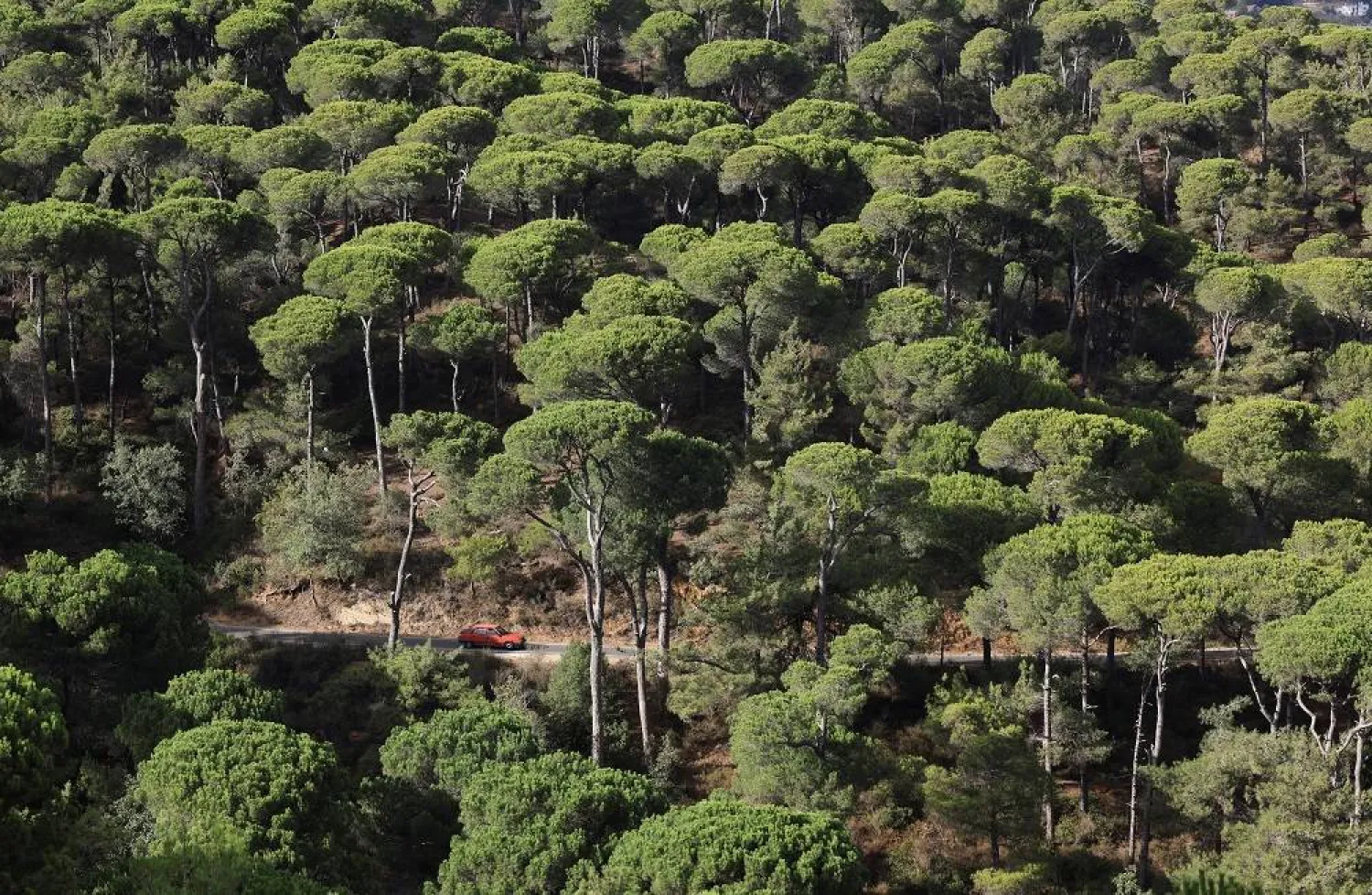
A car passes by a pine tree forest, where a pine crisis is unfolding, caused by an invasive insect that feeds on the cones that produce Lebanon's prized pine nuts, in Bkassine, Lebanon, October 21, 2025. (Reuters)
TT

Lebanon’s Historic Pines Are Dying, One Cone at a Time 

A car passes by a pine tree forest, where a pine crisis is unfolding, caused by an invasive insect that feeds on the cones that produce Lebanon's prized pine nuts, in Bkassine, Lebanon, October 21, 2025. (Reuters)

In the heart of southern Lebanon, where pine trees once stood tall and abundant, a quiet crisis is unfolding. The cones are barren, the trees are drying and a forest that was a lifeline for entire communities is under siege.

Farmers in Bkassine forest have watched their pine yields dwindle for years. At first, they blamed seasonal weather changes. Then, in 2015, scientists confirmed what many feared: an invasive insect had taken hold, one that feeds on the cones that produce Lebanon's prized pine nuts.

"It's not just the nuts," said Dr. Nabil Nemer, a forest health expert at the Holy Spirit University of Kaslik (USEK). "This insect attacks the cones over three years. It doesn't just reduce productivity, it wipes it out."

In some cases, up to 82% of a cone's seed pods are left as empty shells, according to Nemer. Trees weakened by the ravages of climate change are particularly vulnerable.

The insect, Leptoglossus occidentalis, is originally from North America and likely arrived in Lebanon via untreated wooden shipping pallets.

It has since spread across the Mediterranean to Türkiye, and other areas, according to his research.

Livelihoods are under threat in the Bkassine reserve, the Middle East's largest productive pine forest. The trees grow in other parts of Lebanon, but largely not commercially.

For decades, Miled Hareb's family survived on the forest's bounty. That is no longer the case.

"This work was passed down to me. I built my house with it and raised my family with it. But then the trees started dying, and so did our way of life," Hareb told Reuters.

Harvesting pine cones is grueling work. Workers climb towering trees with narrow ladders, balancing on narrow branches without safety gear to collect cones nestled high in the canopy.

Injuries are common and pay has dwindled along with the yields. Nabil Assad, a Syrian laborer who has harvested pine cones in Lebanon for more than a decade, still remembers when up to 250 pine-pickers worked simultaneously in Bkassine.

"Now it's just around 20 or 30 people. There's no work anymore," he said.

A DWINDLING ECOSYSTEM

Most of Lebanon's pine forests were planted hundreds of years ago. These older trees are still within their productive lifespans, but droughts, erratic rainfall and rising temperatures triggered by climate change have made them more vulnerable to the pests.

"A healthy tree can fight back," Nemer said. "But when it's thirsty and starved, it has no defense."

Ahead of this month's COP-30 climate summit in Belem, Brazil, UN officials stressed the importance of shielding forests from pest infestations and other risks, describing forests as "the planet's most powerful natural defense".

Bkassine forest was once home to around 100,000 productive pine trees, according to the UN Development Program.

The number has fluctuated: years of climate stress and pest infestations decreased them and efforts at replanting aimed to offset those losses, but no recent studies offer accurate new figures, Nemer said.

In addition to the cone-eating insect, wood-boring beetles are also killing pines. Dead trees litter the forest floor, attracting more pests and accelerating the decline.

Decades of political and economic turmoil in Lebanon have also taken a toll. After the country's brutal 1975-1990 civil war, state-led forest management fell by the wayside.

Illegal logging has surged since an economic meltdown in 2019.

As productivity drops, market prices have gone up - but few Lebanese can afford them. A kilogram of pine nuts now sells for nearly $100, from around $65 five years ago. Families and even restaurants have swapped out pine nuts for cheaper sliced almonds for Lebanese dishes that call for a crunch.

Efforts to fight back have been slow. Spraying pesticides requires helicopters, which are controlled by the Lebanese army. Logistical delays mean treatments often miss the critical window when insects lay their eggs.

Lebanon's agriculture ministry announced a national spraying campaign for this past August. But Nemer warns that without a broader strategy that involves farmers themselves, it won't be enough.

In Bkassine, farmers are learning to identify pests, report outbreaks and participate in forest management, through training programs led by USEK, the Lebanese Ministry of Agriculture, FAO and the United Nations Environment Program.

"We need to manage the forest as a whole," Nemer said. "This isn't a garden. It's not a farm. It's a living ecosystem."




Hiker Killed in Rare Suspected Mountain Lion Attack in Colorado

FILE - The General Store is seen Oct. 24, 2006, in Glen Haven, Colo. (AP Photo/The Denver Post, Karl Gehring, File)
TT

Hiker Killed in Rare Suspected Mountain Lion Attack in Colorado

FILE - The General Store is seen Oct. 24, 2006, in Glen Haven, Colo. (AP Photo/The Denver Post, Karl Gehring, File)

A hiker in Colorado has died in the state's first suspected fatal mountain lion attack in over 25 years, authorities said.

The woman was found unresponsive by other hikers on the Crosier Mountain trail northeast of Estes Park around noon on Thursday.

The hikers saw a mountain lion near the woman's body and scared it away by throwing rocks. A doctor was among the hikers and attended to the woman but found no pulse, Colorado Parks and Wildlife spokesperson Kara Van Hoose told reporters, according to Reuters.

CPW officers responded to the ⁠scene and shot dead two lions in the area. It is not known whether one or multiple animals were involved in the suspected attack, the agency said in a statement. It is believed the woman was hiking alone.

“There were signs that this was consistent with a mountain lion attack,” Van Hoose told a press ⁠conference.

Mountain lion attacks on humans in Colorado are rare, with 28 reported to CPW since 1990. The last fatal attack was in 1999.

CPW pathologists are performing necropsies on the dead animals to check for abnormalities and neurological diseases like rabies and avian influenza, as well as human DNA, Van Hoose said.

CPW policy mandates the killing of any mountain lion involved in an attack on a human so as to prevent repeat incidents. If human DNA is not found on either dead lion, authorities will continue to ⁠search for animals that may have been involved, Van Hoose said.

Larimer County Coroner will release the identity of the victim and cause of death, she said.

Colorado has a healthy mountain lion population, estimated by CPW to be between 3,800 and 4,400 adults. Conservation efforts have brought the species back from near extinction in the 1960s due to bounty hunting.

Mountain lions are common in the Front Range area where the woman was found, Van Hoose said. The animals go down to lower elevations in winter in search of prey like deer and elk, increasing chances of encounters with humans.


Heroic Staffer Blocks 400-pound Runaway Prop at US Disney Theme Park

FILE - The road to the entrance of Walt Disney World, Monday, March 16, 2020, in Lake Buena Vista, Fla.  (AP Photo/John Raoux, File)
FILE - The road to the entrance of Walt Disney World, Monday, March 16, 2020, in Lake Buena Vista, Fla. (AP Photo/John Raoux, File)
TT

Heroic Staffer Blocks 400-pound Runaway Prop at US Disney Theme Park

FILE - The road to the entrance of Walt Disney World, Monday, March 16, 2020, in Lake Buena Vista, Fla.  (AP Photo/John Raoux, File)
FILE - The road to the entrance of Walt Disney World, Monday, March 16, 2020, in Lake Buena Vista, Fla. (AP Photo/John Raoux, File)

A staffer at Disney World in Florida was hailed as a hero after he blocked a 400-pound (180-kilogram) rubber boulder that was bouncing toward the audience at an Indiana Jones-themed live show.

"Woah! That's heading right for us!" an audience member can be heard saying on a YouTube video of the incident on Tuesday as the weighty object bounces off its track.

The boulder bashes into the staff member who had moved to try to block the prop from bouncing into the audience, knocking him down. Colleagues rush to his aid and quickly get him to his feet, with blood visible on his scalp.

Disney confirmed the incident happened during an "Indiana Jones Epic Stunt Spectacular." It said a performer was injured when a prop moved off its track.

"We're focused on supporting our cast member, who is recovering," a Disney spokesperson said in a statement to AFP on Friday.

"Safety is at the heart of what we do, and that element of the show will be modified as our safety team completes a review of what happened," the spokesperson added.

The Indiana Jones Epic Stunt Spectacular is staged at the Walt Disney World Resort in Orlando, Florida. A blog post on the company's website says the boulder is made of rubber and weighs 400 pounds.


Angelina Jolie Visits Egyptian Side of Rafah Crossing to Gaza

US actress Angelina Jolie speaks to a member of the Egyptian Red Crescent at the Egyptian Rafah border crossing, part of her visit to the North Sinai Governorate to inspect aid entering the Palestinian Gaza Strip, on January 2, 2026. (Photo by AFP)
TT

Angelina Jolie Visits Egyptian Side of Rafah Crossing to Gaza

US actress Angelina Jolie speaks to a member of the Egyptian Red Crescent at the Egyptian Rafah border crossing, part of her visit to the North Sinai Governorate to inspect aid entering the Palestinian Gaza Strip, on January 2, 2026. (Photo by AFP)

Hollywood star Angelina Jolie visited on Friday the Egyptian side of the Rafah crossing into Gaza, where she spoke with members of the Red Crescent and truck drivers ferrying humanitarian aid, AFP journalists said.

According to local media, the actor and former special envoy for the UN refugee agency made the visit to see the condition of injured Palestinians transferred to Egypt and to look into aid deliveries into the devastated territory.

Since the ceasefire between Israel and Hamas began, 414 people have been killed and 1,142 wounded in Gaza, according to the Health Ministry. The overall Palestinian death toll from the war is at least 71,266.

Accompanied by an American delegation and greeted by former and current officials, Jolie said she was "honored" to meet aid volunteers at the crossing.

A Red Crescent volunteer told the Oscar winner that "there are thousands of aid trucks just waiting" at the border crossing.

The Rafah border crossing was set to be reopened under the ceasefire in effect in Gaza since October, but has so far remained closed.