

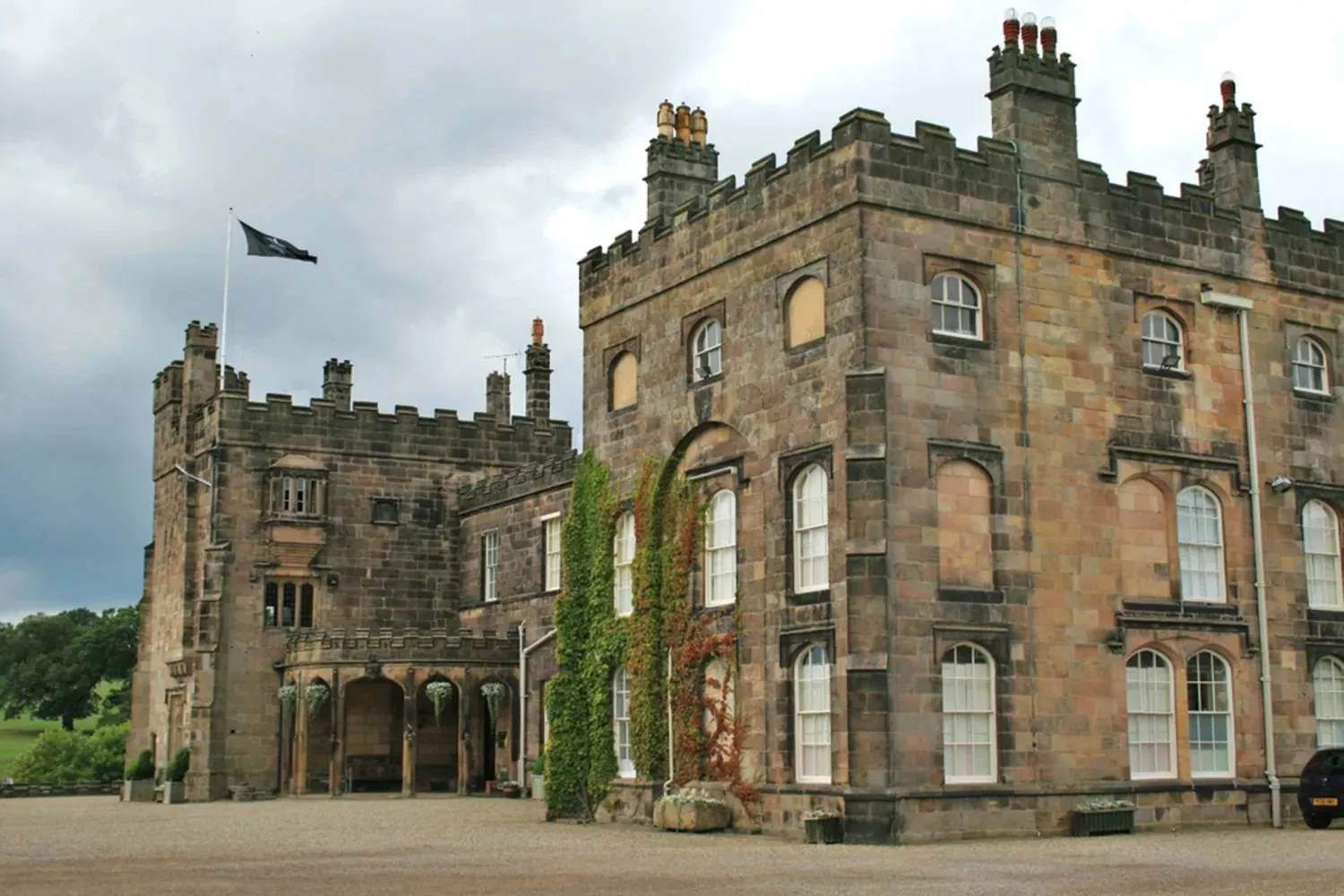

14th-Century Castle Has Had Its Price Cut By £7.5 million

Ripley Castle near Harrogate (Shutterstock) 
TT

14th-Century Castle Has Had Its Price Cut By £7.5 million

Ripley Castle near Harrogate (Shutterstock) 

If every Englishman’s home is his castle, then the opportunity to snap up Ripley Castle could fulfil the ideal for some.

This property near Harrogate, ancestral seat of the Ingilby family for the last seven centuries, came onto the market in January at 21 million pounds, according to the Country Life website.

Perhaps unsurprisingly considering the size and variety of the 445-acre estate, the family are happy to split things into lots; but the bulk of the asking price was the 15 million pounds for the castle itself, including 166 acres of parkland, woodland, lakes and a temple.

Since then, the asking price for the Grade I-listed, 14th-century Ripley Castle been slashed by 7.5 million pounds— something which might set alarm bells ringing, especially as the reduction “is principally down to market conditions,” points out Mark Granger, consultant at Carter Jonas.

The other eight lots — including a pub, village store, woodland and cricket ground — have apparently generated a good deal of interest at or above their original guide price. So why the price cut for the main attraction?

Part of it is the market. Evidence suggests that demand for country houses is slowing, and buyers are becoming picky: “In 2025, among homes priced above 3 million pounds, more than 43% of listings have seen a price reduction, and you are now three times more likely to withdraw from the market than to secure a buyer,” said Jonathan Handford, managing director at Fine & Country, and “while the market has not collapsed, it has become highly selective.”

But there's another more important aspect to the Ripley Castle story.

Appraising a stately home for sale is no easy task, and there is no simple science to it.

Fewer equivalent properties at this end of the market means agents must make a careful assessment of a wider range of factors than the norm, from property size and location to architectural attribution and historic pedigree, state of repair, and even commercial potential.

“Pricing a country house is much like valuing an antique,” Annabel Blackett of Strutt & Parker’s national country house department covering Scotland and the North.



Lego Unveils Tech-Filled Smart Bricks

Lego unveils Smart Bricks (AFP)
TT

Lego Unveils Tech-Filled Smart Bricks

Lego unveils Smart Bricks (AFP)

Lego has unveiled Smart Bricks - tech-filled versions of its small building blocks - which it says will bring sets to life with sound, light and reaction to movement, according to the BBC.

However, the new product range has got a mixed reaction from play experts, who said it risks undermining what makes Lego distinct for children in an increasingly digital world.

Announced at the Consumer Electronics Show (CES) 2026 in Las Vegas, the Danish toymaker's Smart Play system introduces new electronic components to the classic plastic blocks.

Lego said its new tech-enabled products, launching in March with a new Star Wars set, are its “most revolutionary innovation” in nearly 50 years.

But Josh Golin, executive director of children's wellbeing group Fairplay, believes Smart Bricks could “undermine what was once great about Legos” - harnessing children's own imagination during play.

He said the toy did not require extra features to generate sounds or other effects.

“As anyone who has ever watched a child play with old-school Legos knows, children's Lego creations already do move and make noises through the power of children's imaginations,” he told the BBC.

Andrew Manches, professor of children and technology at the University of Edinburgh, agreed the beauty of Lego lay in “the freedom to create, re-create, and adapt simple blocks into endless stories powered by children's imagination.”

But he also welcomed Lego's efforts to integrate physical and digital play with tools that react to the way children interact with its Smart Play products.

Julia Goldin, the company's chief product and marketing officer, previously told the BBC it viewed digital technology as an opportunity to “expand physical play and physical building.”

“We don't look at the digital world as a threat,” she said - adding its smart range weaves interactivity “seamlessly” with its physical products.

What are Lego Smart Bricks?

Lego says its Smart Bricks can sense motion, position and distance, allowing the models to respond in various ways during play.

Measuring 2x4, the brick itself contains sensors, lights, a small sound synthesizer, an accelerometer and a custom-made silicon chip enabling it to detect movement and react to it.

But it is designed to be used with Smart Minifigures and Smart Tags tiles - two additional products making up Lego's Smart Play System.

Similarly adapted from existing Lego components, these possess digital identifiers triggering different sounds or reactions when they detect and interact with each other.

For instance, when tried out by the BBC at CES, a Lego birthday cake recognized when its “candles” were blown out - sounding a cheer and a happy birthday song.

Meanwhile, a Lego helicopter made whooshing sounds when moved or rotated, with its Smart Brick lighting up red upon crashing.

Tom Donaldson, head of Lego's Creative Play Lab, said the tech intended to respond to children's actions and complement the way they naturally play.

He said the Smart Brick's reactions to responses would “hopefully inspire and surprise the user to keep them continuing to play.”

“We are building a platform that we want to last for many years,” he said.
Manches told the BBC reduced cost and size of components has “enabled more toymakers to integrate digital technology seamlessly into a range of toys.”

But he added despite exciting innovation, concerns remain about the security and privacy of new and emerging smart toys for children - particularly those which integrate AI.

“The key is to us all to remain critically reflective of the design of these toys, and to pay much attention to how they influence children's everyday lives,” he said.

It is not the first time Lego has dabbled in digital experimentation or sought to appeal to increasingly online audiences.

Since 2017 it has released augmented reality apps and experiences letting people play with computer-generated models layered over their surroundings.

Through collaborations with video game publishers such as Nintendo and Fortnite-maker Epic Games it has also looked to appeal to fans of trending games or new launches - releasing a Super Mario Minifigure in 2020 with a tiny display screen.

Lego chief executive Niels B. Christiansen said in the firm’s 2024 annual report it had accelerated spending on digital technology as a “strategic area” for the company.


Did Leonardo da Vinci Leave his DNA on Artwork?

Beige seamless vector background with Leonardo da Vinci sketch drawings (Shutterstock)
TT

Did Leonardo da Vinci Leave his DNA on Artwork?

Beige seamless vector background with Leonardo da Vinci sketch drawings (Shutterstock)

Scientists have recovered tiny DNA traces left on Renaissance artifacts, at least some of which they suspect belong to visionary Italian polymath Leonardo da Vinci.

They have recovered trace DNA from a red chalk drawing on paper called “Holy Child”, possibly made by da Vinci, and letters written by his ancestor, Frosino di Ser Giovanni da Vinci, held at a historical archive in Italy, according to The Independent.

Some Y-chromosome DNA sequences from the “Holy Child” artwork and from a letter penned by one of Leonardo’s cousins appear to belong to a genetic grouping of people with a shared ancestry in Tuscany, where the painter was born, according to the study.

When scientists compared the Y-chromosome DNA sequences from the artifacts with large Y-chromosome reference databases, they found the closest match within the broad lineage.

This Y-chromosome lineage is found today at notable frequencies in southern Europe, including Italy, North Africa and parts of the Near East.

Some of the DNA may be from da Vinci himself.

However, this is not conclusive proof, as establishing that any DNA trace from the artifacts indeed belongs to da Vinci is extremely complex, researchers said.

This is because scientists can’t verify genetic sequences from the artifacts against DNA known to have come from da Vinci himself. The iconic inventor has no known descendants and his burial site was disturbed in the early 19th century.

Historical artifacts can accumulate DNA from their environments and can potentially offer useful information about the people who created and handled them, the materials used to make them as well as the environments they passed through.

But studying such precious objects without damaging or contaminating them has long been a challenge.

Now, though, scientists have developed a “minimally invasive” method to recover “biological signatures of history” from Renaissance artwork and correspondence associated with da Vinci’s ancestors.

Most of the DNA traces belong to bacteria, fungi, plants, and viruses, shedding light on the nature of the materials of these artifacts, their storage environment, conservation treatments, and handling over the years.

Some of the genetic material, however, comes from humans.

Since the artifacts assessed in the new study were associated with male historical figures, scientists looked at markers of Y-chromosome DNA found in the biological samples.

“To enable stronger claims, especially relating to provenance, geolocation, or historical characteristics, future work is needed to help distinguish artifact-associated signal from modern handling,” researchers said.


NASA Considers Rare Early ISS Crew Return Due to Astronaut’s Medical Issue

FILE - This photo provided by NASA shows the Moon's shadow covering portions of Canada and the US during a total solar eclipse as seen from the International Space Station on Monday, Aug. 8, 2024. (NASA via AP, File)
TT

NASA Considers Rare Early ISS Crew Return Due to Astronaut’s Medical Issue

FILE - This photo provided by NASA shows the Moon's shadow covering portions of Canada and the US during a total solar eclipse as seen from the International Space Station on Monday, Aug. 8, 2024. (NASA via AP, File)

NASA is considering a rare early return of an astronaut and its crew from the International Space Station (ISS) over an unspecified medical issue, hours after cancelling a planned spacewalk that had been scheduled for Thursday, the ⁠agency said.

According to Reuters, a NASA spokeswoman said the astronaut, who she did not identify out of medical privacy, was in a stable condition on the ⁠orbiting laboratory.

"Safely conducting our missions is our highest priority, and we are actively evaluating all options, including the possibility of an earlier end to Crew-11’s mission," the spokeswoman said in a statement on Wednesday night.

Returning the four-person Crew-11 ⁠crew would be a rare consequence of a medical issue aboard the ISS, where astronauts typically live in six to eight-month rotations with access to basic medical equipment and medications for some types of emergencies.