Study Finds Humans Were Making Fire 400,000 Years Ago, Far Earlier Than Once Thought

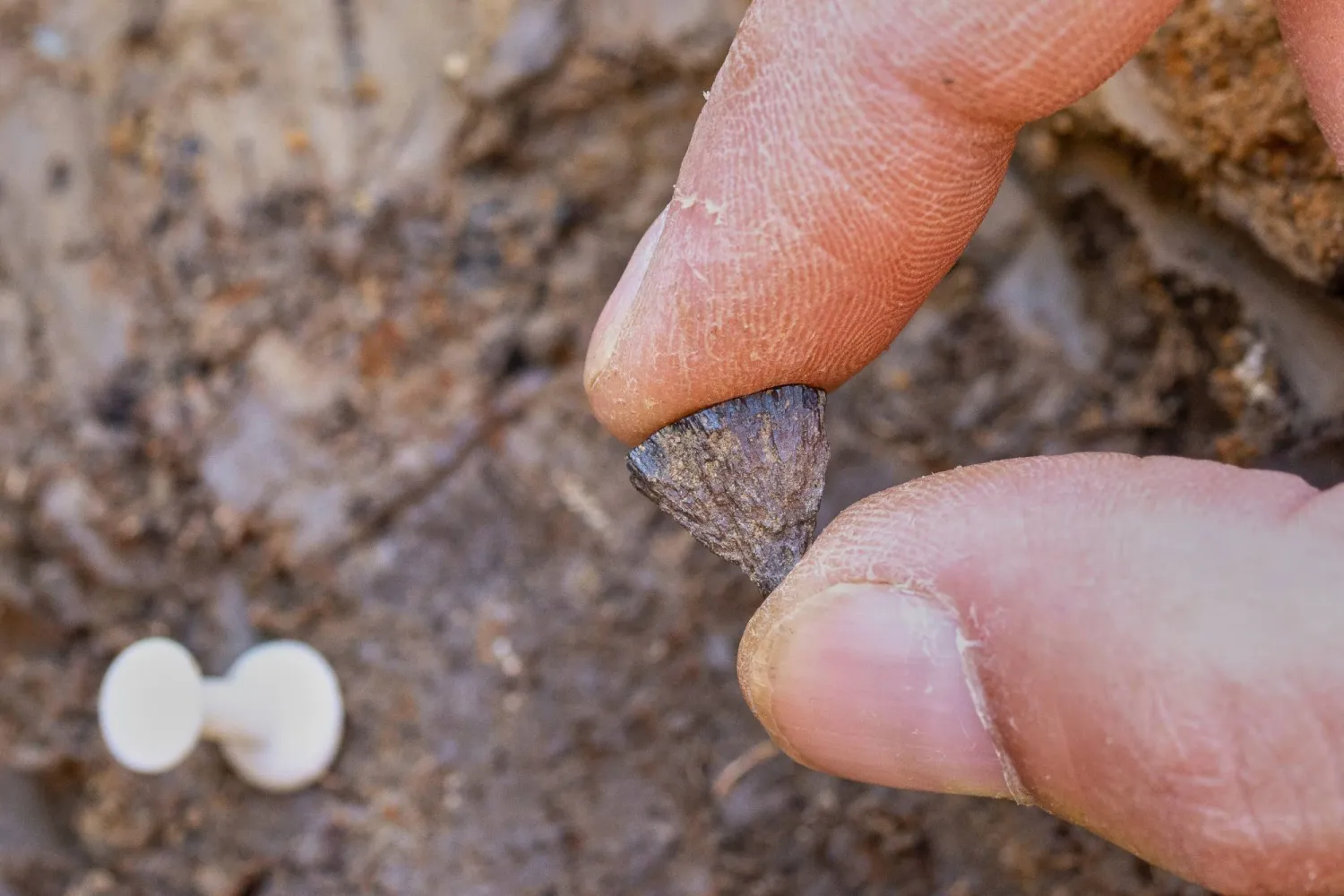
Discovery of the first fragment of iron pyrite in 2017, at Barnham, England. (Jordan Mansfield/Pathways to Ancient Britain Project via AP)
TT

Study Finds Humans Were Making Fire 400,000 Years Ago, Far Earlier Than Once Thought

Discovery of the first fragment of iron pyrite in 2017, at Barnham, England. (Jordan Mansfield/Pathways to Ancient Britain Project via AP)

Scientists in Britain say ancient humans may have learned to make fire far earlier than previously believed, after uncovering evidence that deliberate fire-setting took place in what is now eastern England around 400,000 years ago.

The findings, described in the journal Nature, push back the earliest known date for controlled fire-making by roughly 350,000 years. Until now, the oldest confirmed evidence had come from Neanderthal sites in what is now northern France dating to about 50,000 years ago.

The discovery was made at Barnham, a Paleolithic site in Suffolk that has been excavated for decades. A team led by the British Museum identified a patch of baked clay, flint hand axes fractured by intense heat and two fragments of iron pyrite, a mineral that produces sparks when struck against flint, The Associated Press reported.

Researchers spent four years analyzing to rule out natural wildfires. Geochemical tests showed temperatures had exceeded 700 degrees Celsius (1,292 Fahrenheit), with evidence of repeated burning in the same location.

That pattern, they say, is consistent with a constructed hearth rather than a lightning strike.

Rob Davis, a Paleolithic archaeologist at the British Museum, said the combination of high temperatures, controlled burning and pyrite fragments shows "how they were actually making the fire and the fact they were making it."

Iron pyrite does not occur naturally at Barnham. Its presence suggests the people who lived there deliberately collected it because they understood its properties and could use it to ignite tinder.

Deliberate fire-making is rarely preserved in the archaeological record. Ash is easily dispersed, charcoal decays and heat-altered sediments can be eroded.

At Barnham, however, the burned deposits were sealed within ancient pond sediments, allowing scientists to reconstruct how early people used the site.

Researchers say the implications for human evolution are substantial.

Fire allowed early populations to survive colder environments, deter predators and cook food. Cooking breaks down toxins in roots and tubers and kills pathogens in meat, improving digestion and releasing more energy to support larger brains.

Chris Stringer, a human evolution specialist at the Natural History Museum, said fossils from Britain and Spain suggest the inhabitants of Barnham were early Neanderthals whose cranial features and DNA point to growing cognitive and technological sophistication.

Fire also enabled new forms of social life. Evening gatherings around a hearth would have provided time for planning, storytelling and strengthening group relationships, which are behaviors often associated with the development of language and more organized societies.

Archaeologists say the Barnham site fits a wider pattern across Britain and continental Europe between 500,000 and 400,000 years ago, when brain size in early humans began to approach modern levels and when evidence for increasingly complex behavior becomes more visible.

Nick Ashton, curator of Paleolithic collections at the British Museum, described it as "the most exciting discovery of my long 40-year career."

For archaeologists, the find helps address a long-standing question: When humans stopped relying on lightning strikes and wildfires and instead learned to create flame wherever and whenever they needed it.


Indonesia Floods Were 'Extinction Level' for Rare Orangutans

Residents rest as they search for the remains of their house, buried under piles of uprooted trees swept by the flash flood, in Lintang Baru village in Aceh Tamiang, northern Sumatra, on December 11, 2025. (Photo by Aditya Aji / AFP)
TT

Indonesia Floods Were 'Extinction Level' for Rare Orangutans

Residents rest as they search for the remains of their house, buried under piles of uprooted trees swept by the flash flood, in Lintang Baru village in Aceh Tamiang, northern Sumatra, on December 11, 2025. (Photo by Aditya Aji / AFP)

Indonesia's deadly flooding was an "extinction-level disturbance" for the world's rarest great ape, the tapanuli orangutan, causing catastrophic damage to its habitat and survival prospects, scientists warned on Friday.

Only scientifically classified as a species in 2017, tapanulis are incredibly rare, with fewer than 800 left in the wild, confined to a small range in part of Indonesia's Sumatra.

One dead suspected tapanuli orangutan has already been found in the region, conservationists told AFP.

"The loss of even a single orangutan is a devastating blow to the survival of the species," said Panut Hadisiswoyo, founder and chairman of the Orangutan Information Centre in Indonesia.

And analysis of satellite imagery combined with knowledge of the tapanuli's range suggests that the flooding which killed nearly 1,000 people last month may also have devastated wildlife in the Batang Toru region.

The scientists focused on the so-called West Block, the most densely populated of three known tapanuli habitats, and home to an estimated 581 tapanulis before the disaster.

There, "we think that between six and 11 percent of orangutans were likely killed," said Erik Meijaard, a longtime orangutan conservationist.

"Any kind of adult mortality that exceeds one percent, you're driving the species to extinction, irrespective of how big the population is at the start," he told AFP.

But tapanulis have such a small population and range to begin with that they are especially vulnerable, he added.

Satellite imagery shows massive gashes in the mountainous landscape, some of which extend for more than a kilometer and are nearly 100 meters wide, Meijaard said.

The tide of mud, trees and water toppling down hillsides would have carried away everything in its path, including other wildlife like elephants.

David Gaveau, a remote sensing expert and founder of conservation start-up The Tree Map, said he was flabbergasted by the before-and-after comparison of the region.

"I have never seen anything like this before during my 20 years of monitoring deforestation in Indonesia with satellites," he told AFP.

The devastation means remaining tapanulis will be even more vulnerable, with sources of food and shelter now washed away.

Over nine percent of the West Block habitat may have been destroyed, the group of scientists estimated.

In a draft paper shared with AFP and set to be published as a pre-print in coming days, they warned the flooding represents an "extinction-level disturbance" for tapanulis.

They are urging an immediate halt to development in the region that will damage remaining habitat, expanded protected areas, a detailed survey of the affected area and orangutan populations and work to restore lowland forests.

The highland homes currently inhabited by tapanulis are not their preferred habitat, but it is where remaining orangutans have been pushed by development elsewhere.

Panut said the region had become eerily quiet after the landslides.

"This fragile and sensitive habitat in West Block must be fully protected by halting all habitat-damaging development," he told AFP.


South Korea Exam Chief Quits Over Complaints of Too-hard Tests

People wearing thick winter coats walk on Gwanghwamun Square in central Seoul, South Korea, 12 December 2025.  EPA/YONHAP
People wearing thick winter coats walk on Gwanghwamun Square in central Seoul, South Korea, 12 December 2025. EPA/YONHAP
TT

South Korea Exam Chief Quits Over Complaints of Too-hard Tests

People wearing thick winter coats walk on Gwanghwamun Square in central Seoul, South Korea, 12 December 2025.  EPA/YONHAP
People wearing thick winter coats walk on Gwanghwamun Square in central Seoul, South Korea, 12 December 2025. EPA/YONHAP

The chief organizer of South Korea's notoriously grueling university entrance exams has resigned -- after complaints that an English test he designed was just too difficult.

South Korea's college entry exam, known locally as the "Suneung", is essential for admission to top universities and widely regarded as a gateway to social mobility, economic security and even a good marriage.

But this year just over three percent of exam-takers scored top marks in the English test -- the lowest since absolute grading was introduced for the subject in 2018.

Students were given just 70 minutes to answer 45 questions, Agence France Presse reported.

One question singled out for criticism asked students to assess the political philosophers Immanuel Kant and Thomas Hobbes and analyze their views on the rule of law.

Another asked students to consider the nature of time and clocks, while another probed how the idea of existence might apply to video game avatars.

These sparked significant backlash in a country where the exam is taken so seriously that flights are grounded nationwide for 35 minutes during the English listening test to eliminate any potential noise.

In response, Oh Seung-keol, the chief of Korea's Institute for Curriculum and Evaluation, stepped down.

He felt "a heavy sense of responsibility for the English section of the test, which did not align with the principles of absolute evaluation", the institution said in a statement sent to AFP.

He also apologized for "causing concern to test-takers and their parents, and for causing confusion in the college entrance exam process".

The agency also issued a separate apology, saying it "takes seriously the criticism that the test failed to meet the appropriate level of difficulty and the goal of reducing students' academic burden".

The use of the portmanteau "culturtainment" in the test was also the source of confusion -- even from the academic behind the phrase.

Stuart Moss, a senior lecturer at Leeds Beckett University in the UK, said he was "very surprised" to see the phrase featured.

"I am also of the opinion that this word should never have featured in the exam due it not being in common English usage," he said in an e-mail reply to a South Korean test-taker reported by local daily Munhwa Ilbo.

Enormous pressure placed on students in South Korea's ultra-competitive education system has been partly blamed for teenage depression and suicide rates that are among the highest in the world.

This month, South Korea's National Assembly approved an amended law banning private English-language educational institutes from administering entrance tests to preschoolers.

And test scores have long been a highly sensitive and scrutinized issue.

This week, the nephew of Samsung Electronics chief Lee Jae-yong -- one of South Korea's most powerful and wealthy families -- made headlines after he reportedly failed just one question on the exam, earning him admission to the nation's top Seoul National University.


Japan Bear Victim's Watch Shows Last Movements

Bears have killed several people in Japan this year. Caroline GARDIN / AFP
TT

Japan Bear Victim's Watch Shows Last Movements

Bears have killed several people in Japan this year. Caroline GARDIN / AFP

The watch of a Japanese hiker killed by a bear has revealed harrowing details about his last moments, including that the animal returned to his body the next day, a newspaper report said.

Bears have killed a record 13 people in Japan this year and injured more than 200 others, while reports of the creatures roaming near schools and rampaging in supermarkets have heightened anxiety, especially in rural northern regions.

The hiker's GPS watch, which uses satellite signals to log routes and monitors heart rate, was retrieved after the fatal attack on August 14, the Asahi Shimbun reported.

Data from the device showed that at around 11 am it suddenly deviated from the hiking trail in Hokkaido and went down a forested slope, the daily said, according to Agence France Presse.

In an area of thick brush, it repeatedly circled and passed over the same spot.

The watch also showed that the man's heart stopped beating about 100 to 130 meters (yards) from the trail, indicating that he died there.

The watch remained in the same spot all night but moved again around 9 am the next morning, travelling several hundred meters through the brush.

This suggests the brown bear had come back and dragged the man's body away, the Asahi said.

Three days later, on August 15, a bear with two cubs was spotted dragging his body in its mouth. All three animals were killed.

A mound of earth made by the bear was found nearby and traces of the man -- who was engaged to be married -- were discovered, the report added.

The victim's parents were asked to identify the body, but police asked them only to look at his face because of the extent of injuries.