


Japan’s Only Two Pandas to Be Sent Back to China 

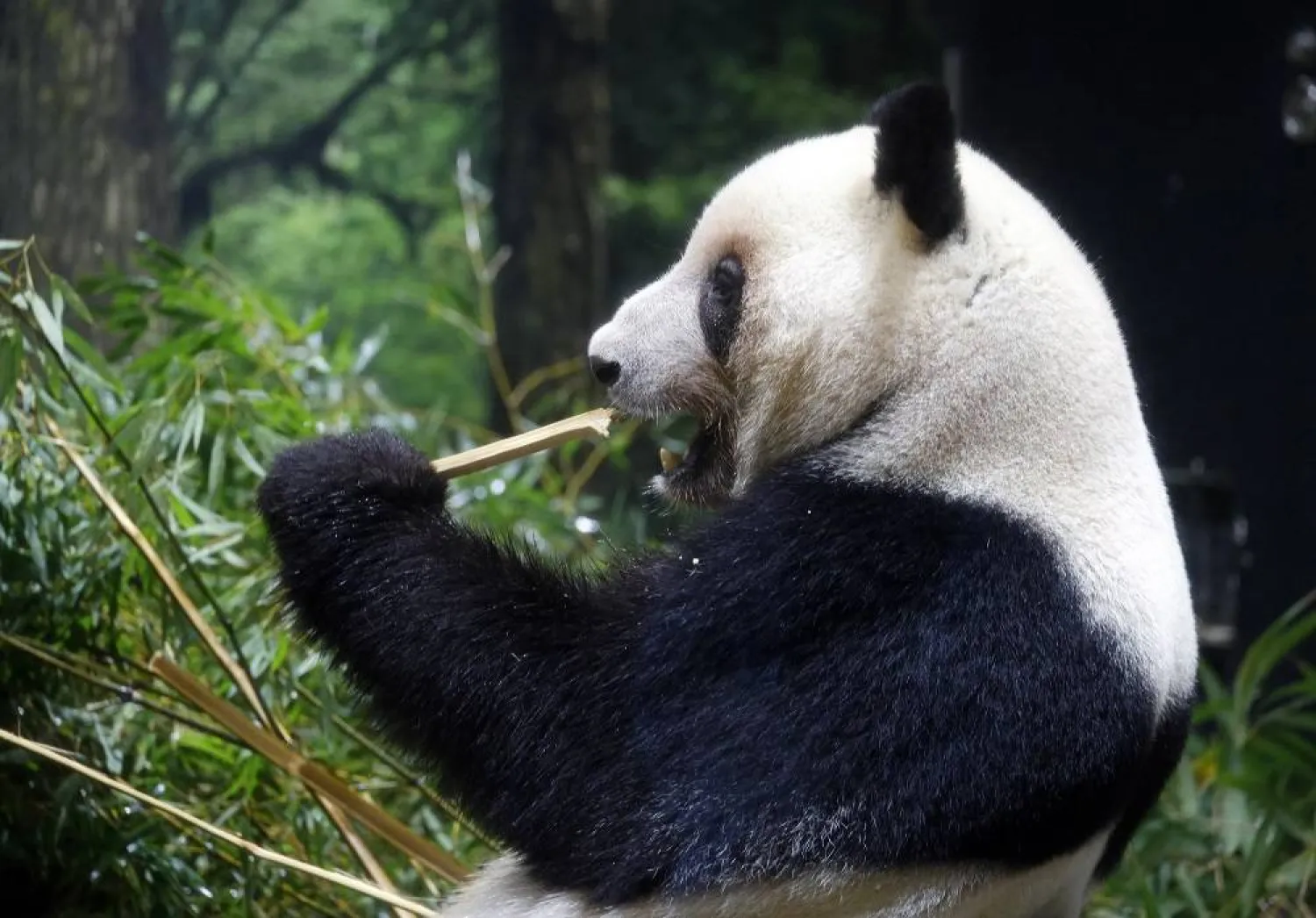
Giant panda Lei Lei eats bamboo at Ueno Zoological Gardens in Tokyo, Japan, 28 November 2025. (EPA)
TT

Japan’s Only Two Pandas to Be Sent Back to China 

Giant panda Lei Lei eats bamboo at Ueno Zoological Gardens in Tokyo, Japan, 28 November 2025. (EPA)

Two pandas at a Tokyo zoo will be returned to China in January, the Tokyo government said on Monday, potentially leaving Japan without the beloved animals for the first time in half a century.

Loaned out as part of China's "panda diplomacy" program, the distinctive black-and-white animals have symbolized friendship between Beijing and Tokyo since the normalization of diplomatic ties in 1972.

Japan currently has only two pandas, Lei Lei and Xiao Xiao, at Tokyo's Zoological Gardens in the Ueno neighborhood.

But the twins are now set to be repatriated a month before their loan period expires in February, said Tokyo Metropolitan Government, which operates the Ueno zoo.

Tokyo's regional government has been asking for the immensely popular mammals to remain at the zoo -- where they attract huge crowds -- but China didn't agree, according to the Nikkei business daily.

In September last year, animal lovers in Tokyo bid farewell to the parents of Lei Lei and Xiao Xiao who returned home.

Just before they left, thousands of tearful fans came out to catch a final glimpse and take photographs of the beloved bears.

The Asahi Shimbun reported that Tokyo is seeking the loan of a new pair, although their arrival before the return of Lei Lei and Xiao Xiao is seen as unlikely.

Ties between Asia's two largest economies are fast deteriorating after Japan's conservative premier Sanae Takaichi hinted that Tokyo could intervene militarily in the event of any attack on Taiwan.

Her comment provoked the ire of Beijing, which regards the island as its own territory.

Japan's top government spokesman Minoru Kihara said pandas have helped ties with China.

"Exchanges through pandas have contributed to improving the feelings between the people of Japan and China. We hope such exchanges will continue," Kihara told a regular press briefing.

He said that "several local governments and zoos have expressed interest in receiving pandas on loan" but did not state whether the national government was asking China for new animals.

The Ueno zoo has long been the beneficiary of panda diplomacy, having cooperated with facilities in China and the United States to successfully breed giant pandas.

Lei Lei and Xiao Xiao were delivered in 2021 by their mother Shin Shin, who arrived in 2011 and was returned to China last year.

Breeding pandas in a zoo environment is fiendishly tricky due to their difficulties mating, false pregnancies and high mortality rates of newborn cubs.



Scientists Trace Latest Interstellar Comet's Home to a Cold, Isolated Corner of the Milky Way

FILE - This image, provided by NASA, shows the interstellar comet 3I/Atlas captured by the Hubble Space Telescope on Nov. 30, 2025, about 178 million miles (286 million kilometers) from Earth. (NASA, ESA, STScI, D. Jewitt (UCLA), M.-T. Hui (Shanghai Astronomical Observatory), J. DePasquale (STScI) via AP, File)
TT

Scientists Trace Latest Interstellar Comet's Home to a Cold, Isolated Corner of the Milky Way

FILE - This image, provided by NASA, shows the interstellar comet 3I/Atlas captured by the Hubble Space Telescope on Nov. 30, 2025, about 178 million miles (286 million kilometers) from Earth. (NASA, ESA, STScI, D. Jewitt (UCLA), M.-T. Hui (Shanghai Astronomical Observatory), J. DePasquale (STScI) via AP, File)

The comet that rambled past us from another star last year likely originated in a cold, isolated corner of the galaxy that had yet to gel into its own solar system, astronomers reported Thursday.

Comet 3I/Atlas is only the third interstellar visitor to be confirmed and quite possibly the oldest. Scientists estimate it could be up to 11 billion years old, more than twice as old as the sun.

A team led by the University of Michigan used the ALMA observatory in Chile’s Atacama Desert to examine the comet last fall. The errant but harmless iceball was discovered last summer, giving NASA and the European Space Agency plenty of time to aim multiple space telescopes at it as it zoomed past Mars in October and made its closest approach to Earth in December. It's now well past Jupiter on its way out of our solar system for good, still visible only to the professionals.

In the study, scientists said they detected extremely high amounts of deuterium, or heavy hydrogen, in the comet's water. That suggests that the comet originated in a place considerably colder — before the star of this solar system even formed — than our own cosmic neighborhood, said the University of Michigan's Teresa Paneque-Carreno.

While our sun may have been surrounded by other newborn stars as it was forming, she noted, this comet's home star could have been more of a loner, leading to less heating and colder conditions.

The findings were published in Nature Astronomy.

The comet's precise place of origin is still unknown. Observations by the Hubble Space Telescope put the size of its nucleus somewhere between a quarter-mile and 3.5 miles (440 meters and 5.6 kilometers). It's hurtling away at 137,000 mph (220,000 kph).

Linking all these “puzzle pieces together may give an idea to how the planet-forming conditions were at these early times,” the Associated Press quoted Paneque-Carreno as saying in an email.

The first known interstellar object to stray into our celestial backyard — Oumuamua — was discovered by a telescope in Hawaii in 2017. Comet 2I/Borisov followed in 2019, named for the Crimean amateur astronomer who first spotted it.


Surgery Begins in Riyadh for Most Complex Conjoined Twins Cases in the World

The Filipino conjoined twins (SPA)
TT

Surgery Begins in Riyadh for Most Complex Conjoined Twins Cases in the World

The Filipino conjoined twins (SPA)

The medical and surgical team of the Saudi Conjoined Twins Program began on Thursday the separation surgery for the Filipino conjoined twins Klea and Maurice Ann, who are joined at the head, at King Abdullah Specialist Children’s Hospital in King Abdulaziz Medical City in Riyadh.

The surgery is in implementation of the directives of Custodian of the Two Holy Mosques King Salman bin Abdulaziz Al Saud and Prince Mohammed bin Salman bin Abdulaziz Al Saud, Saudi Crown Prince and Prime Minister.

Supervisor-General of the King Salman Humanitarian Aid and Relief Center and head of the medical and surgical team Dr. Abdullah Al Rabeeah stated in a press briefing that the conjoined Filipino twins arrived in the Kingdom on May 17, 2025.

He explained that following their admission, the medical team conducted extensive examinations and held multiple consultations, ultimately determining that the case was among the most complex in the world.

This was due to several critical medical factors, including the complex angle of the twins’ heads, extensive sharing of cerebral venous sinuses, and overlapping brain tissue.

He further noted that one of the twins, Klea, was suffering from heart failure and severe kidney atrophy leading to complete renal failure, which significantly increased the surgical risks associated with the separation procedure.

Al Rabeeah stated that the surgical team decided to carry out the operation in five stages, with the participation of 30 consultants, specialists, and nursing and technical staff across multiple disciplines, and noted that the procedure is expected to last approximately 24 hours.

He pointed out that this operation is the 70th procedure in the program, which, since its launch in 1990, has assessed and provided care for 157 conjoined twins from 28 countries across five continents.


Turkish Parliament Passes Bill to Restrict Social Media Access for Under-15s

FILED - 16 May 2024, Mecklenburg-Western Pomerania, Schwerin: The Instagram, Facebook, and WhatsApp apps can be seen on a smartphone display in front of the logo of the internet company Meta. Photo: Jens Büttner/dpa
TT

Turkish Parliament Passes Bill to Restrict Social Media Access for Under-15s

FILED - 16 May 2024, Mecklenburg-Western Pomerania, Schwerin: The Instagram, Facebook, and WhatsApp apps can be seen on a smartphone display in front of the logo of the internet company Meta. Photo: Jens Büttner/dpa

Turkish lawmakers passed a bill late Wednesday that includes restricting access to social media platforms for children under 15, state media reported.

The legislation is the latest in a global trend to protect young people from dangerous online activity.

Its passage comes a week after a 14-year-old boy killed nine students and a teacher at a middle school in Kahramanmaras, southern Türkiye, in a gun attack. Police are investigating the online activity of the perpetrator, who also died, in a bid to uncover his motivation for the attack.

The bill will force social media platforms to install age verification systems, provide parental control tools and require companies to rapidly respond to content deemed harmful, the state-run Anadolu news agency said, according to The Associated Press.

Turkish President Recep Tayyip Erdogan must now accept the bill within 15 days for it to pass into law. He spoke in the wake of the Kahramanmaras killings of the need to mitigate the online risks to children’s safety and privacy.

“We are living in a period where some digital sharing applications are corrupting our children's minds and social media platforms have, to put it bluntly, become cesspools,” he said in a televised address Monday.

The main opposition party - the Republican People’s Party, or CHP - has criticized the proposal, saying children should be protected “not with bans but with rights-based policies.”

Under the law, digital platforms - such as YouTube, TikTok, Facebook, Instagram and others - would have to block children under 15 from opening accounts and introduce parental controls that would manage children’s access.

Online game companies will also be required to appoint a representative in Türkiye to ensure they abide by the new regulations. Potential penalties include internet bandwidth reductions and fines imposed by Türkiye’s communications watchdog.

Restrictions on social media access for children under 16 first began in December in Australia, where social media companies revoked access to about 4.7 million accounts identified as belonging to children.

Last month, Indonesia began implementing a new government regulation banning children younger than 16 from access to digital platforms that could expose them to pornography, cyberbullying, online scams and addiction.

Some other countries — including Spain, France and the United Kingdom — are also taking or considering measures to restrict children’s access to social media amid growing concern that they are being harmed by exposure to unregulated social media content.