


UK Braced for Heavy Snow as Cold Weather Snap in Europe Persists

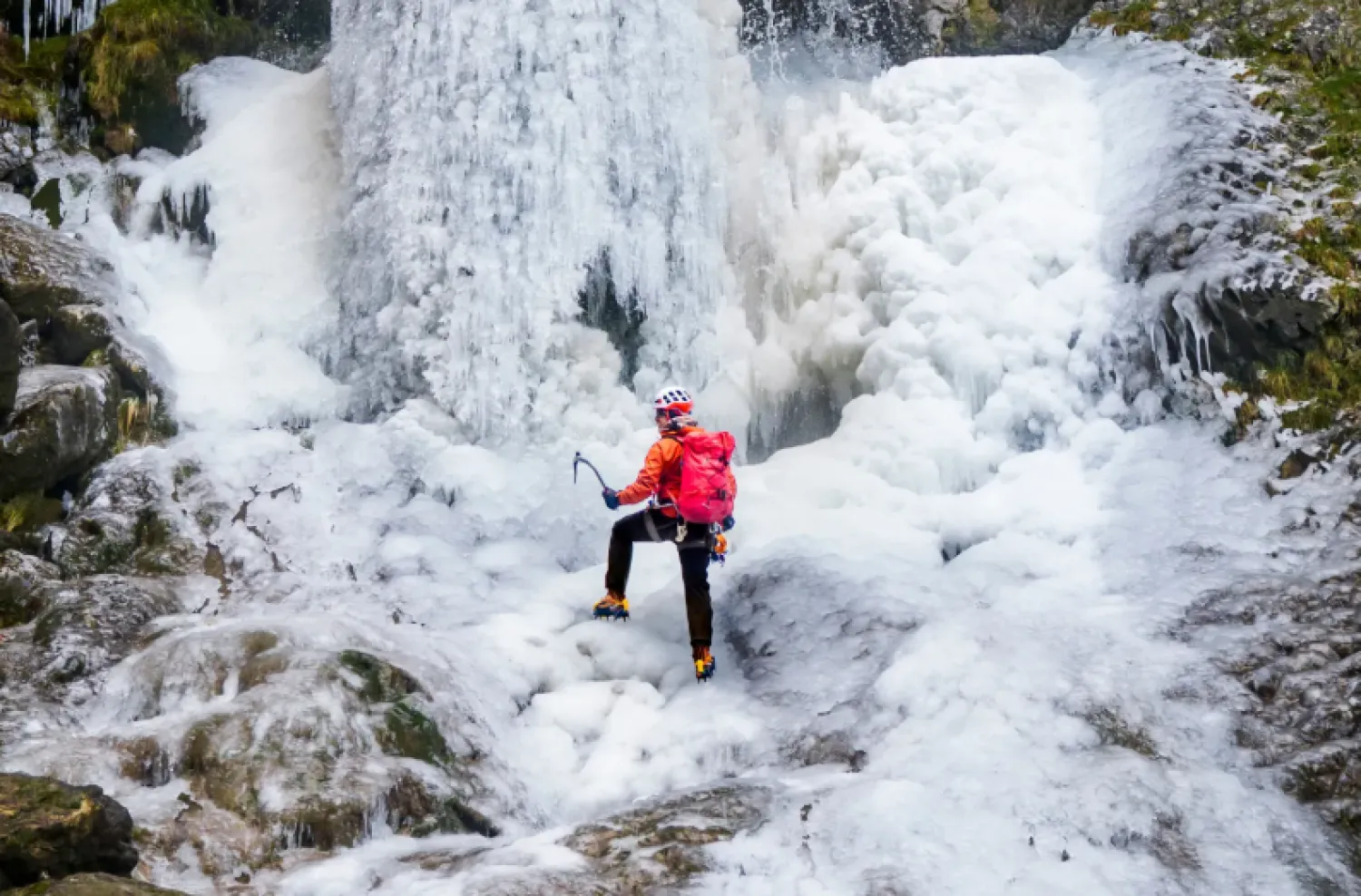
Lost Earth Adventures' instructor Mick Ellerton climbs a frozen waterfall in Gordale Scar near Malham Cove in the Yorkshire Dales National Park, as ice warnings are in place across the UK ahead of a storm which is set to bring heavy snow later in the week, on Wednesday Jan. 7, 2026. (Danny Lawson/PA via AP)
TT

UK Braced for Heavy Snow as Cold Weather Snap in Europe Persists

Lost Earth Adventures' instructor Mick Ellerton climbs a frozen waterfall in Gordale Scar near Malham Cove in the Yorkshire Dales National Park, as ice warnings are in place across the UK ahead of a storm which is set to bring heavy snow later in the week, on Wednesday Jan. 7, 2026. (Danny Lawson/PA via AP)

Britain, already in the midst of one of its coldest and longest cold snaps in years, is set to endure heavy snowfall and strong winds later Thursday that weather authorities have warned could bring a risk to life.

The brunt of the storm coming in from the Atlantic is set to be felt in central England, with as much as 30 centimeters (12 inches) of snow falling in just a few hours, which inevitably will have potential implications for schools, travel and commerce, particularly in more rural areas.

Storm Goretti, which has been named by the French weather service France Meteo, is expected to leave Britain's shores by late Friday before further impacting other parts of northwest Europe, which have already endured snow, ice and freezing temperatures in recent days.

Neil Armstrong, chief forecaster at the Met Office, Britain's national meteorological service, described Goretti as a “multi-hazard event” with heavy rain, strong winds and snow, The AP news reported.

The Met Office has issued amber warnings for many parts of the UK. These have an “increased likelihood of impacts from severe weather” compared to the lower yellow warnings, meaning there is the possibility of travel delays, road and rail closures, flight cancellations, power cuts and potential risk to life and property.

The snowfall will mean trains and planes could be delayed or cancelled, rural communities may be cut off, and power cuts and disruption to mobile signal are likely.

Amber cold weather health alerts have also been extended by the UK Health Security Agency for all regions of England until Jan. 12, which means severe impacts across health and social care services are expected. Officials expect a rise in deaths, particularly among those aged 65 and over or with health conditions, with impacts also possible on younger age groups.

Many parts of Wales, northern England and Scotland have been blanketed with snow over the past few days that has led to numerous school closures and travel disruption.

In the Netherlands, the bad weather eased on Thursday, helping Amsterdam’s Schiphol Airport, which saw hundreds of flights canceled on each of the first three days of the working week, trying to return to normal. However, it was briefly hit by a power outage in the morning.

Dutch national carrier KLM said there were still long lines of passengers at the airport but added that it was “doing everything possible to ensure departing passengers leave on time.”



Experts Say Oceans Soaked up Record Heat Levels in 2025

People exercise along Sydney Harbour, Australia, 08 January 2026. (EPA)
TT

Experts Say Oceans Soaked up Record Heat Levels in 2025

People exercise along Sydney Harbour, Australia, 08 January 2026. (EPA)

The world's oceans absorbed a record amount of heat in 2025, an international team of scientists said Friday, further priming conditions for sea level rise, violent storms, and coral death.

The heat that has accumulated in the oceans last year increased by approximately 23 zettajoules -- an amount equivalent to nearly four decades of global primary energy consumption.

This finding -- published in the journal Advances in Atmospheric Sciences -- was the highest reading of any year since modern record keeping began in the early 1950s, researchers said.

To derive these calculations, more than 50 scientists from 31 research institutions used multiple sources including a thousands-strong fleet of floating robots that track ocean changes to depths of 2,000 meters.

Peering into the depths, rather than fluctuations at the surface, provides a better indicator of how oceans are responding to "sustained pressure" from humanity's emissions, said study co-author Karina von Schuckmann.

"The picture is clear: results for 2025 confirm that the ocean continues to warm," von Schuckmann, an oceanographer from French research institute Mercator Ocean International, told AFP.

Oceans are a key regulator of Earth's climate because they soak up 90 percent of the excess heat in the atmosphere caused by humanity's release of greenhouse gases like carbon dioxide.

All that additional energy has a powerful knock-on effect. Warmer oceans increase moisture in the atmosphere, providing fuel for tropical cyclones and destructive rainfall.

Hotter seas also directly contribute to sea level rise -- water expands when it warms up -- and make conditions unbearable for tropical reefs, whose corals perish during prolonged marine heatwaves.

"As long as the Earth continues to accumulate heat, ocean heat content will keep rising, sea level will rise and new records will be set," said von Schuckmann.

- Humanity's choice -

Ocean warming is not uniform, with some areas warming faster than others.

The tropical oceans, the South Atlantic, the Mediterranean, the northern Indian Ocean, and the Southern Ocean were among waters that absorbed record amounts of heat in 2025.

This occurred even as average sea surface temperatures decreased slightly in 2025 -- yet still remained the third-highest value ever measured.

This decrease is explained by the shift from a powerful, warming El Nino event in 2023-2024 to La Nina-type conditions generally associated with a temporary cooling of the ocean surface.

In the long term, the rate of ocean warming is accelerating due to a sustained increase in greenhouse gas concentrations in the atmosphere caused mainly by burning fossil fuels.

As long as global warming is not addressed and the amount of heat trapped in the atmosphere keeps rising, oceans will keep breaking records, the researchers said.

"The greatest uncertainty in the climate system is no longer the physics, but the choices humanity makes," said von Schuckmann.

"Rapid emission reductions can still limit future impacts and help safeguard a climate in which societies and ecosystems can thrive."


‘Hectic’ Bushfires Threaten Rural Towns in Australian Heatwave

Smoke from the Longwood bushfire is seen at a staging area outside Seymour in central Victoria, Australia, Friday, Jan. 9, 2026. (Joel Carrett/AAP Image via AP)
TT

‘Hectic’ Bushfires Threaten Rural Towns in Australian Heatwave

Smoke from the Longwood bushfire is seen at a staging area outside Seymour in central Victoria, Australia, Friday, Jan. 9, 2026. (Joel Carrett/AAP Image via AP)

Bushfires destroyed houses and razed vast belts of forest in southeast Australia on Friday, firefighters said, as hot winds fanned "hectic" conditions in the tinder-dry countryside.

Temperatures soared past 40C as a heatwave blanketed the region, creating some of the most dangerous bushfire weather since the "Black Summer" blazes of 2019-2020.

Dozens of rural hamlets in the state of Victoria were urged to evacuate while they still could, while three people, including a child, were missing inside one of the state's most dangerous fire grounds.

"If you don't leave now, it could result in your life being lost," Emergency Management Commissioner Tim Wiebusch told reporters.

Powerful wind gusts temporarily grounded firefighting aircraft trying to contain some 30 different blazes dotted across the state.

Already, firefighters fear at least 20 houses have burnt to the ground in the small town of Ruffy, about two hours' drive north of state capital Melbourne.

Country Fire Authority boss Jason Heffernan said the fire danger was "catastrophic" -- the most severe rating possible.

"Victorians should brace themselves for more property loss or worse.

"Today is going to be quite a hectic and volatile day for firefighters, fire authorities and communities."

One of the most destructive bushfires has already razed some 28,000 hectares (70,000 acres) near the town of Longwood, a region cloaked in native forests.

"Some properties have lost everything," said local fire captain George Noye.

"They've lost their livelihoods, they've lost their shearing sheds, livestock, just absolutely devastating," he told national broadcaster ABC.

"But thankfully, at the moment, no lives have been lost."

The worst bushfires have so far been confined to sparsely populated rural areas where towns might number a few hundred people at the most.

- 'Black Summer' -

Photos taken this week showed the night sky glowing orange as the fire near Longwood -- north of state capital Melbourne -- ripped through bushland.

"There were embers falling everywhere. It was terrifying," cattle farmer Scott Purcell told the ABC.

Another bushfire near the small town of Walwa crackled with lightning as it radiated enough heat to form a localized thunderstorm, fire authorities said.

Hundreds of firefighters from across Australia have been called in to help.

"Today represents one of the most dangerous fire days that this state has experienced in years," said state premier Jacinta Allan.

Allan urged people to flee rather than stay put and try to save their homes.

"You will simply not win against the fires of these magnitudes that are created on days like today."

Millions of people in Australia's two most populous states -- Victoria and New South Wales -- are sweltering through the heatwave, including in major cities Sydney and Melbourne.

Power outages left more than 30,000 houses without electricity on one of the hottest days to hit Victoria in years.

Hundreds of baby bats died earlier this week as stifling temperatures settled over the neighboring state of South Australia, a local wildlife group said.

The "Black Summer" bushfires raged across Australia's eastern seaboard from late 2019 to early 2020, razing millions of hectares, destroying thousands of homes and blanketing cities in noxious smoke.

Australia's climate has warmed by an average of 1.51C since 1910, researchers have found, fueling increasingly frequent extreme weather patterns over both land and sea.

Australia remains one of the world's largest producers and exporters of gas and coal, two key fossil fuels blamed for global heating.


New Zealand's Rare Flightless Parrot Begins Breeding Again

New Zealand's critically endangerd kakapo parrot only breeds every few years. Don Merton / DEPARTMENT OF CONSERVATION/AFP/File
TT

New Zealand's Rare Flightless Parrot Begins Breeding Again

New Zealand's critically endangerd kakapo parrot only breeds every few years. Don Merton / DEPARTMENT OF CONSERVATION/AFP/File

New Zealand's critically endangered flightless parrot, the kakapo, started breeding last week for the first time in four years, the government conservation department said.

Only 236 of the rotund and regal-looking green parrots remain in three breeding populations on some of New Zealand's most remote southern islands.

That includes 83 breeding age females, with high hopes this year could bring the most hatched chicks since records began, said AFP.

"It's always exciting when the breeding season officially begins, but this year it feels especially long-awaited after such a big gap since the last season in 2022," said Deidre Vercoe, the Department of Conservation's kakapo recovery operations manager.

"Now it is underway, we expect more mating over the next month and we are preparing for what might be the biggest breeding season since the program began 30 years ago."

In 1995 the Department of Conservation and indigenous Maori tribe Ngai Tahu launched the Kakapo Recovery Program, with a population of just 51 birds at serious risk of extinction.

By 2022, numbers had rebounded to 252, but 16 birds died over the past four years.

This mating season is the 13th in the past 30 years, with the bird breeding every two to four years.

"Kakapo are still critically endangered so we'll keep working hard to increase numbers," Vercoe said.

"But looking ahead, chick numbers are not our only measure of success. We want to create healthy, self-sustaining populations of kakapo that are thriving, not just surviving.

"This means with each successful breeding season we're aiming to reduce the level of intensive, hands-on management to return to a more natural state."

Tane Davis, a Ngai Tahi representative on the recovery program, said it was hoped kakapo would one day thrive throughout New Zealand's South Island.

The first chicks are expected to hatch in mid-February.