


Australian Bushfires Raze Homes, Cut Power to Tens of Thousands

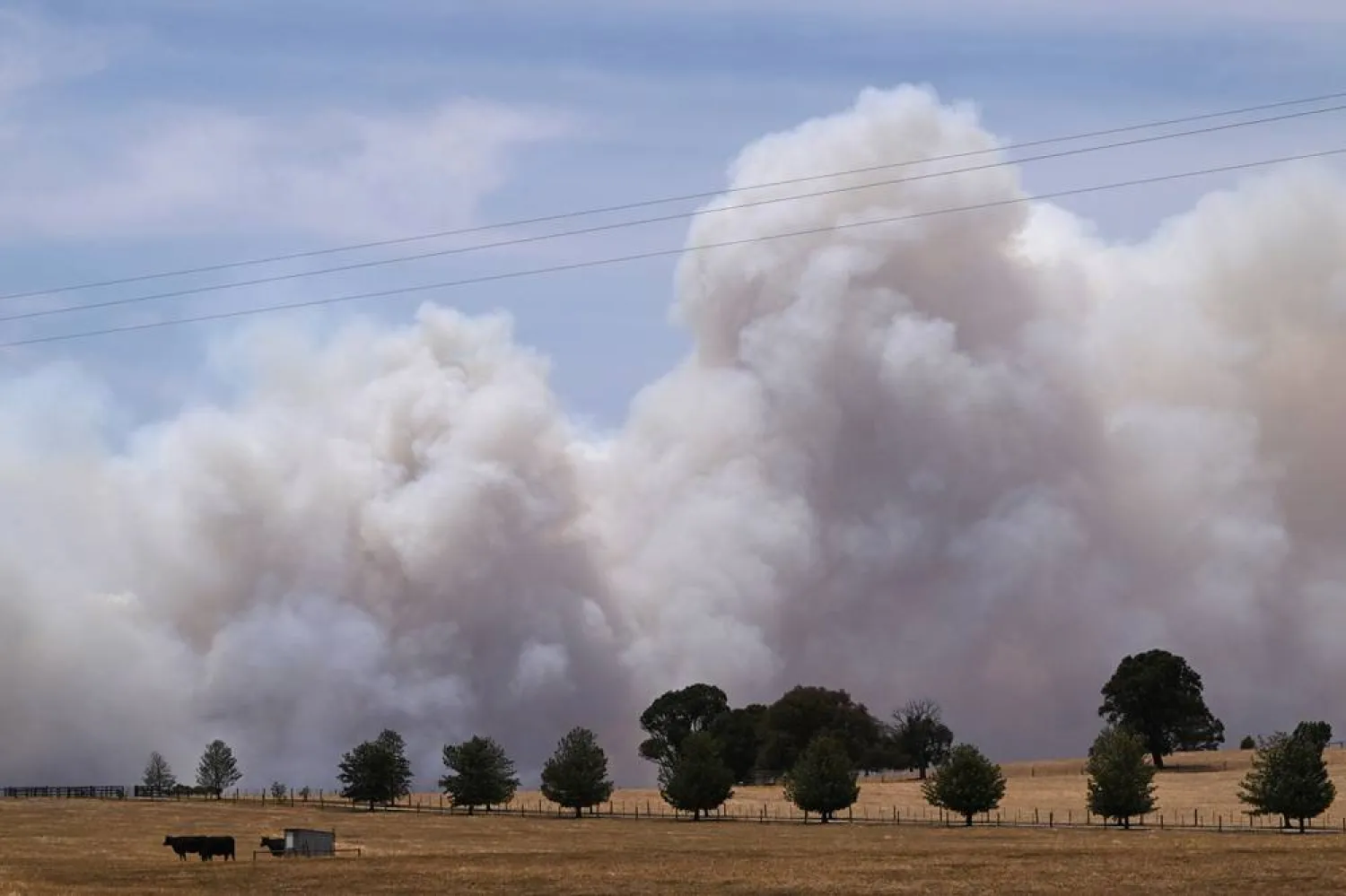
Smoke billows from the Longwood bushfire along the Goulburn Highway in Victoria, Australia, 09 January 2026. (EPA)
TT

Australian Bushfires Raze Homes, Cut Power to Tens of Thousands

Smoke billows from the Longwood bushfire along the Goulburn Highway in Victoria, Australia, 09 January 2026. (EPA)

Thousands of firefighters battled bushfires in Australia's southeast on Saturday that have razed homes, cut power to thousands of homes and burned swathes of bushland.

The blazes have torn through more than 300,000 hectares (741,316 acres) of bushland amid a heatwave in Victoria state since the middle of the week, authorities said on Saturday, and 10 major fires were still burning statewide.

In neighboring New South ‌Wales state, several ‌fires close to the Victorian border were ‌burning ⁠at emergency level, ‌the highest danger rating, the Rural Fire Service said, as temperatures hit the mid-40s Celsius (111 degrees Fahrenheit).

More than 130 structures, including homes, have been destroyed and around 38,000 homes and businesses were without power due to the fires in Victoria, authorities said.

The fires were the worst to hit the state since the Black Summer blazes of 2019-2020 that destroyed an area ⁠the size of Türkiye and killed 33 people.

"Where we can fires will be being brought ‌under control," Victoria Premier Jacinta Allan told ‍reporters, adding thousands of firefighters were ‍in the field.

Prime Minister Anthony Albanese said the nation faced a ‍day of "extreme and dangerous" fire weather, especially in Victoria, where much of the state has been declared a disaster zone.

"My thoughts are with Australians in these regional communities at this very difficult time," Albanese said in televised remarks from Canberra.

One of the largest fires, near the town of Longwood, about 112 km (70 miles) north of Melbourne, has burned ⁠130,000 hectares (320,000 acres) of bushland, destroying 30 structures, vineyards and agricultural land, authorities said.

Dozens of communities near the fires have been evacuated and many of the state's parks and campgrounds were closed.

A heatwave warning on Saturday was in place for large parts of Victoria, while a fire weather warning was active for large areas of the country including New South Wales, the nation's weather forecaster said.

In New South Wales capital Sydney, the temperature climbed to 42.2 C, more than 17 degrees above the average maximum for January, according to data from the nation's weather forecaster.

It predicted ‌conditions to ease over the weekend as a southerly change brought milder temperatures to the state.




Corgis Race, Bark and Sniff Their Way to Glory at a Growing International Race

 Corgis race during the Corgi Race Vilnius 2026 event in Vilnius, Lithuania, Saturday, Aug. 15, 2026. (AP)
Corgis race during the Corgi Race Vilnius 2026 event in Vilnius, Lithuania, Saturday, Aug. 15, 2026. (AP)
TT

Corgis Race, Bark and Sniff Their Way to Glory at a Growing International Race

 Corgis race during the Corgi Race Vilnius 2026 event in Vilnius, Lithuania, Saturday, Aug. 15, 2026. (AP)
Corgis race during the Corgi Race Vilnius 2026 event in Vilnius, Lithuania, Saturday, Aug. 15, 2026. (AP)

It's not all about short-legged speed when 150 corgis gather for an international race celebrating the little dogs. There's a costume parade, the "smartest nose," and — of course — the loudest bark.

The fifth Corgi Race Vilnius drew dogs and their owners to the Lithuanian capital's Vingis park on Saturday for what organizers said was the biggest edition yet. There were competitors from Lithuania, Latvia, Poland, Estonia, Germany, Ukraine, the Czech Republic, the United States and Britain — the country most closely associated with the breed, famously a favorite of the late Queen Elizabeth II.

“In the first year, we gathered 40 corgis from one city. This year, it’s 150 from nine countries, and for the first time we have a participant from the place where the breed originated,” organizer Edvinas Miskas said.

“We call Vilnius the European capital of corgis, and when people from the breed’s homeland start coming to us rather than the other way around, that title begins to sound a little more serious.”

Ninety-four dogs took part in the main running event, competing in qualifiers, semifinals and the final.

In the final, which pitted corgis against each other over 25 meters (82 feet), the winner was American competitor GG, short for Gustave the Girl Dog. Another US entrant, Mr. Corgington, finished a close second. Lithuania's own Moka, a two-time former champion, was third.

But much of the program dispensed with speed to explore the other skills of the dogs and their owners.

There was a costume parade featuring 38 corgis in diverse outfits including a dinosaur suit, a dress and doggy sports gear. Amigo swept both the four-judge jury and the public Facebook vote for a flawless costume entry with a knight-like look.

In the “smartest nose” challenge, dogs searched for hidden treats. Latvian corgis Tora and Rusty shared the win.

And then there was the loudest bark competition. The first British competitor, 12-year-old Pembroke Welsh corgi Duke from Sedbergh in northwest England, didn't participate in the main race because of his stately age but was a hopeful in the barking stakes after, as his owner put it, training for his whole life.

It was Mr. Corgington who won the loudest bark contest, though.

He was one of the most traveled competitors. The final race offered him a rematch after he finished second against GG at a major race at Emerald Downs in Auburn, Washington — her second consecutive win there.

Half of the corgis registered in Vilnius this year were taking part for the first time. But six veterans — costume winner Amigo, Foksas, Foksis, Madeira, Bulka and Dziugas — have attended every edition.


Belgium’s Biggest Wildfire on Record Heads Towards Germany

This aerial photograph shows a wildfire burning in the Hautes Fagnes (High Fens) nature reserve in Waimes on August 15, 2026. (AFP)
TT

Belgium’s Biggest Wildfire on Record Heads Towards Germany

This aerial photograph shows a wildfire burning in the Hautes Fagnes (High Fens) nature reserve in Waimes on August 15, 2026. (AFP)

Firefighters worked through the night to battle Belgium's biggest wildfire on record, which by Sunday morning had burned 3,000 hectares of land and was heading towards the German border, local authorities said.

The blaze in the High Fens, a nature reserve in the east of the country, has been burning since Friday and firefighters from across Belgium and neighboring Germany and Luxembourg have sought ‌to contain it, ‌as have the army and ‌farmers.

Responders ⁠on Sunday were ⁠focused on the front line of the fire moving towards Germany and were hopeful that cooler, more humid weather would support efforts to contain it, Stephanie Ernoux, spokesperson for the administration of the Belgian region of Wallonia, told Reuters.

The fire is ⁠more than double the size of ‌a blaze in ‌2011 that burned close to 1,400 hectares, data from the ‌European Forest Fire Information System showed.

The EU deployed ‌three helicopters and two water bomber aircraft from around Europe on Saturday after Belgium requested emergency reinforcements.

Local authorities said the defensive line protecting evacuated villages from the fire ‌was holding on Sunday, though residents who had been evacuated on Saturday were ⁠told ⁠they should not yet return to their homes.

"No homes have been affected at this stage, although the fire remains close and smoke levels are significant," the office of the governor of Liege said in an update.

The blaze ignited as European countries including Belgium suffered their fifth heatwave of the summer this week.

Scientists say that human-caused climate change has increased the likelihood of the hot and dry conditions that allow wildfires to spread faster and burn longer.


Firefighters Battle Second Day of Blaze on Greek Island

A burnt vehicle after a fire that broke out in the summer resort of Siviri, Chalkidiki, northern Greece, 14 August 2026. (EPA)
TT

Firefighters Battle Second Day of Blaze on Greek Island

A burnt vehicle after a fire that broke out in the summer resort of Siviri, Chalkidiki, northern Greece, 14 August 2026. (EPA)

Firefighters battled for a second day on Sunday to contain a forest fire on the Greek Aegean island of Skyros, as the local mayor voiced hope it could soon be brought under control.

"Within the day I believe the fire will be fully extinguished," Skyros mayor Kyriakos Antonopoulos told state TV ERT.

The fire, which broke out on Saturday, prompted the evacuation of two small communities, but Antonopoulos said no inhabited areas were under threat on Sunday.

Reinforcements to the island of some 3,000 have been rushed in from neighboring areas.

After largely escaping the heatwave temperatures that blanketed much of Europe earlier this summer, Greece has been hit with several major wildfires since late July, fueled by unusually strong winds.

Five firefighters have died so far, including a Danish pilot killed in a mid-air collision between two Bell helicopters while battling a blaze near Athens earlier this month.

There was another scare last week when about 500 tourists were evacuated from beaches on the Halkidiki peninsula in northern Greece as a forest fire threatened two popular resorts.

Some 20,000 hectares of forest and agricultural land have burned this year in major fires near Athens and on the islands of Crete and Paros.

Greece is hit by wildfires every year. Experts say the risk is growing because of human-fueled climate change, which has made droughts and other extreme weather events more severe.