


Freezing Rain Paralyses Transport in Central Europe

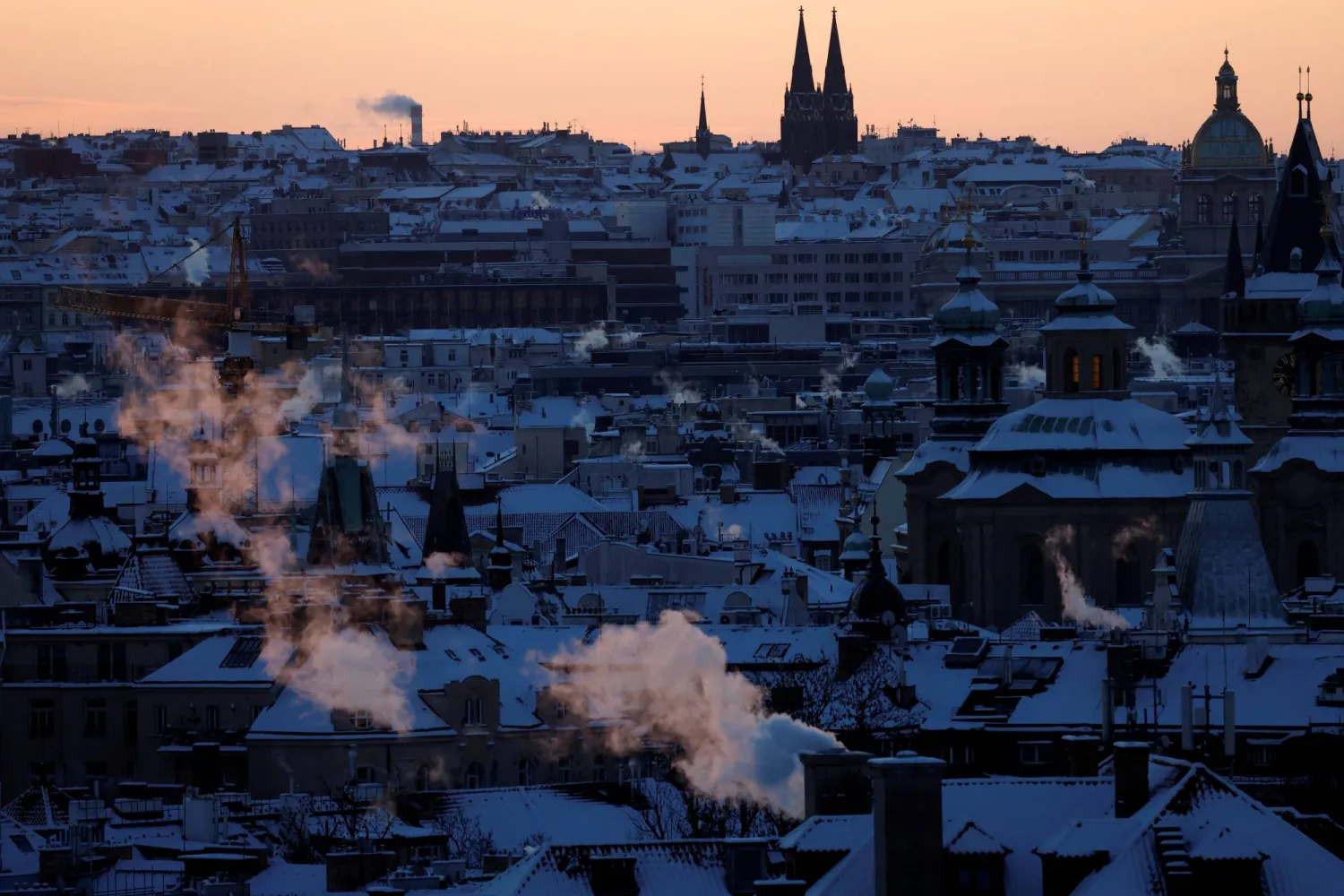
Smoke from chimneys billows over snow-covered rooftops during sunrise as freezing temperatures have hit the country, in Prague, Czech Republic, January 11, 2026. (Reuters)
TT

Freezing Rain Paralyses Transport in Central Europe

Smoke from chimneys billows over snow-covered rooftops during sunrise as freezing temperatures have hit the country, in Prague, Czech Republic, January 11, 2026. (Reuters)

Freezing rain led to flights being suspended at Vienna airport on Tuesday, while neighboring Slovakia, Czech Republic and Hungary also experienced travel disruptions.

Snow and freezing temperatures buffeted Europe last week, with gale-force winds and storms claiming some 15 lives, causing travel mayhem, shutting schools, and cutting power to hundreds of thousands.

A thick layer of ice on the Vienna airport runways led to arriving flights being diverted to other airports, while all departing flights were put on hold early Tuesday.

Austria's state railway company OeBB also asked travelers to postpone non-urgent journeys, with numerous train connections facing interruptions and cancellations.

In neighboring Slovakia, the Bratislava airport was also closed early Tuesday due to bad weather.

Slovak police on Facebook urged people to avoid travel because of "extreme" ice and snow in the west of the country.

In the Czech Republic, ice was also hampering road and rail traffic.

Prague airport came to a virtual standstill, with firefighters having to de-ice the runways.

Around 50 people were treated for injuries because of the icy conditions, according to Prague's emergency services, cited by the CTK agency.

In Hungary, meteorological services also issued alerts for freezing rain and snowfall as severe winter conditions affect a large part of the country.

Trains and flights were experiencing delays, while authorities reported drift ice on the Danube and the Tisza rivers, where icebreakers have been put on alert.

Lake Balaton in the west of the country is currently frozen -- a relatively rare phenomenon seen about once every ten to fifteen years.

However, authorities warned that the ice is still too thin for skating, urging the public to be cautious.



Europe Puts into Orbit Two Earth Observation Satellites

A Vega-C rocket carrying European satellites FLEX and Sentinel-3C lifts off from the Guiana Space Center in Kourou, French Guiana, on September 15, 2026. (AFP)
TT

Europe Puts into Orbit Two Earth Observation Satellites

A Vega-C rocket carrying European satellites FLEX and Sentinel-3C lifts off from the Guiana Space Center in Kourou, French Guiana, on September 15, 2026. (AFP)

The European Space Agency has successfully put into orbit two satellites designed to better detect extreme weather events linked to climate change, officials said.

The European Vega-C rocket successfully launched the Sentinel-3C and Flex satellites after lifting off from the Kourou space center in French Guiana at 10:21 pm Monday (0121 GMT Tuesday), according to an AFP journalist on the scene.

The two satellites were placed into a sun-synchronous orbit nearly two hours after liftoff.

The first satellite, Flex (Fluorescence Explorer), will provide data on the impact of heatwaves on plant matter.

It will monitor fluorescence, the red light emitted by plants when they carry out photosynthesis, aiming to establish the link between "plant stress and fluorescence" and to "quantify it", head of the Flex program Thierry Huiban told AFP at Thales Alenia Space in April.

The second satellite, the Sentinel-3C from the European Union's Copernicus Earth observation program, will measure the marine environment -- including temperature, wave height and ocean currents -- as well as land use and land cover, aiming to optimize yields to prevent food crises.

Such missions are "essential" in helping with the "climate change we are experiencing", said Simonetta Cheli, Director of Earth Observation Programmes at the European Space Agency (ESA), speaking from Kourou.


Astrophysics Study Suggests Venus May Have Swallowed Its Moon

Data from NASA's Magellan spacecraft and Pioneer Venus Orbiter is used in an undated composite image of the planet Venus. (NASA/JPL-Caltech/Handout via Reuters)
TT

Astrophysics Study Suggests Venus May Have Swallowed Its Moon

Data from NASA's Magellan spacecraft and Pioneer Venus Orbiter is used in an undated composite image of the planet Venus. (NASA/JPL-Caltech/Handout via Reuters)

A California-based astrophysicist presented a new theory on Monday to explain why Venus, the planet most like Earth in size, mass and structure, lacks its own moon. Call it a case of celestial cannibalism.

The extremely slow speed at which Venus rotates on its axis would have doomed any natural satellite that may once have orbited that planet to gradually spiral closer to its parent and ultimately be consumed in a cataclysmic smash-up.

So goes the theory offered by scientists at the University of California, Riverside, and published on Monday in The Astrophysical Journal, marking a departure from past explanations for why Venus, the second planet from the sun, is without a lunar companion.

"If it had a moon, and it ‌likely did at ‌some point, it could not have kept it," astrophysicist Stephen Krane, lead ‌author ⁠of the study, told ⁠Reuters on Monday. "That moon would have crashed down on the planet in a relatively short time scale."

Krane said data from computer models based on planetary physics and simulating the gravitational mechanics of hypothetical Venusian moons of various sizes showed them all meeting the same fate - sooner or later collapsing into their mother planet.

Such a presumed moon-gobbling event likely occurred within the first billion years in the history of Venus, Krane said.

Scientists previously theorized that Venus, ⁠known as Earth's "twin," either never acquired its own moon to begin ‌with, or possibly had a moon that was obliterated in ‌the massive impact from another celestial object.

EARTH SPINS MORE SWIFTLY THAN VENUS

The UC Riverside study, focusing on Earth-moon ‌dynamics, found that planetary rotational speed was the key factor.

In contrast to Venus, which takes 243 ‌Earth days to complete a single rotation - slightly longer than its orbit around the sun - Earth spins on its axis every 24 hours, more than 200 times more rapidly than Venus, Krane said.

The transfer of energy from Earth's faster rotation is gradually pushing our moon farther away, causing it to recede from Earth at the rate of ‌4 centimeters (1.6 inches) a year - precisely measured by mirrors left on the lunar surface in 1969 by Apollo 11's astronauts.

Venus, the third brightest object ⁠in the night sky ⁠after the sun and moon, looms large as point of study for scientists seeking to learn more about Earth's history, and its future.

Similar in its rocky structure but slightly smaller than Earth, Venus is enveloped in a thick, toxic atmosphere that has created a runaway greenhouse effect, scorching its surface at temperatures as high as 880 degrees Fahrenheit (471 degrees Celsius), hot enough to melt lead.

While there is no proof a Venusian moon ever existed, it is unlikely that Venus, in its infancy, somehow avoided the kind of world-shattering collision with another proto-planet that is widely believed to have formed Earth's moon, according to Krane.

The dawn of the inner solar system was crowded with large rocky objects hurtling through space and smashing into one another, with Venus probably taking more celestial hits than Earth because Venus was closer to the sun.

Scientists hope to unlock more secrets of Venus with two forthcoming NASA missions set for launch in the late 2020s or early 2030 dubbed DAVINCI+ and VERITAS to study the planet's atmosphere and geologic features.


Chinese Architect Ma Yansong Melds Nature with ‘Futuristic Feel’

Chinese architect and founder of MAD Architects Ma Yansong poses for a photograph in Beijing on August 7, 2026. (AFP)
TT

Chinese Architect Ma Yansong Melds Nature with ‘Futuristic Feel’

Chinese architect and founder of MAD Architects Ma Yansong poses for a photograph in Beijing on August 7, 2026. (AFP)

From a distance, it looks as though a giant spaceship has just landed in the palm tree-dotted streets near downtown Los Angeles.

It could also be a wide-canopied tree or a low passing cloud -- but for its Chinese architect Ma Yansong, as long as the building "sparks curiosity", he's achieved his purpose.

Over the past two decades, Ma has created dozens of visually striking projects in his home country and abroad, integrating nature with sleek, modern designs.

In some ways, his seemingly sci-fi-inspired style is a perfect match for his newest project opening on September 22, the Lucas Museum of Narrative Art in Los Angeles, founded by "Star Wars" creator George Lucas and his wife, Mellody Hobson.

"The building takes on a futuristic feel that generates excitement," Ma told AFP at the Beijing office of MAD Architects, the firm he established in 2004.

"When people visit the Lucas Museum, they will each bring their own unique perspectives," said the 50-year-old, who last year was included on Time magazine's list of the 100 most influential people.

"They might catch a beam of light, see it cutting through the building, glimpse the clouds, the sky, or even the cosmos.

"This sparks curiosity and new ideas -- and those diverse thoughts are incredibly valuable."

- Mountains and water -

A Beijing native, he grew up in a courtyard house typical of the "hutong" alleyways that crisscross the historic center of China's capital city.

"There was a very close connection to nature," he said, recalling the trees and small pockets of open space interspersed in hutong neighborhoods.

Later, he went overseas to train as an architect, graduating from the Yale School of Architecture and working briefly at the studio of acclaimed Iraqi-British designer Zaha Hadid.

Ma and his firm have conceptualized landmark works all over China, including the Harbin Opera House, a vast, swooping structure perched dramatically on the banks of the frigid Songhua River.

Abroad, his notable projects include a pair of twisting residential buildings called the "Absolute Towers" near Toronto, Canada, and a migration-themed museum that opened last year in Rotterdam, the Netherlands.

Ma's architectural vision draws inspiration from traditional Chinese paintings known as "shanshui", or "mountains and water", usually depicting natural scenery.

The Lucas Museum is closely interwoven with its external environment by lawns, trees, running water and a roof covered in vegetation and solar panels.

"If you look at a Chinese garden, it is a completely natural environment, even though it is artificially designed," Ma told AFP.

"There is a global conversation (now) about ecology and how to bring people closer to nature, yet I find that traditional Eastern architecture mastered this long ago," he said.

- People-centered architecture -

Ma told AFP that he embraces what he calls a "major shift" in architecture towards placing people, rather than the buildings themselves, at the center of the design concept.

"We aren't using architecture to flaunt wealth or power," he said.

Although many of MAD's clients wield significant financial resources, Ma said his focus is not merely to impress, but also to create "uniquely valuable space for people to enjoy".

MAD's Beijing office is located in the heart of a hutong neighborhood near where Ma attended school in his youth.

"I like these small streets, with their trees, the people walking by and that certain atmosphere of everyday urban life," he said.

Ma said when he designs a building he wants to make sure it gives "freedom of movement" to residents -- a concept which drove his design of the Baiziwan Social Housing project in Beijing, a subsidized residential compound for low-income communities.

"Many low-income individuals feel they cannot integrate into the city," said Ma.

"Often, such housing is walled off, isolating residents," he said, adding: "It's a psychological barrier -- they feel the city doesn't accept them."

Unlike the closed, block-like apartments that have sprung up in Chinese cities during decades of rapid urbanization, Baiziwan features an open layout with an elevated garden level and a design that optimizes sunlight.

Ma said he doesn't want his buildings "to be a palace or a temple-like structure that demands reverence".

"I want it to be open, a place where everyone feels they are the masters of the city."