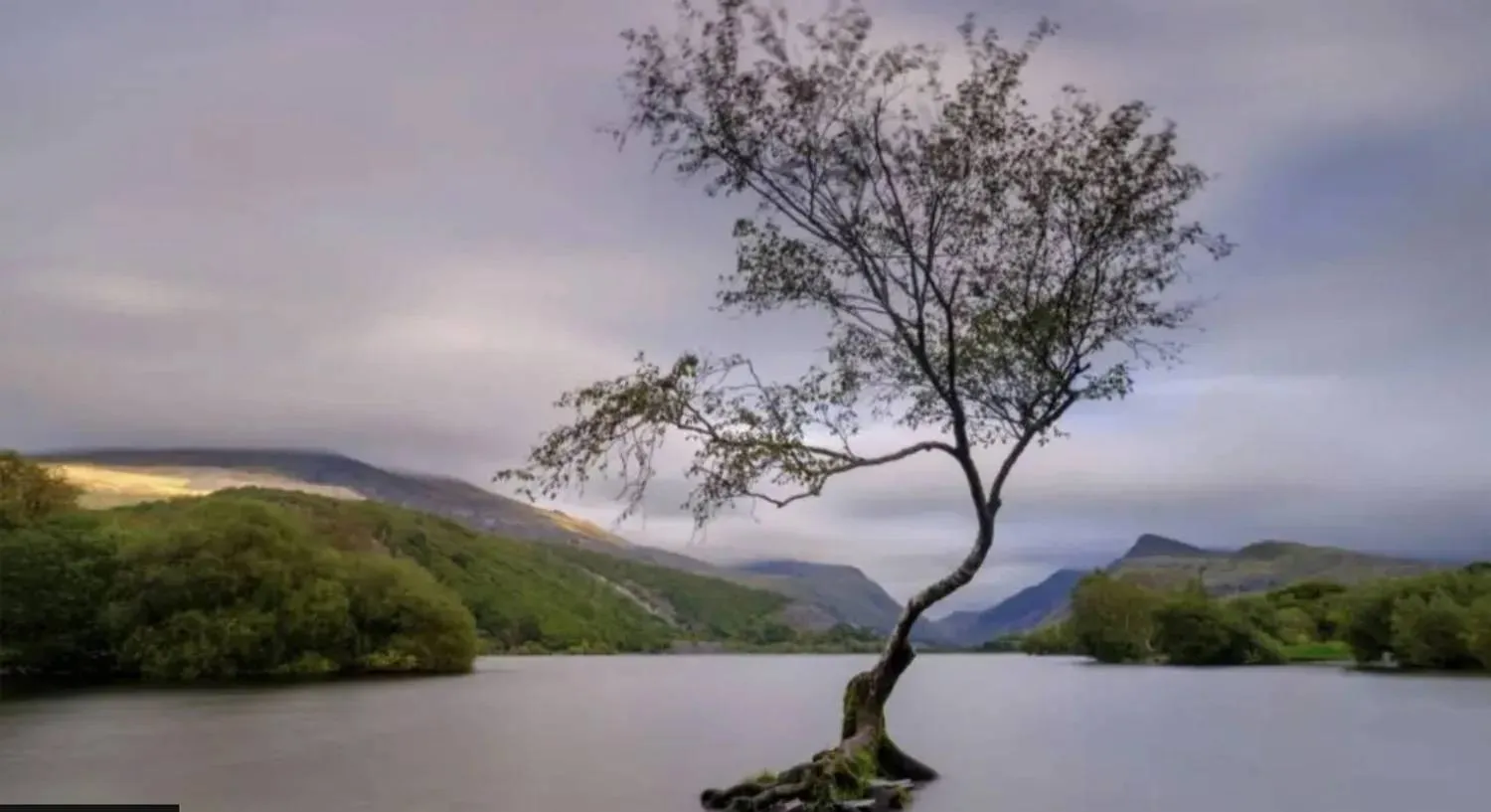
Lonely Tree in Wales Is an Instagram Star, but its Fate Is Inevitable

The Lonely Tree, often pictured submerged in water, was first planted in 2010. (Getty Images)
TT

Lonely Tree in Wales Is an Instagram Star, but its Fate Is Inevitable

The Lonely Tree, often pictured submerged in water, was first planted in 2010. (Getty Images)

It is one of Wales' most-loved beauty spots - but the time of the so-called Lonely Tree being an Instagram star could be slowly coming to an end.

The birch tree's striking setting at Llyn Padarn in Eryri, also known as Snowdonia, draws photographers to capture the sight through the seasons, according to BBC.

But the local authority Cyngor Gwynedd has raised the prospect of the tree, which was planted around 2010, disappearing within the next decade or so.

A lack of nutrients in the soil means birch trees have “a relatively short lifespan” in the area, typically living for around 30 years, but the fact that The Lonely Tree is sometimes submerged in water means its time could be even shorter.

Thousands of walkers and photographers make their way there each year and the tree has many social media sites dedicated to it, including one with 3,500 members on Facebook.

Marc Lock from Bangor, Gwynedd, said: “The Lonely Tree holds a special place in my heart and that of my family.”

He added: “Nestled down by the Lonely Tree, it's a perfect spot for us to sit, reflect and soak in the breath-taking scenery. We often go paddleboarding there in the summer months.”

However, Lock said the area really became his sanctuary after his wife bought him a camera for Christmas and he took up photography.

It was the place he headed to straight away, and he returns regularly at various times of the day and throughout the seasons.

“It's my go-to spot whenever I have some free time and my camera in hand,” he added. “I can't imagine what I would do if anything devastating happened to it like that at the Sycamore Gap tree at Hadrian's Wall. It's simply unthinkable.”

The Sycamore Gap was a much-loved landmark beside Hadrian's Wall in Northumberland that also drew hikers and photographers from far and wide.

It was more than 100 years old and had been the scene of many proposals, with people making the trip there from around the world.

But it was cut down by vandals in September 2023, causing uproar, with thousands of people leaving tributes and posting messages about their love for the beauty spot.

Two men were jailed for four years and three months after admitting the illegal felling.

While maybe not quite as famous as the Sycamore Gap was, The Lonely Tree is every bit as special to those that hold it dear to their heart.


Wildlife to Replace Humans on Next Series of UK Banknotes

Banknotes and coins that feature an image of Britain's King Charles III are pictured on display during a photocall for "The Future of Money" exhibition, at the Bank of England Museum, City of London, UK, Feb. 27, 2024. (AFP)
TT

Wildlife to Replace Humans on Next Series of UK Banknotes

Banknotes and coins that feature an image of Britain's King Charles III are pictured on display during a photocall for "The Future of Money" exhibition, at the Bank of England Museum, City of London, UK, Feb. 27, 2024. (AFP)

Images of ‌animals will feature on the next series of banknotes from the Bank of England, as the central bank shifts away from historical figures such as William Shakespeare, Winston Churchill and Jane Austen over the coming years.

"Nature is a great choice from a banknote authentication perspective and means we can showcase the UK's rich and varied wildlife on the next series of ‌banknotes," Victoria ‌Cleland, the BoE's chief cashier, said.

Bank ‌of ⁠England banknotes have ⁠featured monarchs since Queen Elizabeth first appeared on one in 1960, while Shakespeare was the first historic figure to appear in 1970.

King Charles' portrait will continue to appear on the next series of notes as well, the ⁠BoE said.

The BoE held a ‌consultation on a change ‌to the design of banknotes in July 2025, ‌inviting views from the public.

The theme of ‌nature was supported by 60% of the 44,000 responses, narrowly beating the category of "architecture and landmarks" on 56% and "notable historical figures" on 38%. Other categories included "arts, ‌culture and sport", "innovation" and "noteworthy milestones".

The new notes will feature wildlife native ⁠to ⁠the United Kingdom and will not include household pets, the BoE said. It plans to run a second consultation in the coming months asking for the public's views on specific animals to feature on the notes taken from a list created by British wildlife experts.

The BoE is not the only producer of banknotes in the United Kingdom. Notes are also produced by seven commercial banks in Scotland and Northern Ireland.


North Korea and China to Resume Passenger Train Service After Six-Year Gap

A North Korean flag flutters from a train believed to be carrying North Korean leader Kim Jong Un, as it arrives in Beijing, China, September 2, 2025. (Reuters)
TT

North Korea and China to Resume Passenger Train Service After Six-Year Gap

A North Korean flag flutters from a train believed to be carrying North Korean leader Kim Jong Un, as it arrives in Beijing, China, September 2, 2025. (Reuters)

South ‌Korea's Unification Ministry said on Tuesday that passenger train services between Pyongyang and Beijing are set to resume this week, marking the end of a six-year suspension caused by the COVID-19 pandemic.

The resumption restores a critical transport link between North Korea and its primary economic ally, after ‌years of ‌strict border closures that began ‌in ⁠early 2020.

China's state ⁠railway told the Yonhap News Agency that the Pyongyang–Beijing train will begin the round-trip service on March 12, operating four times a week.

Only the last two carriages will ⁠initially carry passengers, mainly diplomats or ‌others on ‌official business, with ticket sales to the general ‌public possible if seats are ‌available, Yonhap quoted a railway official as saying.

North Korea remains closed to most foreign tourism, with limited exceptions largely for ‌Russian tour groups under restricted arrangements, according to travel agencies organizing trips ⁠to ⁠the country.

Before the pandemic, Chinese visitors made up the largest share of foreign tourists to North Korea, the agencies said.

Tour organizers said on Monday that North Korea had cancelled next month's Pyongyang Marathon for unspecified reasons. The race is one of the few events that has been open to international participants in the isolated state.


Former Fukushima Worker Devotes Life to Abandoned Pets

This picture taken on March 5, 2026 shows former nuclear plant worker Toru Akama playing with a cat during an interview with AFP at his animal shelter in Namie, Fukushima prefecture. (AFP)
TT

Former Fukushima Worker Devotes Life to Abandoned Pets

This picture taken on March 5, 2026 shows former nuclear plant worker Toru Akama playing with a cat during an interview with AFP at his animal shelter in Namie, Fukushima prefecture. (AFP)

Not far from the Fukushima nuclear disaster site, former plant worker Toru Akama tends to dozens of pets abandoned after the catastrophe 15 years ago, work he sees as part of his quest for redemption.

Meows and barks break the silence of the countryside, once an evacuation zone, as the 63-year-old brings food to the animals left behind when their owners fled the triple disaster of March 11, 2011: earthquake, tsunami, and nuclear accident.

"It's because of this plant, where we worked for years, that these animals ended up like this," Akama told AFP at his home in northern Japan, surrounded by cats.

"They should have been able to go on living their lives as pets, but because of this accident they were abandoned.

"I felt it was my duty to protect them," he said.

Akama will never forget what he saw in the wake of the disaster, caused by Japan's strongest earthquake on record.

The tsunami it unleashed killed or left missing 18,500 people, and a wall of water crashed into the Fukushima nuclear plant on the northeast coast causing a devastating meltdown.

A day later, residents were ordered to evacuate and an unbroken line of cars formed on the national highway that runs past Akama's house.

"Then the dogs started wandering in search of something to eat -- least those that weren't chained up," he recalled.

"There was no one left, just my wife and me handing out food."

-'Outrage'-

Akama then began taking the animals into his home: first 40 dogs, then 50.

A decade and a half later, he has found adoptive families for more than 1,000 animals and continues to take in new pets who have been abandoned for other reasons.

He says he has "felt outrage" at the pet owners, who have sometimes left their animals in front of his house.

Some "are remorseful, but others simply do it because the animals have become a nuisance", he said.

In difficult moments, "of course... people's priority is human beings, but animals are living beings too, members of the family. It's as if people were abandoning their own children".

After the nuclear disaster, some residents had to flee by bus, and animals were not allowed aboard.

"There were elderly people in tears, asking if someone could take their pet," he recalled.

A month after the disaster Akama also had to leave, but he returned every day for his work at the plant and to look after his charges.

"Because they had known hunger, I absolutely wanted to give them a good life. Sometimes we went without ourselves in order to buy them quality food," he said.

-They 'watch over me'-

Over the past 15 years, Akama says he has spent almost all of the compensation he received after the plant accident on the animals, and he continues to cover most of their care and food costs.

"I don't have time to deal with collections or crowdfunding campaigns," he explained, although he has received some donations.

Akama's days are structured around cleaning the cages where new arrivals spend their first days, feeding, walking the dogs, and taking in new residents, leaving him little respite.

"It never stops. To be honest, I feel like my old job was easier," he said.

"But thanks to them I've never fallen ill: they force me to stay active. Maybe it's their way of thanking me, of watching over me in their own way."

At first, he kept the ashes of the deceased animals in his house, but he eventually had to build a grave outside to hold the remains of around 30 dogs and even more cats, beneath the inscription "rest in peace".

Akama's brother took over his subcontracting business for the plant, allowing him to devote himself full time to the 47 cats and seven dogs with whom he currently shares his life.

"If I'm still able to keep going today, it's because I carry within me the distress these animals experienced. That's what keeps me going."

He would nevertheless like to find a successor.

"That's my biggest concern right now, because I too am starting to get older," he said.

"But I'd like to keep going like this until the end."