


Kurt Cobain's 'Nevermind' Guitar Up for Sale

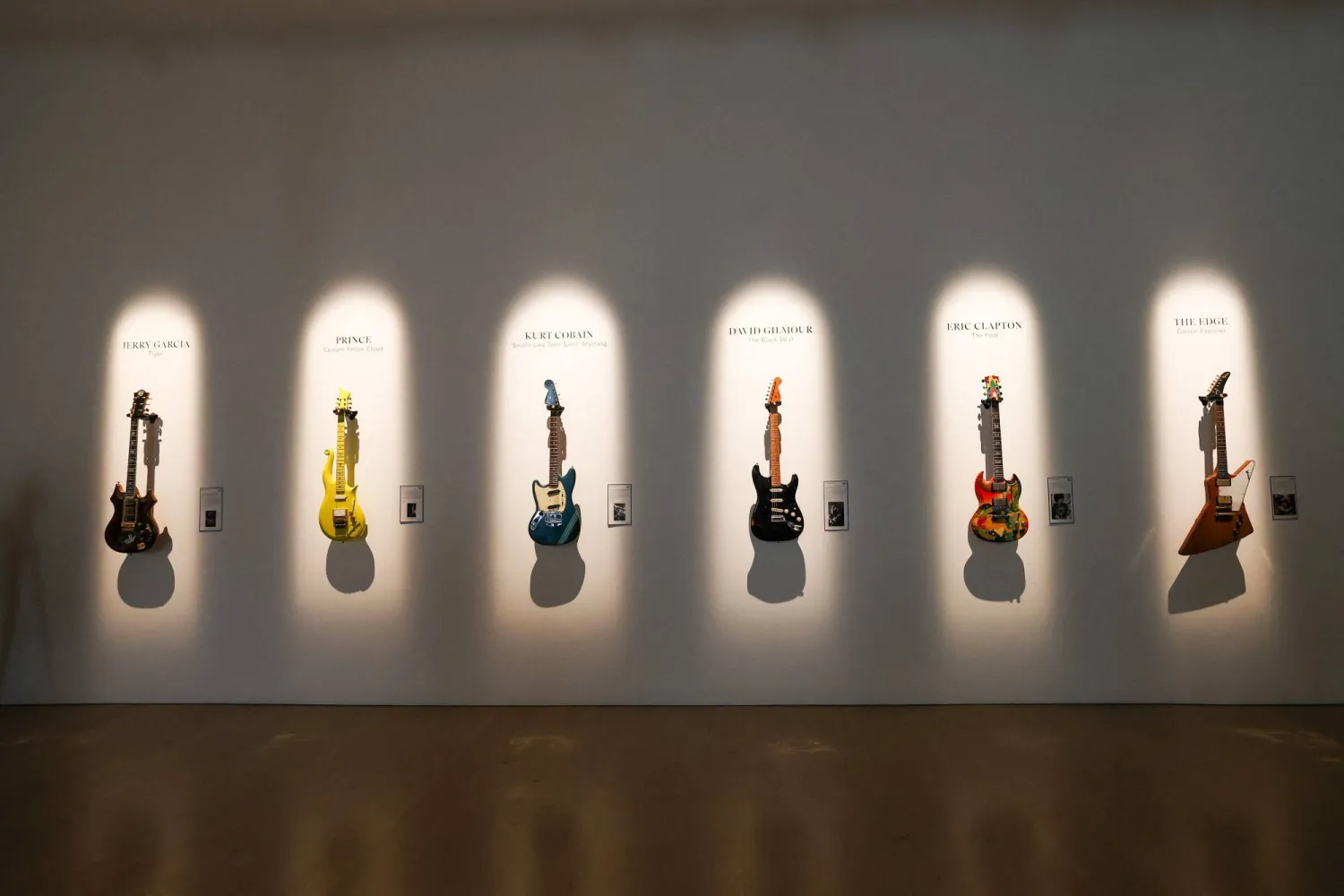
Guitars are displayed during a press preview of The Jim Irsay Collection at Christie's Los Angeles in Beverly Hills, California, on February 5, 2026. (Photo by VALERIE MACON / AFP)
TT

Kurt Cobain's 'Nevermind' Guitar Up for Sale

Guitars are displayed during a press preview of The Jim Irsay Collection at Christie's Los Angeles in Beverly Hills, California, on February 5, 2026. (Photo by VALERIE MACON / AFP)

The guitar played by late rock legend Kurt Cobain on the anthemic grunge track "Smells Like Teen Spirit" is going under the hammer next month.

The 1966 Fender Mustang is among a treasure trove of instruments and musical memorabilia that also includes the logo-emblazoned drum that announced The Beatles to the United States when the Fab Four played "The Ed Sullivan Show" in 1964.

The Jim Irsay collection -- put together by the one-time owner of the Indianapolis Colts NFL team -- includes guitars played by musicians who defined the 20th century, including Pink Floyd's Dave Gilmour, The Grateful Dead's Jerry Garcia, as well as Eric Clapton, John Coltrane and Johnny Cash.

But at the center of the collection are handwritten lyrics for The Beatles' smash "Hey Jude" as well as guitars played by John Lennon, Paul McCartney and George Harrison.

"I think it's fair to say that this collection of Beatles instruments...is the most important assembled Beatles collection for somebody who wasn't a member of the band," Amelia Walker, the London-based head of private and iconic collections at Christie's, told AFP in Beverly Hills.

"There are five Beatles guitars in his collection, as well as Ringo Starr's first Ludwig drum kit (and) John Lennon's piano, on which he composed several songs from Sergeant Pepper."

Also included is "the drum skin from Ringo's second Ludwig kit, which is the vision which greeted 73 million Americans who tuned in to watch 'The Ed Sullivan Show' on the ninth of February 1964 when the Beatles broke America."

The drum kit is expected to fetch around $2 million, while the guitars could sell for around $1 million at the auction in New York, Christie's estimates.

Perhaps the most expensive item in the collection is Cobain's guitar, which experts say might sell for up to $5 million.

"It's a talismanic guitar for people of my generation... who lived through grunge," said Walker.

"(Smells Like Teen Spirit) was the anthem of that generation. That video is so iconic.

"We're incredibly proud and privileged to have that here."


Snowstorm Brings Much of Denmark to a Halt

A car drives in heavy snow at Store Heddinge in South Zealand, Denmark, 05 February 2026.  EPA/Mads Claus Rasmussen
A car drives in heavy snow at Store Heddinge in South Zealand, Denmark, 05 February 2026. EPA/Mads Claus Rasmussen
TT

Snowstorm Brings Much of Denmark to a Halt

A car drives in heavy snow at Store Heddinge in South Zealand, Denmark, 05 February 2026.  EPA/Mads Claus Rasmussen
A car drives in heavy snow at Store Heddinge in South Zealand, Denmark, 05 February 2026. EPA/Mads Claus Rasmussen

Denmark authorities halted public transport, closed schools and cancelled flights on Friday as heavy snowfall blanketed much of the country.

The Nordic country's meteorological institute DMI warned that heavy snow would likely continue until Friday evening in the east, where the capital Copenhagen is located.

Police said people should avoid going outdoors unless necessary and stay indoors in the capital and the surrounding region.

Copenhagen's airport cancelled flights to Paris and Berlin and warned of "delay and cancellation risks because of snowy conditions." Many schools were closed.

In the second-largest city of Aarhus, bus services were cancelled.


Turkish Border Region Feels Economic Fallout from Iran

Turkiye shares 550km of border with Iran, including 300km in the province of Van alone and traditionally, Van, the capital of the province. (AFP)
TT

Turkish Border Region Feels Economic Fallout from Iran

Turkiye shares 550km of border with Iran, including 300km in the province of Van alone and traditionally, Van, the capital of the province. (AFP)

As vice-president of the chamber of commerce in the eastern Turkish city of Van, Fevzi Celiktas's job is to boost the local economy. But he has one major problem: his neighbors.

"We have some of the most feared countries in the world right on our doorstep: Iraq, Syria, and Iran," he told AFP.

"This greatly complicates our development."

Celiktas is not indifferent to the fate of Iranians who cross to the Turkish side of the border after the ruthless repression of protests in January.

But the collapse of their economy and currency, which sparked the popular uprising, is being felt acutely in the province.

Türkiye shares a 550-kilometer (342-mile) border with Iran, 300 of which flank Van province, with the main pedestrian border crossing of Kapikoy just a 90-minute drive from the provincial capital, also called Van.

The latest crisis is another blow to the struggling economy in this region of 1.1 million people which lies at the eastern end of Anatolia.

Perched on the eastern shores of Lake Van and surrounded by snow-capped mountains, the city of Van has traditionally offered escape and relaxation for Iranian tourists.

Visitors come to shop, enjoy the local bars or take out boats on Türkiye’s largest lake, which is also the second-largest in the Middle East.

"Iranian tourists are our main clientele," said Emre Deger, head of Van's tourism professionals association, whose own hotel has seen occupancy rates decline year after year.

Even though winter is the low season, a third of its rooms are usually occupied, he explained.

"But currently, all the hotels are empty or at 10 percent of capacity at best," he added.

- 'For the internet' -

For eight to 10 days after the crackdown on Iranian protesters when there was an internet blackout, the flow of visitors "completely dried up", Deger said.

"Those who came were just here for the internet," he added.

Every morning when the Kapikoy crossing opens, a few dozen travelers arrive in the cold, wearily boarding buses or taxis headed for Van.

Apart from a handful of students and the odd few with long-term plans outside of Iran, not many are prepared to speak, quickly scurrying off to discreet hotels where they keep to themselves.

"Most even hesitate to go out to get food," said Deger, who is waiting for March 21 when Iranians mark Nowruz, Persian New Year, to see if the tourists will return.

One Iranian woman in her 30s from the northwestern city of Tabriz said she understood the decline in visitors.

"There's no middle class left in Iran. We're all at the bottom, the very bottom," she said, without giving her name.

"Everyone is poor."

Back in Iran, she used to work in insurance, but now has a job at an elegant café in downtown Van.

"In the whole of January, I saw maybe two Iranians here," she said.

- 'Our money is worthless' -

"Two years ago, when you came to Türkiye with 5 or 10 million rials ($4-$8), you were fine. Now you need at least 40 or 50 million rials. Hotels, food, everything has become more expensive for us.

"Our money is worthless now."

The monthly salary she earned in Iran would barely last three days in Van today, she added.

"Our customers used to fill entire suitcases with clothes (to take home). But it's very quiet now," said Emre Teker in his clothing store.

Celiktas also blamed US and European sanctions for crippling Iran's economy -- and Van's.

"The Van bypass still isn't finished after 18 years of construction," he said. "It's become a joke, sometimes written on the back of trucks: 'May our love be like the Van bypass and never end'."

If a country faces trade restrictions for decades, it inevitably has consequences, he said.

"In a neighborhood, if your neighbor bothers you, you can move. But you can't do that with countries: you can't replace Iran with Germany, Italy, France, or Russia," he said.

"So you have to reach some sort of agreement."


Taiwan Zoo's Endangered Horses Set to Gallop into Lunar New Year Spotlight

A Przewalski's horse, also known as the Mongolian wild horse, roams in its enclosure at Taipei Zoo in Taipei, Taiwan February 5, 2026. REUTERS/Tsai Hsin-Han
TT

Taiwan Zoo's Endangered Horses Set to Gallop into Lunar New Year Spotlight

A Przewalski's horse, also known as the Mongolian wild horse, roams in its enclosure at Taipei Zoo in Taipei, Taiwan February 5, 2026. REUTERS/Tsai Hsin-Han

Taiwan's premier zoo aims to grab the spotlight this Lunar New Year with its efforts to protect an endangered species of horse native to central Asia that was once extinct in the wild.

The festival ushering in the Year of the Horse will draw attention to the zoo's four specimens of Przewalski's horse, named for a Russian geographer who first encountered them in the late 19th century across a narrowed range in western Mongolia.

"Visitors will look at the horses and think ‌that since ‌this is the Year of the Horse, 'I ‌want ⁠to get ‌to know horses,'" said zookeeper Chen Yun-chieh, who has spent five years looking after the animals.

The Year of the Horse in the Chinese zodiac begins on February 17, ushered in with celebrations in Taiwan, China, South Korea and many parts of Southeast Asia.

"The happiest thing is that, when I show up, they come ⁠right over to me," added Chen, 34, who has a close bond with the animals, ‌and held talks this year to ‍better acquaint zoo visitors with ‍them.

Przewalski's horse, usually brown in color, smaller and shorter than ‍its domesticated relative, had disappeared from the wild by the end of the 1960s, but some remained in captivity.

Usually considered too wild to be ridden, they were reintroduced in China, Kazakhstan, and western Mongolia, and now number 850 across the region.

Taipei Zoo has worked with the Czech Republic's Prague Zoo, which tracks ⁠breeding efforts for the species, to aid a global campaign to protect the horse, with moves such as helping to arrange a 2018 release of horses in Mongolia by the Czech zoo, Reuters reported.

Chen is experienced in the care of other endangered species, such as white rhinos and giraffes.

Many visitors may mistake the horses, also known as the Mongolian wild horse, for the steeds that carried 13th-century ruler Genghis Khan on his raids of conquest, he said.

"But actually they were not," added Chen. "So visitors can take ‌this chance to learn that they're a different species."
