


Tunisia Court Blocks Closure of Factory Blamed for Pollution

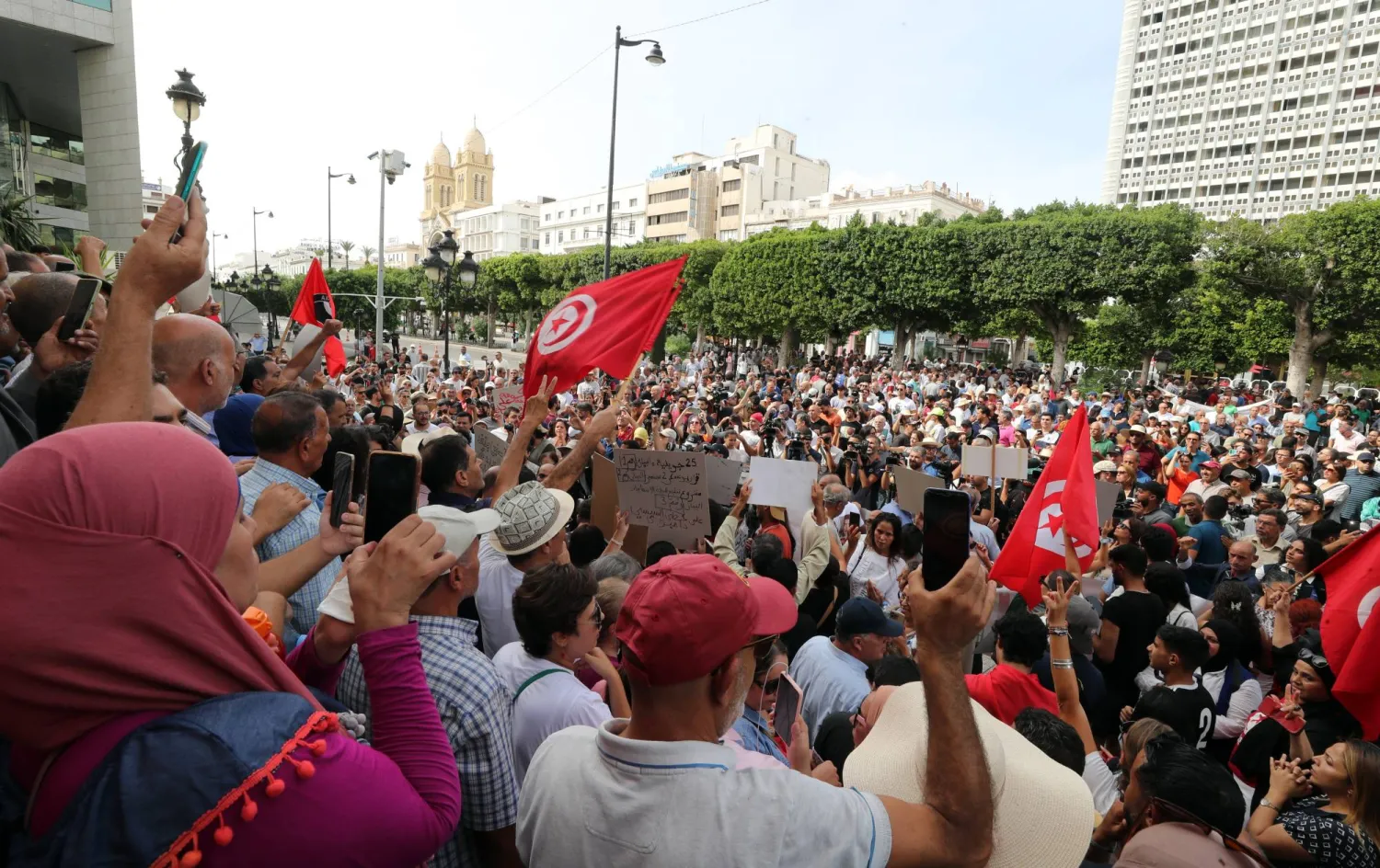
File: One of previous demonstrations demanding halting all activities at the fertilizer factory - EPA
TT

Tunisia Court Blocks Closure of Factory Blamed for Pollution

File: One of previous demonstrations demanding halting all activities at the fertilizer factory - EPA

A Tunisian court on Thursday rejected demands to suspend operations at a fertilizer factory, a lawyer told AFP, after thousands of protesters blamed the plant for a rise in health problems.

The facility in the city of Gabes emits sulphur gases, nitrogen and fluorine, according to an audit last July for the African Development Bank, which reported "major non-compliance" on air and marine pollution.

Mounir Adouni, head of the Gabes bar association that launched the legal action, said Thursday's decision was an emergency ruling and a final verdict was pending.

"The court ruled that there was no sufficient proof of harm, saying allegations of pollution lacked technical and scientific evidence," Adouni said.

Locals in Gabes have for years rallied against the phosphate-processing factory, which makes fertilisers mainly for export.

The bar association lodged its complaint after thousands protested against the plant in October, blaming it for an increase in health problems in the local community.

This month local campaign group Stop Pollution said 12 of its members had been sentenced to a year in prison over a 2020 protest at the plant.

Adouni said the bar will file an appeal on Friday because no date had been set for a hearing on a final ruling.

Despite a 2017 promise to gradually shut the plant down, authorities last year said they were ramping up production.

Taking advantage of rising prices for fertilizer on global markets, Tunisia now wants its output to increase more than fourfold by 2030.

The African Development Bank last month said it would provide Tunisia with $110 million to "support the environmental upgrading and rehabilitation" of the factory.

President Kais Saied has long vowed to revive Tunisia's phosphate sector, hindered by years of underinvestment and unrest, calling it a "pillar of the national economy".



Oscar Statuette for 'Mr. Nobody Against Putin' Goes Missing on Flight

FILE PHOTO: File Photo: Pavel Talankin arrives at the Vanity Fair Oscars party after the 98th Academy Awards, in Beverly Hills, California, US, March 16, 2026. REUTERS/Danny Moloshok/File Photo/File Photo
TT

Oscar Statuette for 'Mr. Nobody Against Putin' Goes Missing on Flight

FILE PHOTO: File Photo: Pavel Talankin arrives at the Vanity Fair Oscars party after the 98th Academy Awards, in Beverly Hills, California, US, March 16, 2026. REUTERS/Danny Moloshok/File Photo/File Photo

The Oscar statuette belonging to Pavel Talankin, the Russian director who won best documentary this year for "Mr. Nobody Against Putin," has gone missing after he was forced to check the award into hold luggage on a flight from New York to Germany, his co-director said.

Talankin was due to fly from John F. Kennedy International Airport to Frankfurt on German carrier Lufthansa. But Transportation Security Administration (TSA) agents told him that the 8.5 lb (3.8 kg) statuette posed a potential security threat, his co-director David Borenstein said on Thursday.

"At the airport, a ⁠TSA agent stopped ⁠him and said the Oscar could be used as a weapon," Borenstein said on Instagram.

"Pavel didn’t have a bag to check it in, so the TSA put the Oscar in a box and sent it to the bottom of the plane," he said, posting a series of pictures, ⁠including of the box.

"It never arrived in Frankfurt."

Responding to Borenstein's Instagram post, Lufthansa said it was taking the matter seriously.

"We deeply regret this situation," a company spokesperson later said in response to a Reuters request for comment.

"Our team is handling this matter with the utmost care and urgency and we are conducting a comprehensive internal search to ensure that the Oscar is found and returned as soon as possible.”

Speaking to the online magazine Deadline.com after arriving in Germany on Thursday, ⁠Talankin ⁠said it was "completely baffling how they consider an Oscar a weapon."

On previous flights on various airlines, he had flown with it "in the cabin, and there never was any kind of problem," he told the outlet.

Talankin and Borenstein's documentary used two years of footage that Talankin recorded at a school where he worked in Russia's Chelyabinsk region, to show how students were exposed to pro-war messaging.

The 35-year-old Talankin, who fled Russia in 2024, has defended the film as a record for posterity to show how "an entire generation became angry and aggressive."


Russia Successfully Test Launches New Soyuz-5 Rocket from Kazakhstan, Space Agency Says

The ⁠new rocket is ‌capable of ‌carrying payloads of up to ‌17 metric tons. (AP file)
TT

Russia Successfully Test Launches New Soyuz-5 Rocket from Kazakhstan, Space Agency Says

The ⁠new rocket is ‌capable of ‌carrying payloads of up to ‌17 metric tons. (AP file)

Russia has test launched its new Soyuz-5 rocket for the first time, the country's space agency said late on Thursday, saying it had lifted off from the Baikonur cosmodrome in Kazakhstan without any issues.

The Soyuz-5, which Roscosmos, ‌Russia's space ‌agency, describes as a ‌launch ⁠vehicle equipped with ⁠the world's most powerful liquid-fueled engine, lifted off successfully at 2100 Moscow time (1800 GMT) on April 30, it said in a statement.

The ⁠new rocket is ‌capable of ‌carrying payloads of up to ‌17 metric tons, will significantly ‌reduce launch costs, and is more effective than its predecessors at placing objects like satellites in near ‌earth orbit, the agency said.

Dmitry Bakanov, the head ⁠of ⁠Roskosmos, said the rocket - which he hailed as a "new step in space exploration" - would create new jobs in Russia and Kazakhstan.

Bakanov has previously told President Vladimir Putin that the Soyuz-5 is the first new launch vehicle that Russia has developed since 2014.


Afghans Celebrate Spring in Bright Red Poppy Fields

This photograph taken on April 24, 2026 shows Afghan men taking a selfie as they stand among the common poppy flowers on a hillside in the Jalayer Valley of Northern Afghanistan’s Shirin Tagab district. (AFP)
TT

Afghans Celebrate Spring in Bright Red Poppy Fields

This photograph taken on April 24, 2026 shows Afghan men taking a selfie as they stand among the common poppy flowers on a hillside in the Jalayer Valley of Northern Afghanistan’s Shirin Tagab district. (AFP)

In the middle of a field filled with bright red poppies, Afghans frolic among the spring flowers in a tradition deeply rooted in the country's north.

Families flocked to the valleys of Shirin Tagab district, near the border with Turkmenistan, to be among thousands of flowers that appeared after abundant rain.

"There has been a drought for almost 10 years. No flowers or greenery grew," said Ghawsudin, who only uses one name.

"This year has been very good, and God is merciful," said the 79-year-old, who drove for three hours just to see the flowers.

Mohammad Ashraf, a 35-year-old visitor, said he hadn't seen so many poppies for more than a decade.

"Now there are so many red flowers, and you see people come here for picnics," he told AFP.

The landscape in Shirin Tagab is brightened by the common poppy, not the opium poppy that authorities have banned.

- 'Vitality and freshness' -

Many Afghans living in the north used to travel to see the poppies after celebrating Persian New Year, Nowruz, in the city of Mazar-i-Sharif.

The Taliban government, which applies a strict interpretation of religious law, has stopped such celebrations each spring.

But the tradition of visiting the poppies, which are widely revered in poems and songs, has endured.

Oriane Zerah, a photographer who published a book about Afghans and flowers, said they are an integral part of daily life.

"As soon as an Afghan has a little space in their garden, they plant a flower. Even in displacement camps, there'll be a flower somewhere. They put them on their pakol, one of their traditional hats, and there are desserts made with flowers," she told AFP.

The poppy has also been associated with wartime in the country, with the flower often placed on the coffins of fighters, according to Afghan writer Taqi Wahidi.

"Dying in the path of the homeland, or in the path of religion and faith, was considered a kind of new resurrection and entry into a new life," he told AFP.

The same flower is widely used in countries, such as Britain, Australia and New Zealand, where people wear artificial poppies to remember those killed in past conflicts.

Nowadays in Afghanistan, however, the poppy "symbolizes vitality and freshness", according to Wahidi.

"At the same time that nature is renewed, human beings also want to bring new colors into their lives," he said.