
How a Syrian Refugee Chef Met Britain's King Charles

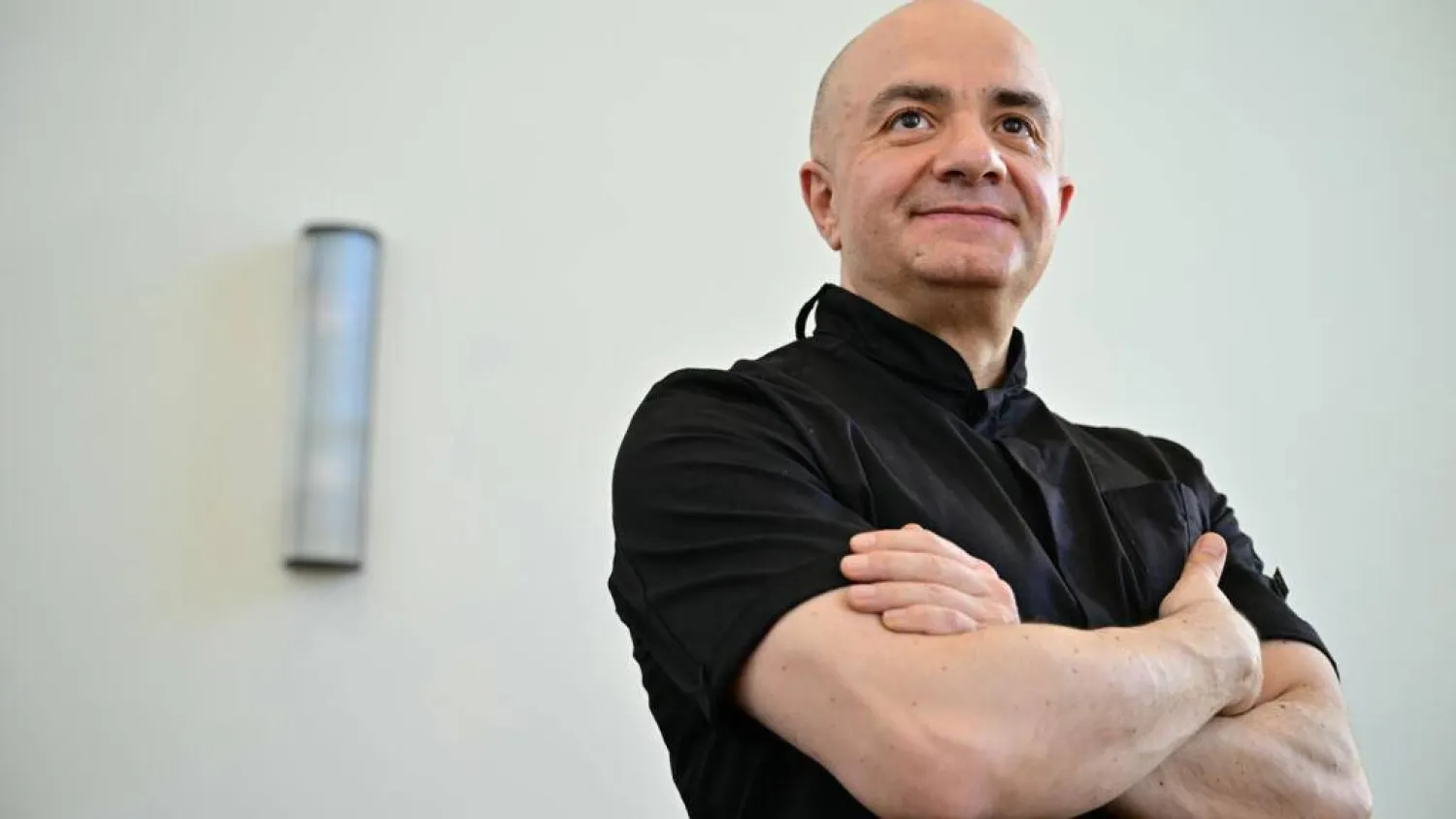
Imad Alarnab, a chef and restaurant owner who fled Syria in 2015, hosted King Charles III at his Soho restaurant. Ben STANSALL / AFP
TT

How a Syrian Refugee Chef Met Britain's King Charles

Imad Alarnab, a chef and restaurant owner who fled Syria in 2015, hosted King Charles III at his Soho restaurant. Ben STANSALL / AFP

Pots clanged and oil sizzled inside the London kitchen of Syrian chef Imad Alarnab, as the former refugee who fled his country's civil war recalled hosting King Charles III.

When the chef left his war-torn homeland in 2015, he never imagined that one day he would watch as cameras flashed and wide-eyed crowds greeted the monarch arriving at his Soho restaurant last year.

Alarnab, 48, said he had asked the king to come to the popular eatery when he met him at Buckingham Palace before an event honoring humanitarian work in 2023.

"I told him 'I would love for you to visit our restaurant one day' and he said: 'I would love to'... I was over the Moon to be honest".

The chef has come a long way since he arrived in London after an arduous journey from Damascus with virtually no money in his pocket.

Fearing for his life, he had escaped Syria after his family was uprooted again and again by fighting.

His culinary empire –- restaurants, cafes, and juice bars peppered across the Syrian capital -- had been destroyed by bombing in just six days in 2013.

Alarnab spent three months crisscrossing Europe in the back of lorries, aboard trains, on foot and even on a bicycle before he reached the UK.

"When I left, I left with nothing," he told AFP, as waiters whirled past carrying steaming plates of traditional Syrian fare.

Starving and exhausted, he spent the last of his money on a train ticket to Doncaster where his sister lived.

'Love letter from Syria'

To make a living, Alarnab initially picked up any odd jobs, such as washing and selling cars, saving enough to bring his wife and three daughters over after seven months.

His love of cooking never left him though. In France, while he was sleeping on the steps of a church, Alarnab had often cooked for hundreds of other refugees.

"I always dreamed of going back to cooking," he said.

So it wasn't long before he found himself back in the kitchen, cooking up a storm across London with his sold-out supper clubs, bustling pop-up cafes, and crowded lunchtime falafel bars.

He now runs two restaurants in the city –- one in Soho's buzzing Kingly Court and another nestled in a corner of the vibrant Somerset House arts center.

"I was looking for a city to love when I found London," Alarnab said, adding it had offered him "space to innovate" and add his own modern twist to classic Syrian dishes.

Far from home, Alarnab said his word-of-mouth success had grown into a "love letter from Syria to the world" that needs no translation.

"You don't really need to speak Arabic or Syrian to know that this is the best falafel ever," he said, pointing to a row of colorful plates.

-'There is hope' -

For Alarnab, spices frying, dough rising and cheese melting inside a kitchen offered an unlikely escape from the real world.

"All my problems, I leave them outside the kitchen and walk in fresh."

When he fled Syria, Alarnab thought going back to Damascus was forever off the table.

Yet he returned for the first time in October, almost a year to the day after longtime leader Bashar al-Assad was toppled in a lightning opposition offensive -- ending almost 14 years of brutal civil war.

He walked the familiar streets of his old home, where his late mother taught him to cook many years ago.

"To return to Damascus and for her not to be there, that was extremely difficult."

Torn between the two cities, Alarnab said he longed to one day rebuild his home in Damascus.

"I wish I could go back and live there. But at the same time, I feel like London is now a part of me. I don't know if I could ever go back and just be in Syria," he said.

Although Syrians still bear the scars of war, Alarnab said he had seen "hope in people's eyes which was missing when I left in 2015".

"The road ahead is still very long, and yes this is only the beginning -- but there is hope."


Artemis Astronauts More than Halfway to Moon, Putting Earth in Rearview

This screengrab from a NASA live broadcast video shows (L-R) NASA astronaut and Artemis II Mission Specialist Christina Koch, NASA astronaut and Artemis II pilot Victor Glover, Canadian Space Agency astronaut Artemis II Mission Specialist Jeremy Hansen and NASA astronaut and Artemis II Commander Reid Wiseman during a press call as they travel to the Moon in the Orion spacecraft, on April 3, 2026.  (Photo by NASA / AFP)
This screengrab from a NASA live broadcast video shows (L-R) NASA astronaut and Artemis II Mission Specialist Christina Koch, NASA astronaut and Artemis II pilot Victor Glover, Canadian Space Agency astronaut Artemis II Mission Specialist Jeremy Hansen and NASA astronaut and Artemis II Commander Reid Wiseman during a press call as they travel to the Moon in the Orion spacecraft, on April 3, 2026. (Photo by NASA / AFP)
TT

Artemis Astronauts More than Halfway to Moon, Putting Earth in Rearview

This screengrab from a NASA live broadcast video shows (L-R) NASA astronaut and Artemis II Mission Specialist Christina Koch, NASA astronaut and Artemis II pilot Victor Glover, Canadian Space Agency astronaut Artemis II Mission Specialist Jeremy Hansen and NASA astronaut and Artemis II Commander Reid Wiseman during a press call as they travel to the Moon in the Orion spacecraft, on April 3, 2026.  (Photo by NASA / AFP)
This screengrab from a NASA live broadcast video shows (L-R) NASA astronaut and Artemis II Mission Specialist Christina Koch, NASA astronaut and Artemis II pilot Victor Glover, Canadian Space Agency astronaut Artemis II Mission Specialist Jeremy Hansen and NASA astronaut and Artemis II Commander Reid Wiseman during a press call as they travel to the Moon in the Orion spacecraft, on April 3, 2026. (Photo by NASA / AFP)

The Artemis 2 astronauts have passed the halfway point between Earth and the Moon on Saturday as they sped toward a planned lunar flyby, with NASA releasing initial images of Earth taken from inside the Orion spacecraft.

Astronaut Christina Koch said the crew had a collective "expression of joy" upon being told of the milestone, which was hit around two days, five hours and 24 minutes after the spacecraft blasted off from the Kennedy Space Center in Florida, AFP said.

"We can see the Moon out of the docking hatch right now, it is a beautiful sight," Koch said around 11 pm (0400 GMT) Friday, according to the space agency's official live broadcast.

NASA's online dashboard showed early Saturday that the Orion spacecraft carrying the astronauts was more than 229,000 kilometers (142,000 miles) from Earth.

The space agency earlier released images from Orion that included a full portrait of Earth, featuring its deep blue oceans and billowing clouds.

After a flurry of high-stakes activity including a dramatic blast-off and an engine firing that catapulted them on their historic trajectory to circle the Moon, the four astronauts aboard were able to catch their breath, even as they continued to perform a variety of equipment checks and tests.

"There has been a tremendous amount of disbelief for me, it's just so extraordinary," said Canadian Jeremy Hansen during a Q&A session with press late Thursday.

"I really like it up here," said Hansen, on his first ever journey to space. "The views are extraordinary."

"It's really fun to be floating around" in zero gravity, he added. "It just makes me feel like a little kid."

Hansen is on the crew with Americans Koch, Victor Glover and Reid Wiseman.

They are due to loop around the Moon early next week -- a feat not accomplished in more than 50 years.

NASA official Lakiesha Hawkins praised the photographs taken by commander Wiseman, calling them "amazing" during a briefing Friday.

"We continue to learn all about our spacecraft as we operate it in deep space with crew for the first time," Hawkins said.

"It's important to remind ourselves of that as we learn a little bit more day by day."

- 'Great spirits' -

Friday's to-do list includes a CPR demonstration and medical kit checks, the US space agency said, as well as preparation for the scientific observations they'll need to document when they are closest to the Moon on day six of their journey.

NASA officials reported Friday that all systems were performing well, and that the astronauts were in "great spirits" and had spoken to their families.

The next major milestone of the approximately 10-day journey is expected overnight Sunday into Monday, at which point the astronauts will enter the "lunar sphere of influence" -- when the Moon's gravity will have stronger pull on the spacecraft than Earth's.

If all proceeds smoothly, as Orion whips around the Moon the astronauts could set a record by venturing farther from Earth than any human before.

"There is nothing normal about this," said mission commander Wiseman late Thursday.

"Sending four humans 250,000 miles away is a Herculean effort, and we are now just realizing the gravity of that."

The Artemis 2 mission is part of a longer-term plan to repeatedly return to the Moon, with the goal of establishing a permanent lunar base that will offer a platform for further exploration.


'Breathtaking': Artemis Astronauts Blast towards Moon

This image taken from video provided by NASA shows the Earth, left, from NASA's Orion spacecraft as it fired its engines heading toward the moon Thursday, April 2, 2026. (NASA via AP)
TT

'Breathtaking': Artemis Astronauts Blast towards Moon

This image taken from video provided by NASA shows the Earth, left, from NASA's Orion spacecraft as it fired its engines heading toward the moon Thursday, April 2, 2026. (NASA via AP)

Four Artemis astronauts were zooming towards the Moon late Thursday after a major engine firing, a milestone that commits NASA to the first crewed lunar flyby in more than half a century.

With enough thrust to accelerate a stationary car to highway driving speed in less than three seconds, the Orion capsule engine blasted the astronauts on their trajectory towards the Moon, which they now will loop as part of the 10-day Artemis 2 mission, reported AFP.

In the moments that followed what the US space agency dubbed a "flawless" firing that lasted just under six minutes, astronaut Jeremy Hansen said that "humanity has once again shown what we are capable of."

The astronauts said they were "glued to the window" taking pictures, and later passed a floating microphone back and forth as they took questions from US television networks.

They said the spacecraft was a little chilly and they were still making it a home, but the crew was all smiles.

"There's nothing that prepares you for the breathtaking aspect of seeing your home planet both lit up bright as day, and also the Moon glow on it at night with the beautiful beam of the sunset," said Christina Koch.

Thursday's nudge came one day after the enormous orange-and-white Space Launch System (SLS) rocket carrying the Orion capsule launched from Kennedy Space Center in Florida for the long-anticipated journey around the Moon.

The astronauts are now on a "free-return" trajectory, which uses the Moon's gravity to slingshot around it before heading back towards Earth without propulsion.

"From this point forward, the laws of orbital mechanics are going to carry our crew to the Moon, around the far side and back to Earth," NASA official Lori Glaze said.

The astronauts are wearing suits that also serve as "survival systems" -- in the unlikely case of a cabin depressurization or leak, they'll maintain oxygen, temperature controls and the correct pressure for up to six days.

The astronauts -- Americans Reid Wiseman, Victor Glover and Koch along with Canadian Hansen -- spent their first hours in space performing checks and troubleshooting minor problems on the spacecraft that has never carried humans before, including a communications issue and a malfunctioning toilet.

Queried on the toilet situation, Koch said she was "proud to call myself the space plumber.

"I like to say that it is probably the most important piece of equipment on board," she said. "So we were all breathing a sigh of relief when it turned out to be just fine."

- 'Herculean' -

Crewmembers also had their first workouts of the mission on the spacecraft's "flywheel exercise device" -- each astronaut will carve out 30 minutes a day for fitness, a bid to minimize the muscle and bone loss that happens without gravity.

The 10-day mission is aimed at paving the way for a Moon landing in 2028.

Artemis 2 marks a series of historic accomplishments: sending the first person of color, the first woman and the first non-American on a lunar mission.

If all proceeds smoothly, the astronauts could also set a record by venturing farther from Earth than any human before.

"There is nothing normal about this," said Wiseman. "Sending four humans 250,000 miles away is a Herculean effort, and we are now just realizing the gravity of that."

The Artemis 2 mission is part of a longer-term plan to repeatedly return to the Moon, with the goal of establishing a permanent base that will offer a platform for further exploration.

The current era of American lunar investment has frequently been portrayed as an effort to compete with China, which aims to land humans on the Moon by 2030.

Asked about division closer to home and what message they had for Americans, Glover said from his vantage point, "You look amazing. You look beautiful."

"From up here, you also look like one thing," he added. "We're all one people."


Trump Ballroom Approved by Panel, Remains Stalled by Judge

Donald Trump has cited the need for the ballroom to host state dinners for visiting dignitaries. Mandel NGAN / AFP/File
TT

Trump Ballroom Approved by Panel, Remains Stalled by Judge

Donald Trump has cited the need for the ballroom to host state dinners for visiting dignitaries. Mandel NGAN / AFP/File

US President Donald Trump's White House ballroom won final planning approval on Thursday, but construction remains in limbo following a court order that he needs congressional approval.

The National Capital Planning Commission (NCPC), which has several Trump appointees on its board, greenlit the plans in an 8-1 vote, said AFP.

The project aims to construct a massive ballroom on the site of the White House's East Wing -- previously best known for housing the First Lady's offices. It was demolished in September.

Trump expressed his thanks in a post on his Truth social media platform, saying, "when completed, it will be the greatest and most beautiful ballroom of its kind anywhere in the world."

Planning approval does not, however, mean construction can go ahead unchecked.

On Tuesday, a federal judge ordered a halt to construction, saying Trump needed congressional approval. The president is "steward" of the White House, Judge Richard Leon wrote. "He is not, however, the owner!"

Will Scharf, the commission's chairman and a political ally of Trump, addressed the lawsuit before the vote, saying, "That order really does not impact our action here today.

"From my perspective, we have a project before us. We've been asked to review it, and that's really our job here today."

He noted that Judge Leon had placed a two-week delay on his stop-work order to allow the Trump administration to appeal.

The ballroom has become a passion project for Trump during his second term: the president often discusses the plan in public appearances, press conferences and meetings.

Trump has repeatedly said that a large ballroom is needed to host, among other key events, state dinners for visiting dignitaries.

"For more than 150 years, every president has dreamt about having a ballroom at the White House to accommodate people for grand parties, state visits, and even, in the modern day, inaugurations," Trump wrote on Truth. "I am honored to be the first president to finally get this much-needed project, which is on time and under budget, underway."

He has promised to meet the costs -- estimated to be upwards of $400 million -- with private donations, not tax payer money.