

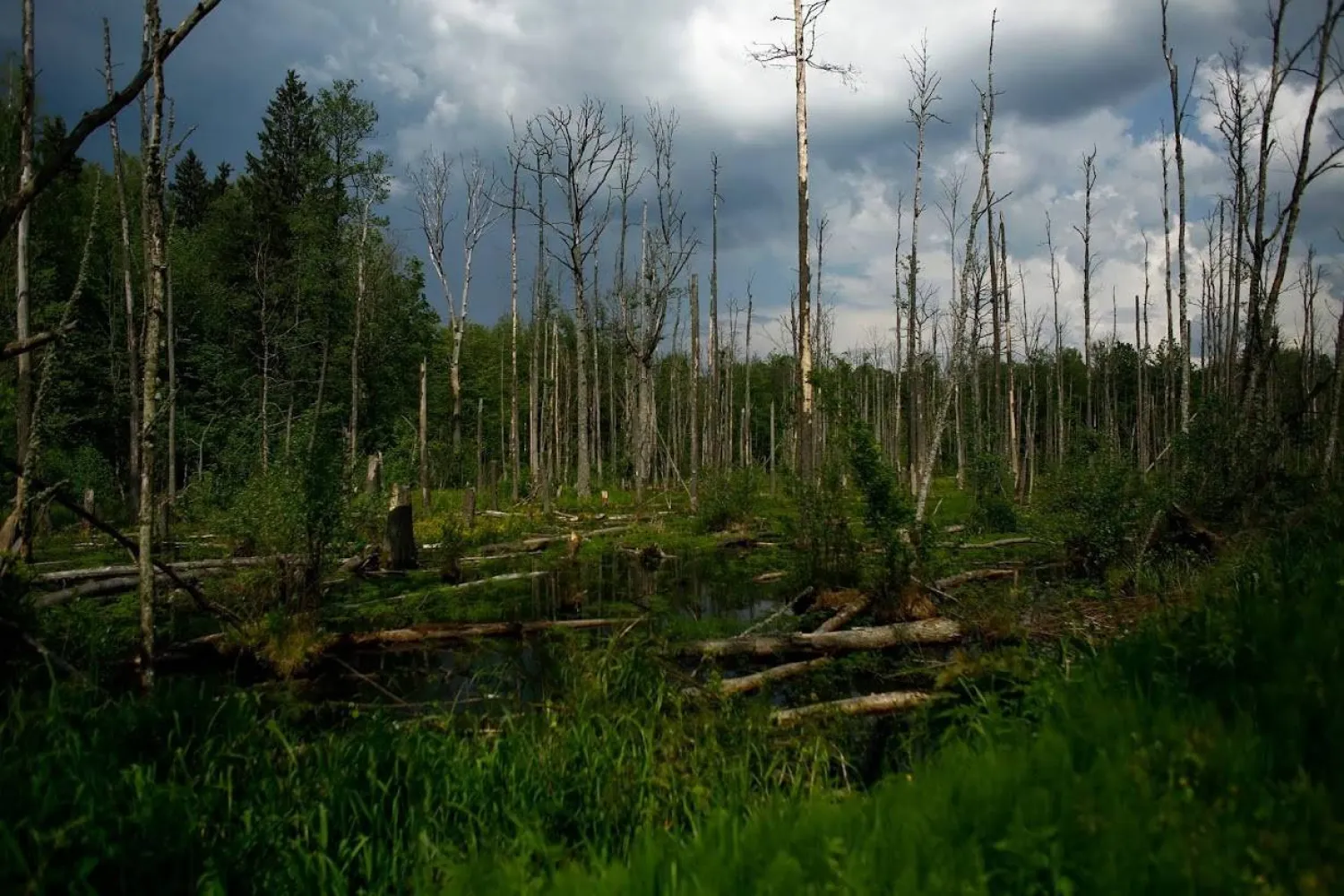

A Herd Stop: Train Kills 3 Rare Bison in Poland

30 May 2016. BIALOWIEZA, POLAND. REUTERS/KACPER PEMPEL
TT

A Herd Stop: Train Kills 3 Rare Bison in Poland

30 May 2016. BIALOWIEZA, POLAND. REUTERS/KACPER PEMPEL

Three wild European bison died on Sunday morning after being hit by a train in Poland's vast UNESCO-listed Bialowieza Forest in the east, the local police told AFP.

According to a police spokesman, a herd of Europe's largest mammals, whose male specimens can reach 900 kilograms (nearly 2,000 pounds), crossed onto the train tracks as a locomotive carrying some 50 passengers between Bialystock and Warsaw aboard was steaming ahead.

"No passenger was injured but three animals perished in this accident, which happened at 7:00 am, near the village of Witowo," spokesman Konrad Karwacki told AFP.

The "Zubr" line train, which takes its name from the Polish word for bison, did not derail and was able to resume its journey around an hour and a half after the collision.

Some 1,200 bison, an emblematic animal in the eastern European country, currently inhabit the Polish part of the great Bialowieza Forest, considered the last primeval woodland in Europe.

The forest, which is divided by the Poland-Belarus border, is a treasure of biodiversity and a giant carbon sink.

Yet several bison fall victim to road accidents in the region every year.

"They are sometimes hit by trains, but these are usually isolated incidents," Professor Rafal Kowalczyk, from a local branch of the Polish Academy of Sciences, told AFP.

"I don't recall an accident where three bison were killed at the same time, run over by a train," the specialist in the giant mammals added.

Devastated by hunting, deforestation and the expansion of agriculture, the European bison nearly became extinct at the beginning of the 20th century.

After disappearing from Bialowieza, its last habitat in Europe, before the outbreak of World War II, the species was saved at the 11th hour thanks to the release of bison reared in zoos back into the wild.



Russian Spacecraft Antenna Problem Forces Manual Docking with ISS

FILE PHOTO: A Soyuz-2.1a rocket booster with a Progress MS-33 cargo spacecraft blasts off to the International Space Station (ISS) from the launch pad at the Baikonur Cosmodrome, Kazakhstan March 22, 2026. Roscosmos/Handout via REUTERS
TT

Russian Spacecraft Antenna Problem Forces Manual Docking with ISS

FILE PHOTO: A Soyuz-2.1a rocket booster with a Progress MS-33 cargo spacecraft blasts off to the International Space Station (ISS) from the launch pad at the Baikonur Cosmodrome, Kazakhstan March 22, 2026. Roscosmos/Handout via REUTERS

An unmanned Russian cargo spacecraft has a problem with an antenna so it will have to be manually docked when it reaches the International Space Station (ISS), Russia's Roscosmos state space corporation said in a statement.

A Soyuz-2.1a rocket launched the Progress MS-33 cargo spacecraft on Sunday from Baikonur in Kazakhstan ⁠but a problem with ⁠one of the KURS automated rendezvous antennas was identified, Roscosmos said.

Russian cosmonaut Sergei Kud-Sverchkov, the current ISS commander, will manually dock the cargo ship on ⁠Tuesday at about 13:35 GMT, Reuters quoted Roscosmos as saying.

"A manual approach of ships to the ISS is regularly practiced by cosmonauts in training," said Oleg Kononenko, head of Russia's Cosmonaut Training Center.

NASA said all other systems are operating as normal and that Roscosmos will continue troubleshooting the ⁠antenna.

The ⁠cargo ship is carrying about 2.5 tons of food, water, fuel, oxygen and supplies for the crew aboard the ISS.

There are currently seven crew aboard the ISS including Russians Kud-Sverchkov, Sergei Mikayev and Andrei Fedyaev, US astronauts Christopher Williams, Jessica Meir and Jack Hathaway, and France's Sophie Adenot.


UN: Planet Trapped Record Heat in 2025

A volunteer holds a bottle of water as a wildfire burns in the village of Vati, on the island of Rhodes, Greece, July 26, 2023. REUTERS/Nicolas Economou/File photo
TT

UN: Planet Trapped Record Heat in 2025

A volunteer holds a bottle of water as a wildfire burns in the village of Vati, on the island of Rhodes, Greece, July 26, 2023. REUTERS/Nicolas Economou/File photo

The amount of heat trapped by the Earth reached record levels in 2025, with the consequences of such warming feared to last for thousands of years, the UN warned Monday.

The 11 hottest years ever recorded were all between 2015 and 2025, the United Nations' WMO weather and climate agency confirmed in its flagship State of the Global Climate annual report.

Last year was the second or third hottest year on record, at about 1.43 Celsius above the 1850-1900 average, the World Meteorological Organization said.

"The global climate is in a state of emergency. Planet Earth is being pushed beyond its limits. Every key climate indicator is flashing red," said UN Secretary-General Antonio Guterres.

"Humanity has just endured the 11 hottest years on record. When history repeats itself 11 times, it is no longer a coincidence. It is a call to act,” AFP quoted him as saying.

For the first time, the WMO climate report includes the planet's energy imbalance: the rate at which energy enters and leaves the Earth system.

Under a stable climate, incoming energy from the Sun is about the same as the amount of outgoing energy, the Geneva-based agency said.

However, the increase in concentrations of heat-trapping greenhouse gases -- carbon dioxide, methane and nitrous oxide -- "to their highest level in at least 800,000 years" has "upset this equilibrium", the WMO said.

"The Earth's energy imbalance has increased since its observational record began in 1960, particularly in the past 20 years. It reached a new high in 2025."

WMO chief Celeste Saulo said scientific advances had improved understanding of the energy imbalance and its implications for the climate.

"Human activities are increasingly disrupting the natural equilibrium and we will live with these consequences for hundreds and thousands of years," she said.

More than 91 percent of the excess heat is stored in the ocean.

"Ocean heat content reached a new record high in 2025 and its rate of warming more than doubled from 1960-2005 to 2005-2025," the WMO said.

Ocean warming has far-reaching consequences, such as degradation of marine ecosystems, biodiversity loss and reduction of the ocean carbon sink, the agency said.

"It fuels tropical and subtropical storms and exacerbates ongoing sea-ice loss in the polar regions."

The Antarctic and Greenland ice sheets have both lost considerable mass, and the annual average extent of Arctic sea ice in 2025 was the lowest or second-lowest ever recorded in the satellite era.

Last year, the global mean sea level was around 11 centimeters higher than when satellite altimetry records began in 1993.

Ocean warming and sea level rise are projected to continue for centuries.

WMO scientific officer John Kennedy said global weather is still under the influence of La Nina, a naturally occurring climate phenomenon that cools surface temperatures in the central and eastern equatorial Pacific Ocean. It brings changes in winds, pressure and rainfall patterns.

Conditions oscillate between La Nina and its warming opposite El Nino, with neutral conditions in between.

The warmest year on record, 2024, was around 1.55C above the 1850-1900 average, and started in a strong El Nino.

Forecasts indicate neutral conditions by the middle of 2026 with a possible El Nino developing before the end of the year, said Kennedy.

If so, "then we're likely to see maybe elevated temperatures again in 2027", he told a press conference.

The World Meteorological Organization's deputy chief, Ko Barrett, said the outlook was a "dire picture".

She said the WMO provided the evidence it sees, hoping that the information "will encourage people to take action".

But there was "no denying" that "these indicators are not moving in a direction that provides for a lot of hope", she said.

With war gripping the Middle East and fuel prices soaring, Guterres said the world should heed the alarm call.

"In this age of war, climate stress is also exposing another truth: our addiction to fossil fuels is destabilizing both the climate and global security," he said.

"Today's report should come with a warning label: climate chaos is accelerating and delay is deadly," he said.


Can Nations Save the Shorebird that Flies 30,000 km a Year?

The Hudsonian godwit (Limosa haemastica) is one of the world's most remarkable travelers, but its population has plunged 95 percent in four decades due to a complex mix of environmental changes across multiple countries. Luke Seitz / Cornell Lab of Ornithology/AFP
TT

Can Nations Save the Shorebird that Flies 30,000 km a Year?

The Hudsonian godwit (Limosa haemastica) is one of the world's most remarkable travelers, but its population has plunged 95 percent in four decades due to a complex mix of environmental changes across multiple countries. Luke Seitz / Cornell Lab of Ornithology/AFP

Chasing an endless summer, one shorebird species undertakes a grueling annual journey from the Arctic to the tip of South America and back -- a feat increasingly fraught with peril.

The Hudsonian godwit (Limosa haemastica) is one of the world's most remarkable travelers, but its population has plunged 95 percent in four decades due to a complex mix of environmental changes across multiple countries, said AFP.

It is one of 42 species proposed for international protection at a meeting of parties to the UN Convention on the Conservation of Migratory Species (CMS) that starts in Brazil on Monday.

Iconic creatures like the snowy owl -- of Harry Potter fame -- striped hyena and hammerhead shark are also on the list deemed in danger of extinction and needing conservation by the countries they pass through.

Migratory birds are facing "rapid and dramatic declines," said Nathan Senner, an ecologist and ornithology professor at the University of Massachusetts Amherst who has studied the Hudsonian godwit for 20 years.

Scientists are still unraveling the mysteries of the shorebird -- which can fly up to 11,000 kilometers (6,800 miles) in one stretch without stopping to eat, drink, or sleep.

And it is only part of the 30,000 kilometers (18,600 miles) that the godwit travels every year from their breeding grounds in the Arctic to Patagonia where they spend the southern summer.

- Disrupted migrations -

In order to do this "epic flight," they need "really predictable, abundant food resources" at every step of the journey, Senner told AFP.

That predictability is crumbling.

In the Arctic, shifting spring timing attributed to climate change has created a mismatch between when chicks hatch and the peak availability of insects they feed on.

One of the puzzles Senner is currently working on is why Hudsonian godwits have begun migrating later by six days than they did a decade ago.

Something "has either disrupted the cues that they use to time their migrations or their ability to successfully and rapidly prepare for the migration," he said.

In southern Chile, a boom in salmon and oyster farming has led to a build-up of infrastructure and the presence of people in the intertidal zones where they feed.

And in the United States, changes in farming practices are making the shallow water wetlands that the godwits rely on rarer and less predictable -- meaning they spend more time looking for a place to stop and feed.

"I think that is emblematic of lots of species, that most species can respond to one kind of change, but not a whole bunch of them all at the same time," said Senner.

- Essential to ecosystems -

"Climate change is taking a heavy toll on species that rely on a 'geological clock' for their survival; many are disappearing," Rodrigo Agostinho, president of Brazil's environmental agency (Ibama), told AFP.

These are some of the issues CMS parties will tackle at their meeting in Brazil's biodiversity-rich Pantanal, one of the world's most important global meetings for wildlife conservation.

These countries are legally obliged to protect species listed as at risk of extinction, conserve and restore their habitats, prevent obstacles to migration and cooperate with other range states.

Nevertheless, among the species listed under CMS, a report released earlier this month showed that 49 percent now have populations that are declining, up from 44 percent two years ago.

Amy Fraenkel, CMS executive secretary, told AFP that most of the species doing worse were birds, such as the Hudsonian godwit.

She said the situation was also "particularly alarming" for fish species, with 97 percent of those listed under the treaty threatened with extinction.

Migratory species "are essential to healthy ecosystems and a healthy planet," playing a key role in pollination, pest control and transporting nutrients, she said.

In a piece of good news, the meeting will propose removing Central Asia's Bactrian deer from its list of animals needing high protection, due to an increase in its population.