


On the Road with Antiprotons: CERN Runs Delicate Test on Transporting Ultrasensitive Antimatter

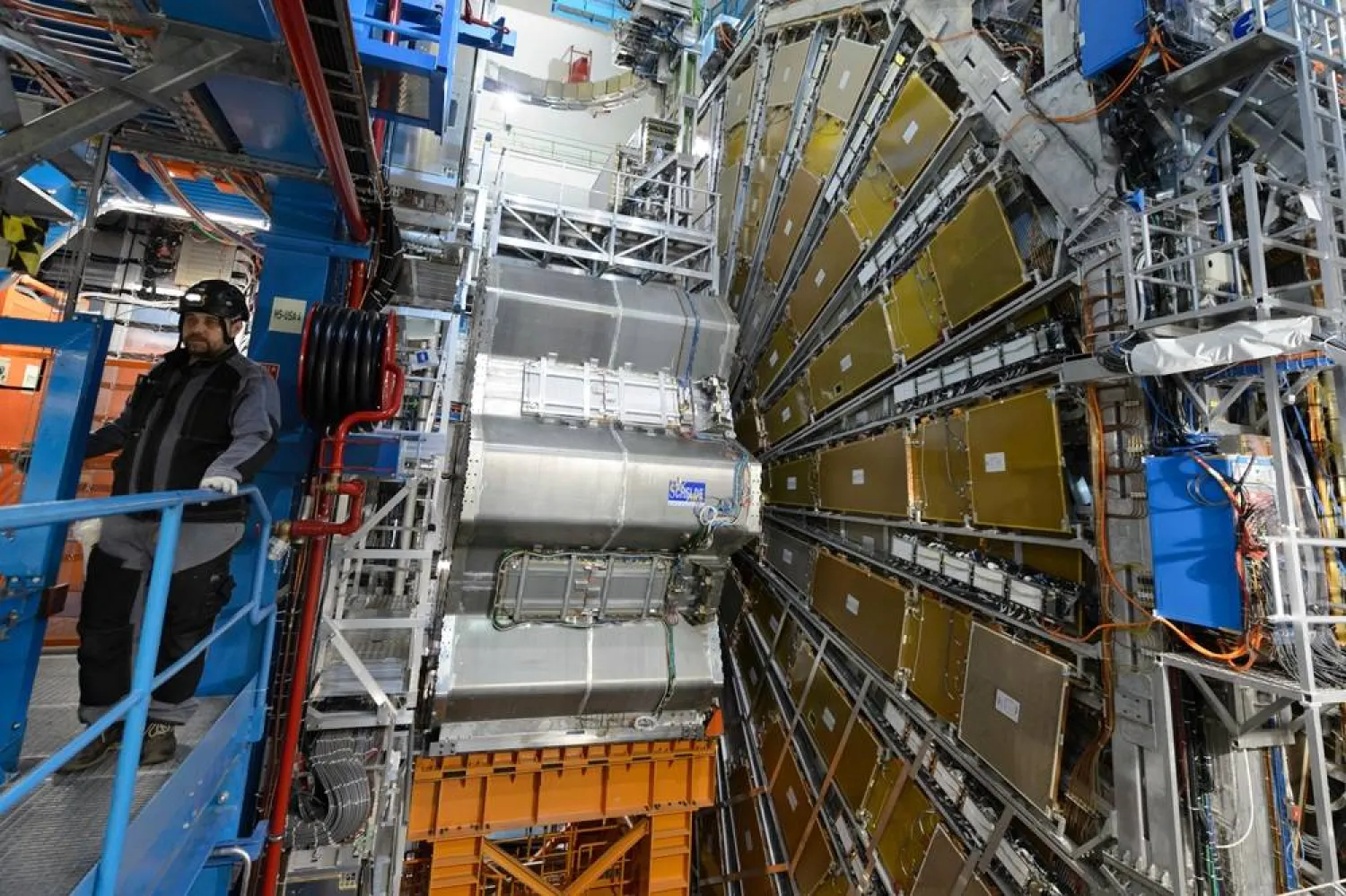
A technician works in the LHC (Large Hadron Collider) tunnel of the European Organization for Nuclear Research, CERN, during a press visit in Meyrin, near Geneva, Switzerland, Feb. 16, 2016. (Laurent Gillieron/Keystone via AP, File)
TT

On the Road with Antiprotons: CERN Runs Delicate Test on Transporting Ultrasensitive Antimatter

A technician works in the LHC (Large Hadron Collider) tunnel of the European Organization for Nuclear Research, CERN, during a press visit in Meyrin, near Geneva, Switzerland, Feb. 16, 2016. (Laurent Gillieron/Keystone via AP, File)

Scientists in Geneva are taking some antiprotons out for a spin — a very delicate one — in a truck, in a never-tried-before test drive.

If this so-called antimatter comes into contact with actual matter — even for a fraction of an instant — it will be annihilated in a quick flash of energy. So experts at the European Organization for Nuclear Research, known as CERN, will, over the course of four hours Tuesday, gingerly wheel out from its lab about 100 antiprotons. They are suspended in a vacuum inside a specially designed box and held in place by supercooled magnets.

Then, they'll ease it into a truck, and take about a half-hour drive to test how — if at all — the infinitesimal particles can be transported by road without seeping out. If all goes well, the antiprotons will be returned back to the lab.

The hard part: Manipulating antimatter, like antiprotons, can be tricky business. As scientists understand the universe today, for every type particle that exists, there is a corresponding antiparticle, exactly matching the particle but with an opposite charge.

If those opposites come into contact, they “annihilate” each other, setting off lots of energy, depending on the masses involved. Any bumps in the road on the test journey that aren't compensated for by the specially-designed box could spoil the whole exercise.

Tuesday’s practice is a first step toward making good on hopes, one day, to deliver CERN antiprotons to researchers at Heinrich Heine University in Düsseldorf, Germany, which is about eight hours away in normal driving conditions.

The antiprotons have been encased in a 1,000-kilogram (2,200 pounds) box called a “transportable antiproton trap.” It's compact enough to fit through ordinary laboratory doors and fit on a truck. It uses superconducting magnets cooled to -269 degrees Celsius (-452 Fahrenheit) that allows the antiprotons to be remain suspended in a vacuum — not touching the inner walls, which are made of ... matter.

The mass in Tuesday's test — slightly less than that of about 100 hydrogen atoms — is so little, experts say, that the worst possible outcome is the loss of the antiprotons. Even if they do touch matter, any release of energy would be unnoticeable, only an oscilloscope, which picks up electrical signals, would be able to detect it.

The trap, says CERN spokeswoman Sophie Tesauri, “is supposed to contain these antiprotons no matter what: if the truck stops, if it starts again, if it has to slam on the brakes — all that.” Work remains: The trap can contain the antiprotons on its own for only about four hours, and the drive to Düsseldorf is twice that.

The Geneva-based center is best known for its Large Hadron Collider, a network of magnets that accelerates particles through a 27-kilometer (17-mile) underground tunnel and slams them together at velocities approaching the speed of light. Scientists then study the results of those collisions.

But the sprawling, buzzing complex of scientific experiment is more than just about smashing atoms together: the World Wide Web, for example, was invented here by Britain’s Tim Berners-Lee in 1989.

Heinrich Heine University is seen as a better place to study antiprotons in-depth, because CERN — with all its other activities — generates a lot of magnetic interference that can skew the study of antimatter.

But to get them there, those antiprotons will have to avoid touching anything on the way.

The center's Antiproton Decelerator, where a proton beam gets fired into a block of metal, causes collisions that generate secondary particles, including lots of antiprotons. It’s billed as a unique machine that produces low-energy antiprotons for the study of antimatter.

CERN’s “Antimatter Factory,” lab officials say, is the only place in the world where scientists can store and study antiprotons.

The center has been experimenting with antimatter for years, and has made breakthroughs on measurement, storage and interaction of antimatter. Two years ago, the team transported a “cloud” of about 70 protons — not antiprotons — across CERN's campus.

It's a similar drill this time, except that with antiprotons, a much better vacuum chamber is needed, according to Christian Smorra, head of a team behind the apparatus designed to store and transport antimatter.

Jittery test teams weren't available for interviews before the exercise, but were expected to explain the results afterward on Tuesday.



No Trees, No Fans: Surviving Extreme Heat in India’s Salt Pans

A worker harvests salt at the Little Rann of Kutch (LRK) region of Gujarat on April 29, 2026. (AFP)
TT

No Trees, No Fans: Surviving Extreme Heat in India’s Salt Pans

A worker harvests salt at the Little Rann of Kutch (LRK) region of Gujarat on April 29, 2026. (AFP)

India faces challenging heatwaves each year, but few places endure conditions as searing as the country's western desert salt pans, where workers rely on simple techniques to survive almost unbearable temperatures.

Up to 50,000 workers in Gujarat spend eight months on the remote salt pans without electricity or healthcare, relying on a tanker to deliver drinking and washing water every 25 days.

They use shaded rest breaks, cloth-cooled water bottles and staggered hours to survive.

In Gujarat's Little Rann of Kutch summer temperatures routinely cross 45C, and can climb to 47-48C.

The same dry heat that makes life punishing also makes the desert ideal for salt production -- Gujarat produces roughly three-quarters of India's total salt output.

"We work in staggered timing... doing our work in early mornings and after sunset," said 42-year-old Babulal Narayan, who rakes the salt as brine water dries in shallow pools.

During the hottest hours, many retreat to makeshift huts -- frames of sticks draped with coarse homespun cloth, plastered with wild donkey dung.

"We sit here every two to three hours, so that we do not feel weak or dizzy," said 17-year-old salt worker Bhavna Rathore.

The dung blocks the sun and allows heat to escape, while the rough cloth allows some air to pass through, she explained.

The huts offer shelter in a landscape without trees or natural shade, and where the sun reflects harshly off the white salt crust.

- 'Heatwave' -

Kanchan Narayan, 44, uses a damp cloth-wrapped bottle hung on a string, cooling the drinking water inside via evaporation.

"The wind helps to cool the water," she said.

Poornima, a salt pan worker, sips black tea during the day -- saying the hot drink induces sweating in the dry weather to cool the body.

The salt is produced by pumping saline water from bore-wells into shallow pans, where the liquid evaporates under the sun and wind.

Workers rake the surface daily to ensure even crystallization. Over weeks, a thick crust of salt forms, which the workers break and stack into mounds.

The job has always involved enduring harsh conditions, but this year the India Meteorological Department (IMD) forecasts an "above-normal number of heatwave days" across several regions, including Gujarat.

Workers are exposed to the heat for longer than before.

Previously, they relied on expensive diesel pumps to bring the saline water to the surface. But a switch to solar has brought down costs and allowed families to operate the pans for longer.

That means work that used to end in March now continues into the hottest months.

- 'Fever' -

The consequences for workers can be deadly, with regular reports of fatigue, dizziness and nausea -- signs of heat stress, when the body's natural cooling systems are overwhelmed.

This can cause organ failure and even death.

Several studies have found high levels of dehydration, heat stress and even signs of kidney malfunction among these communities.

"I take a paracetamol whenever fever becomes high," said Kanchan, a rare worker wearing rubber boots -- to protect against prolonged exposure to brine, that can crack skin so deep it bleeds.

India has no fixed legal temperature at which work must stop.

Instead, it relies on IMD heatwave thresholds -- around 40C for alerts and 47C for "severe" conditions -- with local authorities imposing restrictions.

The desert conditions make the extreme heat marginally more survivable -- at low humidity, sweat evaporates more quickly off the skin, cooling the body.

But conditions are growing harder, with heatwaves intensifying and unseasonal storms also threatening livelihoods.

A sudden rainstorm can dissolve crystallized salt overnight -- forcing workers to restart the evaporation cycle.

"A big dust storm hit us last month, destroying salt worth 200,000 rupees ($2,100)," Narayan said.

He and five relatives made a profit of 250,000 rupees ($2,635) -- or $450 each for eight months of hard work.

But families say they have little alternative.

"What else will we do?" said 65-year-old worker Rasoda Rathore.

"We have no land to farm, no livestock to earn our livelihood from... this is all we know."


Saudi Arabia Elected to UN CSTD for 2027–2030 Term

File photo of the Saudi flag/AAWSAT
TT

Saudi Arabia Elected to UN CSTD for 2027–2030 Term

File photo of the Saudi flag/AAWSAT

Members of the United Nations Economic and Social Council (ECOSOC) elected the Kingdom of Saudi Arabia to the Commission on Science and Technology for Development (CSTD) for the 2027–2030 term, the Saudi Press Agency said on Sunday.

The election reinforces the Kingdom’s international presence and its leading role in shaping global trends and policies in science, technology, and innovation.

The Communications, Space and Technology Commission (CST) stated that the Kingdom’s election reflects its active contribution to discussions on global issues related to emerging technologies, data governance, artificial intelligence, and support for the Sustainable Development Goals.

The commission explained that the Kingdom’s membership will contribute to monitoring implementation of the outcomes of the World Summit on the Information Society (WSIS) and the Global Digital Compact (GDC), in addition to participating in developing relevant international recommendations to be submitted to the United Nations General Assembly for adoption.

It added that this achievement was realized in coordination with the Ministry of Foreign Affairs, reinforcing the Kingdom’s role as an active international partner within the United Nations system, particularly in the fields of communications, technology, and space.

The commission also noted that Saudi Arabia, represented by CST, chaired the 25th session of the CSTD in 2022, reflecting the Kingdom’s international standing and the global community’s confidence in its leadership in digital sectors.


Egypt Calls for Preserving Migration Routes for Birds

Migratory birds in Sinai. Asharq Al-Awsat
TT

Egypt Calls for Preserving Migration Routes for Birds

Migratory birds in Sinai. Asharq Al-Awsat

Egypt has reaffirmed the importance of protecting migratory birds as the country marked World Migratory Bird Day, holding activities under the slogan “Every bird counts... your observation matters” to raise environmental awareness.

Minister of Local Development and Environment Manal Awad said Egypt represents one of the world’s most important migration corridors due to its strategic geographic location linking Europe and Africa.

Millions of birds pass through the country annually during seasonal migration periods, she stated.

According to Awad, Egypt’s coastal areas and wetlands serve as vital resting and feeding stations for migratory birds. So, she stressed the importance of nature reserves in protecting these habitats and supporting biodiversity conservation.

She also highlighted several key sites for migratory birds, including the Zaranik, Ashtoum El-Gamil, and Burullus reserves along the Mediterranean coast, in addition to Ras Mohammed and the northern Red Sea islands.

Awad pointed to the winter migratory bird census project, implemented in cooperation with the Egyptian Environmental Affairs Agency (EEAA) and the Nature Conservation Egypt association, which provides scientific data on bird populations and species diversity.

The ministry said its conservation efforts include issuing annual hunting regulations and conducting campaigns to remove illegal bird-catching nets from protected areas.

Approximately 18 kilometers of illegal nets have been removed from the Ashtoum El-Gamil and Burullus reserves.