


Mouse Study Shows Repeated Cloning Causes Grave Genetic Mutations

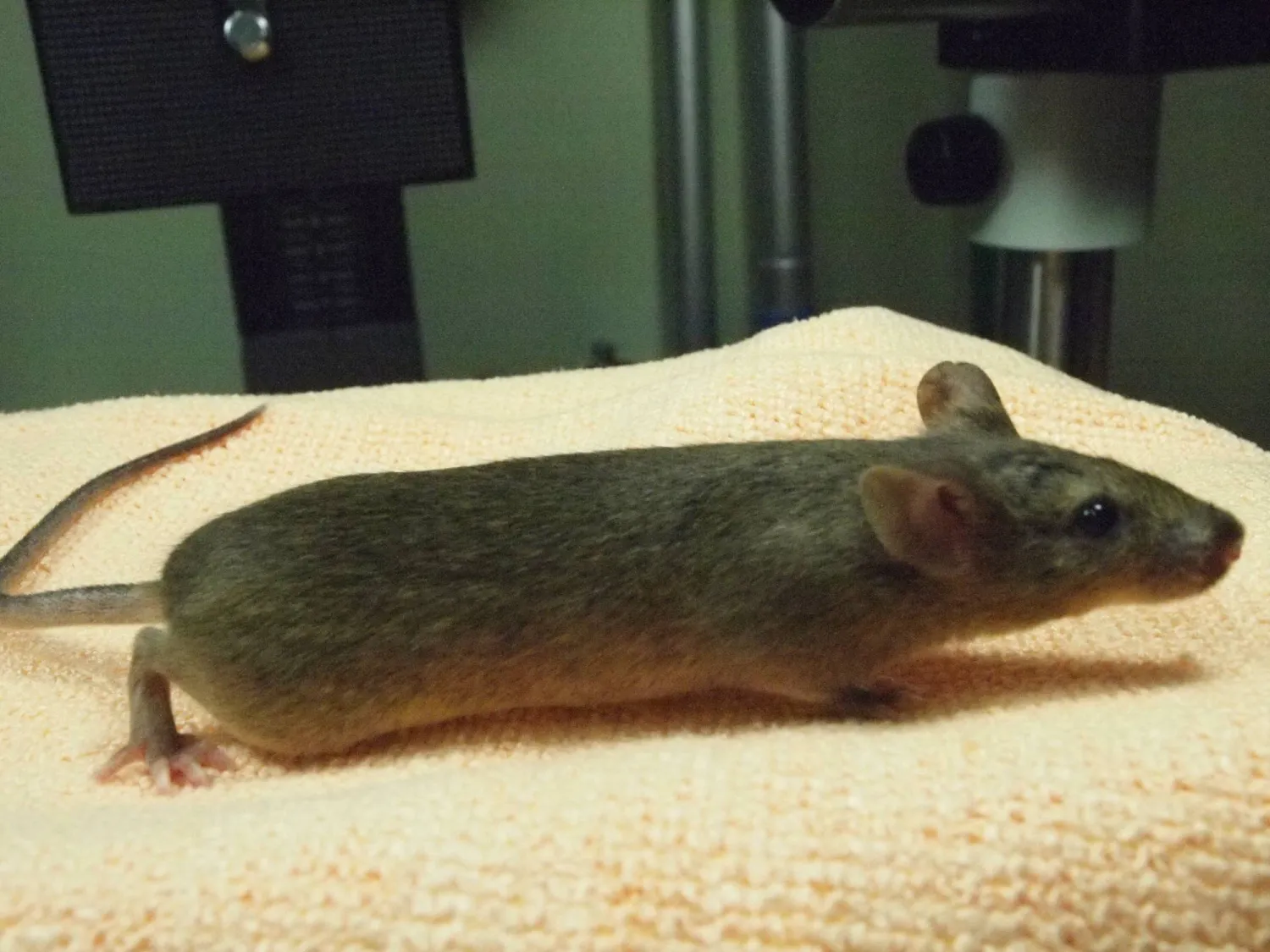
A cloned female mouse inside a laboratory at the University of Yamanashi in Yamanashi, Japan, in this undated photograph released on March 24, 2026. Teruhiko Wakayama/Handout via REUTERS
TT

Mouse Study Shows Repeated Cloning Causes Grave Genetic Mutations

A cloned female mouse inside a laboratory at the University of Yamanashi in Yamanashi, Japan, in this undated photograph released on March 24, 2026. Teruhiko Wakayama/Handout via REUTERS

Revealing the limitations of cloning, researchers who repeatedly cloned mice for two decades have discovered that such serial duplication triggers grave genetic mutations that accumulate over the generations and ultimately become fatal.

A total of 1,206 cloned laboratory mice were generated by the scientists from a single female donor mouse from 2005 to 2025 in research conducted in Japan. There were no outward signs of trouble through the first 25 generations, but mutations subsequently began piling up until becoming fatal. The 58th generation of clones, burdened by mutations but with no visible physical abnormalities, died within a few days of birth.

The research contradicted the notion that clones are identical copies of the original donor animal and disproved the idea that cloning using current technology could be carried out indefinitely with no ill effects.

"No one has ever continued re-cloning for this long before. As a result, this is the first time we've discovered that repeated re-cloning eventually reaches its limits," said developmental biologist Teruhiko Wakayama of the University of Yamanashi, senior author of the research published on Tuesday in the journal ⁠Nature Communications.

"It was ⁠once believed that clones were identical to the original, but it has become clear through this study that mutations occur at a rate three times higher than in offspring born through natural mating," Wakayama said.

"Because all these mutations continue to accumulate, mammals cannot sustain their species through cloning. This study has revealed one of the reasons why mammals, unlike plants and lower animals, cannot maintain their species through cloning."

After generating the first clone, the researchers repeated the process every three to four months, cloning each generation from the one preceding it. Like the original donor mouse, all the clones were females with brown fur.

The researchers published preliminary results in 2013 spanning the first 25 generations ⁠that found the clones to be healthy, with no apparent negative effects.

"At that time, we concluded that re-cloning could likely continue indefinitely. However, in that study, we did not examine the genetic sequences. We continued our research for 13 more years, and as a result, we discovered that our previous conclusion was incorrect - that is, there is a limit to re-cloning," Wakayama said.

The researchers sequenced the genomes of 10 clones from the various generations to understand what was happening at the genetic level.

They found that serial cloning produced an effect akin to duplicating a picture using a copying machine. With the first copy, the image quality deteriorates slightly. When copying that copied image, the quality deteriorates further.

Repeating the process numerous times yields an image very different from the original.

The study results, they said, pointed to the importance of sexual reproduction in countering deleterious genetic mutations in mammals.

The researchers gauged the fertility of the clones by mating them with ordinary male mice. Up to the 20th generation, they gave birth to about 10 babies per litter, ⁠just like ordinary female mice. But ⁠eventually the clones began having smaller litters, reflecting the effects of accumulating mutations.

The researchers used a technique called nuclear transfer to generate the clones. The same method was used to produce Dolly the sheep, the first successfully cloned mammal, at a laboratory in Scotland in 1996, and Cumulina, the first successfully cloned mouse, at a lab in Hawaii in 1998.

With nuclear transfer technology, researchers create an embryo by transferring the nucleus, a cell's primary repository of genetic information, from a donor cell into an egg cell whose own nucleus was removed. A specialized ovarian cell, called a cumulus cell, that surrounds and nurtures a developing egg was used in the cloning.

"We had believed that we could create an infinite number of clones. That is why these results are so disappointing. At this point, we have no ideas for overcoming this limitation. I believe we need to develop a new method that fundamentally improves nuclear transfer technology," Reuters quoted Wakayama as saying.

An increase in large-scale harmful mutations began with the 27th generation including chromosomal abnormalities. For instance, one copy of the X chromosome was lost.

Chromosomes are threadlike structures that carry genetic information from cell to cell. In mammals, females carry two X chromosomes, one inherited from each biological parent.

"In cloning, all genes are passed on to the next generation, meaning that all defective genes are also passed on," Wakayama said.



45 Exoplanets Most Likely to Support Life

Astronomers have suggested 45 exoplanets could support life (Getty)
TT

45 Exoplanets Most Likely to Support Life

Astronomers have suggested 45 exoplanets could support life (Getty)

Astronomers have identified 45 planets that could be the best places to search for alien life.
Scientists have found more than 6,000 exoplanets, or worlds outside of our own solar system.

But many of them are inhospitable to any kind of life, because they are too hot, cold or otherwise dangerous.

Now astronomers have suggested 45 of them that could support life, including famous examples such as Proxima Centauri b, TRAPPIST-1f and Kepler 186f, according to The Independent.

Researchers suggest that the list could be a starting point when looking for signals that could indicate alien life – or potentially sending a spacecraft.

The planets could also help us identify whether our current framework for deciding whether a life could support life, known as the habitable or goldilocks zone, works as a good way of choosing which planets to study by looking at those on the edge of the habitable zone.

The most exciting of the worlds on the list are in the Trappist-1 system, based around a star about 40 light years away. They and some other planets top the list for getting light in a similar way to the Sun on Earth.

But much will depend on whether those worlds have an atmosphere that would actually allow them to hold water, which is thought to be key to life.

“While it's hard to say what makes something more likely to have life, identifying where to look is the first key step – so the goal of our project was to say 'here are the best targets for observation',” said Gillis Lowry, a graduate student who worked on the study.

The researchers hope that the list can be used to help guide the observations of telescopes and spacecraft such as the James Webb Space Telescope, as well as the upcoming Nancy Grace Roman Space Telescope, Extremely Large Telescope, Habitable Worlds Observatory and others that might follow.

Those observations should help confirm whether the planets have atmospheres – the next test for whether they are really habitable.

The work is reported in a new paper, ‘Probing the limits of habitability: a catalogue of rocky exoplanets in the habitable zone,’ published in the journal Monthly Notices of the Royal Astronomical Society.


Library Book Borrowed from Dudley in the UK Handed in Australia

The book now has a new home at the Bairnsdale Library in Australia (Facebook)
TT

Library Book Borrowed from Dudley in the UK Handed in Australia

The book now has a new home at the Bairnsdale Library in Australia (Facebook)

It is not often that mystery surrounds the return of a library book. And at first glance, the return of one on loan from a library in the West Midlands would not seem something to cause a lot of fuss.

The thing is, when the volume - borrowed from Dudley - was handed in, it was to a library 16,898 km away in Australia, according to BBC.

The Hive, written by Gill Hornby, was on loan until the end of March and was well within the return deadline when it ended up at Bairnsdale Library in East Gippsland, Victoria.

There the novel was handed to librarian Jessica Berry who contacted the team in the UK, but no one yet knows how it ended up down under.

“It's always interesting to see where our books end up but this one was literally on the other side of the world,” said Dudley Libraries assistant James Windsor.

“The item originally lived with us at Gornal Library and we've been entertaining some of our regulars with the story of this novel's incredible journey,” Windsor added.

The Hive was first published in 2013 and tells the story of a group of mothers at a primary school. It has been described as “a fascinating and subtle story about group politics and female friendship.”

“It's clearly a very good read,” said Stephanie Rhoden, a manager for Dudley Libraries.
“The book was on loan until the end of March and was therefore returned on time – to a library thousands of miles from ours.”

So will the book now be making its way home to Dudley after its holiday?

Not so, said Rhoden. “We've now withdrawn it from our collection so it can stay where it is. East Gippsland is in the far east of Victoria and looks like an amazing place to be,” she added.


NASA to Build $20 Bn Moon Base, Pause Orbital Lunar Station Plans

NASA Administrator Jared Isaacman speaks during the rollout of NASA's next-generation moon rocket in Cape Canaveral, Florida, US, January 17, 2026. (Reuters)
TT

NASA to Build $20 Bn Moon Base, Pause Orbital Lunar Station Plans

NASA Administrator Jared Isaacman speaks during the rollout of NASA's next-generation moon rocket in Cape Canaveral, Florida, US, January 17, 2026. (Reuters)

NASA's chief on Tuesday said the US space agency will invest $20 billion to develop a base on the Moon, while suspending its plans to create the lunar orbital space station known as Gateway.

"The agency intends to pause Gateway in its current form and shift focus to infrastructure that enables sustained surface operations," Jared Isaacman said in a statement given during a day-long event at NASA headquarters in Washington.

"Despite challenges with some existing hardware, the agency will repurpose applicable equipment and leverage international partner commitments to support these objectives," he said.

The European Space Agency among other international organizations were partners on the planned Gateway project.

It's the latest shake-up at NASA in the wake of changes to the Artemis program, which aims to send Americans back to the Moon and establish a long-term presence there, paving the way for eventual missions to Mars.

The Gateway orbital lunar station was meant to serve both as a point of transfer for astronauts headed to the Moon as well as a platform for research.

The suspension of the initiative isn't entirely surprising: some had criticized it as wasteful or a distraction from other lunar ambitions.

Isaacman said NASA now plans to spend $20 billion over the next seven years to construct the lunar base over dozens of missions, "working together with commercial and international partners towards a deliberate and achievable plan."

"There will be an evolutionary path to building humanity's first permanent surface outpost beyond Earth, and we will take the world along with us."

- Artemis 2 on deck -

Isaacman, who took the helm of NASA late last year, abruptly announced less than a month ago that it was reshuffling its Artemis program that has suffered multiple delays in recent years, as it aims to ensure Americans can return to the Moon's surface by 2028.

That goal remains unchanged, but the US space agency is shifting its flight lineup to include a test mission before an eventual lunar landing to improve launch "muscle memory," Isaacman said.

That strategic revision came amid repeated delays to the Artemis 2 mission, which was originally due to take off as early as February, but is now targeting early April. It is meant to see the first flyby of the Moon in more than half a century.

During his first term, President Donald Trump announced he wanted Americans to once again set foot on the lunar surface.

China is forging ahead with plans for its first crewed mission to the Moon by 2030 at the latest.

The US effort depends in part on the progress of NASA's private partners.

SpaceX and Blue Origin, the respective space companies of dueling billionaires Elon Musk and Jeff Bezos, are contracted to develop lunar landers used in the Artemis program.