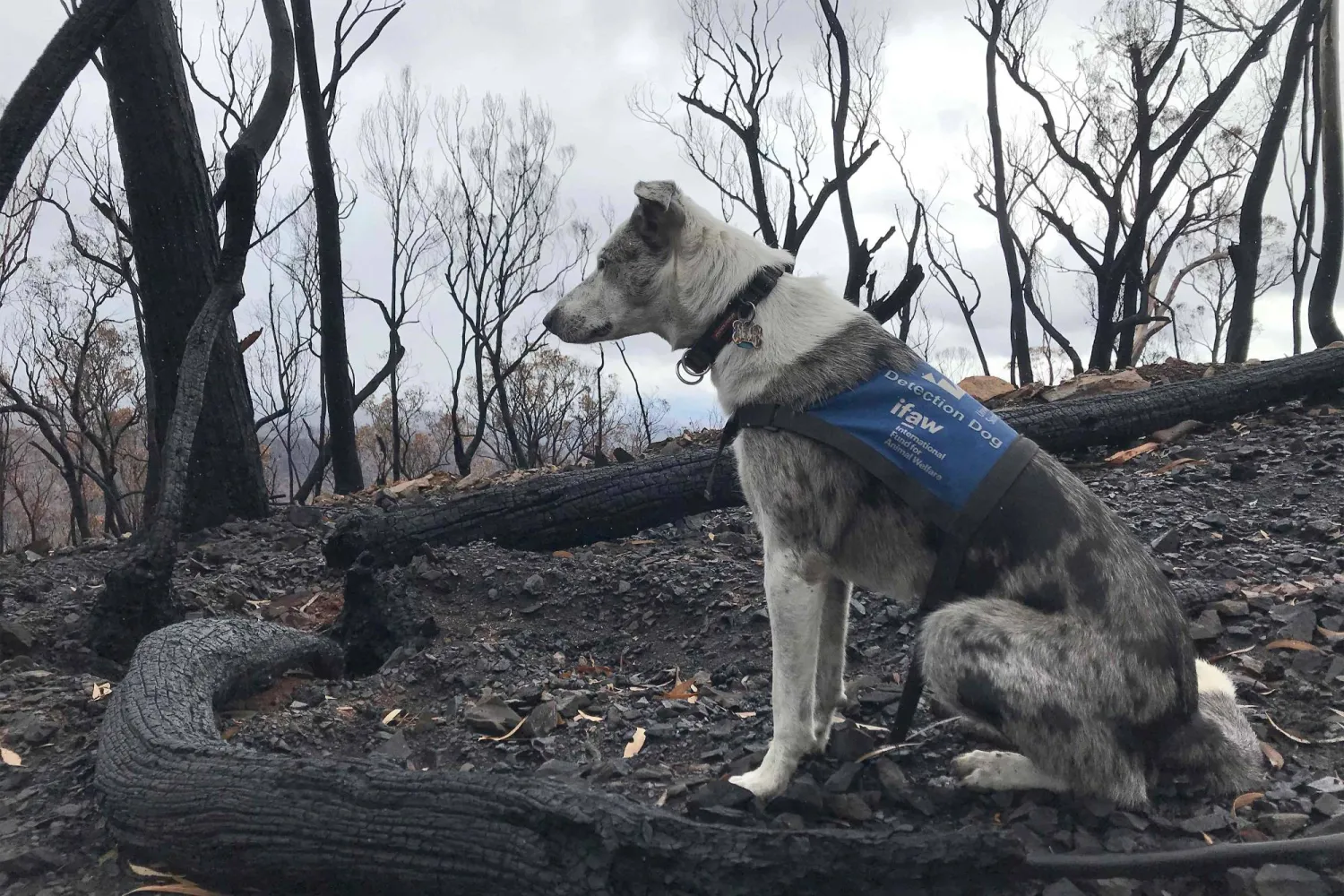
‘Hero’ Australian Dog Who Saved 100 Koalas Retires

This handout picture taken on February 8, 2020 and released by the International Fund for Animal Welfare on March 25, 2026 shows Bear, an Australian Koolie, scanning the Two Thumbs Wildlife Trust Sanctuary for koalas in the Numeralla, Peak View and Nerriga areas of New South Wales. (Handout / International Fund for Animal Welfare (IFAW) / AFP)
TT

‘Hero’ Australian Dog Who Saved 100 Koalas Retires

This handout picture taken on February 8, 2020 and released by the International Fund for Animal Welfare on March 25, 2026 shows Bear, an Australian Koolie, scanning the Two Thumbs Wildlife Trust Sanctuary for koalas in the Numeralla, Peak View and Nerriga areas of New South Wales. (Handout / International Fund for Animal Welfare (IFAW) / AFP)

An Australian dog credited with saving over 100 koalas from bushfires is retiring after a decade of service.

Bear, an 11-year-old Australian Koolie, was one of the first dogs in the country to be trained on the scent of koala fur.

The International Fund for Animal Welfare called using dogs to detect koalas a "novel" approach.

"No one knew if it could be done," IFAW head of programs Josey Sharrad wrote in a statement about Bear on Monday.

As a pup, the four-legged hero's boundless energy made it tough to stay indoors, but he found his true potential in the bush.

"He literally went from chewing the walls of a Gold Coast apartment to roaming through the Aussie bush on a mission to save our most iconic species," Sharrad said.

Bear's skills saved over 100 koalas as the Black Summer bushfires raged across Australia's eastern seaboard from late 2019 to early 2020, razing millions of hectares, destroying thousands of homes and blanketing cities in noxious smoke.

The tail-wagging detective with a "joyful and goofy" personality retires with an extensive list of accolades, including an Animal of the Year award and Puppy Tales Photos Australian Dog of the Year award.

He also features in a "dogumentary" called "Bear: Koala Hero", and in a book, "Bear to the Rescue".

Bear will embark on a slower-paced chapter on the Sunshine Coast with one of his former handlers, getting belly rubs and playing his favorite game, fetch.

One of his former handlers, Romane Cristescu, said Bear had been a "tireless ambassador for koalas for a decade".

"He melted hearts all around the world, and opened many doors so we could have critical and difficult conversations about climate change and its impacts on the threatened koalas, as well as so many other species."


Exotic Pet Trade Thrives in China Despite Welfare Concerns

A visitor holds a sugar glider at a pet fair in Beijing on March 19, 2026. (Photo by WANG Zhao / AFP)
TT

Exotic Pet Trade Thrives in China Despite Welfare Concerns

A visitor holds a sugar glider at a pet fair in Beijing on March 19, 2026. (Photo by WANG Zhao / AFP)

Pet lovers eagerly gathered around a container to snap photos of meerkats at a Beijing animal fair, each selling for $320, while nearby a raccoon nervously paced in a cage only slightly bigger than itself.

Throngs of people from across China packed into the cavernous exhibition halls for the annual pet fair, where exotic animals are a more common sight than cats or dogs.

The exotic pet industry is experiencing rapid growth with a market nearing 10 billion yuan ($1.45 billion), Chinese state media have said.

Approximately 17.07 million people in China have exotic pets, Xinhua reported last year, and animal rights groups have raised concerns about welfare standards.

Unconventional pets are particularly popular among young people, with videos on how to raise them widely shared on social media platforms.

An 18-year-old putting down a deposit for a meerkat told AFP he was confident it would be easier to raise the animal than his previous cats and dogs.

"I feel that raising exotic pets is really just child's play by comparison," said Xiong, who had travelled to Beijing from Jiangxi province.

He had previously bought a sugar glider -- a nocturnal palm-sized possum sold at the same store -- and said he found raising exotic pets easier as they did not feel separation anxiety as dogs do.

It was "quite a hassle-free" experience, Xiong said.

"When you want to interact, it's happy to engage with you, but when you're not in the mood, it's perfectly content playing by itself," he told AFP.

In another part of the fair, patterned snakes and spotted geckos squirmed in round plastic containers as people shopped for their latest reptile.

Yang Xurui brought his green Argentine snake to the fair, where he told AFP he was searching for new exotic pets.

"I consider her a friend of mine," said Yang, 24, caressing the slithering creature hanging around his neck.

"Every day, the moment I walk through the door, she stands tall and straight like a giant green onion to welcome me home," he added.

"She keeps me company while I watch TV, and then, come evening, she goes off to bed on her own -- marking the end of our day together."

Yang said he feels a certain sense of responsibility to dispel commonplace fear of snakes as pets.

"I want to tell everyone that she isn't terrible, that she isn't something to be feared."

China's Ministry of State Security has warned against the exotic pet craze it says is driven by trend-seekers.

"The trade, rearing, medical treatment, and abandonment of these exotic animals harbor latent safety risks," it said last year, adding that this warrants "serious attention".

Animal welfare regulations, however, remain lax in China, where pets such as fish, birds and pigs are commonly sold even in shopping malls.

The pandemic, meanwhile, sparked fears that animals may be carriers of diseases including Covid-19, which was widely believed to have originated in bats.

Authorities in China should target the traders, breeders, and retailers who depend on the business -- and its expansion -- for profit, said Peter Li, a specialist in China's animal protection policy at the University of Houston-Downtown.

Businesses engaged in the sale and transport of exotic animals have reportedly used fraudulent labeling, withheld critical information, and engaged in deliberate deception to move these animals through supply chains, Li told AFP.

Abandoned exotic species can reproduce rapidly in the wild, creating significant ecological pressures on local environments, while diseases carried by them could pose public health risks, he said.

Public awareness in China regarding wildlife protection has improved significantly, but some consumers of exotic pets still lack sufficient knowledge before purchasing such animals, conservation charity WWF told AFP.

"Some consumers may not be fully aware of which species are legal to own, whether specific permits are required, the varying levels of care difficulty for different species, long-term financial costs," it added.

At the fair, 26-year-old Zhang Yue agreed that bringing certain animals "into human-inhabited environments could lead to various repercussions".

Nevertheless, Zhang told AFP she would still consider owning a sugar glider as they are "absolutely adorable".


Mouse Study Shows Repeated Cloning Causes Grave Genetic Mutations

A cloned female mouse inside a laboratory at the University of Yamanashi in Yamanashi, Japan, in this undated photograph released on March 24, 2026. Teruhiko Wakayama/Handout via REUTERS
TT

Mouse Study Shows Repeated Cloning Causes Grave Genetic Mutations

A cloned female mouse inside a laboratory at the University of Yamanashi in Yamanashi, Japan, in this undated photograph released on March 24, 2026. Teruhiko Wakayama/Handout via REUTERS

Revealing the limitations of cloning, researchers who repeatedly cloned mice for two decades have discovered that such serial duplication triggers grave genetic mutations that accumulate over the generations and ultimately become fatal.

A total of 1,206 cloned laboratory mice were generated by the scientists from a single female donor mouse from 2005 to 2025 in research conducted in Japan. There were no outward signs of trouble through the first 25 generations, but mutations subsequently began piling up until becoming fatal. The 58th generation of clones, burdened by mutations but with no visible physical abnormalities, died within a few days of birth.

The research contradicted the notion that clones are identical copies of the original donor animal and disproved the idea that cloning using current technology could be carried out indefinitely with no ill effects.

"No one has ever continued re-cloning for this long before. As a result, this is the first time we've discovered that repeated re-cloning eventually reaches its limits," said developmental biologist Teruhiko Wakayama of the University of Yamanashi, senior author of the research published on Tuesday in the journal ⁠Nature Communications.

"It was ⁠once believed that clones were identical to the original, but it has become clear through this study that mutations occur at a rate three times higher than in offspring born through natural mating," Wakayama said.

"Because all these mutations continue to accumulate, mammals cannot sustain their species through cloning. This study has revealed one of the reasons why mammals, unlike plants and lower animals, cannot maintain their species through cloning."

After generating the first clone, the researchers repeated the process every three to four months, cloning each generation from the one preceding it. Like the original donor mouse, all the clones were females with brown fur.

The researchers published preliminary results in 2013 spanning the first 25 generations ⁠that found the clones to be healthy, with no apparent negative effects.

"At that time, we concluded that re-cloning could likely continue indefinitely. However, in that study, we did not examine the genetic sequences. We continued our research for 13 more years, and as a result, we discovered that our previous conclusion was incorrect - that is, there is a limit to re-cloning," Wakayama said.

The researchers sequenced the genomes of 10 clones from the various generations to understand what was happening at the genetic level.

They found that serial cloning produced an effect akin to duplicating a picture using a copying machine. With the first copy, the image quality deteriorates slightly. When copying that copied image, the quality deteriorates further.

Repeating the process numerous times yields an image very different from the original.

The study results, they said, pointed to the importance of sexual reproduction in countering deleterious genetic mutations in mammals.

The researchers gauged the fertility of the clones by mating them with ordinary male mice. Up to the 20th generation, they gave birth to about 10 babies per litter, ⁠just like ordinary female mice. But ⁠eventually the clones began having smaller litters, reflecting the effects of accumulating mutations.

The researchers used a technique called nuclear transfer to generate the clones. The same method was used to produce Dolly the sheep, the first successfully cloned mammal, at a laboratory in Scotland in 1996, and Cumulina, the first successfully cloned mouse, at a lab in Hawaii in 1998.

With nuclear transfer technology, researchers create an embryo by transferring the nucleus, a cell's primary repository of genetic information, from a donor cell into an egg cell whose own nucleus was removed. A specialized ovarian cell, called a cumulus cell, that surrounds and nurtures a developing egg was used in the cloning.

"We had believed that we could create an infinite number of clones. That is why these results are so disappointing. At this point, we have no ideas for overcoming this limitation. I believe we need to develop a new method that fundamentally improves nuclear transfer technology," Reuters quoted Wakayama as saying.

An increase in large-scale harmful mutations began with the 27th generation including chromosomal abnormalities. For instance, one copy of the X chromosome was lost.

Chromosomes are threadlike structures that carry genetic information from cell to cell. In mammals, females carry two X chromosomes, one inherited from each biological parent.

"In cloning, all genes are passed on to the next generation, meaning that all defective genes are also passed on," Wakayama said.


45 Exoplanets Most Likely to Support Life

Astronomers have suggested 45 exoplanets could support life (Getty)
TT

45 Exoplanets Most Likely to Support Life

Astronomers have suggested 45 exoplanets could support life (Getty)

Astronomers have identified 45 planets that could be the best places to search for alien life.
Scientists have found more than 6,000 exoplanets, or worlds outside of our own solar system.

But many of them are inhospitable to any kind of life, because they are too hot, cold or otherwise dangerous.

Now astronomers have suggested 45 of them that could support life, including famous examples such as Proxima Centauri b, TRAPPIST-1f and Kepler 186f, according to The Independent.

Researchers suggest that the list could be a starting point when looking for signals that could indicate alien life – or potentially sending a spacecraft.

The planets could also help us identify whether our current framework for deciding whether a life could support life, known as the habitable or goldilocks zone, works as a good way of choosing which planets to study by looking at those on the edge of the habitable zone.

The most exciting of the worlds on the list are in the Trappist-1 system, based around a star about 40 light years away. They and some other planets top the list for getting light in a similar way to the Sun on Earth.

But much will depend on whether those worlds have an atmosphere that would actually allow them to hold water, which is thought to be key to life.

“While it's hard to say what makes something more likely to have life, identifying where to look is the first key step – so the goal of our project was to say 'here are the best targets for observation',” said Gillis Lowry, a graduate student who worked on the study.

The researchers hope that the list can be used to help guide the observations of telescopes and spacecraft such as the James Webb Space Telescope, as well as the upcoming Nancy Grace Roman Space Telescope, Extremely Large Telescope, Habitable Worlds Observatory and others that might follow.

Those observations should help confirm whether the planets have atmospheres – the next test for whether they are really habitable.

The work is reported in a new paper, ‘Probing the limits of habitability: a catalogue of rocky exoplanets in the habitable zone,’ published in the journal Monthly Notices of the Royal Astronomical Society.