

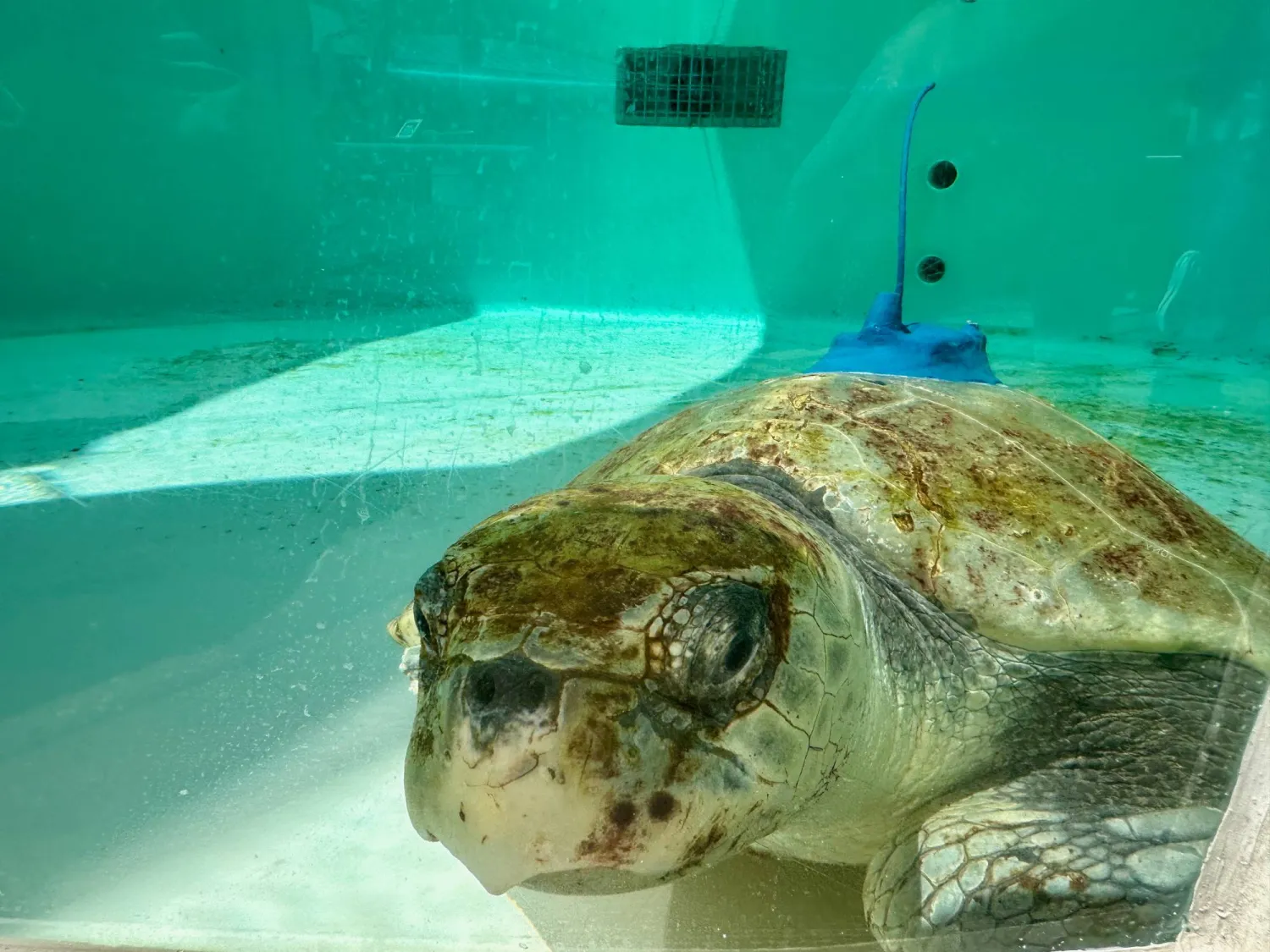

3-limbed Sea Turtle Being Tracked at Sea by Satellite

An adult female Kemp's ridley sea turtle is seen swimming in a tank at Loggerhead Marinelife Center after a satellite tracking device was attached to its shell in Juno Beach, Fla. on Tuesday, March 24, 2026. (AP Photo/Cody Jackson)
TT

3-limbed Sea Turtle Being Tracked at Sea by Satellite

An adult female Kemp's ridley sea turtle is seen swimming in a tank at Loggerhead Marinelife Center after a satellite tracking device was attached to its shell in Juno Beach, Fla. on Tuesday, March 24, 2026. (AP Photo/Cody Jackson)

The veterinary staff at a Florida sea turtle hospital is getting help from space to monitor the animals they have rehabilitated. They're particularly interested in amputees.

Using satellite tracking devices in a collaboration between the Loggerhead Marinelife Center and the Smithsonian Conservation Biology Institute, scientists are learning how well sea turtles can survive in the wild after losing a limb.

Amelie, a Kemp's ridley sea turtle who lost her right forelimb to a predator — most likely a shark, the center said — was taken to the beach on Wednesday for her highly anticipated release. The turtle paused for about 30 seconds, then slowly made her way into the Atlantic Ocean as onlookers cheered.

Amelie had been rescued and brought to the center by the Inwater Research Group in Port St. Lucie, Florida, seven weeks earlier after a traumatic amputation. She underwent surgery to clean and close the wound, and was treated for pneumonia while in a tank at the center.

When veterinarians deemed her healthy enough to return to the sea, they glued a tracking device to her shell.
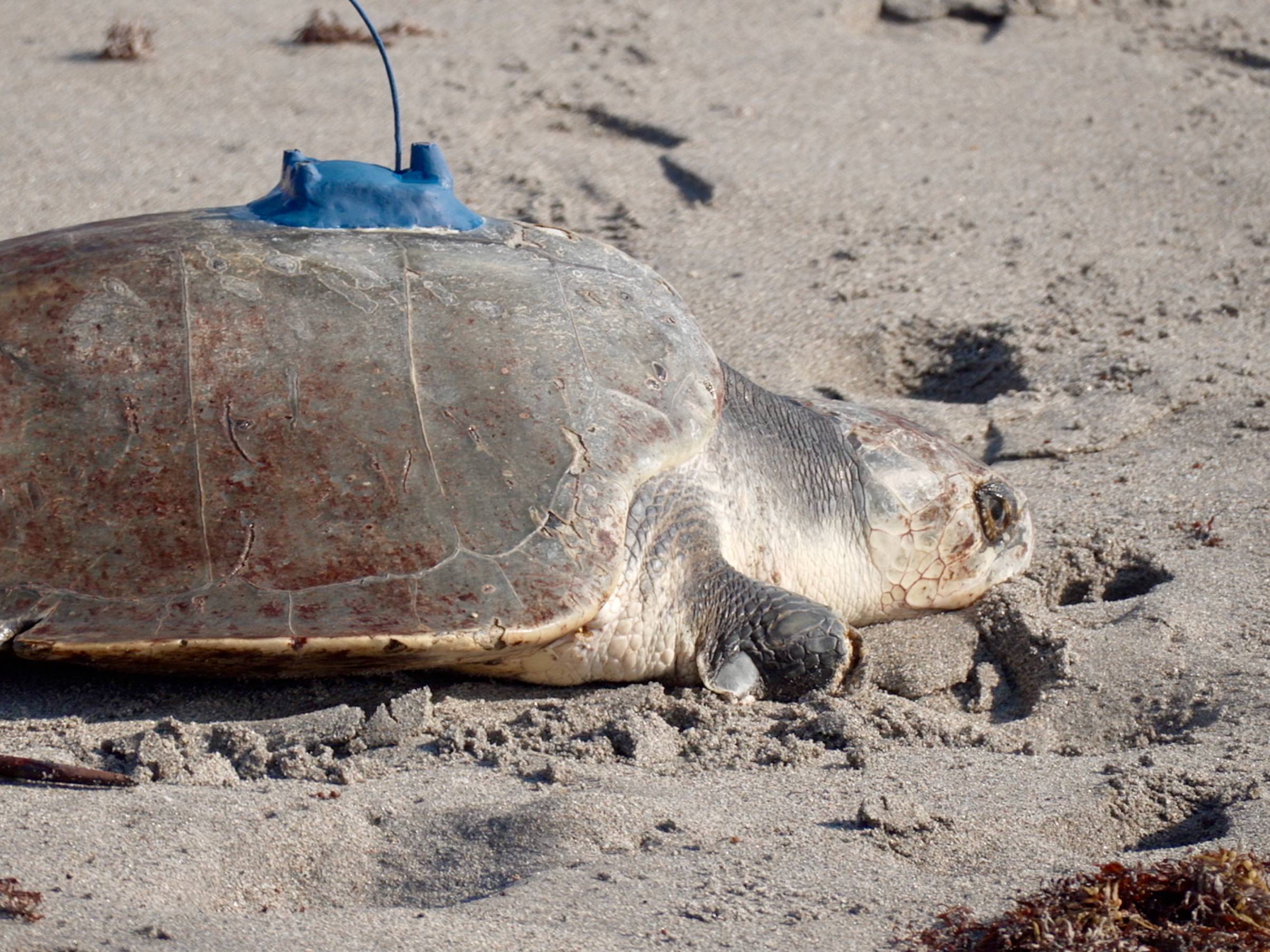
A rehabilitated adult female Kemp's ridley sea turtle crawls toward the ocean during a release in Juno Beach, Fla. on Wednesday, March 25, 2026. (AP Photo/Cody Jackson)

An ultrasound confirmed that Amelie is developing eggs, giving researchers another reason to track her movements.

Kemp's ridley turtles, the rarest of sea turtle species, are more typically found on Florida's Gulf Coast, so treating Amelie was especially significant, said Andy Dehart, the center's president and CEO.

Amelie is actually the fourth amputee sea turtle being tracked by the enter, Loggerhead research director Sarah Hirsch said. They include a three-limbed turtle named Pyari who has traveled nearly 700 miles since her release in January, her tracker shows.

“We do know that they can be successful in the wild because we have seen them on our nesting beaches, but we really want to understand their dive behaviors, how they’re migrating once they’re back in the wild," The Associated Press quoted Hirsch as saying.

The satellite tags have a saltwater switch that detects when the turtle comes up to the surface to breathe, triggering the transmission of data to the satellites. Their location appears online after a 24-hour delay. To view Amelie and other turtles tracked for various research projects, visit the Loggerhead website.

“They’ve been through a lot," Hirsch said. "They’ve gotten a lot of medical care here, and to see them be able to go back out and contribute to the population is really rewarding.”



Meet the Artemis Crew in NASA's First Astronaut Mission to the Moon in More than a Half-century

Artemis 2 crew members, from left, Mission Spc. Jeremy Hansen, of Canada, Mission Spc. Christina Koch, Commander Reid Wiseman, and Pilot Victor Glover pose for a photo after the crew’s arrival at the Kennedy Space Center Friday, March 27, 2026, in Cape Canaveral, Fla. (AP Photo/Chris O’Meara)
TT

Meet the Artemis Crew in NASA's First Astronaut Mission to the Moon in More than a Half-century

Artemis 2 crew members, from left, Mission Spc. Jeremy Hansen, of Canada, Mission Spc. Christina Koch, Commander Reid Wiseman, and Pilot Victor Glover pose for a photo after the crew’s arrival at the Kennedy Space Center Friday, March 27, 2026, in Cape Canaveral, Fla. (AP Photo/Chris O’Meara)

The four astronauts making NASA’s next lunar leap bear little resemblance to the Apollo era.

The Americans who blazed the trail to the moon more than half a century ago were white men chosen for their military test pilot experience. This first Artemis crew includes a woman, a person of color and a Canadian, products of a more diversified astronaut corps.

None of them were alive during NASA’s storied Apollo program that sent 24 astronauts to the moon including 12 moonwalkers. They won’t land on the moon this time or even orbit it, but the out-and-back journey will take them thousands of miles deeper into space than even the Apollo astronauts ventured, promising unprecedented views of the lunar far side, The AP news reported.

Here’s a look at the Artemis astronauts whose mission aims to pave the path for future moon landings:

Commander Reid Wiseman Leading the nearly 10-day mission is a widower who considers solo parenting — not rocketing to the moon — his biggest and most rewarding challenge.

Wiseman, 50, a retired Navy captain from Baltimore, was serving as NASA’s chief astronaut when asked three years ago to lead humanity’s first lunar trip since 1972. His wife Carroll’s death from cancer in 2020 gave him pause.

He’d spent more than five months at the International Space Station in 2014, and his two teenage daughters, especially the older one, had “zero interest” in him launching again.

“We talked about it and I said, ‘Look, of all the people on planet Earth right now, there are four people that are in a position to go fly around the moon,” he said. “I cannot say no to that opportunity.”

The next day, homemade moon cupcakes awaited him, along with his daughters' support. The toughest part isn’t leaving them — “it's the stress that I’m putting on them,” he said.

Open with his daughters about everything, he recently told them where he keeps his will.

Pilot Victor Glover As one of NASA’s few Black astronauts, Glover sees his presence on the mission as “a force for good.”

The 49-year-old Navy captain and former combat pilot from Pomona, California, makes it a habit to listen to Gil Scott-Heron’s “Whitey on the Moon” and Marvin Gaye’s “Make Me Wanna Holler” from the white-dominated Apollo era.

“I listen to those for perspective,” he said. “It captures what we did well, what we did poorly.”

The ability for him now to offer hope to others is “an amazing blessing and a privilege.” Despite having one spaceflight behind him — an early SpaceX crew run to the International Space Station — he finds himself in new personal territory. His four daughters are in their late teens and early 20s, “and I spend as an much time and thought preparing them as NASA does preparing me.”

He’s hyper-focused on running “our best race so that we can hand the baton off to the next leg” — a 2027 practice docking mission in orbit around Earth between an Orion crew capsule and one or two lunar landers. The all-important moon landing would follow in 2028 with yet another set of astronauts.

Mission specialist Christina Koch The last time Koch blasted into space, she was gone almost a year, so she’s not sweating a quick trip to the moon and back.

The 47-year-old electrical engineer from Jacksonville, North Carolina, holds the record for the longest single spaceflight by a woman — 328 days. She took part in the first all-female spacewalk during her lengthy stay at the space station in 2019.

More than any one individual, “it’s about celebrating the fact that we’ve arrived to this place in history” where women can fly to the moon, she said.

Before she got called up by NASA, Koch spent a year at a South Pole research station. Between that and her space stint, she feels she's “inoculated” most of her family and friends.

“So far, I haven't gotten too many nerves from folks. Maybe my dog, but I've reassured her that it's only 10 days. It's not going to be as long as last time.”

Her and her husband's rescue pooch is named Sadie Lou.

Canadian Space Agency's Jeremy Hansen The Canadian fighter pilot and physicist is making his space debut, stressful enough, but also serving as his country's first emissary to the moon.

“Maybe I'm naive, but I don't feel a lot of personal pressure.”

Hansen, 50, grew up on a farm near London, Ontario, before moving to Ingersoll and pursuing a flying career. The Canadian Space Agency selected him as an astronaut in 2009, and he was named to the Artemis crew in 2023.

He realizes only now how much effort it took to send men to the moon during Apollo.

“When I walk out and I look at the moon now, it looks and feels a little bit farther than it used to be,” he said. “I just understand in the details how much harder it is than I thought it was watching videos of it.”

Dangers still loom — something he’s shared with his college-aged son and twin daughters. “The most likely outcome is that we will come back safe. There’s a chance we won’t, and you will be able to move through life even if that happens,” he assured them.


Scattered Rain Revitalizes Desert Outings, Camping in Saudi Hail

Campsites have sprung up throughout the region - SPA
TT

Scattered Rain Revitalizes Desert Outings, Camping in Saudi Hail

Campsites have sprung up throughout the region - SPA

Recent scattered rainfall across Saudi Arabia's Hail Region has drawn residents and visitors to the plains, mountains, and popular sites such as the Aja and Salma mountains, the Qana sand dunes, and the outskirts of Jubbah, revitalizing desert outings and camping while providing families and youth with a distinctive spring atmosphere.

According to SPA, campsites have sprung up throughout the region, creating vibrant social hubs centered on traditional gatherings and outdoor hospitality.

This seasonal surge in visitors increased traffic on roads leading to desert areas, as enthusiasts flock to experience the mild weather and natural scenery unique to Hail’s rainy season.


Whale Stranded at Baltic Sea Resort Has Swum Off Sandbank. But it Isn't Safe Yet

A humpback whale swims in the Baltic Sea, accompanied by an inflatable boat, after freeing itself the night before from being stranded off Niendorf in Timmendorfer Strand, Germany, Friday March 27, 2026. (Marcus Brandt/dpa via AP)
TT

Whale Stranded at Baltic Sea Resort Has Swum Off Sandbank. But it Isn't Safe Yet

A humpback whale swims in the Baltic Sea, accompanied by an inflatable boat, after freeing itself the night before from being stranded off Niendorf in Timmendorfer Strand, Germany, Friday March 27, 2026. (Marcus Brandt/dpa via AP)

A whale that was stranded for days in shallow water at a Baltic Sea resort in Germany has swum free from a sandbank overnight after a last-ditch rescue effort. But it isn't out of danger yet.

An excavator spent Thursday digging an escape channel. The whale then swam through it overnight, marine biologist Robert Marc Lehmann said Friday, German news agency dpa reported.

But he cautioned that it was only a small step in the right direction for the marine mammal, which is 12-15 meters (39-49 feet) long, and that it will only really be at home again if it reaches the Atlantic Ocean.

The whale was spotted stuck on an underwater sandbank in Timmendorfer Strand, a popular resort town, on Monday morning. Initial efforts to free it and coax it back toward deeper water, including using coast guard and fire department boats to create large waves, were unsuccessful. The Baltic Sea lacks strong tides that could have freed the whale.

On Thursday morning, rescuers brought in excavators to dig a trench in front of the whale's head, while Lehmann approached the animal and guided the digging. They worked until well after sunset, but hadn't quite been able to get the whale out by the time they had to stop work for the night.

Early on Friday morning, the whale was on its way out of Lübeck Bay, where Timmendorfer Strand is located, said Stephanie Gross of the Institute of Terrestrial and Aquatic Wildlife Research. She said the massive mammal, which was about 300 meters (nearly 1,000 feet) off the coast, was being accompanied by a coast guard ship and several boats.

Experts assume that the whale is a young male, as males, unlike females, tend to migrate. It also appeared to be the same whale that was spotted several times in the port of Wismar, east of Timmendorfer Strand, in recent weeks.

It was not immediately clear why the whale was in the area and got stranded.

Humpback whales aren't native to the Baltic. This one faces a journey of several hundred kilometers (miles) through German and Danish waters if it is to reach the North Sea.