


How a Paris-Area Wildlife Hospital Keeps Rescued Animals Wild

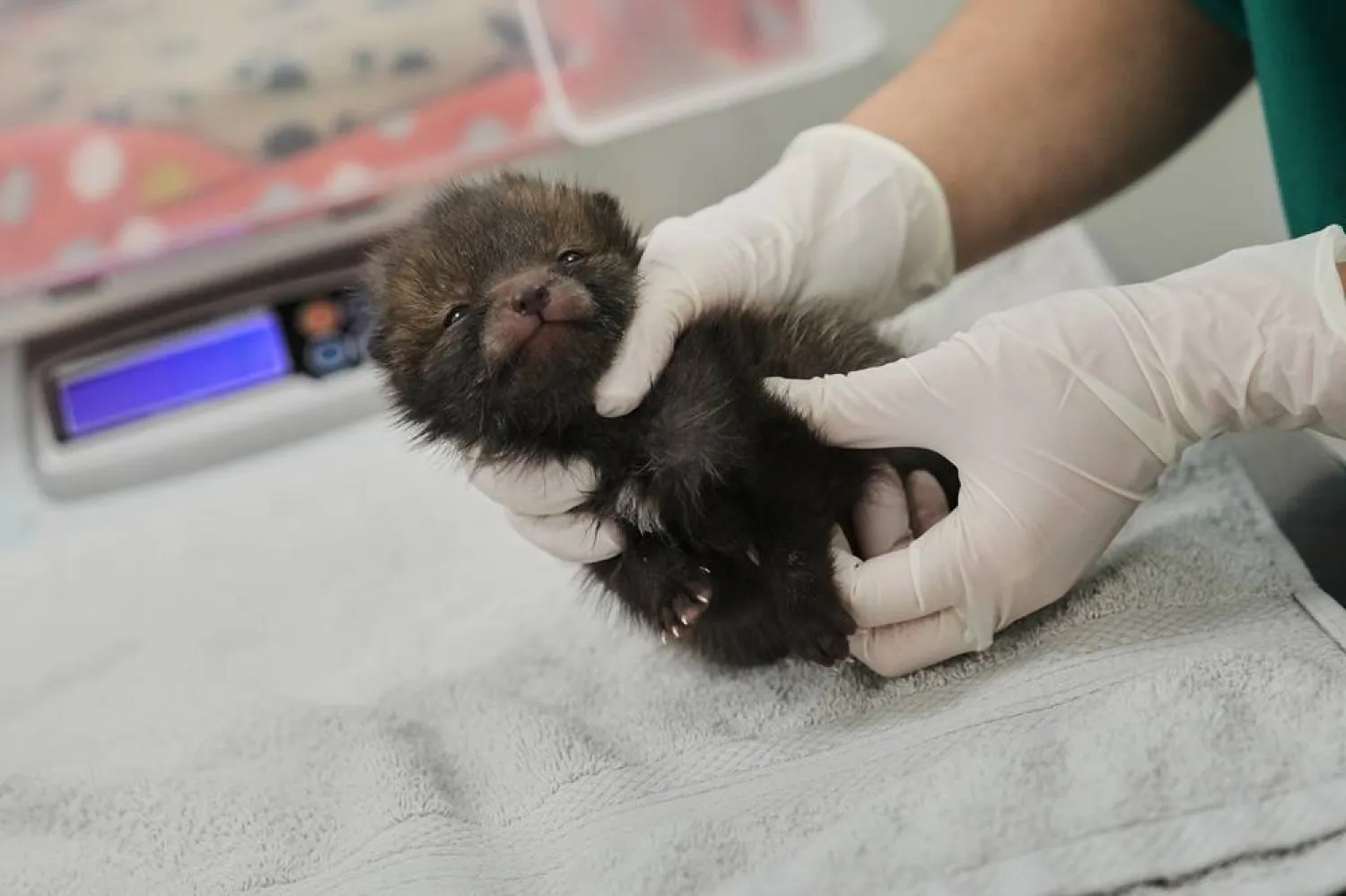
A baby fox is treated at the Wildlife Veterinary Hospital in Maisons-Alfort, outside Paris, April 17, 2026. (AP)
TT

How a Paris-Area Wildlife Hospital Keeps Rescued Animals Wild

A baby fox is treated at the Wildlife Veterinary Hospital in Maisons-Alfort, outside Paris, April 17, 2026. (AP)

A wildlife hospital in a southeastern Paris suburb is a place of no cuddles but lots of care. It helps injured, sick and orphaned animals — often victims of human activity and increasing urbanization — heal so they can return to their natural habitat.

Last week, a female fox cub was found alone in a garden on the city's outskirts, with no sign of her mother nearby. Now a team of volunteers takes care of her around the clock.

“We’ll make sure she’s eating well,” animal caretaker Valentin Delon said. “If that’s not the case, we might provide supplemental bottles to ensure she gains enough weight.”

Over the past year, the Wildlife Veterinary Hospital in Maisons-Alfort has taken in more than 10,400 wild animals, including a wide variety of birds and European mammals such as foxes, deer and hedgehogs.

Like the little brown-furred cub, the animals can easily capture a caretaker's heart, but bonding with humans is not an option when the goal is to eventually return them to the wild.

The baby fox was found by residents who own hunting dogs. Estimated to be about 2 weeks old, she was far too young to survive on her own.

At the Maisons-Alfort hospital, veterinarian Julie Piazza carefully examined her and aside from a minor injury, possibly caused by a wild animal or a dog’s bite, she was found to be in good health.

The cub was fed artificial milk — a product matching the composition of animal-produced milk — and because of that, her abdomen was swollen, Piazza said.

"That’s common in a young one that has had a disruption in its diet,” she added.

Once healed, the animals are transferred to outdoor enclosures and aviaries to prepare for a reintroduction into their natural environment.

Delon, the caretaker, says that “any kind of imprinting” — measures that attach the animals to their caregiver long-term — must be avoided.

“So we don’t cuddle them, we don’t talk to them,” she said. “There’s really a distance to maintain for their own good in the end, so they can be released later.”

Because she is just a cub, once she grows sufficiently, the baby fox will first be transferred to a rehabilitation center and placed with other foxes in an enclosure.

“We can’t just release her into the wild like that,” Delon said. “She really needs to go into an enclosure first, and then gradually we’ll open the door so she can come and go while still being fed. Then we’ll gradually reduce the food, and that’s how we achieve a truly gradual release.”

Juveniles are especially vulnerable

The hospital ran by the Faune Alfort group is the only facility in the greater Paris area that treats a wide range of wild species. Some 86% of its patients are birds.

Last week, there was a swan with a broken wing, injured hedgehogs, dozens of ducklings often found on balconies and elsewhere without parents, and lots of pigeons that are treated just as carefully as rarer birds.

Elisa Mora, head of communications for Faune Alfort, a nonprofit group running the Maisons-Alfort hospital, said a record 200 admissions were reported in a single day last summer. The hospital is mostly financed by donations from individuals and charities, and relies on volunteers to help feed and care for the animals.

April to September is the “juvenile period when wild animals reproduce” and the admissions peak, Mora said.

“Wild animals are already vulnerable, but juveniles even more so,” she said. Those too badly injured or unable to return to the wild have to be euthanized.

Veterinarian Jean-François Courreau launched Faune Alfort in 1987, inspired by students willing to better treat wild animals. Six years later, the idea turned into a proper hospital, hosted by the National Veterinary School of Alfort, established in the 18th century.

“It’s hard to stand by helplessly in front of an animal in distress without being able to do anything,” Courreau said, adding that it's his duty to help as a vet.

When people find a wild animal in distress, they think “I can’t do anything, and the animal is going to die,” he said. “So when they know a care center exists and that they can bring the animal there, it’s a huge relief.”

The vast majority of animals brought to the hospital — as many as 60% to 80% of admissions — are victims of road collisions, animals caught in barbed wire or injured by people using gardening tools or agricultural machinery, among other causes.


UK Set to Break Record for Hottest May Day

A drone view shows people using kayaks and paddle boards in the River Thames at Teddington Lock, London’s first official river bathing water site, as temperatures climb over the bank holiday weekend due to a heat dome spreading across the region, in London, Britain, May 24, 2026. (Reuters)
TT

UK Set to Break Record for Hottest May Day

A drone view shows people using kayaks and paddle boards in the River Thames at Teddington Lock, London’s first official river bathing water site, as temperatures climb over the bank holiday weekend due to a heat dome spreading across the region, in London, Britain, May 24, 2026. (Reuters)

Britain was set to break its record for the hottest day in May on Monday, the national weather agency predicted, as the country sweltered in an "unprecedented" heatwave.

"Today will be the hottest day in May in the UK in our temperature records, with highs of 35 degrees Celsius expected," the Met Office said on social media.

The current record for the hottest May day is 32.8C, set in 1922 and seen again in 1944.

"Records are usually only broken by tenths of a degree -- making this heatwave unprecedented for the time of year," added the Met Office statement.

Monday is also expected to be the hottest bank holiday ever, as heatwave conditions spread to parts of southeast England and London by Sunday night.

"We rarely see temperatures above 35C, even in the summer months, so to see temperatures getting close to 35C in May is, as I say, pretty historic," Met Office meteorologist Tom Morgan told the Press Association news agency.

"It's nice to have it, but it is much, much hotter than it should be in the UK," Andrea Quaine, a 41-year-old mother, told AFP in London as temperatures exceeded 30C on Sunday.

"I am worried about it because it obviously shows that global warming is happening," she added.

"The weather here, it's like a mini version of hell. It's boiling. It's like really hot. The sunscreen, it will protect me, but it's really hot," said 10-year-old Liza Nizari, who was visiting London from Manchester in the northwest.

Scientists say human-induced climate change is making extreme weather events like heatwaves, droughts and floods more intense, resulting in temperature records being broken more frequently.

Britain saw its hottest year on record in 2025.

Climate advisers last week warned the UK government that the country was "built for a climate that no longer exists" and urged it to adapt infrastructure like schools and hospitals for a warming planet.


How Collecting DNA Samples in the Wild Could Transform Conservation

A golden monkey is seen in Volcanoes National Park in Kinigi, Rwanda, Thursday, March 19, 2026. (AP)
TT

How Collecting DNA Samples in the Wild Could Transform Conservation

A golden monkey is seen in Volcanoes National Park in Kinigi, Rwanda, Thursday, March 19, 2026. (AP)

A guide called out to endangered golden monkeys with grunts and clicks to signal he posed no threat, a familiar sound in the mist-covered forests of Rwanda ’s Volcanoes National Park.

Here in one of Africa's most well-known parks, steep ridges and dense vegetation often obscure even the largest mountain gorillas — also endangered — and scientists are turning to new technology to detect and protect them.

Known as environmental DNA, or eDNA, the technology allows researchers to identify species using genetic material like fur or feces left in soil and water. This reduces the impact of human interaction during wildlife surveys that can leave researchers groping through the mist.

The technology, more often used in marine conservation work, was introduced by the African Wildlife Foundation in partnership with the Rwandan government. It aims to develop a list of all species in the country. That will help protect biodiversity that is threatened by climate change and population growth.

“We selected eDNA as a new technology to bring solutions and to complement existing methods used in ecological monitoring,” said the foundation’s country manager for Rwanda, Patrick Nsabimana.

Biodiversity monitoring for decades has relied on camera traps, which operate when animals trigger their sensors, and ranger observations.

But that is a challenge in rugged terrain such as the Virunga mountains that are central to Volcanoes National Park, which covers part of Rwanda, Uganda and Congo. Insecurity in the border area also can limit ranger movement.

Nsabimana said eDNA is a cost-effective monitoring approach in large ecosystems such as Virunga. Samples are taken from locations like downstream ponds that are likely to have traces of animals on higher ground. Then they are tested.

“With one sample, you can detect multiple species, mammals, birds, amphibians and many others,” said Deogratias Tuyisingize, a Rwanda-based biodiversity researcher with the Dian Fossey Gorilla Fund that is also involved in the project.

He said a combination of traditional methods and new technology is needed to ensure all species are monitored. Because of steep ravines and mountainsides, “we are sure we were missing some species."

Meanwhile, having a better sense of where endangered species are could help in patrolling against poachers, people with the project said.

The ability to generate a broad snapshot of biodiversity is critical for conservation, especially as Rwanda expands some of its national parks by rehabilitating previously agricultural land.

“We can see how species are colonizing these sites over time,” Tuyisingize said.

That allows conservationists to measure success by the return of rare or threatened species, and offers early warnings of invasive species.

But the eDNA technology is not without limitations. It cannot reliably estimate how many animals are present in an ecosystem. DNA can linger long after a species has left.

Being able to process samples in Rwanda is also a challenge, as the project's initial ones had to be sent to Europe for analysis.

Joshua Newton, who conducted research on eDNA for Curtin University’s Trace and Environmental DNA Laboratory, said challenges also include having cold storage to preserve DNA samples and ensuring samples are not contaminated.

Data gaps are another issue. Africa has relatively limited genetic reference libraries, despite decades of conservation work on the continent, making it harder to match DNA samples to known species.

Most genetic reference libraries come from Europe and America, said James Munyawera, a lab specialist with the Dian Fossey Gorilla Fund.

Researchers are now building region-specific databases.

The project in Volcanoes National Park has also begun training residents of local communities, along with rangers, to participate in monitoring efforts by collecting samples.


‘He’s Tiny! It’s Blue!’: Scientists Find New Deep-Sea Octopus

An undated handout picture released on May 22, 2026 by the Charles Darwin Foundation shows a newly discovered blue pygmy octopus off the Galapagos Islands. (Charles Darwin Foundation / AFP)
TT

‘He’s Tiny! It’s Blue!’: Scientists Find New Deep-Sea Octopus

An undated handout picture released on May 22, 2026 by the Charles Darwin Foundation shows a newly discovered blue pygmy octopus off the Galapagos Islands. (Charles Darwin Foundation / AFP)

On the ocean floor near the Galapagos Islands, a submersible controlled by scientists came across a mysterious octopus as blue as the ocean and no bigger than a golf ball.

"He's tiny! It's blue!" one excited scientist was recorded as saying when she first caught sight of the cerulean cephalopod on footage transmitted from the sub.

The team from the Charles Darwin Foundation had just discovered a new species of octopus nearly 1,800 meters (5,900 feet) below the water's surface, according to research published on Monday.

"Right away, I knew it was something really special," said octopus expert Janet Voight, who was asked to identify the strange species.

At first the curator at the Field Museum of Natural History in Chicago had to make do with photos of the animal.

Then she received its preserved body in the mail.

"When it arrived, I was like 'Oh! My goodness! It's beautiful'," Voight told AFP.

She was immediately interested because the closest known octopus of that shape lives off the coast of Uruguay -- in a different ocean on the other side of South America.

Normally to describe a new octopus species, a specimen needs to be cut open so that its mouth, beak, teeth and other parts can be examined.

"We only had the one specimen, so I didn't want to take it apart," Voight said.

Instead, the team at the Field Museum used CT scans to take thousands of X-ray images, then compiled them to make a 3D model of the octopus, revealing its insides.

"There's nothing like spending the day looking at something no other human has ever seen," the Field Museum's X-ray lab head Stephanie Smith said in a statement.

- 'Deep purple' -

The new species, named Microeledone galapagensis, stands out for reasons other than its blue hue, which is believed to be the rarest color in nature.

The octopus appears to be the runt of the Megaleledonidae family, whose members are normally much larger and live in the Southern Ocean surrounding Antarctica.

"Its stubby little arms with only one row of suckers set it apart from most octopus we are familiar with," Voight said.

Even among "other species with short little arms and a single sucker row, its coloration and smooth skin on the back surface separate it", she added.

While the octopus is light blue on its back, underneath it is a "very deep purple", Voight said.

"We think this color pattern helps keep it safe. If the octopus grabs a prey item that emits light, that light may attract predators that might then eat the octopus," she explained.

"So the octopus puts its dark-colored web over the prey item, keeping itself safe."

Surprisingly, it is not uncommon to find new species of octopus in the deep sea -- particularly in areas that have not been well explored, which is a massive amount of the ocean floor.

"If you took all the land on Earth and pieced it together, you would not cover the Pacific Ocean," Voight pointed out.

She added that she had last seen a new octopus in 2023, off the coast of Costa Rica.

The first sighting of the new blue octopus was made in 2015 near Darwin Island, named after the English scientist whose visit to the Galapagos helped him form the theory of evolution.

Voight's research on the species was published in the journal Zootaxa.
