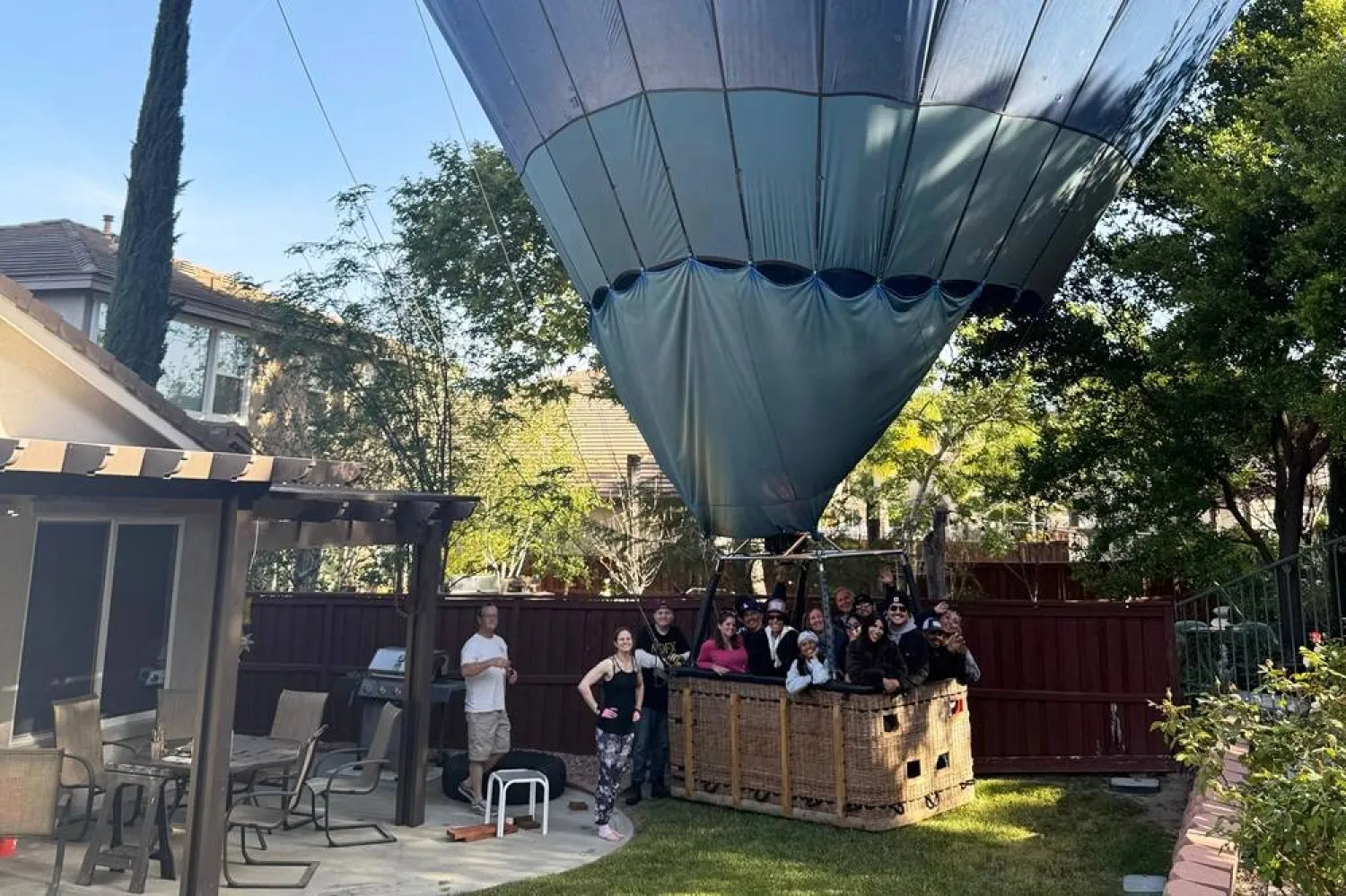
Hot Air Balloon with 13 Aboard Makes Emergency Landing in California Backyard

This photo provided by Hunter Perrin shows people riding a hot air balloon posing for a photo after making an emergency landing in Perrin's backyard on Saturday, April 18, 2026, in Temecula, Calif. (Hunter Perrin via AP)
TT

Hot Air Balloon with 13 Aboard Makes Emergency Landing in California Backyard

This photo provided by Hunter Perrin shows people riding a hot air balloon posing for a photo after making an emergency landing in Perrin's backyard on Saturday, April 18, 2026, in Temecula, Calif. (Hunter Perrin via AP)

A balloon landed in a Southern California backyard — a balloon with 13 people.

The enormous hot air balloon, with a pilot and passengers in the basket, descended perfectly Saturday on a small plot of grass at a home in Temecula. Hunter Perrin said he had no idea that he had visitors until a neighbor alerted him.

“I was watching TV and my wife was doing yoga,” Perrin told The Associated Press. “There was a man standing in front of my door saying, ‘They just landed.’ What? I was very confused.”

But there they were, a group of anxious people suddenly relieved to be on solid ground. Perrin's grassy backyard patch is only about 10 feet (3 meters) wide.

“It was unbelievable, like something out of a Disney fairy tale,” Jenna Perrin said. “The balloon didn't hit our house or our trees. It was kissing the fence.”

Brianna Avalos and her husband were riding in the balloon to celebrate their 10th wedding anniversary. She said the pilot informed passengers that he needed to make an emergency landing because of low fuel and a shift in winds.

“At first I was like, ‘Oh my God! We’re in a backyard! This is crazy!’” Avalos told KABC-TV.

The blue balloon with gold stars and a crescent moon image was a spectacle as it came to rest in the backyard, towering over Perrin's home. The pilot disembarked the passengers, returned aloft and then landed the balloon nearby in the street, where it was dismantled.

“He was an amazing pilot,” Avalos said.

Denni Barrett, the owner of Magical Adventure, which provides the balloon rides, declined to identify the pilot but said he had “exercised great judgment” and “done the right thing.”

“Most of our landings are in wine country,” Barrett said, referring to vineyards in California's Riverside County. “Usually they're bigger backyards.”


US Study Tests Psilocybin to Fight Cancer Side Effects

A health worker from the community health center prepares a cervical cancer and rubella vaccination during the School Children Immunization Month (BIAS) program at a school  in Banda Aceh, Indonesia, 27 August 2026. EPA/HOTLI SIMANJUNTAK
A health worker from the community health center prepares a cervical cancer and rubella vaccination during the School Children Immunization Month (BIAS) program at a school in Banda Aceh, Indonesia, 27 August 2026. EPA/HOTLI SIMANJUNTAK
TT

US Study Tests Psilocybin to Fight Cancer Side Effects

A health worker from the community health center prepares a cervical cancer and rubella vaccination during the School Children Immunization Month (BIAS) program at a school  in Banda Aceh, Indonesia, 27 August 2026. EPA/HOTLI SIMANJUNTAK
A health worker from the community health center prepares a cervical cancer and rubella vaccination during the School Children Immunization Month (BIAS) program at a school in Banda Aceh, Indonesia, 27 August 2026. EPA/HOTLI SIMANJUNTAK

Here's a novel idea for countering the painful side effects of chemotherapy: beforehand, take the hallucinogenic drug found in magic mushrooms.

The study published Thursday in the journal Science involved tests on rats and certain human tissues as researchers looked at using psilocybin to fight a condition called peripheral neuropathy, which affects millions of people around the world.

It is a nerve ailment that hits about three quarters of all people who undergo chemo and commonly causes numbness and tingling, Patrick Dougherty, a co-author of the study, said in a call with reporters.

But a third of that group will develop non-stop, burning pain, said Dougherty, a pain treatment specialist at the University of Texas MD Anderson Cancer Center.

The symptoms can lead to trouble walking and other debilitating complications that can last after a person finishes chemotherapy, and even remain with them for life, AFP reported.

And it is not just a quality-of-life issue. This complication also affects a cancer patient's chances of survival because sometimes the side effects are so bad they force doctors to cut back on chemo or stop it altogether.

It was almost by accident that these researchers found that psilocybin can help cancer patients.

The team was initially studying how the disease manages to hijack nerve cells in order to grow.

And the researchers were surprised to see the mushroom ingredient -- it was being used to study a brain pathway regeneration concept called neuroplasticity -- actually prevented the emergence of peripheral neuropathy.

Later experiments highlighted psilocybin's role in protecting nerve cells and stimulating inside them the transport of mitochondria, often referred to as a cell's powerhouse.

This is key because chemo destroys the microscopic railroads that allow mitochondria to send energy all the way to the tips of people's hands and feet, killing off nerve endings there.

Psilocybin also seems to act on the brain, preserving electrical activity that chemotherapy thwarts.

In rodents, taking two doses of psilocybin before chemo was enough to prevent the appearance of painful hypersensitivity during as many as six rounds of treatment. And it did this without affecting the animal's immune system or hindering the cancer-fighting action.

"This is a highly promising finding," said Kristy Townsend, a professor of neurobiology at The Ohio State University who was not involved in the study.

And psilocybin's nerve-protecting quality does not seem to be linked to its hallucinogenic effects because a non-hallucinogenic analogue had the same effect in a lab test, she added.

Before the treatment can be made standard for people, testing will be needed to see if it is safe and effective, said Townsend.

This will be a long, slow process though it should be eased by a boom in medical research on psychedelic substances and a Trump administration executive order in April to speed up research and regulatory reviews, these scientists say.

The MD Anderson Cancer Center plans to launch clinical tests with psilocybin on cancer patients later this year.

Meanwhile it is important for cancer patients to avoid using magic mushrooms on their own as treatment, the researchers warned.

Psilocybin is legal in a few US states.

The drug has an "amplifier" effect and cancer patients who take it without supervision could feel more stressed and anxious than they already are because of their cancer diagnosis, said Gregory Jones, a psychiatrist who took part in the study released Thursday.

"If you put somebody in adversity under these psychedelic substances, you can get much worse," Jones said.


Tesla Starts Cybercab Rides in Austin, Drawing US Safety Agency Interest

A Tesla's "Cybercab" is displayed in downtown Austin, Texas, on September 3, 2026. (AFP)
TT

Tesla Starts Cybercab Rides in Austin, Drawing US Safety Agency Interest

A Tesla's "Cybercab" is displayed in downtown Austin, Texas, on September 3, 2026. (AFP)

Tesla said on Thursday it was offering rides in "limited areas of Austin, Texas" in its two-seater Cybercab, a vehicle without a steering wheel or pedals, with the US auto safety agency responding that it was evaluating the effort.

CEO Elon Musk has said the Cybercab is key to transforming Tesla into a dominant force in driverless vehicles. Tesla in recent weeks has promoted what it called an exclusive "Cybercab launch event" in Austin on Thursday, drawing interest from investors and fans, some of whom came to Texas to try out the golden, butterfly-door cars.

Musk himself skipped the event, attendees said, and remarks from executives on pricing plans, manufacturing and technology lasted only about a quarter of an hour, according to videos posted after the event.

The electric-vehicle maker has a limited robotaxi ride-hailing service with a network of autonomous Model Ys, some with human safety monitors. Its fleet registered in Texas is less than half that of autonomous rival Waymo, whose autonomous service has cars with human controls – but no human drivers. Over time, Tesla ‌intends to make the ‌no-steering-wheel Cybercab the main driverless vehicle model operating within a larger robotaxi network.

Federal safety norms typically require ‌human ⁠controls, and the safety ⁠regulator, the National Highway Traffic Safety Administration, signaled its interest in Tesla's activity.

"NHTSA is in contact with Tesla and is evaluating the situation," the spokesperson said, without elaborating.

Tesla updated its robotaxi website, saying Cybercab rides were available only in some parts of Austin. Tesla did not specify when it would charge fares, although executives at the event described plans to use dynamic pricing, which would rise with demand, while promising "a first-class experience at coach price".

Tesla AI Chief Ashok Elluswamy, one of the presenters, said that anyone could ride. "It's open to the entire public," he said.

Several Tesla investors and social media personalities in Austin enthused over the look and feel of the Cybercab, posting videos of their rides as well as the event, which included at least one partially manufactured Cybercab.

Musk has promised ⁠for years that driverless Teslas are imminent, including at a Cybercab unveiling in October 2024 at a Los ‌Angeles-area movie studio, but Tesla's robotaxi rollout has fallen short of his targets, and some ‌analysts in recent months have flagged the slower-than-expected growth.

In a Thursday afternoon video, Musk calls it "the first car that is specifically built for unsupervised full self-driving."

MARKET ‌VALUE UNDERPINNED BY ROBOTAXI AMBITIONS

Since launching a pilot in Austin in June 2025, Tesla has expanded its robotaxi service to a handful ‌of other cities in Texas and Florida.

Analysts and investors see driverless vehicles as key to Tesla's future and a central underpinning of its $1.4 trillion market value, far higher than any other automaker. Tesla's core electric-vehicle business faces pressure from global competition, particularly Chinese EV makers.

Musk has said the Cybercab will eventually be Tesla's largest-volume vehicle, supplying a global network of robotaxis and allowing individual owners to add or remove their vehicles from a Tesla-managed driverless ride-hailing fleet when they are not using the cars.

Tesla ‌said production began in April 2026, though Musk cautioned in April that initial production "will be very slow."

REGULATORY HURDLES LIMIT DEPLOYMENT

It is unclear how quickly Tesla will be able to fully deploy the vehicles.

Federal regulations ⁠limit the number of vehicles ⁠any manufacturer can sell without a steering wheel and pedals. Established manufacturers can deploy an unlimited number of such vehicles for testing.

In California, a key market, Tesla does not have permits to operate a robotaxi service or to test driverless vehicles without a safety driver who can take over in the front seat.

In July 2025, Musk said the company's robotaxi network would expand at a "hyper-exponential rate" and be available to half the population of the US by the end of 2025.

Those predictions did not pan out, and Musk and his executives have struck a more cautious tone in recent months, saying the company is taking a careful approach to avoid injuries or fatalities.

REAL-WORLD TESTING REVEALS SERVICE GAPS

Reuters tested out the robotaxi service in the weeks after Dallas and Houston events earlier this year and found long wait times, with sometimes no availability at all.

On three occasions when a reporter managed to get a ride in Dallas, the robotaxi would not drop him at his downtown destination within Tesla's advertised service area. Each time, it left him about a 15-minute walk away. Tesla did not respond to requests for comment about the service issues.

Tesla had 420 autonomous vehicles registered in Texas as of Wednesday evening, according to state records, including 45 Cybercab vehicles. Earlier on Wednesday, state records showed Tesla had registered 314 vehicles. Alphabet's Waymo, the current US leader in driverless taxis, has 988 vehicles registered in the state.



After Heatwaves, Will EU Pivot Back to the Climate Fight?

A person cools off in front of a fan as tourists seek relief from high summer temperatures in the Colosseum in Rome, Italy, 28 August 2026. (EPA)
TT

After Heatwaves, Will EU Pivot Back to the Climate Fight?

A person cools off in front of a fan as tourists seek relief from high summer temperatures in the Colosseum in Rome, Italy, 28 August 2026. (EPA)

Is climate change set for a comeback as a top EU priority, after a deadly summer of record-breaking heatwaves across Europe?

The fight against global warming is expected to feature prominently in a key policy speech by EU chief Ursula von der Leyen this month, after two years critics say were marked by major environmental rollbacks.

With Europe barely emerging from a sweltering summer, climate would have been hard to ignore in the normally sprawling "State of the European Union" address -- a yearly speech setting out political priorities for the next 12 months.

After years as a leading EU cause, climate concerns have taken the backseat to defence and industry goals over the past couple of years -- to the frustration of environmentalists.

The bloc has notably watered down new green rules for businesses and proposed abandoning a ban on the sale of new internal combustion engine cars by 2035.

Yet some hope the September 16 speech could signal a rebalancing of priorities in Brussels.

In August, about 200 environmental groups urged von der Leyen in a letter to use the speech to lay out concrete plans to wean the 27-nation bloc off fossil fuels.

And in a possible harbinger of things to come, the EU's 27 commissioners are scheduled to meet Swedish climatologist Johan Rockstrom for a post-summer seminar in Brussels on Friday.

- 'Uphill battle' -

But other evidence points in a different direction.

EU sources say von der Leyen will focus on "climate resilience" and the economic potential of green industries -- two low-hanging fruits.

The latter has been a familiar refrain during von der Leyen's seven years at the helm and legislation on climate resilience was already due to be presented before the end of the year.

The kind of ambitious climate legislation that defined von der Leyen's first five years in office -- known as the Green Deal -- is a hard sell in Brussels these days.

Green parties lost out in the 2024 European elections, and the business-friendly center-right now holds sway in a European Parliament where climate sceptics on the far-right also have a bigger say.

The priority is not "to repaint in green laws that Europeans have asked to be changed", said right-wing lawmaker Celine Imart.

Within the commission itself there are divisions.

In recent months, for example, green voices have clashed with pro-business colleagues over the impact of a carbon market reform on the aviation and maritime transport sectors.

At the same time, EU countries are wrangling over where to allocate the limited resources that are to be dished out under the bloc's next long-term budget.

"It's going to be an uphill battle," said Green leader Terry Reintke.

Her group was nevertheless going to "push very, very hard" to have von der Leyen lay out concrete climate actions in her speech.

"We are talking about existential situations here," she told AFP.