Meet the Baby Koala Hiding in Its Mom’s Pouch at a Florida Zoo’s New Outback Habitat

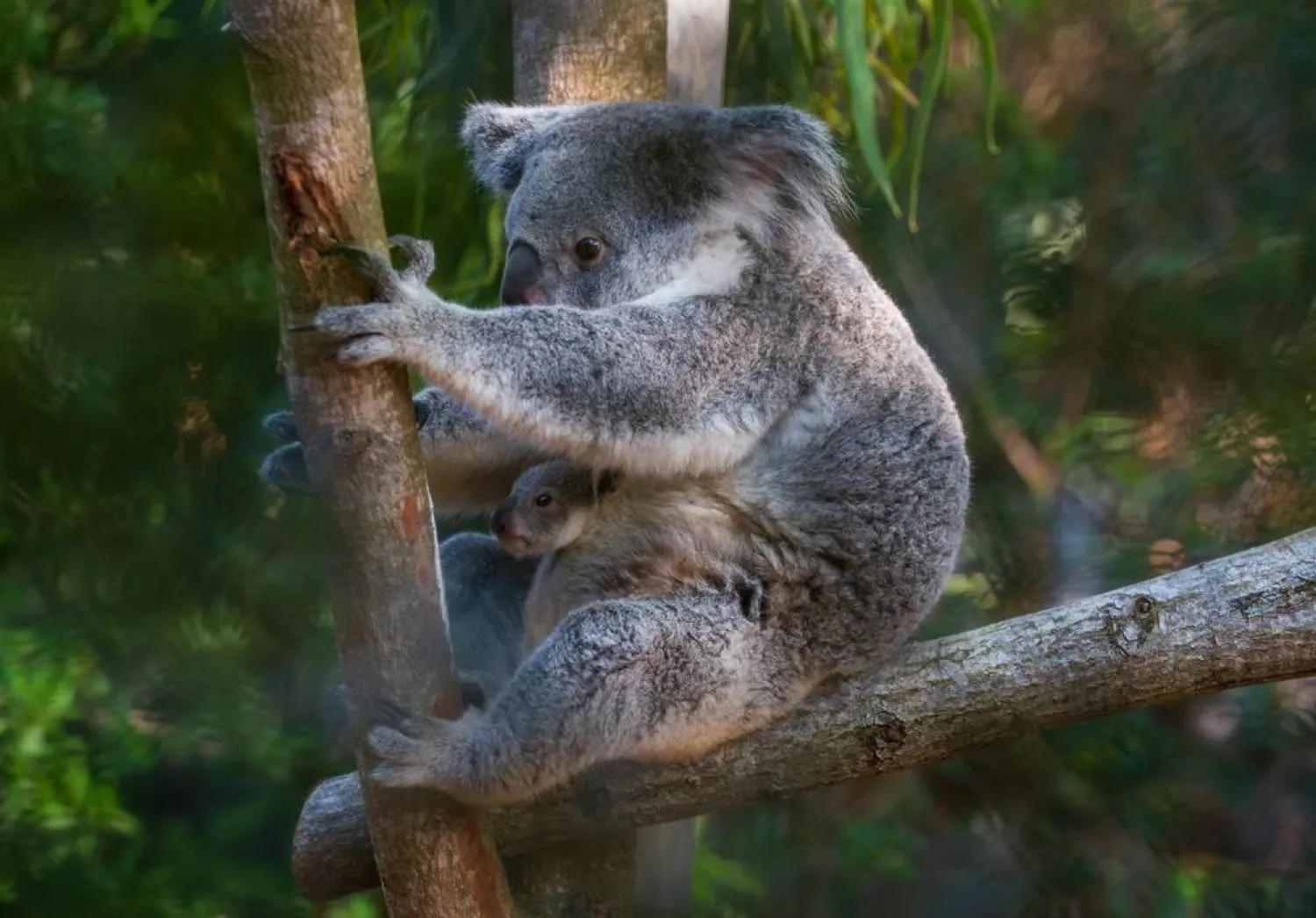
This photo provided by the Palm Beach Zoo Conservation Society Clearance shows a koala named Ellin and her newborn joey in a habitat at the Palm Beach Zoo Conservation Society in West Palm Beach, Fla., on Saturday, April 18, 2026. (John Towey/Palm Beach Zoo Conservation Society via AP)
TT

Meet the Baby Koala Hiding in Its Mom’s Pouch at a Florida Zoo’s New Outback Habitat

This photo provided by the Palm Beach Zoo Conservation Society Clearance shows a koala named Ellin and her newborn joey in a habitat at the Palm Beach Zoo Conservation Society in West Palm Beach, Fla., on Saturday, April 18, 2026. (John Towey/Palm Beach Zoo Conservation Society via AP)

A zoo in Florida has two reasons to celebrate — the first birth of a koala and a newly renovated habitat for the cuddly creatures is opening to the public on Saturday.

“For the zoo and for us here, it’s the very big deal,” said Amarylis Celestina, who oversees carnivores and koalas at the Palm Beach Zoo & Conservation Society in West Palm Beach, Florida. "We are trying the best that we can to help with a lot of the genetic diversity within the population that we have here in the United States. So that’s why it’s important that we do have a joey and that we were successful this year.”

The joey, born to Ellin and Sydney last fall, remains in its mother's pouch and has just recently started to become visible to zoo officials.

They continue to monitor Ellin's weight, and are providing extra food as she cares for the baby.

Meanwhile, the koala population is enjoying a renovated habitat, which includes more greenery, new perching for exercising, and solar tubes to bring in more natural light.

The changes bring a bit of the Australian outback to the zoo for koalas, which are an endangered species. They are able to move between their climate-controlled indoor exhibit and the expanded outdoor area.

“This new habitat is a milestone for our koalas,” Margo McKnight, the zoo's CEO and president said in a news release. “The deliberate design supports the voluntary, cooperative care our zoologists and koalas have developed together.”

Koalas in the US are on loan from the Australian federal government to help with conservation practices.

Koalas are generally peaceful, have a calm nature and enjoy a “slow” lifestyle. They like to climb and hop between the trees in the habitat.

The renovations are designed to help koalas express their natural behaviors, zoo officials said.


African Ants at the Center of International Smuggling … Queen Sold for Over $1,000

Ants become the center of an international smuggling trade (AFP) 
TT

African Ants at the Center of International Smuggling … Queen Sold for Over $1,000

Ants become the center of an international smuggling trade (AFP) 

Kenyan ant expert Dino Martins gushes over the red and black insects that have become the center of an international smuggling trade.

Martins has been visiting the network of nests of these Giant African Harvester Ants outside Nairobi for 40 years.

“They're big and bold... They're the tigers of the ant world,” the entomologist told AFP.

“Each nest here has just one queen and she is the mother who founded this nest 40, 50 or even 60 years ago,” he said.

Martins was shocked when he learned that thousands of queens from this Messor cephalotes species were being harvested and shipped abroad in syringes and test tubes to be sold for hundreds of dollars each.

The trade came to light in Kenya last year when two Belgian teenagers were arrested in possession of nearly 5,000 queen ants, and accused of “biopiracy.”

Kenyan authorities fear a new form of poaching, focused less on ivory and furs, and more on insects, reptiles and rare plants.

The judge even compared it to the slave trade.

“Imagine being violently removed from your home and packed into a container with many others like you... It almost sounds as if the reference above is to the slave trade,” he said in his ruling.

The Belgians were handed a fine of around $8,000, but as more cases have emerged, sentences have hardened: last month a Chinese national was sentenced to one year in prison for attempting to traffic 2,000 ants.

On several European websites, the queens go for around 200 euros ($230).

Colonies can take 20-30 years to produce new queens. They provide all manner of services to the ecosystem: dispersing grass seeds, aerating the soil, and providing food for animals like pangolins.

Martins also considers the smuggling trade unethical simply because “ants have feelings.”

The trade “exploded” with the arrival of the internet, said Jerome Gippet, a researcher at the Swiss University of Fribourg.

Formerly the interest of a few passionate individuals, it eventually gave way to sophisticated networks of collectors, intermediaries and smugglers.

A study Gippet published in 2017 found more than 500 ant species -- a third of the total -- were sold online. More than 10% were potentially invasive with uncertain impacts on foreign ecosystems.

“I'm not advocating for a ban on the ant trade. It's very useful in educational terms, in terms of reconnecting with nature, or simply providing enjoyment... But it has to be done responsibly,” he said.


Jackson Pollock Work Sells for $181 Mn

American painter Jackson Pollock at his studio in East Hampton, N.Y., in 1953. (Archive via Getty Images)
TT

Jackson Pollock Work Sells for $181 Mn

American painter Jackson Pollock at his studio in East Hampton, N.Y., in 1953. (Archive via Getty Images)

A Jackson Pollock painting sold for a record $181.2 million on Monday at Christie's in New York, leading a blockbuster day at the auction house.

With its black drips of paint accented by touches of red on a huge canvas spanning over three meters (nine feet), Pollock's "Number 7A, 1948" sold for $181.2 million, including fees.

According to ARTnews, the sale makes it the fourth most expensive work ever sold at auction.

The previous auction record for the abstract expressionist painter was $61.2 million, set in 2021. Other works by him have been sold privately for up to $200 million.

"It is with this work that Pollock finally frees himself from the shackles of conventional easel painting and produces one of the first truly abstract paintings in the history of art," Christie's said in a statement.

"Danaide," a bronze head sculpted around 1913 by Romanian-born artist Constantin Brancusi, sold for $107.6 million, topping its previous record of $71.2 million set in 2018.

"No. 15 (Two Greens and Red Stripe)" by American painter Mark Rothko sold for $98.4 million, while Catalan artist Joan Miro's "Portrait of Madame K." was bought for $53.5 million.

The sales smashed previous records for Rothko ($86.9 million) and Miro ($37 million) set in 2012.

Monday's eye-watering auction follows a string of records set at Sotheby's in November last year.

Austrian master Gustav Klimt's "Portrait of Elisabeth Lederer", which he painted between 1914 and 1916, sold for $236.4 million, becoming the second most expensive work ever sold at auction.

"The Dream (The Bed)" (1940), a self-portrait by Mexican artist Frida Kahlo, sold for $54.7 million, setting a record for the price of a painting by a woman.

The most expensive painting ever sold at auction remains the "Salvator Mundi," (Savior of the World), a Renaissance work attributed to Leonardo da Vinci, which was bought for $450 million in 2017.


EU-China Spacecraft Takes off on Mission to Probe Solar Winds

The SMILE spacecraft is prepared for launch in Kourou, French Guiana. (ESA/AFP)
TT

EU-China Spacecraft Takes off on Mission to Probe Solar Winds

The SMILE spacecraft is prepared for launch in Kourou, French Guiana. (ESA/AFP)

A joint European-Chinese spacecraft blasted off into orbit Tuesday to investigate what happens when extreme winds and giant explosions of plasma shot out from the Sun slam into Earth's magnetic shield.

Particularly fierce solar storms can knock out satellites, threaten astronauts -- and create dazzling auroras in the skies known as the northern or southern lights.

To find out more about this little-understood space weather, the van-sized SMILE spacecraft is tasked with making the first-ever X-ray observations of the Earth's magnetic field.

The spacecraft achieved lift-off on a Vega-C rocket at 0352 GMT on Tuesday from Europe's spaceport in Kourou, French Guiana, on the northeastern coast of South America.

Fifty-five minutes later, SMILE detached at 700 kilometers (435 miles) of altitude to make its own way onwards to an extremely elliptical orbit thousands of kilometers above the surface of our planet.

SMILE will be at an altitude of 5,000 kilometers when it flies over the South Pole, allowing it to transmit data to the Bernardo O'Higgins research station in Antarctica.

But the spacecraft will be 121,000 kilometers above the Earth when it swings over the North Pole -- an orbit which the European Space Agency (ESA) says will allow the mission to "observe the northern lights non-stop for 45 hours at a time for the first time ever".

SMILE -- or the Solar Wind Magnetosphere Ionosphere Link Explorer -- is a joint mission between the ESA and the Chinese Academy of Sciences.

- Dazzling auroras -

Solar wind is a stream of charged particles shot out from the Sun.

Sometimes this wind is kicked up into a huge storm by massive eruptions of plasma called coronal mass ejections. Hurtling at around two million kilometers an hour, these powerful blasts take a day or two to reach the Earth.

When they arrive, the Earth's magnetic field acts as a shield, deflecting most of the charged particles.

However, during particularly intense events, some particles can penetrate our atmosphere, where they have the potential to take out power grids or communication networks.

During the worst geomagnetic storm on record, in 1859, bright auroras were seen as far south as Panama -- and telegraph operators around the world were given electric shocks.

Solar winds can now also pose a danger to satellites orbiting the Earth, as well as astronauts sheltering inside space stations.

Given these threats, scientists want to learn more about space weather, so the world can better forecast and prepare for big blasts in the future.

To help with this endeavor, the SMILE mission plans to detect the X-rays emitted when charged particles from the Sun interact with the neutral particles of the Earth's upper atmosphere.

SMILE is expected to start collecting data just an hour after it is put into orbit.

The mission is designed to run for three years, but could be extended if all goes well.

Lift-off was originally planned for April 9, but was postponed due to a technical issue.