
Inside the World’s Largest Art Heist When over $500M of Paintings Were Stolen from a Boston Museum

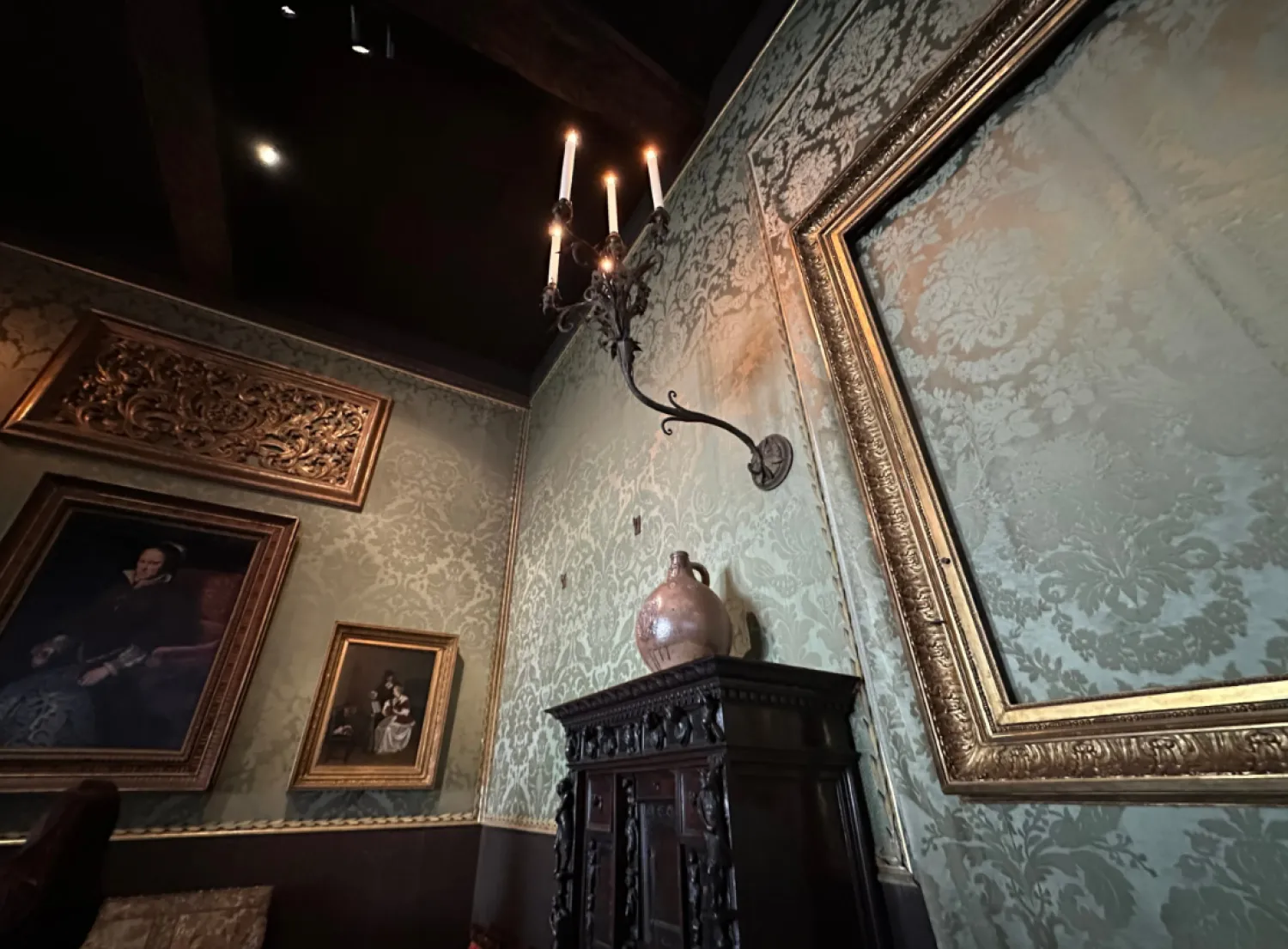
 An empty frame hangs on patterned green walls in the Dutch Room at the Isabella Stewart Gardner Museum, where artworks were stolen in a 1990 art heist, April 9, 2026, in Boston. (AP Photo/Leah Willingham)
An empty frame hangs on patterned green walls in the Dutch Room at the Isabella Stewart Gardner Museum, where artworks were stolen in a 1990 art heist, April 9, 2026, in Boston. (AP Photo/Leah Willingham)
TT

Inside the World’s Largest Art Heist When over $500M of Paintings Were Stolen from a Boston Museum

 An empty frame hangs on patterned green walls in the Dutch Room at the Isabella Stewart Gardner Museum, where artworks were stolen in a 1990 art heist, April 9, 2026, in Boston. (AP Photo/Leah Willingham)
An empty frame hangs on patterned green walls in the Dutch Room at the Isabella Stewart Gardner Museum, where artworks were stolen in a 1990 art heist, April 9, 2026, in Boston. (AP Photo/Leah Willingham)

For decades, the 1990 theft of 13 artworks from the Isabella Stewart Gardner Museum — now valued at more than $500 million — has remained unsolved.

It remains the largest art theft in history — far surpassing more recent museum thefts, including a daylight heist at the Louvre that involved far fewer works and was resolved more quickly. In 2013, the FBI said it knew who was responsible for the Boston museum heist but declined to name them, fueling speculation that persists today.

A former FBI agent who led the investigation for more than two decades is now offering the first detailed account of how investigators reached that conclusion — and publicly identifying the men he believes were involved. In a new book, Geoff Kelly traces how the artworks moved through criminal networks, where violence took the lives of key suspects and witnesses, and challenges long-circulating theories by revisiting key details.

The irony at the center is that Gardner’s intention was for the museum to remain frozen in time, stipulating in her will that nothing in the Venetian palazzo-inspired building would be changed after her death. Gardner, who lived in the museum and died there in 1924, intended for the paintings, sculptures and architectural fragments to remain exactly as she had arranged.

The empty gilded frames of the missing paintings still hang in the museum today — silent witnesses to what was taken.

The art heist Early on March 18, 1990, as Boston wound down from St. Patrick’s Day celebrations, two men dressed as police officers arrived at the museum and convinced a security guard to let them in, violating protocol.

The men handcuffed the guards in the basement and made their way to the museum’s Dutch Room, where they cut Vermeer’s “The Concert” and Rembrandt’s “Christ in the Storm on the Sea of Galilee" from their frames, also taking works by Degas and Manet.

They also took a Napoleonic eagle finial — a decorative metal piece of comparatively little value that investigators later found puzzling — and the museum’s security videotapes.

The museum offered a $5 million reward that they then doubled a decade later for information leading to the recovery of the works.

Boston-area network of criminals Some tips pointed to the Irish Republican Army and to Boston mob figures, including notorious crime boss Whitey Bulger.

Kelly followed one lead to France, where he watched through binoculars as FBI agents, posing as wealthy intermediaries, lounged on a yacht — drinking champagne and eating strawberries — in an effort to draw out suspected Corsican mob figures.

Closer to home, agents searched houses across New England, relying heavily on informants. A triple murderer known as “Meatball” who was terminally ill secretly recorded conversations with suspected associates in hopes of earning money for his family.

But none of the tips led to the paintings.

Violence complicates matters In the decades since the robbery, several people believed to have ties to the heist were killed, and another died under suspicious circumstances.

Robert “Bobby” Donati, a Boston mob associate long suspected in the case, was found stabbed to death in 1991, his body left in the trunk of a car after his home had been ransacked.

Years earlier, Donati has visited the Gardner with another known art thief, Myles Connor, to scope it out for a robbery and said that if he ever took the museum’s Napoleonic finial, it would be his “calling card.” Years later, a jeweler told investigators Donati tried to sell a finial from the Isabella Stewart Gardner Museum but backed off, saying it was “too hot.”

A separate line of evidence centered on George Reissfelder, who investigators believe owned the getaway car.

Kelly tracked down Reissfelder’s brother, a retired military officer who had initially not believed his brother was involved. He broke down after being shown Manet’s “Chez Tortoni,” saying he recognized it as a painting he himself hung above his brother’s bed.

Reissfelder later died under suspicious circumstances. When investigators searched his home, the painting was gone.

Both men had ties to TRC Auto Electric, a Dorchester shop linked to Charles “Chuck” Merlino’s crew.

Investigation with limited resources Though investigators believed they knew who was responsible, they had a difficult time finding definitive proof.

In its early stages, the FBI assigned a single agent to the case, which Kelly said slowed progress.

“You have to keep in mind when you’re talking about investigations, they come down to dollars and cents,” Kelly said. It was “like pulling teeth” to secure resources. At the time, federal investigators in Boston were heavily focused on violent crime, drug trafficking and organized crime cases.

Kelly said a decision to release surveillance footage despite investigators’ objections became a lasting distraction. With no usable video from the night of the robbery, prosecutors released footage from the night before that showed a museum employee entering the building after his car broke down. Kelly said he objected to the theory that the employee was casing the museum, since that possibility had already been reviewed and dismissed. The footage fueled years of misplaced suspicion, since the man was later determined not to be involved.

Theories about an inside job at the museum Among the questions that linger is whether it was an inside job.

In photos from that night, a museum guard is seen handcuffed in the basement, his head wrapped in duct tape.

Investigators noted that shortly before the robbery, the guard opened a door against policy — one that faced the area where the thieves were later seen waiting — a move investigators considered highly unusual and suspicious.

“It’s the immutable laws of time and space,” Kelly said. “I think that there was enough information back then that he could have been charged. Would it be enough to convict him? I don’t know.”

By the time investigators examined those questions more closely, Kelly said, the statute of limitations had expired, leaving them with little leverage to compel cooperation.

The museum guard, Rick Abath, denied any involvement in the theft. He died in 2024.

The artworks that disappeared Kelly personifies the missing artworks and describes them as “perfect fugitives.”

“They don’t go to the doctor. They don’t get stopped for speeding. They don’t leave fingerprints,” he said. “They can just disappear.”

Unlike human fugitives, he said, artworks can also be copied.

Over the years, that has meant chasing down false leads — including paintings spotted in a Reno antique market, hanging in private homes and even one that appeared in an episode of the TV show “Monk.”

Because the works are so recognizable, it's nearly impossible to sell them publicly.

“Stealing the artwork from the museum, that’s the easy part,” Kelly said. “Profiting from it, that’s the difficult part.”

He imagines the paintings will surface one day — outliving those who carried out the heist.

“I have no doubt they still exist,” he said



‘Fingerprints’ of Black Hole’s Event Horizon Detected for First Time

An actual image of the black hole where scientists looked for a ring of light, which is matter and radiation circling at extreme speeds around a region of darkness representing the black hole. (Event Horizon Telescope collaboration)
TT

‘Fingerprints’ of Black Hole’s Event Horizon Detected for First Time

An actual image of the black hole where scientists looked for a ring of light, which is matter and radiation circling at extreme speeds around a region of darkness representing the black hole. (Event Horizon Telescope collaboration)

Scientists have detected the "fingerprints" of a black hole's event horizon -- the boundary from which nothing can escape -- for the first time, according to research published on Wednesday.

The discovery was made by studying ripples in space-time called gravitational waves that were created when two black holes violently smashed into each other.

A black hole's event horizon is known as the "point of no return" because not even light can avoid being swallowed into its darkness.

This has made them incredibly difficult to learn anything about.

However, there is one event of such cataclysmic violence that it could offer a chance to glimpse this extreme phenomenon -- when two black holes merge into one.

When this cosmic death spiral occurs, it shoots gravitational waves across the universe which scientists have been detecting for the last decade.

For the new research published in Nature, an international team of researchers analyzed data from the strongest gravitational wave ever recorded, known as GW250114, detected by the LIGO observatory in January 2025.

By isolating the last burst of waves -- known as "direct waves" -- from this black hole merger, the scientists said they were able to extract information from closer to an event horizon than ever before.

"This black hole horizon concept normally appears in science fiction," lead study author Sizheng Ma of the Perimeter Institute for Theoretical Physics in Canada told AFP.

"But now we are really able to touch the region around the horizon with gravitational data," he added.

"Sometimes I cannot believe this is really happening."

- Causing a stir -

The last stage of two black holes merging is like a spoon stirring a glass of water, Sizheng Ma explained.

The resulting swirl in space creates the ripple of gravitational waves that travel at the speed of light in all directions.

If the metaphorical spoon is stirring close enough to the black hole's event horizon, "this offers us a chance to decode the physics around that region", Sizheng Ma said.

By supporting the theory of general relativity, the results "proved that Einstein was correct again," he added.

The scientists emphasized that more research was needed to decipher what can be gleaned about event horizons using this method.

But they did detect information about how black holes twist space around themselves as they rotate -- a phenomenon known as "frame dragging".

"This is similar to pushing a glass into a table and twisting it, so that the tablecloth winds up around it," Maximiliano Isi, a gravitational wave astrophysicist at Columbia University, told AFP.

In the future, the team of scientists hope to find signs of tiny changes known as quantum fluctuation.

"In this way, we can really probe this near horizon region to look for a new physics," including searching for a deviation from general relativity, Sizheng Ma said.

- Reaction mixed -

Experts not involved in the study urged caution.

Francesco Sannino, an Italian theoretical physicist who studies black holes, told AFP it was "compelling analysis" but needed to be checked by other researchers.

Still, it was "striking" that the scientists were able to show that gravitational waves carried the event horizon's "fingerprints," he said.

The astrophysicist Isi described the work as "tantalizing".

"More generally, understanding the physics of black holes and their mergers is important as it might shed light on how space and time are woven together at a more fundamental level," he told AFP.

Sean McWilliams, an astrophysicist at West Virginia University, was skeptical that the gravitational wave frequency analyzed by the scientists was actually "dictated" by the event horizon.

For this reason, "the actual observed signal doesn't really tell us anything about the horizon or the other properties directly related to it", he told AFP.

Sizheng Ma said McWilliams's statement was "not correct," suggesting he had conflated two different aspects in the paper.

"There is often considerable resistance and criticism in the early stages of promoting a new concept," he said, adding he is working on another paper to "clarify these confusions and possible misinterpretations".


Asteroid Zooming Past Earth on Saturday Visible to Stargazers

FILE PHOTO: A nighttime view of Earth, derived from satellite images taken daily over the past decade, capturing human activity on the planet through the emissions of artificial light, is seen in this image released on April 8, 2026. Michala Garrison/NASA Earth Observatory/Handout via REUTERS
TT

Asteroid Zooming Past Earth on Saturday Visible to Stargazers

FILE PHOTO: A nighttime view of Earth, derived from satellite images taken daily over the past decade, capturing human activity on the planet through the emissions of artificial light, is seen in this image released on April 8, 2026. Michala Garrison/NASA Earth Observatory/Handout via REUTERS

A large asteroid that will zoom harmlessly past Earth on Saturday will be visible to stargazers using a small telescope or large binoculars, the European Space Agency announced Wednesday.

The asteroid will come within 2,560,000 kilometers of Earth at 1114 GMT on Saturday, which is more than six times the distance between the Earth and the Moon.

Called (152637) 1997 NC1, the asteroid will be speeding along at nearly nine kilometers a second, posing no threat to Earth as any chance of an impact has been ruled out.

Discovered in 1997, the asteroid is estimated to be between 750 and 1,650 meters wide, according to calculations based on how much sunlight it reflects.

However other estimates suggest it could be smaller, AFP quoted the ESA as saying in a statement.

"A close approach to Earth by an object this size only occurs every few years, although this time the bright nearby Moon might impede its observability at closest approach," Juan Luis Cano of the ESA's Planetary Defense Office said in a statement.

For stargazers with telescopes or binoculars, the asteroid will be visible in parts of the Northern Hemisphere as it approaches, almost everywhere as it speeds past Earth, and only from the Southern Hemisphere as it departs.

But this depends if people are in areas of the world where the sky is dark enough as it passes.


Think Tank: Singapore, Indonesia, Malaysia and Brunei Face High Risk of Severe Haze this Year

People stop by a cafe with murals painted on its facade in the Arab Street district of Singapore on June 16, 2026. (Photo by Roslan RAHMAN / AFP)
TT

Think Tank: Singapore, Indonesia, Malaysia and Brunei Face High Risk of Severe Haze this Year

People stop by a cafe with murals painted on its facade in the Arab Street district of Singapore on June 16, 2026. (Photo by Roslan RAHMAN / AFP)

Singapore, Indonesia, Malaysia and Brunei face a high risk of severe haze this year due to hot and dry weather conditions, biofuel demand and economic pressures, a research institute said Wednesday.

The Singapore Institute of International Affairs said it was the second time it had issued a red risk rating since launching its Haze Outlook report in 2019. The previous red risk rating was in ⁠2023, Reuters reported.

Here are some ⁠details:

August to September is the peak danger period for haze in the Southeast Asian region, driven by the El Niño and Indian Ocean Dipole weather phenomena, the report said.

The ⁠return of El Niño is expected to create a longer and stronger dry season at a time when fire preparedness could be adversely affected by economic uncertainty and cost pressures.

The SIIA said rising costs of fertilizer and fuel as a result of the Iran war could lead to unsustainable activity such as the use ⁠of ⁠fire rather than machinery to clear land and dispose of waste.

Land use could also intensify as demand for biofuels rises due to energy supply disruptions.

"This trend will continue even if the US-Iran agreement holds, as countries now want energy independence," said SIIA associate director Khor Yu-Leng.

ASEAN cooperation and sustainable land management will be critical to reducing risks, the report said.