


Researchers: Tropical Forest Loss Eases After Record Year

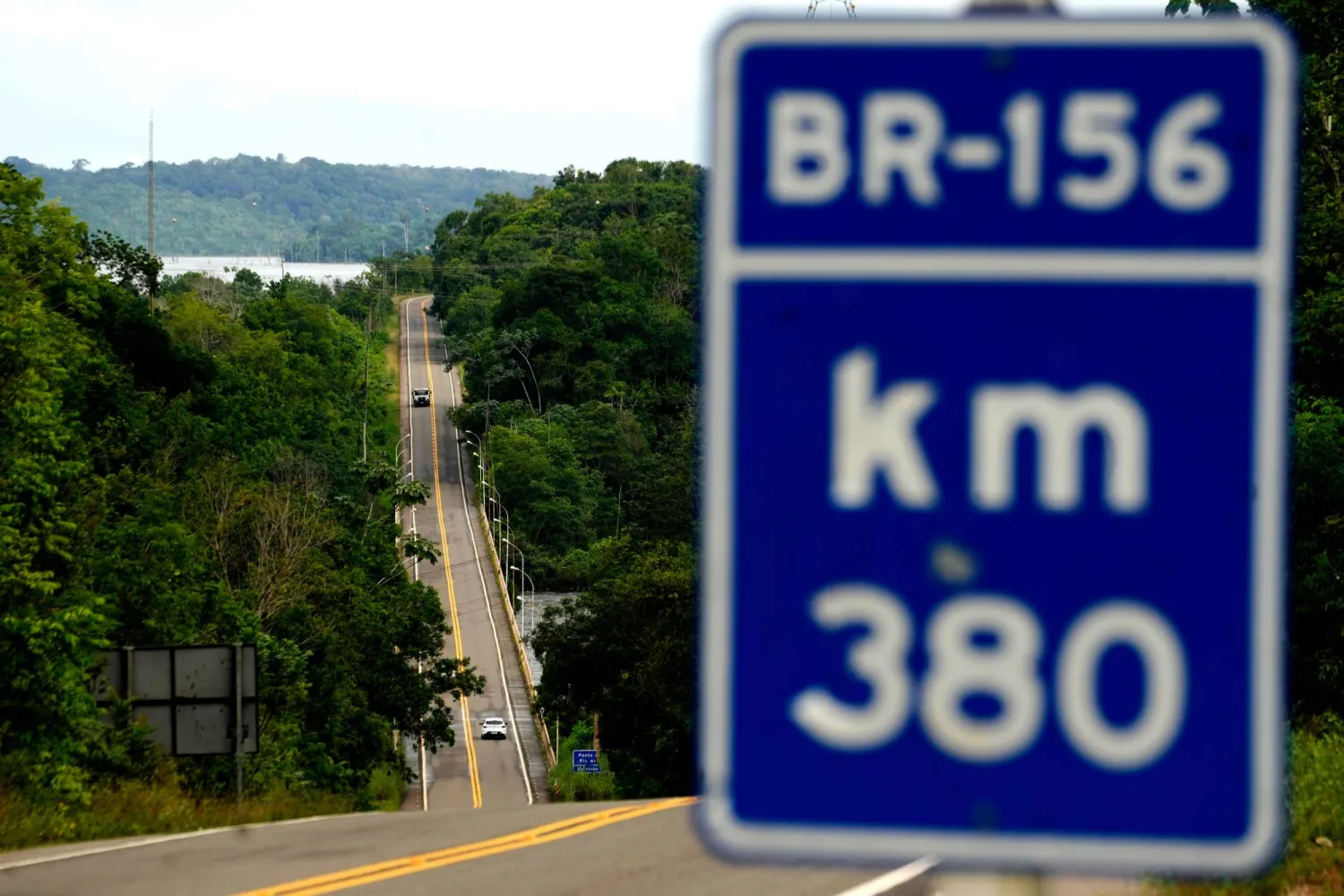
Vehicles drive on a fully paved section of BR-156 highway that connects the state capital Macapa with the city of Oiapoque, Amapa state, Brazil, Monday, March 9, 2026. (AP Photo/Eraldo Peres)
TT

Researchers: Tropical Forest Loss Eases After Record Year

Vehicles drive on a fully paved section of BR-156 highway that connects the state capital Macapa with the city of Oiapoque, Amapa state, Brazil, Monday, March 9, 2026. (AP Photo/Eraldo Peres)

The pace of tropical forest destruction slowed in 2025 after record losses the year before but remained at worrying levels equivalent to 11 football fields per minute, researchers said Wednesday.

The world lost 4.3 million hectares (10.6 million acres) of tropical primary rainforest last year -- down 36 percent from 2024, said researchers from the World Resources Institute (WRI) and the University of Maryland.

"A drop of this scale in a single year is encouraging -- it shows what decisive government action can achieve," said Elizabeth Goldman, co-director of WRI's Global Forest Watch platform.

"But part of the decline reflects a lull after an extreme fire year," Goldman said.

The researchers also warned that fires fueled by climate change have become a "dangerous new normal" which threatens to reverse the recent gains made by government efforts to tackle deforestation.

The warming El Nino weather phenomenon is expected to return in the middle of the year, which could push global temperatures even higher, raising the threat of heatwaves, droughts and wildfires.

The researchers, who used satellite data for their report, noted that last year's forest loss was still significant -- about the size of Denmark and 46 percent higher than a decade ago.

Despite last year's progress, global forest loss remains 70 percent above the level required to meet the 2030 goal of halting and reversing forest loss, the researchers said.

"A good year is a good year, but you need good years forever if you're going to conserve, for example, the tropical rainforest," Matthew Hansen, director of the GLAD Lab at the University of Maryland, said in a media briefing.

Much of last year's slowdown was due to sharp declines in Brazil, home to the biggest rainforest in the world.

Brazil's forest loss, excluding fires, was 41 percent lower than in 2024 -- its lowest rate on record.

"Brazil's declines are associated with stronger environmental policies and enforcement since President Lula took office in 2023," Goldman said in a news briefing, referring to Brazilian leader Luiz Inacio Lula da Silva.

Lula relaunched an anti-deforestation action plan and increased penalties for environmental crimes, AFP quoted her as saying.

But the country's forests are still threatened by agriculture, which remains the largest driver of forest loss to make room for soy fields and cattle ranches.

Some states in the Amazon have passed legislation to weaken environmental protections, the researchers said.

"Several countries showed that strong policy action can reduce forest loss quickly," Goldman said.

Forest loss in neighboring Colombia fell 17 percent, the second lowest year on record since 2016, thanks to government policies and agreements limiting forest clearing.

Government policies also helped to limit forest loss in Indonesia, where it increased by 14 percent but was well below the highs seen a decade ago.

In Malaysia, government efforts have helped to stabilize forest loss in the country.

Tropical forest loss remained high in other parts of the world, including in Bolivia, the Democratic Republic of Congo, Cameroon and Madagascar, the researchers said.

Global tree cover loss fell by 14 percent last year.

While agricultural expansion is still the leading driver of tree cover loss across the tropics, fires played a major role worldwide, accounting for 42 percent of the destruction.

"For the past three years, fires burned more than twice as much tree cover as they did two decades ago," Goldman said.

While humans cause most fires in the tropics, climate change is intensifying natural fire cycles in northern and temperate regions, the researchers said.

Canada had its second-worst fire year on record last year as wildfires tore through 5.3 million hectares of forest.

"Climate change and land clearing have shortened the fuse on global forest fires," Hansen said. "They are turning seasonal disturbances into a near-permanent state of emergency."




Peru Police Disguised as World Cup Mascots Arrest a Suspected Drug Dealer in Lima

 Mascots of the World Cup, Maple the Moose (L), Zayu the Jaguar (C) and Clutch the Bald Eagle pose for a picture ahead of the 2026 World Cup Group A football match between South Korea and the Czech Republic at the Guadalajara Stadium in Zapopan on June 11, 2026. (AFP)
Mascots of the World Cup, Maple the Moose (L), Zayu the Jaguar (C) and Clutch the Bald Eagle pose for a picture ahead of the 2026 World Cup Group A football match between South Korea and the Czech Republic at the Guadalajara Stadium in Zapopan on June 11, 2026. (AFP)
TT

Peru Police Disguised as World Cup Mascots Arrest a Suspected Drug Dealer in Lima

 Mascots of the World Cup, Maple the Moose (L), Zayu the Jaguar (C) and Clutch the Bald Eagle pose for a picture ahead of the 2026 World Cup Group A football match between South Korea and the Czech Republic at the Guadalajara Stadium in Zapopan on June 11, 2026. (AFP)
Mascots of the World Cup, Maple the Moose (L), Zayu the Jaguar (C) and Clutch the Bald Eagle pose for a picture ahead of the 2026 World Cup Group A football match between South Korea and the Czech Republic at the Guadalajara Stadium in Zapopan on June 11, 2026. (AFP)

Two Peruvian police officers disguised as World Cup mascots Clutch and Maple helped to arrest a suspected drug dealer in Lima.

Colonel Carlos Alcántara, head of the Green Squadron —a unit that combats common crime — said they captured Carlos Cabrera, 48, with the help of the two undercover agents on Thursday during the opening match of the World Cup between Mexico and South Africa.

“Thanks to intelligence work, we realized that this person was a diehard football fan and was caught up in World Cup fever," Alcántara said. "Therefore, we decided to disguise personnel as World Cup mascots so we could approach him without raising suspicion and apprehend him.”

The officers as mascots used a metal sledgehammer to break down a door to enter with colleagues.

For the World Cup, Clutch is a bald eagle representing the United States, while Maple is a moose representing Canada. México is symbolized by a jaguar named Zayu.

Police said 2,524 packets of cocaine base and a gun were found during the operation. In Peru, the micro-trafficking of drugs is punishable by three to seven years in prison when a person is found with five to 50 grams of cocaine base.

In previous operations, Peruvian police have disguised themselves as other fictional movie characters such as the Grinch, Freddy Krueger, Deadpool and Wolverine and even Santa Claus to approach those they are going to arrest without arousing suspicion.


England Hit by Training Kit Theft Ahead of Kansas City Arrival

Football - FIFA World Cup 2026 - England Training - Gardens North County District Park, Palm Beach Gardens, Florida, US - June 9, 2026 England's Jude Bellingham, Reece James and Kobbie Mainoo during training. (Reuters)
TT

England Hit by Training Kit Theft Ahead of Kansas City Arrival

Football - FIFA World Cup 2026 - England Training - Gardens North County District Park, Palm Beach Gardens, Florida, US - June 9, 2026 England's Jude Bellingham, Reece James and Kobbie Mainoo during training. (Reuters)

England have ‌suffered a theft of training equipment ahead of their arrival in Kansas City, local police said, after a vehicle transporting the gear to their World Cup base was broken into.

The incident occurred while equipment was ‌being transferred ‌from England's pre-tournament ‌base ⁠in Florida to ⁠Swope Soccer Village, where it was due to be in place before the squad begin training after their arrival in Kansas City ⁠on Saturday.

"We are investigating ‌a ‌possible theft of equipment from a ‌team vehicle that arrived ‌in Kansas City with items missing this evening," police said.

"The investigation is ongoing. Two subjects ‌of interest were taken into custody pending further investigation."

Balls ⁠and ⁠boots were among the items believed to have been stolen, according to British media reports.

Reuters has contacted the Football Association for comment.

The theft could affect England's preparations for their World Cup opener against Croatia on Wednesday in Dallas.


Woman Critically Injured in Shark Attack off Sydney’s Coogee Beach

 Lifeguards erect a sign that says "Beach Closed" following a shark attack at Coogee Beach in Sydney, Australia, June 13, 2026. (Reuters)
Lifeguards erect a sign that says "Beach Closed" following a shark attack at Coogee Beach in Sydney, Australia, June 13, 2026. (Reuters)
TT

Woman Critically Injured in Shark Attack off Sydney’s Coogee Beach

 Lifeguards erect a sign that says "Beach Closed" following a shark attack at Coogee Beach in Sydney, Australia, June 13, 2026. (Reuters)
Lifeguards erect a sign that says "Beach Closed" following a shark attack at Coogee Beach in Sydney, Australia, June 13, 2026. (Reuters)

A woman was critically injured off a popular Sydney beach on Saturday in the latest in a spate of shark attacks in Australia.

The woman, believed to be in her 30s, suffered serious leg and arm injuries in the attack at 11:15 a.m. off Coogee Beach, a police statement said.

Three spearfishing divers have been killed by sharks off the Australian coast since May 16, bringing the total of fatalities in the nation this year to four.

Australia has averaged between two and three fatal shark attacks a year since 2000, according to the Australian Shark Incident Database, a partnership of the Taronga Conservation Society Australia, Flinders University and the New South Wales state government.

On Saturday, police said the victim was attacked while swimming. Bystanders pulled her from the water and commenced first aid on the beach before paramedics arrived, the statement said.

The victim was taken to a rugby field near the beach from where she was flown by helicopter to a hospital. Police described her condition as critical.

Last Saturday, a 4.5-meter (15-foot) white shark killed Daniel Turpin, 35, as he was spearfishing with family off Michaelmas Island near the port city of Albany in Western Australia state.

On May 24, 39-year-old spearfishing diver Michael Jensz suffered fatal head injuries in an attack on the Great Barrier Reef off Australia’s northeast coast. Bull sharks had been seen in the vicinity.

A week earlier, on May 16, a four-meter (13-foot) white shark fatally mauled 38-year-old spearfishing diver Steve Mattabonni off the coast of Perth, Western Australia.

Australia’s other fatal shark attack this year occurred in January, when a 12-year-old boy died in a hospital days after he was mauled by a bull shark in Sydney Harbor.

Last year, Australia recorded five fatal shark attacks. Attacks in Australia have become more common over the decades as the population has grown and activities such as surfing and scuba diving have gained in popularity.
