
US Company Aims to Resurrect Bluebuck Antelope that was Hunted to Extinction

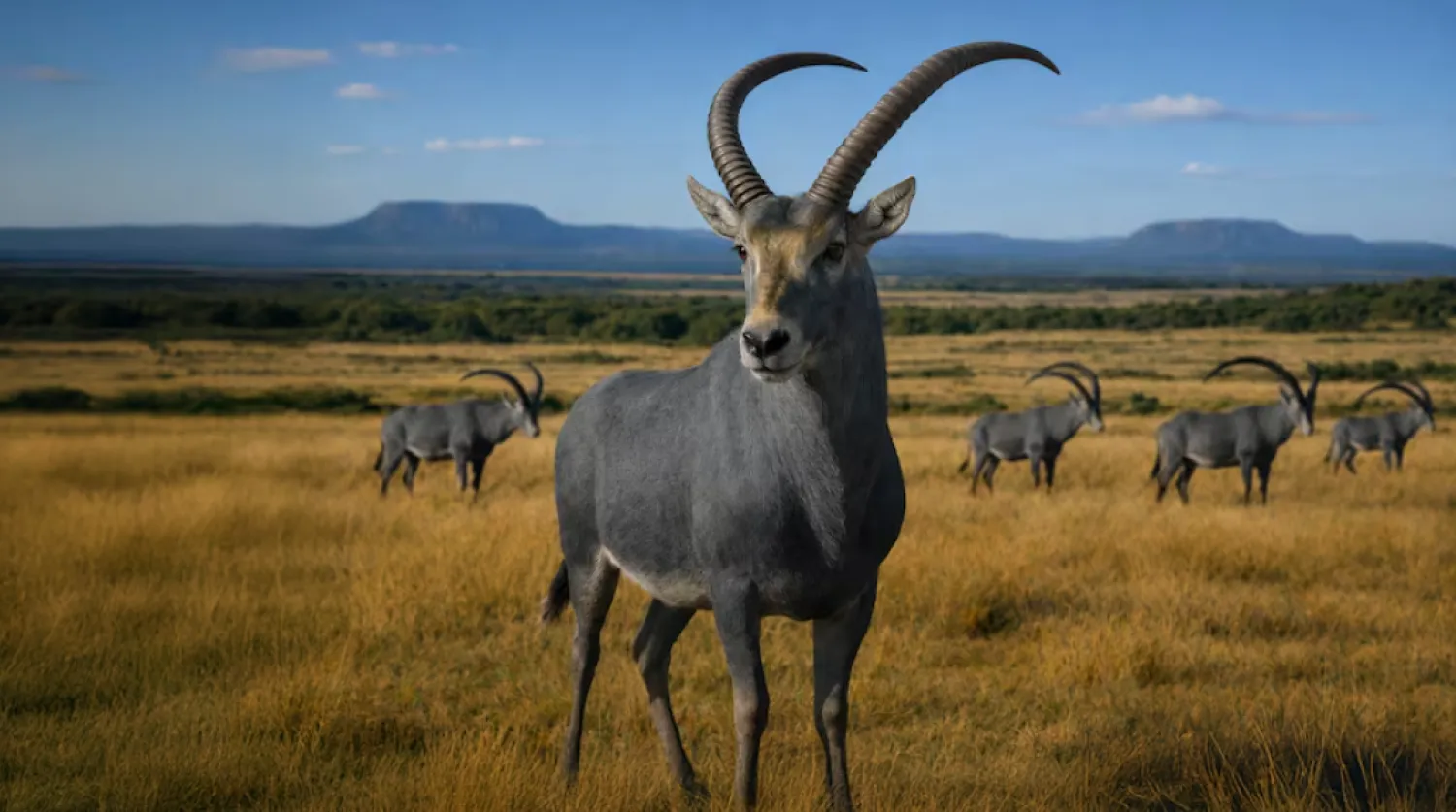
An artist's rendering of the extinct African antelope species called the Bluebuck, released on April 30, 2026. Colossal Biosciences/Handout via REUTERS
TT

US Company Aims to Resurrect Bluebuck Antelope that was Hunted to Extinction

An artist's rendering of the extinct African antelope species called the Bluebuck, released on April 30, 2026. Colossal Biosciences/Handout via REUTERS

The bluebuck, an antelope with a silvery slate-blue coat and striking horns, inhabited the coastal grasslands of South Africa's southwestern Cape region until European settlers hunted it to extinction in around 1800. A US company now plans to resurrect the bluebuck as part of its de-extinction efforts.

Dallas-based Colossal Biosciences announced on Thursday that it has made the bluebuck the sixth species in its de-extinction portfolio based on genetic engineering, alongside three other mammals - the dire wolf, woolly mammoth and thylacine, also called the Tasmanian tiger - and two birds, the dodo and moa, Reuters reported.

"We're two years into the bluebuck project and have already completed several foundational steps," Colossal CEO and co-founder Ben Lamm told Reuters. "We are equally excited about how our technology can help living antelopes today. About a third of the world's roughly 90 antelope species are threatened or near-threatened."

Prized for the unique color of their hides, bluebuck were hunted to extinction just 34 years after the species was first documented scientifically. The animal stood about four feet (1.2 meters) tall at the shoulder, with backward-curving and ringed black horns reaching about 22 inches (56.5 cm) long, and was smaller than the closely related roan and sable antelopes.

"Humans did this. European settlers shot the bluebuck out of the Cape in under 34 years. There's no ambiguity about the cause and there's no ambiguity about the responsibility. If we have the capability to right that wrong, I think we have an obligation to," Lamm said.

The company in April 2025 announced the birth of three genetically engineered wolf pups created with the help of ancient DNA obtained from fossilized remains of dire wolves, an Ice Age predator that went extinct roughly 13,000 years ago. The process used to create them involved editing the genes of the gray wolf, the closest living relative of the extinct species, to add dire wolf traits, and creating an embryo.

In the case of the bluebuck, Colossal is editing the genes of an African antelope called the roan, its closest living relative.

"We are now in the genome-editing phase, where we introduce key bluebuck edits and genes into roan antelope cells," Lamm said, adding, "After finishing the various edits, the next step will be to use the edited cells to create an embryo and move toward implantation. From there, gestation would take about nine months."

The plan is for the embryo to be implanted into a surrogate roan mother. Through cloning, embryos were created from edited gray wolf cells in the dire wolf project, and these were implanted in surrogate domesticated dog mothers.

A MUSEUM SPECIMEN

Lamm said the company mainly used a mounted bluebuck skin from a young male specimen at the Swedish Museum of Natural History in Stockholm to obtain bluebuck DNA.

The team compared the bluebuck and roan genomes to understand what made the bluebuck unique, Lamm said, noting that the two species are more than 98% genomically similar. The team has created pluripotent stem cells in roan antelope - "essentially versatile 'starter cells' that can become many different cell types," Lamm said.

"We've also made breakthroughs in reproductive methods, including successfully collecting eggs from antelope species using advanced techniques," Lamm said.

Even as a growing number of species slip into oblivion due to human actions including hunting and habitat destruction, scientists have debated the ethics of attempting to resurrect extinct species.

"Honestly, I think the debate sometimes functions as a way to avoid a harder conversation, which is that conservation as currently practiced is not winning. We are losing species faster than our existing toolkit can address," Lamm said.

Colossal called the wolves it created dire wolves and referred to the species as the world's first successfully "de-extincted" animal. Some outside experts described them as genetically modified gray wolves.

"The dire wolves are doing great," Lamm said.

"The three dire wolves live on a 2,000-acre (810-hectare) secure, expansive ecological preserve that allows us to monitor and manage them while providing them a semi-wild habitat to thrive in. We hope to have more dire wolf pups by the end of the year. We will also have scientific progress announcements around the mammoth, dodo, thylacine and moa before the end of the year, but the projects are all running on track," Lamm said.



Robot Recovers Artifacts From 500-Year-Old Shipwreck

This photograph shows a screen displaying live footage of the CAMARA 4 wreck and its cargo, transmitted by the “ROV C 4000”, a remotely operated vehicle manufactured by the French company LD Travocean and designed for seabed exploration, during an archaeological mission on the CAMARA 4 wreck from the bridge of the (BSAA) Jason, off the coast of Ramatuel, in southeastern France on April 7, 2026.  (Photo by Thibaud MORITZ / AFP)
This photograph shows a screen displaying live footage of the CAMARA 4 wreck and its cargo, transmitted by the “ROV C 4000”, a remotely operated vehicle manufactured by the French company LD Travocean and designed for seabed exploration, during an archaeological mission on the CAMARA 4 wreck from the bridge of the (BSAA) Jason, off the coast of Ramatuel, in southeastern France on April 7, 2026. (Photo by Thibaud MORITZ / AFP)
TT

Robot Recovers Artifacts From 500-Year-Old Shipwreck

This photograph shows a screen displaying live footage of the CAMARA 4 wreck and its cargo, transmitted by the “ROV C 4000”, a remotely operated vehicle manufactured by the French company LD Travocean and designed for seabed exploration, during an archaeological mission on the CAMARA 4 wreck from the bridge of the (BSAA) Jason, off the coast of Ramatuel, in southeastern France on April 7, 2026.  (Photo by Thibaud MORITZ / AFP)
This photograph shows a screen displaying live footage of the CAMARA 4 wreck and its cargo, transmitted by the “ROV C 4000”, a remotely operated vehicle manufactured by the French company LD Travocean and designed for seabed exploration, during an archaeological mission on the CAMARA 4 wreck from the bridge of the (BSAA) Jason, off the coast of Ramatuel, in southeastern France on April 7, 2026. (Photo by Thibaud MORITZ / AFP)

Deep in the Mediterranean Sea off the French coast, the pincer of a remotely guided underwater robot closed around a centuries-old jug resting near the wreck of a 16th-century merchant ship.

A French navy officer identified only as Sebastien, who did not disclose his full identity for security reasons, said handling the site requires extreme precision to avoid damaging the wreck or stirring up sediment that could impair visibility.

According to CBS News, Sebastien is overseeing the first mission in a series of archaeological explorations at what is considered the deepest shipwreck in French territorial waters, located about two hours from the French Riviera.

The shipwreck was discovered by chance last year during a routine military seabed survey off Ramatuelle, near Saint-Tropez. Archaeologists believe the vessel was sailing from northern Italy, carrying ceramics and metal ingots, before sinking.

The French navy has now returned, in cooperation with the culture ministry’s underwater archaeology department, to examine artifacts preserved at a depth of more than 1.5 miles below the surface.

This photograph shows an underwater stereoscopic photogrammetry camera on the articulated arm of the “ROV C 4000,” a remotely operated vehicle manufactured by the French company LD Travocean and designed for seabed exploration, on the deck of the (BSAA) Jason, chartered for an archaeological mission on the wreck of the CAMARA 4 off the coast of Ramatuel, in southeastern France on April 7, 2026. (Photo by Thibaud MORITZ / AFP)

Cannons and Ceramic Jugs on the Seabed

The navy is keeping the wreck’s location confidential, referring to it as “Camarat 4,” despite the fact that reaching it requires advanced technical capabilities due to its depth.

At dawn, a mission vessel arrived at the site carrying a remotely operated underwater robot, along with two large containers serving as field laboratories for marine archaeologists.

The robot, equipped with cameras and claw-like arms, was lowered into the depths via a long cable, while experts monitored its movements on screens.

After about an hour, it began gliding over piles of rounded ceramic jugs scattered across the seabed.

Images transmitted to the surface revealed details of the wreck, including cannons alongside hundreds of jugs and plates decorated with plant motifs, crosses and fish shapes.

The robot captured eight images per second over three hours, enabling the collection of more than 86,000 images, later used to produce a precise three-dimensional model of the site.

Archaeologist Franca Cibecchini said the clarity at that depth was striking: “It was excellent, something you wouldn’t imagine at this depth.” She added that the ship was likely a merchant vessel carrying glazed ceramics from Liguria in northwestern Italy, possibly loaded in the ports of Genoa or Savona.

Earlier surveys had identified two cauldrons, an anchor and six cannons at the site, along with modern debris such as a drinks can and an empty yogurt container visible near the anchor.

Pilots specializing in underwater robots from the French Navy, along with researchers, watch live feeds on screens showing the “ROV C 4000,” a remotely operated vehicle manufactured by the French company LD Travocean and designed for seabed exploration, during an archaeological mission on the wreck of the CAMARA 4 from the bridge of the (BSAA) Jason, off the coast of Ramatuel, in southeastern France, April 7, 2026. (Photo by Thibaud MORITZ / AFP)

Recovering One of the Deepest Finds

Marine Sadania, head of the excavation team, said the findings represent an important source for understanding 16th-century maritime trade, given the limited detailed historical records available.

During the recovery operation, the team carefully guided the robot as it lowered its arm to gently lift a crate, although one ceramic piece broke during the process.

Several jugs and plates were successfully retrieved and later examined in laboratories in Marseille, where initial analysis revealed dark blue lines and multicolored geometric patterns.

Sadania said these items are among the deepest artifacts ever recovered from a shipwreck in France.

The discovery follows the 2019 identification of the submarine La Minerve off Toulon at a depth of about 1.4 miles. The vessel sank in 1968 with 52 sailors aboard.

In a separate development, officials announced the discovery of another 16th-century shipwreck found during military exercises off Sweden’s coast.


Hailstorm Kills Emu at Missouri Zoo, Damages Hundreds of Vehicles

This undated photo provided by Dickerson Park Zoo on Wednesday, April 29, 2026, shows an emu named Adam at the zoo in Springfield, Mo. (Samantha Marshall/Dickerson Park Zoo via AP)
TT

Hailstorm Kills Emu at Missouri Zoo, Damages Hundreds of Vehicles

This undated photo provided by Dickerson Park Zoo on Wednesday, April 29, 2026, shows an emu named Adam at the zoo in Springfield, Mo. (Samantha Marshall/Dickerson Park Zoo via AP)

Glass shards flew everywhere as Eric Gockel waited out one of the worst hailstorms to hit the US State of Missouri.


One of the softball-size hunks of ice that hit the Springfield area on Tuesday measured 4.75 inches (12 centimeters). The hail killed an emu at the zoo, injured some drivers, knocked out power to thousands and damaged hundreds of vehicles and even some aircraft.


“I feel blessed that I came out unscathed,” Gockel, whose windshield was battered as he waited in his car along the side of a highway for the storm to pass, said Wednesday.


Severe spring weather is plaguing the South and Midwest, and emergency management officials said the hailstorm was Springfield's worst in history, although it falls short of a state record.


Mark Burchfield, a meteorologist with the National Weather Service in Springfield, said that distinction goes to the 6-inch (15.2-centimeter) hail recorded in 2004 near the town of Maryville.


“It's very rare,” he said of the Springfield storm. “This was a supercell thunderstorm that was able to really have a lot of wind shear with it and a lot of energy that allowed the hailstone to stay up aloft for a lot longer.”


At the Dickerson Park Zoo in Springfield, staff tried to move animals inside, including Adam, a 21-year-old female emu. But an emu’s natural behavior is to lie down and take cover, spokesperson Joey Powell said in an email to The Associated Press.


Adam died from head trauma. And Oscar, a 17-year-old type of flightless bird called a rhea, was injured by the hail but was receiving pain medication and doing well Wednesday morning, as the zoo remained closed.


This photo provided by Dickerson Park Zoo shows hail damage sustained by the zoo Tuesday, April 28, 2026, in Springfield, Mo. (Dickerson Park Zoo via AP)


Some of the worst damage was recorded at the Springfield-Branson National Airport, about 5 miles (8 kilometers) northwest of the city center.


Dozens of flights were delayed or canceled, and hundreds of vehicles had windshields or sunroofs busted out, said Ren Luebbering, the airport public information officer.


Some passengers had to be bused around 100 miles (160 kilometers) away to the airport in Bentonville, Arkansas, because rental cars were damaged.


Luebbering said airport staff spent three hours covering the most badly damaged vehicles with donated tarps.


“We think we put 300 or 400 tarps out there on cars,” Luebbering said. The airport warned online: “Expect damage to your vehicle.”


Nicolette Zangara, a spokesperson for the Springfield-Greene County Office of Emergency Management, said she had a bad feeling early on.


“You could just tell from what we were seeing on radar that the hail was growing in size,” Zangara said. “And then we started getting pictures from some of our neighboring counties, some of the hail that they were getting. And from that moment we knew it was going to be a bad storm.”


She said a few people called 911 to report being injured when the hail smashed their windshield, but she didn’t have exact numbers. She said the worst of the damage appears to be to vehicles. She said her car is so dented that it resembles the surface of a golf ball.


“It just seems like the last week of April is kind of cursed for our area,” she said, noting the area was hit hard a year ago by spring storms.


Ever since the hail hit, Gockel has been submitting insurance claims. The gutters on his house were “blown to smithereens” and a crew is headed out to evaluate how his roof held up.


He runs a pizza business and a food truck was damaged, along with work trucks and his teen daughter's first car, which he bought her around a month ago.


Gockel is used to storm warnings. Normally, he responds to them by standing on the front porch and watching, rather than taking cover.


“Rarely does anything crazy come to fruition,” he said. “This is the first time that I really feel like the actual event lived up to the warning."


Australia's 'Most Beautiful' Street Fed Up with Viral Fame

This picture taken on April 27, 2026 shows tourists visiting a street in Gerringong, about a two-hour drive south of Sydney. (Photo by Saeed KHAN / AFP)
TT

Australia's 'Most Beautiful' Street Fed Up with Viral Fame

This picture taken on April 27, 2026 shows tourists visiting a street in Gerringong, about a two-hour drive south of Sydney. (Photo by Saeed KHAN / AFP)

Viral posts of an Australian street dubbed the country's "most beautiful" have enticed coachloads of visitors to a picturesque seaside town -- and locals have had enough of it.

Just a two-hour drive south of Sydney, Gerringong is much like many other photogenic hamlets along Australia's east coast, with multi-million-dollar properties set against stunning views of the azure blue sea.

But recent posts on Instagram, TikTok and as far afield as China's RedNote showing the town's Tasman Drive have left residents fuming that their little slice of paradise has turned into an internet sensation.

"It's getting beyond a joke for a small country town," Peter Hainsworth, 81, told AFP as tourists frolicked on the rolling hills nearby.

"You've got people who are trying to do three-point turns, they're standing in the middle of the road taking photographs, they're leaving their rubbish.

"Everyone's fed up."

Nearby, tourists posed in the middle of the road for selfies to the fury of a sweary local resident on a bicycle who declined to speak to AFP.

Overtourism concerns have sparked backlash in many hotspots worldwide, from European cities Barcelona and Venice to Japan -- where officials erected a barrier to block a popular view of Mount Fuji in 2024 because of the disruptive behavior of unruly tourists.

Some Gerringong residents have resorted to extreme measures, turning on garden sprinklers to prevent tourists from taking pictures on their lawns.

Others are setting up a committee to demand the road be declared a one-way street -- a bid to halt the seemingly endless stream of cars slowing to a halt as they film the viral view.

One neighbor reportedly sold their house to escape the furor.

"It's nice to see people enjoying it, but really, it's just getting a bit too much," resident Linda Bruce, 76, told AFP on a hill next to the viral view.

"It's just so weird to see so many people coming all this way for the view."

Thanks to the massive reach of the posts, which have racked up millions of views, tourists have come from across Asia -- an "unusual" sight in Gerringong, Bruce said.

"I mean, it's an amazing country, and it's there to share... it's just a bit much for the locals."

Some of the tourists have had less far to travel.

Sagar Munjal, a 28-year-old taxi driver living in Parramatta, near Sydney, drove down with friends to see the view after spotting it on Instagram.

"My eyes were totally stunned," he said.

"You can enjoy the coastal drive with the beach plus beautiful mountains."

"I was amazed to see that."

Andy Liao, a property developer originally from Chengdu, China who now lives in Sydney, told AFP he and his family had driven down after seeing the street on RedNote.

"The landscape is so beautiful," he said. "That's why I drove two hours."

But Andy said he understood why locals might be annoyed with the attention.

"If I'm living here, I don't want too many people coming to my backyard."

This picture taken on April 27, 2026 shows tourists taking photos on a street in Gerringong, about a two-hour drive south of Sydney. (Photo by Saeed KHAN / AFP)

Others were less sympathetic to the residents' plight.

Kevin Medina, a 22-year-old cook from Colombia, provoked a string of expletives from one local when he took selfies on the roadside.

"They should be really happy, because are they getting more people to know this beautiful place."

Chief among the locals' complaints is that the tourists are not spending money in the area -- they simply show up, snap their selfies and leave.

Deputy mayor and local business owner Melissa Matters told AFP the financial impact was mixed.

"Some businesses are experiencing not a lot of uptake," but others "are doing quite well out of it", she said.

And while many residents had moved down from the big city seeking a quiet life, Matters said Gerringong was hardly a stranger to outsiders.

"We've always been about tourism here."

Back on Tasman Drive, tourists excitedly posed for pictures next to a speed bump sign as a grumbling resident glared at them.

"You sort of wonder, why are they doing this?" Bruce said.

"Is it because they really, really love the area and think it's so wonderful to see the view, or are they just ticking off another box on their to-do list?"