

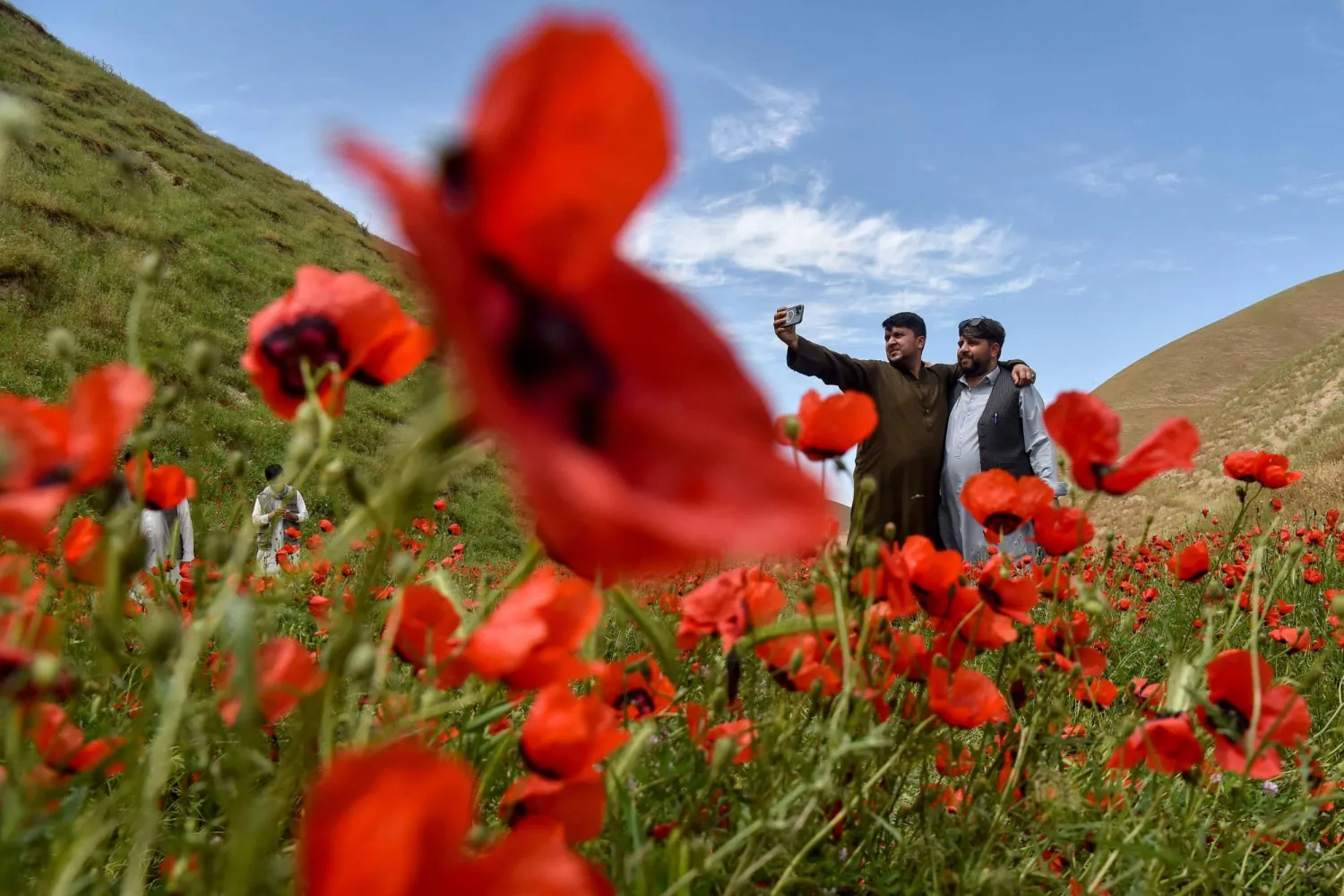

Afghans Celebrate Spring in Bright Red Poppy Fields

This photograph taken on April 24, 2026 shows Afghan men taking a selfie as they stand among the common poppy flowers on a hillside in the Jalayer Valley of Northern Afghanistan’s Shirin Tagab district. (AFP)
TT

Afghans Celebrate Spring in Bright Red Poppy Fields

This photograph taken on April 24, 2026 shows Afghan men taking a selfie as they stand among the common poppy flowers on a hillside in the Jalayer Valley of Northern Afghanistan’s Shirin Tagab district. (AFP)

In the middle of a field filled with bright red poppies, Afghans frolic among the spring flowers in a tradition deeply rooted in the country's north.

Families flocked to the valleys of Shirin Tagab district, near the border with Turkmenistan, to be among thousands of flowers that appeared after abundant rain.

"There has been a drought for almost 10 years. No flowers or greenery grew," said Ghawsudin, who only uses one name.

"This year has been very good, and God is merciful," said the 79-year-old, who drove for three hours just to see the flowers.

Mohammad Ashraf, a 35-year-old visitor, said he hadn't seen so many poppies for more than a decade.

"Now there are so many red flowers, and you see people come here for picnics," he told AFP.

The landscape in Shirin Tagab is brightened by the common poppy, not the opium poppy that authorities have banned.

- 'Vitality and freshness' -

Many Afghans living in the north used to travel to see the poppies after celebrating Persian New Year, Nowruz, in the city of Mazar-i-Sharif.

The Taliban government, which applies a strict interpretation of religious law, has stopped such celebrations each spring.

But the tradition of visiting the poppies, which are widely revered in poems and songs, has endured.

Oriane Zerah, a photographer who published a book about Afghans and flowers, said they are an integral part of daily life.

"As soon as an Afghan has a little space in their garden, they plant a flower. Even in displacement camps, there'll be a flower somewhere. They put them on their pakol, one of their traditional hats, and there are desserts made with flowers," she told AFP.

The poppy has also been associated with wartime in the country, with the flower often placed on the coffins of fighters, according to Afghan writer Taqi Wahidi.

"Dying in the path of the homeland, or in the path of religion and faith, was considered a kind of new resurrection and entry into a new life," he told AFP.

The same flower is widely used in countries, such as Britain, Australia and New Zealand, where people wear artificial poppies to remember those killed in past conflicts.

Nowadays in Afghanistan, however, the poppy "symbolizes vitality and freshness", according to Wahidi.

"At the same time that nature is renewed, human beings also want to bring new colors into their lives," he said.



Help Wanted: Australian Conservation Group Seeks New Koala Rescue Dog

This handout photo from the International Fund for Animal Welfare (IFAW) taken on November 10, 2023, shows Bear, a koala detection dog who recently retired, during a training session at an unknown location.  (Photo by Handout / International Fund for Animal Welfare (IFAW) / AFP)
This handout photo from the International Fund for Animal Welfare (IFAW) taken on November 10, 2023, shows Bear, a koala detection dog who recently retired, during a training session at an unknown location. (Photo by Handout / International Fund for Animal Welfare (IFAW) / AFP)
TT

Help Wanted: Australian Conservation Group Seeks New Koala Rescue Dog

This handout photo from the International Fund for Animal Welfare (IFAW) taken on November 10, 2023, shows Bear, a koala detection dog who recently retired, during a training session at an unknown location.  (Photo by Handout / International Fund for Animal Welfare (IFAW) / AFP)
This handout photo from the International Fund for Animal Welfare (IFAW) taken on November 10, 2023, shows Bear, a koala detection dog who recently retired, during a training session at an unknown location. (Photo by Handout / International Fund for Animal Welfare (IFAW) / AFP)

An Australian animal welfare group is seeking a heroic dog with an appetite for adventure for a full-time position as a koala rescuer.

The successful pooch will replace the world-famous Bear, credited with saving over 100 koalas from bushfires during a decade of service.

"Bear set the gold standard for koala detection dogs," the International Fund for Animal Welfare (IFAW) Oceania head of programs Josey Sharrad said, according to AFP.

"He's leaving very big boots to fill, but now it's time to find his successor to follow in his pawprints and keep protecting koalas."

The ideal candidate will be a rescue pup with a lot of energy and an "obsessive" personality -- attributes that might make it hard to find a home but which make it perfect for saving koalas, IFAW said.

"By only recruiting a rescue dog, it's a win-win -- giving a dog the chance of a new life while helping our iconic koalas," Innovation for Conservation director and handler Russell Miller said.

Other key attributes are a love of play, confidence and a gentle temperament towards fellow animals is crucial.

They must also be medium sized -- "not too small that they struggle in the bush, not too big that the handlers can't carry them when needed", according to the IFAW job ad.

Interviews were being held in eastern Australia's Sunshine Coast but applications by video are also welcome.

Bear's skills saved over 100 koalas as the Black Summer bushfires raged across Australia's eastern seaboard from late 2019 to early 2020, razing millions of hectares, destroying thousands of homes and blanketing cities in noxious smoke.

The tail-wagging detective with a "joyful and goofy" personality retired with an extensive list of accolades -- including an Animal of the Year award and Puppy Tales Photos Australian Dog of the Year award.


2 Humpback Whales Set Records Swimming between Australia and Brazil

This photo provided by the Pacific Whale Foundation in May 2026, shows a humpback whale breaching off the coast of Australia. (Pacific Whale Foundation via AP)
TT

2 Humpback Whales Set Records Swimming between Australia and Brazil

This photo provided by the Pacific Whale Foundation in May 2026, shows a humpback whale breaching off the coast of Australia. (Pacific Whale Foundation via AP)

Scientists have spotted two humpback whales that made separate, record-breaking crossings between Australia and Brazil.

The whales were identified by their distinctive tail markings at the two locations about 9,000 miles (14,500 kilometers) apart. They traveled in opposite directions and journeyed farther than any humpback known so far.

“It’s a very rare event, but it is a really wonderful demonstration of just how wide-ranging these animals are,” said Phillip Clapham, former head of a NOAA whale research program who was not involved with the new findings.

Humpback whales are known for roaming long distances across major oceans in predictable patterns, typically following migration routes learned from their mothers. They feed on krill and small fish in the warmer months and breed in tropical waters over winter.

It's difficult to track the movements of creatures that spend most of their lives underwater. In the new study, scientists analyzed over 19,000 whale images taken in the past four decades by research groups and citizen scientists, The Associated Press reported.

Recognition software helped to identify the whales based on their tails' color patterns and jagged edges. Researchers pinpointed two different whales at breeding sites in eastern Australia and Brazil over the years, suggesting they had crossed from one place to the other.

One whale traveled just over 9,300 miles (15,000 kilometers), outranking previous recordholders including a humpback that swam from Colombia to Zanzibar.

The findings were published Tuesday in the journal Royal Society Open Science.

Since the photos only depict the whales at the beginning and end of their journeys, researchers don't know the exact route they took.

Whales don't typically travel between mating sites so it's not yet clear why these two separately embarked on their journeys. They may have met other whales on shared feeding grounds and split off instead of returning to where they came from, study co-author Stephanie Stack with the Pacific Whale Foundation said in an email.

“Finding not one but two individuals that have crossed between Australia and Brazil challenges what we thought we knew about how separate these populations really are,” Stack said.

Such odysseys are more difficult for whales in the Northern Hemisphere, where massive continents make traveling across oceans tougher.

Scientists said the record journey shows just how far humpback whales can go. These methods can also help keep track of them as climate change warms oceans, possibly changing where krill live and where humpbacks might go to feed and breed.


Animal Welfare Groups: 3 South African Zoo Elephants Are Depressed, Sue to Move Them

FILE - Charley, an ageing four-ton African elephant, is trained to enter a transport container, on Aug. 9, 2024 at the Pretoria, South Africa's, National Zoological Gardens. (AP Photo, File)
TT

Animal Welfare Groups: 3 South African Zoo Elephants Are Depressed, Sue to Move Them

FILE - Charley, an ageing four-ton African elephant, is trained to enter a transport container, on Aug. 9, 2024 at the Pretoria, South Africa's, National Zoological Gardens. (AP Photo, File)

The mental well-being of three elephants in a zoo in South Africa is the subject of an unusual court case, with animal welfare groups saying they are depressed and should be moved to a larger conservation park where they can be happy.

The case this week will ask a South African court to decide if the state is meeting its legal obligations with regard to the welfare of the animals and the conditions in which they are kept, according to David Bilchitz, a board member at Animal Law Reform South Africa, one of the groups bringing the case.

Experts would show in court that the elephants are unhappy, The Associated Press quoted Bilchitz as saying. The animal welfare groups said a part of the South African Constitution puts an obligation on authorities to look after animals.

The zoo in question in Johannesburg is publicly owned and has defended its management of the elephants, saying they are well cared for.

Bilchitz said elephants have highly complex social structures and specific physical and mental needs, and generally live in herds of 20-50 animals that roam large areas in the wild.

He said that the three elephants at the zoo — named Lammie, Ramadiba and Mopane — live in an enclosure not much bigger than a soccer field with none of the typical stimulation that elephants need, like trees to forage from and mud pools to bathe in.

“They are sad, depressed and frustrated,” Bilchitz told AP. “They are listless and stand around.”
He said the elephants had shown signs of psychological distress, like standing and rocking and other “repetitive compulsive behavior.”

Johannesburg Zoo said in a statement that there had been a “media scourge” over the condition of the elephants and maintained they were healthy and also popular with zoo staff and visitors. It also said that relocating elephants from zoos to semiwild sanctuaries is not always successful.

There is a kind of precedent for the case. In 2024, an old bull elephant called Charley was relocated from another South African zoo to a game reserve after he outlived his elephant companions at the zoo and animal experts believed he was lonely.

The zoo agreed that Charley should be taken to the reserve to retire after he spent decades in captivity, including around 16 years in a circus.